Pharmaceutical Unit Dose Packaging Market Size and Growth
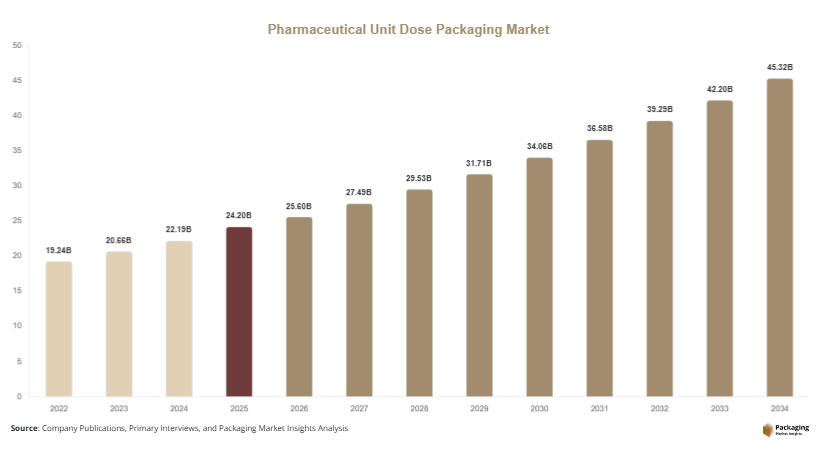
The global pharmaceutical unit dose packaging market size is estimated at USD 24.2 billion in 2025, and it is projected to reach USD 25.6 billion in 2026. By 2034, the market is expected to grow to approximately USD 45.8 billion, registering a compound annual growth rate (CAGR) of 7.4% during 2025–2034. This growth reflects increasing adoption of automated dispensing systems, rising hospital pharmacy modernization, and the growing demand for error-free medication administration. The pharmaceutical unit dose packaging market is expanding steadily as healthcare systems across the globe prioritize medication safety, dosing accuracy, and patient adherence.
One of the key growth factors is the rising prevalence of chronic diseases such as diabetes, cardiovascular disorders, and cancer, which require long-term medication management. Unit dose packaging ensures accurate dosing, reduces medication errors, and improves patient compliance. Another important driver is the expansion of hospital automation systems, where unit dose packaging integrates with automated dispensing machines to streamline workflows and reduce operational inefficiencies. Additionally, regulatory pressure on pharmaceutical safety and traceability is pushing manufacturers toward standardized, serialized packaging formats.
Key Highlights:
- North America dominated the market with a 34.2% share in 2025.
- Asia Pacific is projected to grow at the fastest CAGR of 8.2%.
- Blister-based unit dose packaging led the type segment with a 41.6% share.
- Plastic-based packaging materials accounted for a 52.1% share.
- Hospitals remained the leading end-use segment with a 48.3% share.
- The US remained the dominant country with a market size of USD 8.6 billion in 2025 and USD 9.1 billion in 2026.
Explore more data points, trends and opportunities Download Free Sample Report
Market Trends
Integration of Automation and Smart Dispensing Systems
A major trend shaping the pharmaceutical unit dose packaging market is the integration of automation within hospital pharmacies and pharmaceutical distribution systems. Automated dispensing machines are increasingly being linked with unit dose packaging formats to improve medication accuracy and reduce human intervention. Hospitals are adopting robotic dispensing systems that rely heavily on pre-packaged unit doses to streamline workflows. This trend reduces medication errors, improves inventory control, and enhances operational efficiency. Additionally, the integration of barcode and RFID tracking systems allows real-time monitoring of drug movement within healthcare facilities, ensuring better compliance and traceability.
Shift Toward Patient-Centric and Adherence-Focused Packaging
Another significant trend is the shift toward patient-centric packaging designs that improve medication adherence. Pharmaceutical companies are increasingly focusing on packaging formats that are easy to understand, open, and administer, especially for elderly patients. Unit dose packaging provides clear labeling, dosage separation, and simplified consumption schedules, which help reduce confusion and missed doses. This trend is particularly strong in long-term care and home healthcare settings. The growing emphasis on outpatient care and self-medication is also driving demand for personalized packaging solutions that enhance patient engagement and treatment outcomes.
Market Drivers
Rising Demand for Medication Safety and Error Reduction
One of the primary drivers of the pharmaceutical unit dose packaging market is the increasing focus on medication safety. Hospitals and healthcare providers are under pressure to reduce medication errors, which can lead to severe patient complications and increased healthcare costs. Unit dose packaging ensures that each dose is individually labeled and pre-measured, significantly reducing the risk of incorrect dosing. Regulatory bodies are also enforcing stricter compliance standards, encouraging healthcare institutions to adopt standardized packaging formats. This has led to widespread adoption of unit dose systems in both developed and emerging healthcare markets.
Growth of Hospital Pharmacy Automation
The rapid expansion of automated hospital pharmacy systems is another key driver. Healthcare facilities are investing in automated dispensing cabinets and centralized pharmacy systems that rely on unit dose packaging for efficient operation. These systems improve inventory management, reduce labor costs, and enhance medication distribution accuracy. The increasing adoption of electronic health records (EHRs) and digital prescription systems further supports this trend. As hospitals continue to modernize their infrastructure, demand for compatible unit dose packaging solutions is expected to rise significantly.
Market Restraint
High Cost of Implementation and Packaging Transition Challenges
Despite strong growth potential, the pharmaceutical unit dose packaging market faces challenges related to high implementation costs. Transitioning from traditional bulk packaging to unit dose systems requires significant investment in packaging machinery, automation systems, and workforce training. Smaller hospitals and healthcare facilities, particularly in developing regions, often face budget constraints that limit adoption. Additionally, pharmaceutical manufacturers must redesign production lines to accommodate unit dose formats, which increases operational complexity.
Another challenge is the integration of unit dose systems with existing supply chain infrastructure. Many healthcare systems still rely on legacy inventory and dispensing methods, making the transition to automated unit dose packaging difficult. Compatibility issues between packaging formats and dispensing machines can also create inefficiencies. For example, smaller clinics may avoid adopting unit dose systems due to initial setup costs, even if long-term benefits include reduced medication errors and improved efficiency. These financial and operational barriers slow down market penetration in cost-sensitive regions.
Market Opportunities
Expansion in Home Healthcare and Outpatient Services
The growing shift toward home healthcare presents a major opportunity for the pharmaceutical unit dose packaging market. As healthcare systems aim to reduce hospital admissions and costs, more patients are being treated at home. Unit dose packaging provides an ideal solution for managing multiple medications in a simplified format. It improves adherence and reduces the risk of dosage errors among patients managing chronic conditions independently. Pharmaceutical companies are increasingly designing packaging tailored for home use, including calendar-based dosing packs and portable blister systems.
Adoption of Sustainable and Eco-Friendly Packaging
Sustainability is becoming a major opportunity area in the market. Pharmaceutical companies are exploring biodegradable materials, recyclable blister packs, and reduced-plastic packaging designs to comply with environmental regulations. Governments and healthcare organizations are also encouraging greener packaging solutions to reduce medical waste. Innovations in paper-based unit dose packaging and compostable films are gaining traction. These developments not only reduce environmental impact but also enhance brand reputation and regulatory compliance, creating long-term growth opportunities.
Report Scope
| Report Metric | Details |
|---|---|
| Market Size in 2025 | USD 24.2 Billion |
| Market Size in 2026 | USD 25.6 Billion |
| Market Size in 2034 | USD 45.8 Billion |
| CAGR | 7.4% (2026-2034) |
| Base Year for Estimation | 2025 |
| Historical Data | 2022-2024 |
| Forecast Period | 2026-2034 |
| Report Coverage | Revenue Forecast, Competitive Landscape, Supply Chain Disruption, Growth Factors, Environment & Regulatory Landscape and Trends |
| Geographies Covered | North America, Europe, APAC, Middle East and Africa, LATAM |
| Countries Covered | U.S., Canada, U.K., Germany, France, Spain, Italy, Russia, Nordic, Benelux, Rest of Europe, China, South Korea, Japan, India, Australia, Singapore, Taiwan, South East Asia, Rest of Asia-Pacific, UAE, Turky, Saudi Arabia, South Africa, Egypt, Nigeria, Rest of MEA, Brazil, Mexico, Argentina, Chile, Colombia, Rest of LATAM |
Explore more data points, trends and opportunities Download Free Sample Report
Segmental Analysis
By Packaging Type
Blister-based unit dose packaging dominated the market in 2024 with a 41.6% share. This segment is widely used due to its ability to provide individual dose protection, clear labeling, and tamper resistance. Hospitals and pharmacies prefer blister packs for oral solid medications because they reduce dispensing errors and improve patient compliance. Their compatibility with automated dispensing machines further strengthens their dominance in institutional settings.
Pouch-based unit dose packaging is expected to be the fastest-growing subsegment, with a CAGR of 7.9%. Growth is driven by increasing adoption in hospital pharmacies and long-term care facilities. Pouch systems offer flexibility, lower material usage, and cost efficiency. They are particularly useful in high-volume dispensing environments where automation and speed are essential.
By Material
Plastic-based packaging materials dominated with a 52.1% share in 2024. Their widespread use is due to durability, flexibility, and compatibility with various drug formulations. Plastics are widely used in blister packs and pouches due to their protective barrier properties and cost efficiency. However, environmental concerns are pushing gradual shifts toward sustainable alternatives.
Biodegradable materials are the fastest-growing segment, with a CAGR of 7.6%. Increasing environmental regulations and sustainability initiatives are driving adoption. Pharmaceutical companies are investing in bio-based polymers and recyclable films to reduce environmental impact while maintaining packaging performance.
By End-use
Hospitals accounted for the dominant share of 48.3% in 2024. Hospitals rely heavily on unit dose packaging to improve medication accuracy, streamline pharmacy operations, and integrate with automated dispensing systems. This segment benefits from high patient inflow and strict safety protocols.
Long-term care facilities are the fastest-growing subsegment, with a CAGR of 7.8%. Growth is driven by increasing elderly population and rising demand for chronic disease management. These facilities require simplified medication management systems, making unit dose packaging essential for improving adherence and reducing errors.
Pharmaceutical Unit Dose Packaging Market Segmentations
By Packaging Type
- Blister Unit Dose Packaging
- Pouch Unit Dose Packaging
- Strip Packaging
- Ampoules & Vials Unit Dose
By Material Type
- Plastic-Based Packaging
- Aluminum Foil Packaging
- Paper & Paperboard Packaging
- Biodegradable & Sustainable Materials
By End-User
- Hospitals
- Retail Pharmacies
- Long-Term Care Facilities
- Home Healthcare
Regional Analysis
North America
North America accounted for approximately 34.2% of the global market share in 2025, with a projected CAGR of 7.0% during 2025–2034. The region benefits from advanced healthcare infrastructure, high adoption of automation technologies, and strong regulatory frameworks supporting medication safety. Hospitals in the region are increasingly adopting automated dispensing systems integrated with unit dose packaging.
The United States dominates the regional market due to its large hospital network and advanced pharmaceutical industry. A key growth factor is the widespread implementation of hospital automation systems, including robotic dispensing and electronic prescribing platforms, which rely heavily on unit dose packaging formats.
Europe
Europe held around 28.0% market share in 2025, growing at a CAGR of 6.8%. The region is driven by stringent EU regulations on drug traceability and serialization. Healthcare providers are increasingly adopting standardized packaging formats to comply with safety guidelines.
Germany leads the European market due to its strong pharmaceutical manufacturing base. A unique growth factor is the enforcement of EU Falsified Medicines Directive (FMD), which mandates serialization and tracking of pharmaceutical products, boosting demand for unit dose packaging.
Asia Pacific
Asia Pacific accounted for 26.0% share in 2025, with the fastest CAGR of 8.2%. Growth is driven by expanding healthcare infrastructure, rising pharmaceutical production, and increasing patient population.
China dominates the region due to its large-scale pharmaceutical manufacturing industry. A key growth factor is the rapid expansion of hospital networks and government healthcare reforms improving medication accessibility and safety standards.
Middle East & Africa
MEA held around 6.0% market share in 2025, with a CAGR of 6.5%. Growth is supported by healthcare modernization programs and increasing pharmaceutical imports.
The United Arab Emirates leads the region due to advanced healthcare infrastructure. A unique growth factor is government investment in smart hospital initiatives, which is driving adoption of automated dispensing systems and unit dose packaging.
Latin America
Latin America accounted for 6.0% share in 2025, growing at a CAGR of 7.2%. The region is witnessing increasing healthcare investments and expansion of pharmaceutical distribution networks.
Brazil dominates the market due to its large public healthcare system. A key growth factor is the expansion of government-led medication distribution programs that rely on standardized unit dose packaging for efficiency and safety.
Competitive Landscape
The pharmaceutical unit dose packaging market is moderately consolidated, with key players focusing on automation, innovation, and strategic partnerships. Major companies include Omnicell Inc., Becton Dickinson (BD), West Pharmaceutical Services, Amcor Plc, and Catalent Inc. Omnicell Inc. is considered a leading player due to its strong presence in hospital automation and integrated dispensing systems that rely heavily on unit dose packaging solutions.
Recent developments include expansion of smart pharmacy solutions, integration of AI-driven dispensing technologies, and partnerships between packaging manufacturers and healthcare automation providers. Companies are also investing in sustainable packaging innovations to align with environmental regulations and improve market competitiveness.
Key Players List
- Omnicell Inc.
- Becton Dickinson and Company
- West Pharmaceutical Services
- Amcor Plc
- Catalent Inc.
- Schott AG
- AptarGroup Inc.
- Gerresheimer AG
- Uhlmann Group
- SGD Pharma
- Berry Global Inc.
- Cardinal Health
- McKesson Corporation
- Baxter International
- Avery Dennison Corporation