Suppository Packaging Market Size and Growth
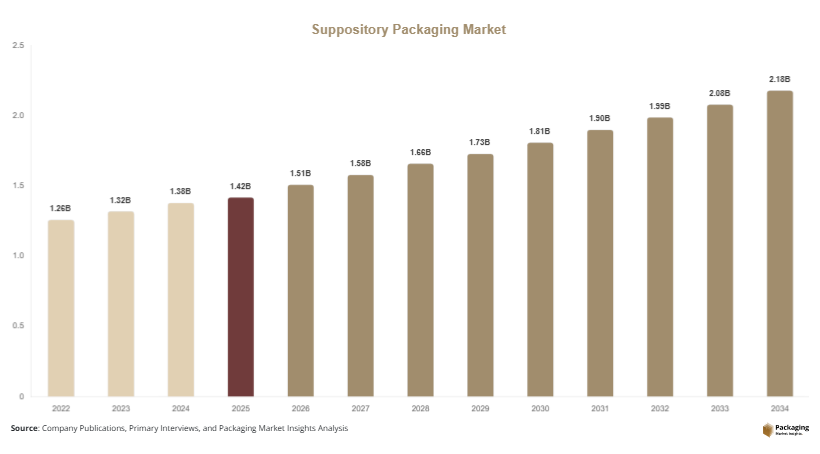
The global suppository packaging market size was valued at approximately USD 1.42 billion in 2025 and is expected to reach USD 1.51 billion in 2026. Over the forecast period, the market is projected to expand significantly, reaching USD 2.28 billion by 2034, growing at a CAGR of 4.7% from 2025 to 2034. This growth reflects the increasing adoption of suppositories for targeted drug delivery, especially in pediatric, geriatric, and rectal/vaginal treatment applications. The suppository packaging market is witnessing consistent growth due to the rising demand for effective pharmaceutical delivery systems and secure packaging solutions.
One of the primary growth factors is the rising prevalence of chronic diseases and gastrointestinal disorders, which require alternative drug administration methods. Suppositories offer advantages such as bypassing the digestive system and providing localized treatment, which increases their demand. Another key factor is the growing pharmaceutical industry, particularly in emerging economies where access to healthcare is improving. This expansion is driving the need for reliable and protective packaging solutions that ensure product stability and safety.
Key Highlights
- Asia Pacific dominated the market with a 38.2% share in 2025, while Latin America is projected to grow at the fastest CAGR of 5.8%.
- Plastic-based packaging led the type segment with a 34.7% share, while aluminum foil packaging is expected to grow at a CAGR of 5.2%.
- Blister packaging dominated with a 49.3% share, while strip packaging is forecasted to grow at a CAGR of 5.5%.
- Pharmaceutical applications led the segment with 100% share, while hospital usage is expected to grow at a CAGR of 5.1%.
- China remained the dominant country with a market size of USD 320 million in 2025 and USD 340 million in 2026.
Explore more data points, trends and opportunities Download Free Sample Report
Market Trends
Increasing Preference for Unit-Dose and Blister Packaging Formats
The growing emphasis on hygiene, convenience, and accurate dosing is driving the adoption of unit-dose and blister packaging formats in the suppository packaging market. These formats provide individual compartments for each dose, reducing the risk of contamination and ensuring proper dosage. This is particularly important in pharmaceutical applications where precision and safety are critical. Blister packaging also enhances product visibility and protection, making it a preferred choice for manufacturers and consumers. The trend is further supported by advancements in packaging technology that enable efficient production and improved material performance. As healthcare systems continue to prioritize patient safety and compliance, the demand for unit-dose packaging is expected to increase.
Rising Demand for Sustainable and Eco-Friendly Packaging Materials
Sustainability is becoming an important consideration in the pharmaceutical packaging industry. Manufacturers are exploring the use of recyclable and biodegradable materials to reduce environmental impact. This includes the development of eco-friendly alternatives to traditional plastic materials. The shift toward sustainable packaging is driven by regulatory requirements and increasing consumer awareness of environmental issues. Companies are also focusing on reducing packaging waste and improving recyclability. This trend is expected to influence material selection and drive innovation in the suppository packaging market.
Market Drivers
Growth of Pharmaceutical Industry and Increasing Healthcare Access
The expansion of the pharmaceutical industry is a major driver of the suppository packaging market. As healthcare access improves in emerging economies, the demand for pharmaceutical products is increasing. This is particularly evident in regions with growing populations and rising healthcare expenditure. The need for effective drug delivery systems is driving the adoption of suppositories, which in turn increases the demand for specialized packaging solutions. Pharmaceutical companies are investing in advanced packaging technologies to ensure product safety and compliance with regulatory standards.
Demand for Safe and Tamper-Evident Packaging Solutions
The need for secure and tamper-evident packaging is another key driver of the market. Suppositories are sensitive products that require protection from contamination and environmental factors. Packaging solutions such as blister packs and strip packs provide a barrier against moisture and air, ensuring product stability. Additionally, tamper-evident features enhance consumer confidence and meet regulatory requirements. The increasing focus on patient safety and product integrity is driving the adoption of advanced packaging solutions in the suppository packaging market.
Market Restraint
High Cost of Advanced Packaging Materials and Machinery
The high cost associated with advanced packaging materials and machinery is a significant restraint for the suppository packaging market. Materials such as aluminum foil and specialized plastics offer superior protection but come at a higher cost compared to traditional options. Additionally, the machinery required for producing advanced packaging formats involves significant capital investment. This can be a barrier for small and medium-sized enterprises, limiting their ability to adopt advanced packaging solutions. For example, companies operating in cost-sensitive markets may prefer simpler packaging options to reduce expenses, which can impact the adoption of high-performance packaging technologies.
Market Opportunities
Development of Innovative and Patient-Friendly Packaging Designs
The development of innovative packaging designs presents significant opportunities for the suppository packaging market. Manufacturers are focusing on creating user-friendly packaging that improves ease of use and enhances patient experience. This includes features such as easy-open designs and clear labeling. These innovations are particularly important for elderly and pediatric patients, who may face challenges in handling traditional packaging formats. The demand for patient-centric packaging solutions is expected to drive market growth.
Expansion in Emerging Markets and Healthcare Infrastructure
Emerging markets offer substantial growth opportunities for the suppository packaging market. Rapid urbanization and increasing healthcare investments are driving the demand for pharmaceutical products. Countries in Asia Pacific, Latin America, and Africa are witnessing improvements in healthcare infrastructure, which is supporting market growth. The expansion of pharmaceutical manufacturing in these regions is also creating opportunities for packaging companies. As healthcare systems continue to develop, the demand for high-quality packaging solutions is expected to increase.
Report Scope
| Report Metric | Details |
|---|---|
| Market Size in 2025 | USD 1.42 Billion |
| Market Size in 2026 | USD 1.51 Billion |
| Market Size in 2034 | USD 2.28 Billion |
| CAGR | 4.7% (2026-2034) |
| Base Year for Estimation | 2025 |
| Historical Data | 2022-2024 |
| Forecast Period | 2026-2034 |
| Report Coverage | Revenue Forecast, Competitive Landscape, Supply Chain Disruption, Growth Factors, Environment & Regulatory Landscape and Trends |
| Geographies Covered | North America, Europe, APAC, Middle East and Africa, LATAM |
| Countries Covered | U.S., Canada, U.K., Germany, France, Spain, Italy, Russia, Nordic, Benelux, Rest of Europe, China, South Korea, Japan, India, Australia, Singapore, Taiwan, South East Asia, Rest of Asia-Pacific, UAE, Turky, Saudi Arabia, South Africa, Egypt, Nigeria, Rest of MEA, Brazil, Mexico, Argentina, Chile, Colombia, Rest of LATAM |
Explore more data points, trends and opportunities Download Free Sample Report
Segmental Analysis
By Type
Plastic-based packaging accounted for the largest market share in 2024, contributing 34.7% to the overall market. These materials are widely used due to their flexibility, durability, and cost-effectiveness. Plastic packaging provides adequate protection against moisture and contamination, making it suitable for pharmaceutical applications.
Aluminum foil packaging is expected to grow at the fastest CAGR of 5.2%. The superior barrier properties of aluminum foil make it an ideal choice for protecting sensitive pharmaceutical products. The increasing demand for high-performance packaging materials is driving the adoption of aluminum foil packaging.
By Application
Blister packaging dominated the market in 2024, accounting for 49.3% of the total share. This format is widely used due to its ability to provide individual compartments for each dose, ensuring hygiene and convenience.
Strip packaging is projected to grow at the fastest CAGR of 5.5%. The compact design and cost efficiency of strip packaging make it a popular choice for pharmaceutical manufacturers. The increasing demand for efficient packaging solutions is driving its adoption.
By End-Use
The pharmaceutical segment held the largest share in 2024, accounting for 100% of the market. The use of suppository packaging is primarily driven by pharmaceutical applications, where product safety and integrity are critical.
Hospital usage is expected to grow at the fastest CAGR of 5.1%. The increasing demand for healthcare services and the expansion of hospital infrastructure are driving the adoption of suppository packaging solutions.
Suppository Packaging Market Segmentations
By Product Type
- Plastic-Based Packaging
- Aluminum Foil Packaging
- Combination Materials
By Application
- Blister Packaging
- Strip Packaging
- Others
By End-Use
- Pharmaceutical
- Hospitals
- Clinics
Regional Analysis
North America
North America accounted for approximately 21.5% of the global market share in 2025 and is expected to grow at a CAGR of 4.2% during the forecast period. The region benefits from a well-established pharmaceutical industry and advanced healthcare infrastructure. The demand for high-quality packaging solutions is driven by strict regulatory requirements and a focus on patient safety.
The United States dominates the regional market due to its large pharmaceutical sector. A key growth factor is the increasing adoption of advanced packaging technologies that enhance product safety and compliance with regulations.
Europe
Europe held a market share of 24.3% in 2025 and is projected to grow at a CAGR of 4.4%. The region is characterized by strong regulatory frameworks and a focus on sustainable packaging solutions. The demand for eco-friendly materials is driving innovation in the market.
Germany is the leading country in the European market, supported by its strong pharmaceutical industry. A unique growth factor is the emphasis on sustainable and recyclable packaging materials.
Asia Pacific
Asia Pacific dominated the market with a 38.2% share in 2025 and is expected to grow at a CAGR of 5.2%. The region’s growth is driven by increasing healthcare access and rising pharmaceutical production. The expansion of manufacturing facilities is supporting market growth.
China leads the regional market due to its large population and growing healthcare sector. A key growth factor is the increasing demand for affordable and effective drug delivery systems.
Middle East & Africa
The Middle East & Africa region accounted for 7.0% of the market share in 2025 and is expected to grow at a CAGR of 4.8%. The region is witnessing improvements in healthcare infrastructure and increasing demand for pharmaceutical products.
The United Arab Emirates is the dominant country in the region, supported by its growing healthcare sector. A unique growth factor is the increasing investment in healthcare facilities and services.
Latin America
Latin America held a market share of 9.0% in 2025 and is projected to grow at the fastest CAGR of 5.8%. The region is experiencing increased demand for pharmaceutical products due to improving healthcare access.
Brazil dominates the regional market, driven by its large population and expanding healthcare system. A key growth factor is the rising demand for cost-effective packaging solutions.
Competitive Landscape
The suppository packaging market is moderately fragmented, with several global and regional players competing based on product quality, innovation, and pricing strategies. Companies are focusing on developing advanced packaging materials and designs to meet evolving industry requirements. Strategic collaborations and product launches are common strategies used to strengthen market presence.
Amcor plc is recognized as a leading player in this market, known for its innovative packaging solutions. The company recently introduced new sustainable packaging materials aimed at reducing environmental impact. Other key players are also investing in research and development to enhance product performance and meet regulatory standards.
Key Players List
- Amcor plc
- Constantia Flexibles Group
- Huhtamaki Oyj
- Berry Global Inc.
- Mondi Group
- Sonoco Products Company
- Gerresheimer AG
- WestRock Company
- UFlex Ltd.
- Clondalkin Group
- Winpak Ltd.
- Sealed Air Corporation
- AptarGroup, Inc.
- CCL Industries Inc.
- Schott AG