Pharmacy Repackaging System Market Size and Growth
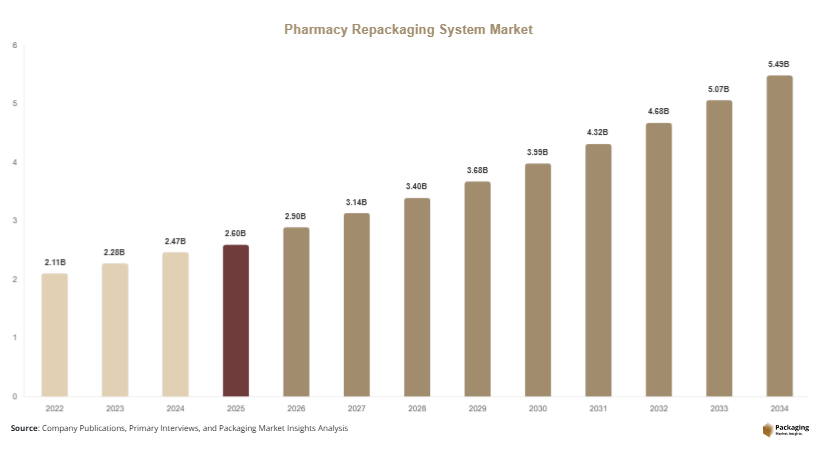
The global pharmacy repackaging system market size was valued at approximately USD 2.6 billion in 2025 and is expected to reach around USD 2.9 billion in 2026. By 2034, the market is projected to attain nearly USD 5.8 billion, expanding at a CAGR of 8.3% during 2025–2034. Growing pharmaceutical consumption, increasing geriatric population, and rising hospital admissions are significantly contributing to market expansion. Healthcare providers are increasingly investing in automated pharmacy infrastructure to improve operational accuracy and reduce dispensing costs.
One of the primary growth factors is the increasing focus on medication error reduction in hospitals and healthcare institutions. Automated repackaging systems provide accurate labeling, barcode integration, and dosage tracking, minimizing the risk of incorrect medication dispensing. Another major factor is the rising adoption of centralized pharmacy automation systems across healthcare networks. In addition, the growing demand for unit-dose packaging in long-term care facilities and outpatient centers is accelerating the adoption of advanced pharmacy repackaging technologies.
Key Highlights:
- North America dominated the market with a 38.2% share in 2025.
- Asia Pacific is projected to grow at the fastest CAGR of 9.1%.
- Automated repackaging systems led the type segment with a 46.8% share.
- Plastic-based packaging materials dominated with a 51.7% share.
- Hospital pharmacies led the end-use segment with 44.9% share.
- The US remained the dominant country with a market size of USD 1.1 billion in 2025 and USD 1.2 billion in 2026.
Explore more data points, trends and opportunities Download Free Sample Report
Market Trends
Integration of Robotic Pharmacy Automation Systems
The pharmacy repackaging system market is experiencing strong adoption of robotic automation technologies in medication dispensing and packaging operations. Healthcare facilities are increasingly integrating robotic repackaging systems with pharmacy inventory management software to improve dispensing speed and reduce manual intervention. These systems are capable of sorting, labeling, sealing, and tracking medications with high precision. For example, large hospital networks are implementing robotic repackaging units that support centralized pharmaceutical distribution and automated unit-dose packaging. This trend is reducing operational costs while improving patient safety standards. In the future, AI-integrated robotic systems with predictive inventory analytics and remote monitoring capabilities are expected to further transform pharmacy automation workflows and enhance efficiency across healthcare facilities.
Rising Demand for Unit-Dose Packaging Solutions
The increasing preference for unit-dose packaging is another major trend shaping the pharmacy repackaging system market. Unit-dose packaging improves medication traceability, minimizes contamination risks, and reduces dispensing errors in hospitals and long-term care facilities. Healthcare providers are increasingly shifting from bulk medication handling to patient-specific packaging systems that enhance safety and compliance. For example, hospital pharmacies are adopting automated blister packaging systems that provide barcode-enabled medication identification for individual doses. This trend is particularly important in geriatric care and chronic disease management where patients require multiple medications daily. Future growth is expected to be supported by rising demand for personalized medicine and increasing implementation of medication adherence programs across healthcare systems.
Market Drivers
Increasing Focus on Medication Safety and Error Reduction
The growing emphasis on medication safety is a major driver for the pharmacy repackaging system market. Medication errors remain a significant challenge in healthcare environments, especially in hospitals handling high prescription volumes. Automated repackaging systems reduce human error by providing accurate dosage labeling, barcode verification, and standardized packaging formats. For example, hospitals using automated unit-dose repackaging systems have reported improvements in medication tracking and dispensing accuracy. Healthcare regulators are also encouraging the implementation of barcode-based medication administration systems to improve patient safety. As healthcare providers continue prioritizing quality care and compliance, demand for advanced pharmacy repackaging technologies is expected to increase steadily.
Expansion of Healthcare Infrastructure and Pharmaceutical Consumption
The expansion of healthcare infrastructure and rising pharmaceutical consumption are strongly supporting market growth. Aging populations, increasing chronic disease prevalence, and growing hospital admissions are driving higher prescription volumes globally. Healthcare facilities are investing in pharmacy automation systems to manage increasing medication demand efficiently. For example, newly established healthcare centers in Asia and the Middle East are adopting automated medication packaging systems to improve workflow management and reduce operational costs. The increasing availability of specialized pharmaceutical therapies and long-term treatment programs is further strengthening the need for advanced repackaging systems across healthcare networks.
Market Restraint
One of the key restraints affecting the pharmacy repackaging system market is the high initial investment and maintenance cost associated with automated pharmacy equipment. Advanced repackaging systems equipped with robotic technologies, barcode integration, and AI-based monitoring platforms require substantial capital expenditure, limiting adoption among small healthcare facilities and independent pharmacies. In addition, installation, calibration, and software integration costs further increase operational expenses. For example, rural hospitals and smaller outpatient clinics often face budget limitations that delay automation investments. The need for skilled technical personnel and regular equipment maintenance also creates operational challenges. Furthermore, regulatory compliance requirements related to pharmaceutical labeling and packaging standards can increase implementation complexity for healthcare providers operating across multiple regions.
Market Opportunities
Growth of Centralized Pharmacy Automation Centers
The expansion of centralized pharmacy automation centers presents a major opportunity for the pharmacy repackaging system market. Healthcare systems are increasingly consolidating pharmaceutical operations into centralized facilities to improve inventory management and reduce medication dispensing costs. Automated repackaging systems play a critical role in these facilities by supporting large-scale unit-dose packaging and barcode-based medication tracking. For example, multi-hospital healthcare networks are implementing centralized repackaging centers that distribute pre-packaged medications to affiliated healthcare facilities. Future demand is expected to rise as healthcare providers focus on improving efficiency, reducing pharmaceutical waste, and standardizing medication management processes across regional healthcare systems.
Adoption of Smart and Connected Packaging Technologies
The growing adoption of smart packaging technologies is creating new growth opportunities in the pharmacy repackaging system market. Advanced packaging systems integrated with RFID, cloud monitoring, and digital medication tracking capabilities are improving pharmaceutical supply chain visibility and patient adherence management. For instance, connected blister packaging systems can monitor medication usage patterns and provide adherence reminders to patients through mobile applications. Future innovations may include AI-assisted medication monitoring and remote pharmaceutical inventory management solutions. As healthcare systems increasingly adopt digital health technologies, demand for intelligent pharmacy repackaging solutions is expected to expand significantly.
Report Scope
| Report Metric | Details |
|---|---|
| Market Size in 2025 | USD 2.6 Billion |
| Market Size in 2026 | USD 2.9 Billion |
| Market Size in 2034 | USD 5.8 Billion |
| CAGR | 8.3% (2026-2034) |
| Base Year for Estimation | 2025 |
| Historical Data | 2022-2024 |
| Forecast Period | 2026-2034 |
| Report Coverage | Revenue Forecast, Competitive Landscape, Supply Chain Disruption, Growth Factors, Environment & Regulatory Landscape and Trends |
| Geographies Covered | North America, Europe, APAC, Middle East and Africa, LATAM |
| Countries Covered | U.S., Canada, U.K., Germany, France, Spain, Italy, Russia, Nordic, Benelux, Rest of Europe, China, South Korea, Japan, India, Australia, Singapore, Taiwan, South East Asia, Rest of Asia-Pacific, UAE, Turky, Saudi Arabia, South Africa, Egypt, Nigeria, Rest of MEA, Brazil, Mexico, Argentina, Chile, Colombia, Rest of LATAM |
Explore more data points, trends and opportunities Download Free Sample Report
Segmental Analysis
Type
Automated repackaging systems dominated the type segment with approximately 46.8% market share in 2024. These systems are widely used because they improve packaging speed, medication accuracy, and operational efficiency in high-volume pharmaceutical environments. Hospitals, retail pharmacies, and centralized medication distribution centers rely heavily on automated systems for unit-dose packaging and barcode labeling operations. For example, large hospital networks use automated repackaging equipment to streamline medication dispensing and reduce manual handling errors. The dominance of this segment is also supported by increasing healthcare digitization and rising demand for workflow optimization. Automated systems integrated with barcode scanning and electronic inventory management software are improving pharmaceutical traceability and regulatory compliance. As healthcare facilities continue expanding automation initiatives, demand for automated repackaging systems is expected to remain strong across global healthcare markets.
Robotic repackaging systems are projected to be the fastest-growing subsegment with a CAGR of 9.5% during 2025–2034. Growth is driven by increasing adoption of AI-assisted pharmacy automation technologies and rising demand for fully integrated medication management systems. Robotic systems provide advanced functionality such as automated sorting, labeling, packaging, and real-time inventory monitoring. For example, healthcare institutions are increasingly implementing robotic pharmacy systems capable of handling large prescription volumes with minimal human intervention. Future market growth is expected to be supported by declining robotics costs and advancements in cloud-connected pharmacy automation platforms. The integration of predictive analytics and AI-supported medication tracking systems is likely to accelerate adoption in hospitals and centralized pharmacy operations worldwide.
Material
Plastic-based packaging materials accounted for the dominant material segment with approximately 51.7% share in 2024. Plastic materials are extensively used in pharmacy repackaging due to their durability, moisture resistance, lightweight structure, and compatibility with automated packaging systems. Polyethylene and polypropylene films are commonly used in unit-dose pouches, blister packs, and medication containers. For example, hospital pharmacies widely use plastic blister packaging to maintain medication integrity and improve traceability. The dominance of this segment is also supported by cost efficiency and compatibility with barcode printing technologies. Plastic packaging remains highly preferred because it provides secure sealing and extended shelf-life protection for pharmaceutical products across large healthcare environments.
Eco-friendly paper-based materials are expected to emerge as the fastest-growing subsegment with a CAGR of 8.4% during the forecast period. Growth is driven by increasing sustainability initiatives across healthcare institutions and rising demand for recyclable pharmaceutical packaging. Hospitals and pharmacies are gradually adopting paper-based medication packaging solutions to reduce plastic waste and improve environmental performance. For instance, several European healthcare providers are introducing recyclable medication pouches and biodegradable labeling materials for pharmacy repackaging operations. Future innovations in moisture-resistant paper coatings and sustainable pharmaceutical packaging films are expected to expand adoption further. Regulatory pressure regarding sustainable healthcare operations is likely to accelerate the shift toward environmentally friendly repackaging materials.
End-Use
Hospital pharmacies dominated the end-use segment with approximately 44.9% market share in 2024. Hospitals handle large prescription volumes daily, making automated medication repackaging essential for improving workflow efficiency and patient safety. Unit-dose packaging systems are widely used in hospitals to reduce medication errors and support barcode medication administration protocols. For example, multi-specialty hospitals rely on centralized repackaging systems to prepare patient-specific medications for inpatient care units. The dominance of hospital pharmacies is also linked to increasing healthcare digitization and expansion of integrated pharmaceutical management systems. Rising hospital admissions and growing chronic disease prevalence continue supporting strong demand for pharmacy repackaging systems in this segment.
Long-term care facilities are projected to register the fastest CAGR of 9.0% through 2034. Growth is driven by increasing elderly populations and rising demand for medication adherence management solutions. Long-term care providers increasingly use automated blister packaging and patient-specific dosage systems to improve medication accuracy and simplify drug administration for elderly patients. For example, nursing homes are implementing automated packaging systems that organize medications by date and dosage schedule. Future growth is expected to be supported by expanding geriatric healthcare services and increasing prevalence of chronic conditions requiring multiple medications. Advanced adherence packaging solutions integrated with digital monitoring systems are also expected to gain popularity across long-term care environments.
Pharmacy Repackaging System Market Segmentations
By Type
- Automated Repackaging Systems
- Semi-Automated Repackaging Systems
- Robotic Repackaging Systems
- Unit-Dose Packaging Systems
- Blister Packaging Systems
By Material
- Plastic-Based Packaging Materials
- Paper-Based Packaging Materials
- Aluminum Foil Materials
- Composite Packaging Materials
- Sustainable Packaging Materials
By End-User
- Hospital Pharmacies
- Retail Pharmacies
- Long-Term Care Facilities
- Centralized Pharmacy Centers
- Outpatient Healthcare Facilities
Regional Analysis
North America
North America accounted for approximately 38.2% share of the pharmacy repackaging system market in 2025 and is expected to grow at a CAGR of 7.9% during 2025–2034. The region benefits from advanced healthcare infrastructure, strong adoption of pharmacy automation technologies, and increasing focus on patient safety standards. Hospitals and retail pharmacy chains across the region are heavily investing in automated medication packaging systems to improve dispensing efficiency and reduce medication errors. The expansion of electronic health records and barcode medication administration systems is also supporting market growth. Rising pharmaceutical consumption and increasing demand for centralized medication management systems are further strengthening regional demand for pharmacy repackaging technologies.
The United States dominates the regional market due to its extensive hospital network and strong healthcare technology adoption. A key growth driver is the increasing implementation of automated pharmacy workflows in large healthcare systems. For example, hospital groups across the country are deploying robotic repackaging systems integrated with inventory management software to streamline pharmaceutical operations. Canada is also witnessing rising demand for unit-dose packaging systems due to increasing emphasis on long-term care medication safety. The regional market continues to benefit from rising investment in healthcare digitization and pharmacy automation infrastructure.
Europe
Europe represented nearly 26.4% market share in 2025 and is projected to expand at a CAGR of 8.0% during the forecast period. The region is characterized by strong pharmaceutical regulations, increasing healthcare modernization, and growing adoption of medication traceability systems. Healthcare providers across Europe are implementing automated pharmacy repackaging technologies to improve medication accuracy and reduce hospital workflow inefficiencies. Demand for unit-dose packaging systems is increasing in public healthcare institutions and long-term care facilities. Sustainability initiatives are also encouraging the adoption of environmentally friendly pharmaceutical packaging materials and energy-efficient repackaging systems.
Germany leads the European market due to its advanced pharmaceutical manufacturing industry and strong hospital automation infrastructure. A unique growth driver is the increasing integration of pharmacy repackaging systems with hospital digital management platforms. For example, German healthcare facilities are investing in connected dispensing systems that synchronize medication packaging with patient records and electronic prescription systems. France and the United Kingdom are also significant contributors due to rising healthcare automation investments and increasing chronic disease management programs. The regional market is expected to maintain steady growth as healthcare providers continue prioritizing medication safety and operational efficiency.
Asia Pacific
Asia Pacific is projected to register the fastest growth in the pharmacy repackaging system market with a CAGR of 9.1% during 2025–2034 and accounted for nearly 22.7% market share in 2025. Rapid healthcare infrastructure development, increasing pharmaceutical demand, and growing hospital automation investments are supporting regional market expansion. Countries such as China, Japan, South Korea, and India are experiencing rising adoption of automated medication management technologies. Increasing healthcare expenditure and growing elderly populations are also contributing to rising prescription volumes and demand for pharmacy repackaging systems.
Japan dominates the regional market due to its advanced healthcare technology ecosystem and aging population. A major growth driver is the increasing demand for medication adherence packaging systems for elderly patients managing chronic conditions. For example, Japanese hospitals and pharmacies are implementing automated blister packaging systems designed for patient-specific dosage scheduling. China is also experiencing rapid growth due to healthcare modernization initiatives and expansion of pharmaceutical distribution infrastructure. India is emerging as a promising market with increasing investment in hospital automation and retail pharmacy modernization projects.
Middle East & Africa
The Middle East & Africa region accounted for around 6.3% share in 2025 and is projected to grow at a CAGR of 7.2% through 2034. Market growth is supported by healthcare infrastructure development, rising pharmaceutical imports, and increasing investment in hospital modernization projects. Governments across Gulf countries are expanding healthcare capacity and implementing digital healthcare systems, creating demand for automated medication management solutions. Hospitals are increasingly adopting pharmacy repackaging systems to improve dispensing accuracy and operational efficiency. The expansion of private healthcare facilities is also supporting market adoption across urban centers.
Saudi Arabia dominates the regional market due to rising healthcare spending and expansion of pharmaceutical distribution networks. A unique growth driver is the increasing development of smart hospitals equipped with advanced pharmacy automation systems. For example, newly established healthcare facilities in Riyadh and Jeddah are integrating centralized medication dispensing and automated repackaging technologies into hospital operations. South Africa is also witnessing growing adoption of pharmacy automation solutions in large healthcare institutions. Future growth is expected to be supported by healthcare digitization programs and increasing pharmaceutical consumption across the region.
Latin America
Latin America held approximately 6.4% market share in 2025 and is expected to expand at a CAGR of 8.4% during the forecast period. The market is driven by rising healthcare investments, increasing pharmaceutical consumption, and improving hospital infrastructure across major economies. Healthcare providers are gradually adopting automated pharmacy technologies to improve operational efficiency and medication safety. Growing awareness regarding medication dispensing accuracy and inventory management is encouraging hospitals to invest in pharmacy repackaging systems. The expansion of private healthcare networks is also contributing to market growth.
Brazil dominates the Latin American market due to its large pharmaceutical sector and expanding hospital network. A major growth driver is the increasing modernization of retail pharmacy chains and centralized pharmaceutical distribution centers. For example, Brazilian healthcare providers are investing in automated blister packaging systems and barcode-enabled medication tracking technologies to improve dispensing accuracy. Mexico is also experiencing rising demand for pharmacy automation solutions due to increasing healthcare expenditure and pharmaceutical supply chain expansion. The regional market is expected to benefit from continued healthcare infrastructure improvements and rising adoption of digital healthcare systems.
Competitive Landscape
The pharmacy repackaging system market is moderately competitive, with companies focusing on automation technologies, software integration, and advanced medication management systems. Leading manufacturers are investing in robotic dispensing platforms, barcode-enabled packaging technologies, and connected pharmacy infrastructure solutions to strengthen their market presence. Strategic collaborations with hospitals, retail pharmacy chains, and healthcare technology providers are becoming increasingly common.
Omnicell, Inc. remains one of the leading market participants due to its strong portfolio of automated medication dispensing and pharmacy workflow management solutions. The company continues expanding its AI-integrated pharmacy automation capabilities for hospital and centralized pharmacy applications. BD (Becton, Dickinson and Company) is focusing on advanced medication packaging systems and barcode-enabled pharmaceutical tracking technologies. Swisslog Healthcare is investing in robotic pharmacy automation systems designed for large healthcare institutions and centralized distribution centers.
Other major players are emphasizing cloud-based inventory management, connected packaging systems, and sustainability-focused pharmaceutical packaging materials. Mergers, acquisitions, and healthcare technology partnerships continue shaping the competitive landscape. Companies are also investing in smart medication adherence systems and integrated digital pharmacy platforms to address growing healthcare automation demand.
Key Players List
- Omnicell, Inc.
- BD (Becton, Dickinson and Company)
- Swisslog Healthcare
- TCGRx
- Parata Systems LLC
- Yuyama Co., Ltd.
- ARxIUM Inc.
- Pearson Medical Technologies
- JVM Co., Ltd.
- ScriptPro LLC
- Medical Packaging Inc., LLC
- RxSafe LLC
- Kirby Lester LLC
- Capsa Healthcare
- Euclid Medical Products