Biologics Drug Packaging Market Size and Growth
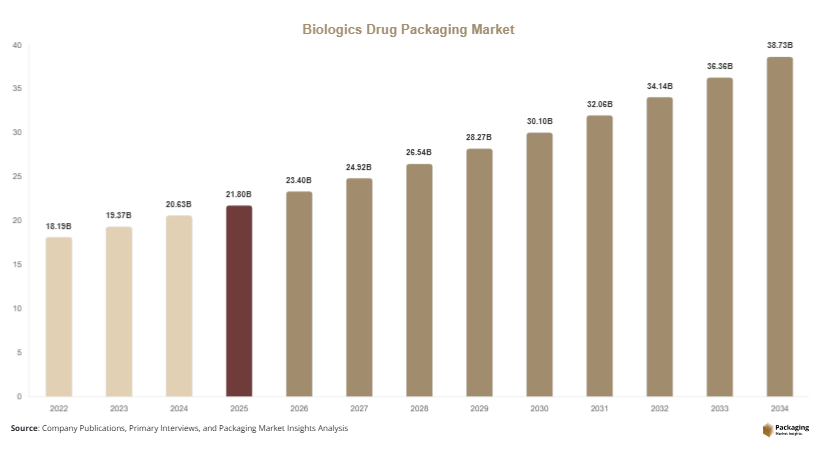
The global biologics drug packaging market size was valued at approximately USD 21.8 billion in 2025 and is projected to reach USD 23.4 billion in 2026. With continuous expansion in biopharmaceutical production and innovation in packaging technologies, the market is forecasted to reach USD 41.2 billion by 2034, registering a CAGR of 6.5% during the forecast period (2025–2034). The biologics drug packaging market is witnessing steady growth due to the rising adoption of biologic therapies, increasing demand for advanced drug delivery systems, and strict regulatory requirements for product safety and integrity.
One of the key growth factors is the rapid increase in biologics and biosimilars development, particularly in therapeutic areas such as oncology, immunology, and rare diseases. These drugs require specialized packaging solutions that ensure stability, sterility, and protection from environmental conditions. Another important driver is the growing emphasis on patient safety and regulatory compliance, which is encouraging the adoption of high-quality packaging formats such as prefilled syringes, vials, and cartridges. These formats reduce contamination risks and improve dosing accuracy.
Key Market Insights:
- Asia Pacific dominated the market with a 36.8% share in 2025, while Latin America is projected to grow at the fastest CAGR of 7.1%.
- Glass packaging led the material segment with a 48.5% share, while advanced polymer packaging is expected to grow at a CAGR of 6.9%.
- Prefilled syringes dominated the product type segment with a 34.2% share, while auto-injectors are forecasted to grow at a CAGR of 7.4%.
- Oncology applications led the segment with 39.6% share, while immunology applications are expected to grow at a CAGR of 7.2%.
- United States remained the dominant country with a market size of USD 7.6 billion in 2025 and USD 8.2 billion in 2026.
Explore more data points, trends and opportunities Download Free Sample Report
Market Trends
Increasing adoption of advanced primary packaging solutions
The biologics drug packaging market is experiencing a shift toward advanced primary packaging formats such as prefilled syringes, cartridges, and auto-injectors. These packaging types offer enhanced convenience, accurate dosing, and reduced risk of contamination, making them suitable for sensitive biologic drugs. Pharmaceutical companies are increasingly adopting these formats to improve patient compliance and support self-administration, particularly for chronic conditions.
In addition, these advanced packaging solutions reduce drug wastage and improve operational efficiency during manufacturing and distribution. Innovations in materials, such as cyclic olefin polymers, are enhancing the performance of these packaging formats by providing superior chemical resistance and clarity. As biologics continue to dominate the pharmaceutical pipeline, the demand for high-performance primary packaging solutions is expected to increase significantly.
Expansion of cold chain and temperature-controlled packaging
Temperature-sensitive biologics require strict storage and transportation conditions, which is driving the demand for cold chain packaging solutions. The biologics drug packaging market is witnessing increased adoption of insulated containers, phase change materials, and temperature-monitoring devices to ensure product stability throughout the supply chain.
Advancements in smart packaging technologies are enabling real-time monitoring of temperature and humidity, reducing the risk of product degradation. Pharmaceutical companies are investing in robust cold chain infrastructure to comply with regulatory standards and maintain product quality. As the global distribution of biologics expands, the importance of temperature-controlled packaging solutions continues to grow, supporting overall market development.
Market Drivers
Rising demand for biologics and biosimilars
The increasing development and commercialization of biologics and biosimilars are key factors driving the biologics drug packaging market. Biologics are widely used in the treatment of chronic and complex diseases, including cancer, autoimmune disorders, and genetic conditions. The growing prevalence of these diseases is leading to higher demand for biologic therapies, thereby increasing the need for specialized packaging solutions.
Biosimilars are also gaining traction as cost-effective alternatives to branded biologics, further expanding the market. Packaging plays a critical role in maintaining the efficacy and safety of these drugs, which often require sterile and contamination-free environments. As pharmaceutical companies continue to invest in biologics research and development, the demand for advanced packaging solutions is expected to rise steadily.
Increasing focus on patient-centric drug delivery
The shift toward patient-centric healthcare is influencing the design and development of biologics packaging solutions. Patients increasingly prefer self-administration options that offer convenience and flexibility, driving demand for user-friendly packaging formats such as auto-injectors and prefilled syringes.
These packaging solutions reduce the need for hospital visits and enable patients to manage their treatments at home. Pharmaceutical companies are focusing on ergonomic designs, ease of use, and safety features to enhance patient experience. This trend is particularly significant in chronic disease management, where long-term treatment adherence is critical. As healthcare systems emphasize patient convenience and efficiency, the demand for innovative packaging solutions continues to grow.
Market Restraint
High cost and complexity associated with specialized packaging solutions
The biologics drug packaging market faces challenges due to the high cost and complexity of specialized packaging solutions required for biologic drugs. These drugs are sensitive to environmental factors such as temperature, light, and contamination, necessitating the use of advanced materials and technologies. The development and manufacturing of such packaging solutions involve significant investment in research, equipment, and quality control processes.
Additionally, regulatory requirements for biologics packaging are stringent, requiring extensive testing and validation to ensure product safety and compliance. This increases the overall cost of packaging and can pose challenges for small and medium-sized pharmaceutical companies. For example, implementing cold chain packaging systems requires substantial infrastructure and operational expenses. Despite these challenges, ongoing technological advancements are expected to gradually reduce costs and improve accessibility.
Market Opportunities
Growth in emerging biopharmaceutical markets
Emerging markets present significant opportunities for the biologics drug packaging market due to increasing healthcare investments, rising disease prevalence, and expanding access to biologic therapies. Countries in Asia Pacific, Latin America, and the Middle East are witnessing rapid growth in biopharmaceutical production and consumption.
Government initiatives to improve healthcare infrastructure and promote local manufacturing are further supporting market expansion. Pharmaceutical companies are establishing production facilities in these regions to meet growing demand, creating opportunities for packaging manufacturers. As access to biologic treatments improves, the need for reliable and cost-effective packaging solutions is expected to increase significantly.
Innovation in sustainable and high-performance packaging materials
Sustainability is becoming an important consideration in the biologics drug packaging market, creating opportunities for innovation in eco-friendly materials. Companies are developing recyclable and lightweight packaging solutions that reduce environmental impact while maintaining product integrity.
High-performance materials such as advanced polymers and coated glass are improving the durability and functionality of packaging solutions. These materials offer enhanced barrier properties, chemical resistance, and compatibility with biologic drugs. As regulatory pressures and environmental concerns continue to rise, companies that invest in sustainable and high-performance packaging technologies are likely to gain a competitive advantage.
Report Scope
| Report Metric | Details |
|---|---|
| Market Size in 2025 | USD 21.8 Billion |
| Market Size in 2026 | USD 23.4 Billion |
| Market Size in 2034 | USD 41.2 Billion |
| CAGR | 6.5% (2026-2034) |
| Base Year for Estimation | 2025 |
| Historical Data | 2022-2024 |
| Forecast Period | 2026-2034 |
| Report Coverage | Revenue Forecast, Competitive Landscape, Supply Chain Disruption, Growth Factors, Environment & Regulatory Landscape and Trends |
| Geographies Covered | North America, Europe, APAC, Middle East and Africa, LATAM |
| Countries Covered | U.S., Canada, U.K., Germany, France, Spain, Italy, Russia, Nordic, Benelux, Rest of Europe, China, South Korea, Japan, India, Australia, Singapore, Taiwan, South East Asia, Rest of Asia-Pacific, UAE, Turky, Saudi Arabia, South Africa, Egypt, Nigeria, Rest of MEA, Brazil, Mexico, Argentina, Chile, Colombia, Rest of LATAM |
Explore more data points, trends and opportunities Download Free Sample Report
Regional Analysis
North America
North America accounted for approximately 34.2% of the biologics drug packaging market share in 2025 and is projected to grow at a CAGR of 6.1% during the forecast period. The region benefits from a strong biopharmaceutical industry, advanced healthcare infrastructure, and high investment in research and development activities. The presence of leading pharmaceutical companies and packaging manufacturers supports continuous innovation in packaging technologies.
The United States dominates the regional market due to its large biologics production capacity and strong regulatory framework. A key growth factor is the increasing adoption of self-administration therapies, which is driving demand for advanced packaging formats such as prefilled syringes and auto-injectors.
Europe
Europe held around 27.6% of the market share in 2025 and is expected to grow at a CAGR of 6.3%. The region is characterized by strong regulatory standards and a focus on quality and safety in pharmaceutical packaging. Increasing demand for biologics and biosimilars is supporting market growth.
Germany leads the regional market, driven by its advanced manufacturing capabilities and robust pharmaceutical sector. A unique growth factor is the increasing investment in sustainable packaging solutions, supported by strict environmental regulations and circular economy initiatives.
Asia Pacific
Asia Pacific dominated the biologics drug packaging market with a 36.8% share in 2025 and is projected to grow at a CAGR of 6.9%. Rapid growth in the biopharmaceutical sector, increasing healthcare expenditure, and rising demand for biologic therapies are driving market expansion in the region.
China is the leading country in this region, supported by its expanding pharmaceutical manufacturing base and government initiatives to promote biotechnology innovation. A key growth factor is the increasing production of biosimilars, which is driving demand for cost-effective packaging solutions.
Middle East & Africa
The Middle East & Africa region accounted for approximately 5.6% of the market share in 2025 and is expected to grow at a CAGR of 6.7%. The region is witnessing increasing demand for advanced healthcare solutions, including biologic therapies.
Saudi Arabia dominates the regional market due to its growing healthcare sector and investments in pharmaceutical manufacturing. A unique growth factor is the development of healthcare infrastructure and cold chain logistics, which supports the distribution of temperature-sensitive biologics.
Latin America
Latin America held a market share of 5.8% in 2025 and is projected to grow at the fastest CAGR of 7.1%. The region is experiencing growth in biologics adoption due to improving healthcare access and rising awareness of advanced treatments.
Brazil leads the regional market, supported by its large population and expanding pharmaceutical industry. A key growth factor is the increasing availability of biosimilars, which is driving demand for efficient and affordable packaging solutions.
Biologics Drug Packaging Market Segmentations
By Material
- Glass
- Plastic
- Metal
- Advanced Polymers
By Product Type
- Prefilled Syringes
- Vials
- Ampoules
- Cartridges
- Auto-Injectors
By Application
- Oncology
- Immunology
- Infectious Diseases
- Rare Diseases
Segmental Analysis
By Material
Glass packaging dominated the market with a share of 48.5% in 2024 due to its excellent barrier properties and compatibility with biologic drugs. Glass vials and ampoules are widely used for storing injectable biologics, as they provide protection against contamination and chemical interactions. Despite challenges related to breakage and weight, glass remains a preferred material due to its reliability and regulatory acceptance.
Advanced polymer packaging is expected to grow at the fastest CAGR of 6.9%, driven by innovations in materials such as cyclic olefin copolymers. These materials offer improved durability, lightweight properties, and resistance to breakage. Their compatibility with sensitive biologic formulations is supporting their adoption in modern packaging solutions.
By Product Type
Prefilled syringes held the largest share of 34.2% in 2024, driven by their convenience, accuracy, and reduced risk of contamination. These packaging formats are widely used in the administration of biologic drugs, particularly for chronic conditions requiring regular dosing.
Auto-injectors are projected to be the fastest-growing segment, with a CAGR of 7.4%. Their ease of use and suitability for self-administration are driving adoption among patients and healthcare providers. The increasing prevalence of chronic diseases is further supporting the growth of this segment.
By Application
Oncology applications dominated the market with a share of 39.6% in 2024 due to the high demand for biologic therapies in cancer treatment. Packaging solutions in this segment focus on maintaining drug stability and ensuring safe delivery.
Immunology applications are expected to grow at the fastest CAGR of 7.2%, driven by increasing prevalence of autoimmune diseases. Packaging innovations in this segment emphasize patient convenience and product safety, supporting market growth.
Competitive Landscape
The biologics drug packaging market is characterized by the presence of several global players focusing on innovation, quality, and regulatory compliance. Companies are investing in advanced packaging technologies and expanding their product portfolios to meet the growing demand for biologics.
Schott AG is recognized as a leading player in the market, known for its expertise in glass packaging solutions. The company recently introduced advanced glass materials designed to improve durability and reduce breakage risks. Other key players are focusing on strategic partnerships and capacity expansion to strengthen their market position and address increasing demand.
Key Players
- Schott AG
- Gerresheimer AG
- West Pharmaceutical Services, Inc.
- Amcor plc
- Berry Global Inc.
- Nipro Corporation
- Stevanato Group
- SGD Pharma
- Catalent, Inc.
- AptarGroup, Inc.
- WestRock Company
- Corning Incorporated
- Becton, Dickinson and Company
- DWK Life Sciences
- Ompi (Stevanato Group)