First Aid Packaging Kit Market Size and Growth
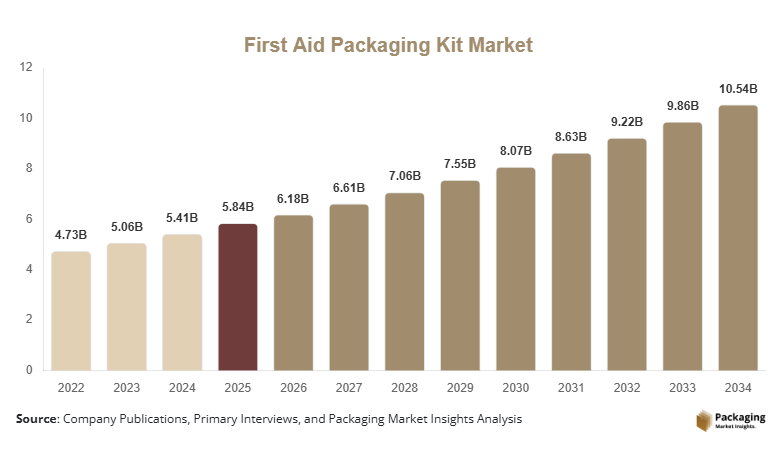
The global first aid packaging kit market size is estimated at USD 5.84 billion in 2025, while the market is projected to reach USD 6.18 billion in 2026. By 2034, the market is forecasted to achieve approximately USD 10.52 billion, registering a CAGR of 6.9% during 2025–2034. The first aid packaging kit market is witnessing stable growth due to increasing awareness regarding emergency preparedness, workplace safety regulations, and rising demand for portable healthcare solutions. First aid packaging kits are widely used in hospitals, households, industrial facilities, educational institutions, transportation services, sports centers, and military operations. These kits are designed to store and organize medical essentials such as bandages, antiseptics, gloves, gauze, medications, scissors, and emergency response tools in secure and durable packaging formats.
One of the major growth factors supporting market expansion is the increasing implementation of occupational health and safety standards across industries. Governments and regulatory agencies are mandating the availability of first aid kits in workplaces, manufacturing plants, schools, and public transportation systems. Another important growth factor is the rising participation in outdoor recreational activities such as trekking, camping, sports, and adventure tourism, which has increased demand for portable and lightweight first aid packaging kits. Additionally, growing awareness regarding emergency response preparedness among households and commercial establishments is contributing to higher product adoption globally.
Key Highlights
- North America dominated the market with a 34.6% share in 2025.
- Asia Pacific is projected to grow at the fastest CAGR of 7.5%.
- Plastic-based first aid packaging kits led the material segment with a 44.9% share.
- Workplace emergency kits dominated the application segment with 39.8% share.
- Industrial end-users led the segment with a 36.4% share.
- The US remained the dominant country with a market size of USD 1.72 billion in 2025 and USD 1.83 billion in 2026.
Explore more data points, trends and opportunities Download Free Sample Report
Market Trends
Growing Demand for Sustainable and Lightweight Packaging Solutions
Sustainability is becoming a major trend in the first aid packaging kit market as manufacturers and consumers focus on reducing environmental impact. Companies are increasingly developing recyclable, biodegradable, and lightweight packaging materials for first aid kits used in healthcare facilities, workplaces, and households. Eco-friendly paperboard cases, reusable fabric pouches, and recyclable plastic containers are gaining popularity due to changing environmental regulations and consumer preferences. In addition, lightweight packaging improves portability and storage convenience, particularly for travel and outdoor first aid kits. Manufacturers are also reducing unnecessary plastic usage and adopting minimalistic packaging designs. This trend is expected to encourage innovation in durable and sustainable medical packaging technologies throughout the forecast period.
Integration of Smart Labeling and Organized Storage Features
Another important trend shaping the first aid packaging kit market is the integration of smart labeling systems and advanced storage designs. Manufacturers are introducing color-coded compartments, QR-code-based instructions, and digital inventory tracking systems to improve emergency response efficiency. Smart packaging solutions help users quickly identify essential medical supplies during emergencies and reduce confusion in high-pressure situations. Hospitals, industrial facilities, and schools are increasingly adopting organized first aid kits with modular compartments for faster accessibility. Some advanced kits also include expiration tracking labels and refill indicators to ensure compliance with safety regulations. This trend is supporting product differentiation and improving user convenience across professional and consumer applications.
Market Drivers
Increasing Workplace Safety Regulations and Compliance Requirements
The growing implementation of workplace safety standards is a major driver of the first aid packaging kit market. Governments and labor organizations across multiple countries require businesses to maintain properly stocked first aid kits in offices, factories, warehouses, construction sites, and transportation facilities. Rising awareness regarding employee safety and emergency preparedness is encouraging organizations to invest in standardized medical kits with durable packaging systems. Industrial sectors such as manufacturing, mining, energy, and logistics are particularly driving demand due to higher workplace injury risks. In addition, periodic safety inspections and compliance audits are increasing replacement and replenishment rates for first aid packaging kits across commercial and industrial environments.
Rising Outdoor Activities and Emergency Preparedness Awareness
The increasing popularity of outdoor recreational activities and emergency preparedness initiatives is significantly contributing to market growth. Consumers participating in hiking, sports, camping, road travel, and adventure tourism are purchasing portable first aid kits to manage minor injuries and medical emergencies. Governments and disaster management agencies are also promoting emergency readiness programs for households and communities. The growing frequency of natural disasters and public health emergencies has increased awareness regarding the importance of accessible first aid supplies. Compact and travel-friendly packaging designs are becoming increasingly popular among consumers seeking convenience and mobility. These factors are collectively supporting strong demand for first aid packaging kits worldwide.
Market Restraint
Fluctuating Raw Material Prices and Product Standardization Challenges
One of the primary restraints affecting the first aid packaging kit market is the fluctuation in raw material prices used for packaging production. Costs associated with plastics, aluminum, paperboard, and medical-grade fabrics can vary significantly due to supply chain disruptions, energy costs, and global trade uncertainties. These fluctuations impact manufacturing expenses and reduce profit margins for packaging companies. Additionally, the lack of globally standardized regulations for first aid kit contents and packaging formats creates challenges for manufacturers operating across multiple regions. Different countries and industries often require varying product specifications and safety standards, increasing production complexity and inventory management costs. For example, industrial first aid kits designed for construction sites may require different packaging structures and medical contents compared to household emergency kits. These variations can slow large-scale product standardization and limit operational efficiency for manufacturers serving global markets.
Market Opportunities
Expansion of E-Commerce and Direct-to-Consumer Sales Channels
The rapid growth of e-commerce platforms presents a significant opportunity for the first aid packaging kit market. Online retail channels allow manufacturers to reach a broader consumer base, including households, schools, travelers, and small businesses. E-commerce platforms provide easy product comparisons, subscription-based refill services, and customizable kit options that improve customer convenience. Digital marketing strategies and online awareness campaigns are also increasing consumer understanding regarding emergency preparedness. Additionally, the expansion of cross-border online sales is enabling manufacturers to enter emerging markets with lower distribution costs. Companies investing in attractive, compact, and user-friendly packaging are likely to benefit from increasing online consumer demand during the forecast period.
Development of Customized and Industry-Specific First Aid Kits
The increasing demand for customized first aid solutions is creating new opportunities for packaging manufacturers. Industries such as construction, oil and gas, sports, hospitality, transportation, and military operations require specialized first aid kits tailored to specific workplace risks and operational environments. Manufacturers are developing customized packaging formats with industry-specific medical supplies and durable storage designs. For example, waterproof and shock-resistant kits are becoming popular in marine and outdoor industries, while compact travel kits are gaining demand among airline and tourism operators. The ability to offer tailored packaging solutions improves customer satisfaction and supports premium product positioning. This opportunity is expected to encourage innovation in modular and application-specific packaging technologies.
Report Scope
| Report Metric | Details |
|---|---|
| Market Size in 2025 | USD 5.84 Billion |
| Market Size in 2026 | USD 6.18 Billion |
| Market Size in 2034 | USD 10.52 Billion |
| CAGR | 6.9% (2026-2034) |
| Base Year for Estimation | 2025 |
| Historical Data | 2022-2024 |
| Forecast Period | 2026-2034 |
| Report Coverage | Revenue Forecast, Competitive Landscape, Supply Chain Disruption, Growth Factors, Environment & Regulatory Landscape and Trends |
| Geographies Covered | North America, Europe, APAC, Middle East and Africa, LATAM |
| Countries Covered | U.S., Canada, U.K., Germany, France, Spain, Italy, Russia, Nordic, Benelux, Rest of Europe, China, South Korea, Japan, India, Australia, Singapore, Taiwan, South East Asia, Rest of Asia-Pacific, UAE, Turky, Saudi Arabia, South Africa, Egypt, Nigeria, Rest of MEA, Brazil, Mexico, Argentina, Chile, Colombia, Rest of LATAM |
Explore more data points, trends and opportunities Download Free Sample Report
Segmental Analysis
By Material Type
Plastic-based first aid packaging kits dominated the market in 2024, accounting for approximately 44.9% of the total market share. Plastic materials remain widely preferred because they provide durability, moisture resistance, lightweight handling, and cost efficiency. Hard plastic cases are commonly used in industrial workplaces, hospitals, schools, and public transportation systems due to their ability to protect medical contents from external damage and contamination. Manufacturers are also introducing transparent and compartmentalized plastic packaging designs to improve accessibility and organization during emergencies. The availability of reusable and tamper-resistant plastic containers further supports segment growth. Additionally, plastic-based packaging allows manufacturers to produce portable first aid kits in various shapes and sizes suitable for different applications and end-user requirements.
Eco-friendly paperboard packaging is projected to be the fastest-growing subsegment, registering a CAGR of 7.3% during the forecast period. Increasing environmental concerns and sustainability regulations are encouraging manufacturers to develop biodegradable and recyclable packaging alternatives. Paperboard first aid packaging kits are gaining popularity among environmentally conscious consumers, educational institutions, and healthcare providers seeking to reduce plastic waste. Advancements in coated paper technologies are improving durability and moisture resistance, making paper-based packaging more practical for emergency medical applications. In addition, governments and businesses are increasingly supporting sustainable procurement practices, which is accelerating demand for eco-friendly first aid packaging materials. The segment is also benefiting from rising consumer preference for lightweight and recyclable packaging formats.
By Application
Workplace emergency kits dominated the application segment in 2024 with a market share of approximately 39.8%. Industrial facilities, offices, warehouses, construction sites, and transportation operators are major users of workplace first aid kits due to mandatory occupational safety regulations. These kits are designed to address common workplace injuries such as cuts, burns, sprains, and minor accidents. Employers are increasingly investing in organized and regulation-compliant first aid packaging systems to improve emergency response capabilities and meet safety inspection requirements. Durable packaging materials with labeled compartments are widely used to improve accessibility during emergencies. Rising industrialization and increasing employee safety awareness across multiple sectors are further contributing to the growth of workplace emergency kit applications.
Travel and outdoor first aid kits are expected to grow at the fastest CAGR of 7.7% during the forecast period. Increasing participation in camping, trekking, sports, adventure tourism, and international travel is driving demand for lightweight and portable first aid packaging solutions. Consumers are seeking compact kits that are easy to carry and capable of addressing minor injuries during outdoor activities. Manufacturers are introducing waterproof pouches, foldable packaging designs, and multifunctional storage systems to improve convenience for travelers and outdoor users. The growing popularity of emergency preparedness products among families and tourists is also contributing to segment expansion. Online retail platforms are further accelerating product visibility and accessibility for outdoor and travel-oriented first aid kits.
By End-Use
Industrial end-users dominated the first aid packaging kit market in 2024, accounting for nearly 36.4% of the global share. Manufacturing plants, construction companies, mining operations, logistics providers, and energy facilities require first aid kits to comply with occupational safety regulations and maintain workplace emergency preparedness. Industrial environments often involve higher injury risks, increasing the need for durable and accessible first aid packaging solutions. Employers are investing in heavy-duty packaging cases capable of protecting medical supplies from dust, moisture, and physical damage. In addition, periodic workplace safety audits and compliance inspections are supporting continuous procurement of replacement and refill kits. The growth of industrial infrastructure projects across developing economies is further contributing to increased segment demand.
Household consumers are projected to witness the fastest CAGR of 7.1% during the forecast period. Rising awareness regarding emergency preparedness, growing healthcare consciousness, and increasing concerns about home accidents are encouraging consumers to purchase first aid kits for residential use. Compact and aesthetically designed packaging formats are becoming increasingly popular among households seeking convenient storage solutions. E-commerce platforms and retail pharmacies are improving product accessibility and supporting broader consumer adoption. In addition, public awareness campaigns regarding disaster preparedness and child safety are contributing to growing demand for home-use first aid kits. Manufacturers are also offering family-specific and customizable packaging kits to address varying household medical needs.
First Aid Packaging Kit Market Segmentations
By Material Type
- Plastic Packaging
- Metal Packaging
- Fabric Packaging
- Eco-Friendly Paperboard Packaging
By Application
- Workplace Emergency Kits
- Travel and Outdoor Kits
- Sports First Aid Kits
- Household First Aid Kits
- Medical and Healthcare Kits
By End-User
- Industrial
- Household Consumers
- Healthcare Institutions
- Educational Institutions
- Military and Defense
Regional Analysis
North America
North America accounted for approximately 34.6% of the global first aid packaging kit market share in 2025 and is expected to grow at a CAGR of 6.1% during the forecast period. The region benefits from strong workplace safety regulations, advanced healthcare infrastructure, and high consumer awareness regarding emergency preparedness. Increasing demand from schools, offices, industrial facilities, and public institutions is supporting market expansion. The region also has a strong presence of first aid kit manufacturers and packaging technology providers.
The United States dominates the North American market due to extensive occupational safety compliance requirements and high adoption of emergency medical products. A unique growth factor in the country is the increasing use of customized first aid kits in corporate offices and educational institutions. Organizations are investing in branded and application-specific first aid kits to improve emergency readiness and meet workplace safety standards.
Europe
Europe held nearly 26.4% of the global market share in 2025 and is projected to register a CAGR of 6.0% over the forecast period. The region’s growth is driven by strict healthcare safety standards, rising environmental awareness, and growing demand for sustainable packaging materials. Increasing participation in outdoor sports and travel activities is also supporting higher demand for portable first aid kits. In addition, public health campaigns promoting emergency preparedness are contributing to market growth across European countries.
Germany leads the European market due to its strong industrial sector and advanced healthcare packaging industry. One unique growth factor is the country’s focus on environmentally sustainable packaging solutions. German manufacturers are increasingly introducing recyclable and reusable first aid packaging materials to comply with environmental regulations and support circular economy initiatives within the healthcare and consumer goods sectors.
Asia Pacific
Asia Pacific dominated the first aid packaging kit market growth outlook with rapid expansion and is expected to register the fastest CAGR of 7.5% through 2034. Rising healthcare awareness, expanding industrialization, and increasing investments in workplace safety programs are major factors supporting regional growth. Countries across the region are strengthening emergency response infrastructure and improving healthcare accessibility. Additionally, growing disposable income and rising outdoor recreational activities are increasing demand for portable first aid kits.
China remains the dominant country in Asia Pacific due to its large manufacturing base and rapidly growing healthcare products industry. A unique growth factor is the expansion of e-commerce healthcare product sales in urban and rural regions. Online retail platforms are significantly increasing consumer access to affordable and customized first aid packaging kits, supporting strong product demand across the country.
Middle East & Africa
The Middle East & Africa region accounted for approximately 5.1% of the global market share in 2025 and is expected to grow at a CAGR of 6.4% during the forecast period. Investments in healthcare modernization, industrial development, and public safety infrastructure are supporting regional demand for first aid packaging kits. Governments are also increasing awareness regarding emergency preparedness and workplace health regulations. The expansion of tourism and transportation sectors is further contributing to market growth.
Saudi Arabia dominates the regional market due to increasing industrial projects and rising healthcare expenditure. A unique growth factor is the growing focus on worker safety in large-scale construction and energy projects. Industrial employers are increasingly procuring durable and regulation-compliant first aid kits to support occupational safety programs and improve emergency response capabilities at project sites.
Latin America
Latin America held around 4.2% of the global market share in 2025 and is projected to grow at a CAGR of 6.8% during the forecast period. Rising healthcare awareness, improving workplace safety regulations, and increasing consumer demand for emergency preparedness products are supporting market growth. The region is also witnessing growing adoption of first aid kits in schools, public transportation systems, and sports facilities. Expanding retail distribution networks are further improving product availability.
Brazil is the leading country in the Latin American market due to its growing healthcare sector and large industrial workforce. One unique growth factor is the increasing popularity of travel and outdoor recreation activities. Consumers participating in adventure tourism and long-distance road travel are driving demand for compact and portable first aid packaging kits across the country.
Competitive Landscape
The first aid packaging kit market is moderately competitive, with global and regional companies competing through product innovation, packaging durability, customization, and sustainability initiatives. Manufacturers are focusing on lightweight materials, organized storage systems, and environmentally friendly packaging solutions to strengthen their market positions. Strategic partnerships with healthcare distributors, industrial safety providers, and e-commerce retailers are also becoming increasingly common.
Johnson & Johnson is recognized as one of the leading companies in the market due to its strong healthcare brand presence and diversified first aid product portfolio. In 2024, the company introduced an upgraded line of travel first aid kits featuring recyclable packaging materials and smart inventory labeling systems. Other significant players include 3M Company, Acme United Corporation, Honeywell International Inc., and Medline Industries. These companies are investing in product customization, digital retail expansion, and advanced packaging technologies to address evolving consumer and industrial safety requirements.
Key Players List
- Johnson & Johnson
- 3M Company
- Acme United Corporation
- Honeywell International Inc.
- Medline Industries
- Cintas Corporation
- Certified Safety Manufacturing
- St John Ambulance
- Lifeline First Aid LLC
- Tender Corporation
- Safety First Aid Group
- Beiersdorf AG
- Rapid Care Inc.
- Firstar Healthcare
- Green Guard First Aid & Safety
- Hartmann Group
- Reliance Medical Ltd.