Blow Fill Seal Technology Market Size
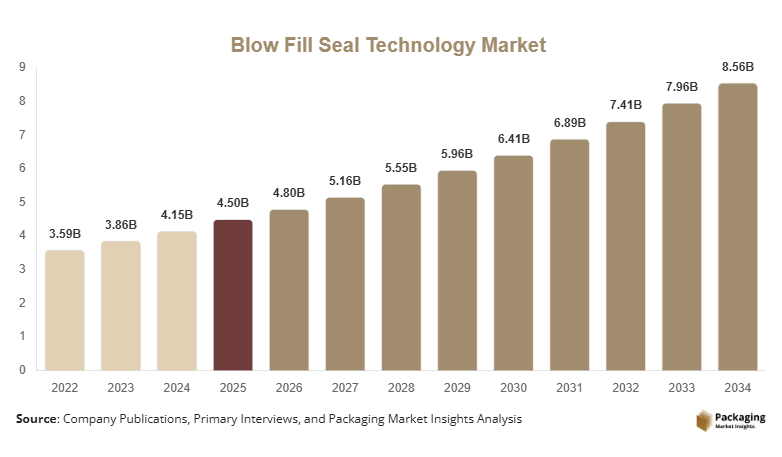
The Blow Fill Seal technology market size is projected at USD 4.8 billion in 2026 and is expected to hit USD 8.6 billion by 2034 with a CAGR of 7.5%.
The report presents a comprehensive analysis of production capacity, technological advancements, application trends, regional performance, competitive landscape, and supply chain developments. It evaluates demand patterns, manufacturing capabilities, and investment opportunities across key end-use industries.
Blow fill seal technology is an aseptic manufacturing process that forms, fills, and seals plastic containers in a single automated operation, minimizing contamination risks. Global production exceeded 82.6 billion BFS containers during 2025, while manufacturing utilization remained above 91%. Pharmaceutical applications contributed approximately 67.8% of total consumption, healthcare accounted for 18.5%, and food & beverage represented 13.7%. More than 79% of sterile ophthalmic and respiratory liquid products utilize BFS packaging, reinforcing the blow-fill-seal technology market.
Explore more data points, trends and opportunities Download Free Sample Report
Blow Fill Seal Technology Market Trends
Growing Adoption of Advanced Aseptic Manufacturing
Manufacturers continue investing in high-speed BFS production systems capable of producing more than 18,000 containers per hour. Global production capacity exceeded 82.6 billion units in 2025, while automated aseptic processing adoption increased by 16.3%. Demand for preservative-free pharmaceutical packaging expanded by 14.8%, strengthening the blow-fill-seal technology market.
Digital monitoring, robotic handling, and Industry 4.0 integration are improving manufacturing efficiency. Smart production systems reduced operational downtime by approximately 19%, while AI-enabled quality inspection improved defect detection rates above 98%. Single-dose packaging demand increased by 17.4%, particularly across pharmaceutical and healthcare industries, supporting the blow-fill-seal technology market.
Blow Fill Seal Technology Market Drivers
Increasing Demand for Sterile Pharmaceutical Packaging
Growing production of injectable drugs, ophthalmic solutions, respiratory medicines, and biologics continues driving industry expansion. Pharmaceutical manufacturers produced more than 55.8 billion BFS containers during 2025, while sterile liquid drug demand increased by 13.6%. Regulatory emphasis on contamination-free manufacturing accelerated BFS adoption across more than 72% of new aseptic production facilities, driving the blow-fill-seal technology market.
Blow Fill Seal Technology Market Restraints
High Capital Investment Requirements
Installation of advanced BFS production lines requires substantial capital expenditure and specialized infrastructure. Equipment investment frequently exceeds USD 4 million per production line, while facility validation costs increased by approximately 11.4%. Maintenance expenses rose nearly 8.7%, creating financial barriers for small manufacturers within the blow-fill-seal technology market.
Blow Fill Seal Technology Market Opportunities
Expansion of Biopharmaceutical Manufacturing
Rapid expansion of biologics, vaccines, biosimilars, and personalized medicines is creating strong growth opportunities. Global biologic drug production increased by 15.1% during 2025, while demand for sterile single-dose packaging expanded by 18.2%. Emerging pharmaceutical manufacturing facilities across Asia-Pacific and Latin America continue supporting the blow-fill-seal technology market.
Challenges in Blow Fill Seal Technology Market
Stringent Regulatory Compliance and Validation
Manufacturers face strict compliance requirements related to aseptic processing, container integrity, and process validation. Validation timelines increased by approximately 12%, while quality assurance expenditures rose 10.6% during 2025. More than 87% of facilities invested in automated inspection technologies to maintain compliance throughout the blow-fill-seal technology market.
Report Scope
| Report Metric | Details |
|---|---|
| Market Size in 2025 | USD 4.5 Billion |
| Market Size in 2026 | USD 4.8 Billion |
| Market Size in 2034 | USD 8.6 Billion |
| CAGR | 7.5% (2026-2034) |
| Base Year for Estimation | 2025 |
| Historical Data | 2022-2024 |
| Forecast Period | 2026-2034 |
| Report Coverage | Revenue Forecast, Competitive Landscape, Supply Chain Disruption, Growth Factors, Environment & Regulatory Landscape and Trends |
| Geographies Covered | North America, Europe, APAC, Middle East and Africa, LATAM |
| Countries Covered | U.S., Canada, U.K., Germany, France, Spain, Italy, Russia, Nordic, Benelux, Rest of Europe, China, South Korea, Japan, India, Australia, Singapore, Taiwan, South East Asia, Rest of Asia-Pacific, UAE, Turkey, Saudi Arabia, South Africa, Egypt, Nigeria, Rest of MEA, Brazil, Mexico, Argentina, Chile, Colombia, Rest of LATAM |
Explore more data points, trends and opportunities Download Free Sample Report
Blow Fill Seal Technology Market Segmentation
The market is segmented by type and application. Bottles accounted for approximately 49.4% of global production, while pharmaceutical applications maintained nearly 67.8% of overall consumption due to expanding sterile drug manufacturing.
By Type
Bottles represented approximately 49.4% of market demand. Annual production exceeded 40.8 billion units during 2025. These containers provide excellent sterility, lightweight construction, and leak resistance and are widely utilized for respiratory therapies, saline solutions, and ophthalmic products.
Ampoules accounted for nearly 28.3% of total production with output exceeding 23.4 billion units. Their unit-dose format, tamper resistance, and contamination-free design make them suitable for injectable drugs, vaccines, and sterile pharmaceutical preparations.
Vials contributed approximately 22.3% of industry volume with production surpassing 18.4 billion units. BFS vials offer excellent dimensional consistency, reduced contamination risks, and compatibility with advanced pharmaceutical filling operations.
By Application
Pharmaceuticals remained the dominant application, with approximately a 67.8% share. Production exceeded 55.8 billion BFS containers in 2025. High adoption for respiratory therapies, ophthalmic formulations, injectable drugs, and preservative-free medications continues driving demand.
Healthcare represented approximately 18.5% of total consumption with production exceeding 15.3 billion units. Medical diagnostics, wound care solutions, and sterile irrigation products remain major applications supporting segment expansion.
Food & beverage accounted for approximately 13.7% share, with production exceeding 11.3 billion containers. The technology supports aseptic dairy products, nutritional beverages, and specialty liquid food packaging requiring extended shelf life
Blow Fill Seal Technology Market Segmentations
Type
- Bottles
- Ampoules
- Vials
Application
- Pharmaceuticals
- Healthcare
- Food & Beverage
Blow Fill Seal Technology Market Regional Outlook
North America
North America accounted for approximately 35.8% of global demand during 2025. Production exceeded 29.6 billion containers, led by the United States and Canada. Pharmaceutical manufacturing represented more than 71% of regional BFS consumption.
Europe
Europe contributed nearly 30.1% of industry revenue with production surpassing 24.9 billion units. Germany, France, Italy, Switzerland, and the United Kingdom remained major manufacturing centers supported by advanced pharmaceutical industries.
Asia-Pacific
Asia-Pacific represented approximately 27.9% of global production, exceeding 23.1 billion containers annually. China, India, Japan, and South Korea continue investing in pharmaceutical manufacturing and aseptic packaging technologies.
Latin America
Latin America accounted for approximately 3.6% of market demand. Brazil and Mexico remained primary regional contributors due to expanding pharmaceutical manufacturing capacity.
Middle East & Africa
Middle East & Africa represented nearly 2.6% of global consumption. Increasing healthcare investments, pharmaceutical production, and government support for domestic manufacturing continue supporting regional growth.
Top Players in Blow-Fill-Seal Technology Market
- Recipharm AB
- Rommelag Group
- Curida AS
- Unither Pharmaceuticals
- Weiler Engineering, Inc.
- Brevetti Angela S.r. l.
- Unipharma LLC
- Horizon Pharmaceutical Inc.
- Pharmapack Co., Ltd.
- Takeda Pharmaceutical Company Limited
- The Ritedose Corporation
- Birgi Mefar Group
- Laboratorios SALVAT S.A.
- Catalent, Inc.
- Nipro Corporation
Rommelag Group
- Estimated market presence of approximately 18%.
- Leading provider of blow fill seal machinery, aseptic packaging systems, and contract manufacturing solutions.
- The company maintains strong global positioning through advanced BFS equipment, continuous innovation, regulatory compliance expertise, and long-standing partnerships with pharmaceutical manufacturers. Investments in automation, sustainable manufacturing, and high-capacity production systems continue strengthening its competitive leadership across sterile packaging applications.
Recipharm AB
- Estimated market presence of approximately 13%.
- Recognized for contract pharmaceutical manufacturing supported by advanced BFS production capabilities.
- The company operates multiple aseptic manufacturing facilities serving global pharmaceutical clients. Strong expertise in sterile liquid formulations, biologics, respiratory therapies, and ophthalmic products enables continued expansion through technological innovation, quality assurance, and international manufacturing partnerships.