Single Dose Packaging Market Size and Growth
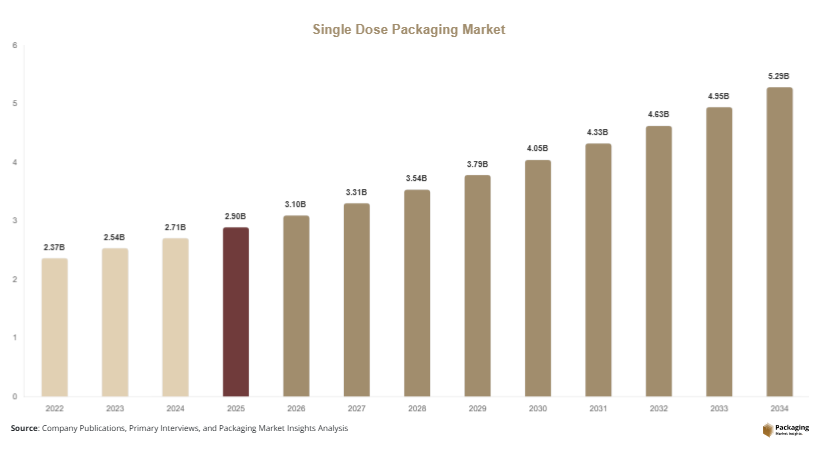
The global single dose packaging market size is estimated at USD 2.9 billion, and it is projected to reach approximately USD 3.1 billion in 2026. By 2034, the market is expected to grow significantly to nearly USD 4.8 billion, registering a CAGR of 6.9% during 2025–2034. The single dose packaging market is experiencing steady expansion driven by increasing demand for precise dosing, improved patient compliance, and contamination-free packaging formats across pharmaceutical and consumer health industries.
Growth in this market is primarily supported by the rising global consumption of pharmaceutical products, especially unit-dose medications designed for elderly patients and chronic disease management. The increasing prevalence of chronic diseases such as diabetes, cardiovascular disorders, and respiratory conditions is pushing demand for accurate, single-use packaging formats. Additionally, expanding over-the-counter (OTC) drug adoption is reinforcing market growth.
Key Highlights:
- Asia Pacific dominated the market with a 38.4% share in 2025
- North America is expected to grow at the fastest CAGR of 6.9% (2025–2034)
- Pharmaceuticals accounted for 52.3% share in 2025
- Blister packs led the packaging type segment with 41.7% share in 2025
- Plastic-based materials held 46.8% market share in 2025
- The U.S. market reached USD 610.2 million in 2025 and USD 653.5 million in 2026
Explore more data points, trends and opportunities Download Free Sample Report
Market Trends
Shift Toward Unit-Dose Pharmaceutical Packaging
The market is witnessing a strong shift toward unit-dose and single-dose packaging formats across pharmaceutical manufacturing. This trend is driven by increasing demand for patient safety, dosage accuracy, and reduced medication errors. Hospitals and pharmacies are adopting single-dose packaging to improve inventory control and streamline medication dispensing processes. Regulatory authorities are also encouraging standardized dosing formats to ensure compliance and reduce wastage. Pharmaceutical companies are integrating automated packaging systems that support high-speed production of blister packs and sachets. This trend is particularly strong in developed markets where aging populations require consistent medication management. The growing focus on home healthcare is further strengthening demand for easy-to-use single-dose packaging formats.
Adoption of Sustainable and Advanced Packaging Materials
Sustainability is becoming a major trend shaping the single dose packaging market. Manufacturers are increasingly using recyclable plastics, biodegradable films, and low-impact aluminum alternatives. This shift is driven by environmental regulations and rising consumer awareness regarding packaging waste. Companies are investing in advanced barrier materials that maintain drug stability while reducing environmental impact. Innovations in polymer science are enabling the development of thinner yet durable packaging solutions. Additionally, pharmaceutical firms are partnering with packaging suppliers to reduce carbon footprint across the supply chain. The trend is also influenced by corporate sustainability commitments, pushing companies toward eco-friendly packaging formats without compromising safety or shelf life.
Market Drivers
Rising Demand for Accurate and Safe Drug Delivery
One of the primary drivers of the single dose packaging market is the increasing need for precise drug delivery systems. Medication errors remain a significant concern in healthcare systems, particularly among elderly patients and individuals with chronic illnesses. Single-dose packaging minimizes the risk of incorrect dosage by providing pre-measured units that are easy to consume. Hospitals and clinics are adopting these packaging systems to improve patient safety and operational efficiency. Additionally, pharmaceutical companies are focusing on packaging innovations that support adherence monitoring. The rise in self-medication practices and OTC drug usage is further reinforcing the demand for reliable single-dose formats.
Expansion of Pharmaceutical and Healthcare Infrastructure
Global expansion of pharmaceutical manufacturing and healthcare infrastructure is another major growth driver. Emerging economies are investing heavily in healthcare systems, increasing access to essential medicines. This expansion is directly boosting demand for efficient packaging solutions, including blister packs, ampoules, and sachets. The growth of e-pharmacies and online drug distribution platforms is also contributing to demand for tamper-proof and easy-to-ship packaging formats. Pharmaceutical companies are scaling up production capacities, which requires standardized and cost-efficient packaging solutions. Furthermore, increasing clinical trials and drug development activities are driving demand for specialized single-dose packaging formats.
Market Restraint
High Production Costs and Material Complexity
A key restraint affecting the single dose packaging market is the relatively high production cost associated with advanced packaging formats. Single-dose packaging requires precise manufacturing technologies, high-quality barrier materials, and strict regulatory compliance, all of which increase operational costs. Small and medium-sized pharmaceutical companies often face challenges in adopting these solutions due to budget constraints. Additionally, complex multilayer materials used for improved drug protection make recycling difficult, increasing waste management challenges. The requirement for specialized machinery and automation systems further raises capital investment needs. In price-sensitive markets, cost remains a major barrier, limiting widespread adoption. This restraint is particularly significant in developing regions where healthcare budgets are limited and cost-effective bulk packaging is still preferred.
Market Opportunities
Growth in Personalized Medicine and Patient-Centric Packaging
The increasing focus on personalized medicine presents a strong opportunity for the single dose packaging market. As treatment plans become more customized based on patient profiles, demand for precise and flexible packaging formats is rising. Single-dose packaging aligns well with personalized drug regimens by ensuring accurate dosing and minimizing medication waste. Pharmaceutical companies are developing smart packaging solutions that integrate digital tracking and adherence monitoring features. This trend is particularly relevant in oncology and chronic disease treatment areas. The integration of IoT-enabled packaging systems is also expected to enhance patient engagement and compliance tracking. As healthcare becomes more individualized, single-dose packaging will play a critical role in supporting targeted therapies.
Expansion of Emerging Markets Healthcare Access
Emerging economies represent a significant growth opportunity due to increasing healthcare access and rising pharmaceutical consumption. Countries in Asia, Latin America, and Africa are investing in healthcare infrastructure and expanding drug distribution networks. This is creating demand for safe, affordable, and efficient packaging solutions. Single-dose packaging is gaining traction in rural healthcare systems where ease of use and dosage accuracy are critical. Governments are also supporting pharmaceutical localization, encouraging packaging manufacturers to set up production facilities in these regions. The expansion of generic drug markets is further driving adoption of cost-effective single-dose packaging formats.
Report Scope
| Report Metric | Details |
|---|---|
| Market Size in 2025 | USD 2.9 Billion |
| Market Size in 2026 | USD 3.1 Billion |
| Market Size in 2034 | USD 4.8 Billion |
| CAGR | 6.9% (2026-2034) |
| Base Year for Estimation | 2025 |
| Historical Data | 2022-2024 |
| Forecast Period | 2026-2034 |
| Report Coverage | Revenue Forecast, Competitive Landscape, Supply Chain Disruption, Growth Factors, Environment & Regulatory Landscape and Trends |
| Geographies Covered | North America, Europe, APAC, Middle East and Africa, LATAM |
| Countries Covered | U.S., Canada, U.K., Germany, France, Spain, Italy, Russia, Nordic, Benelux, Rest of Europe, China, South Korea, Japan, India, Australia, Singapore, Taiwan, South East Asia, Rest of Asia-Pacific, UAE, Turky, Saudi Arabia, South Africa, Egypt, Nigeria, Rest of MEA, Brazil, Mexico, Argentina, Chile, Colombia, Rest of LATAM |
Explore more data points, trends and opportunities Download Free Sample Report
Segmental Analysis
Material Type
Plastic-based materials dominated the single dose packaging market with a 46.8% share in 2024, driven by their cost efficiency, flexibility, and strong barrier protection properties. These materials are widely used in blister packs, sachets, and unit-dose containers due to their lightweight nature and compatibility with high-speed packaging systems. Pharmaceutical companies prefer plastic-based formats for large-scale production because they reduce manufacturing complexity and ensure product stability.
The fastest-growing subsegment is biodegradable and recyclable materials, expected to grow at a CAGR of 7.5% (2025–2034). This growth is driven by increasing environmental regulations and sustainability commitments from pharmaceutical companies. Manufacturers are investing in bio-based polymers and recyclable multilayer films to reduce environmental impact while maintaining drug stability. Europe and North America are leading adoption due to strict environmental compliance frameworks.
Packaging Type
Blister packs dominated the packaging type segment with a 41.7% share in 2024, primarily due to their widespread use in tablets and capsules across pharmaceutical applications. Their ability to provide unit-dose protection, extend shelf life, and prevent contamination makes them highly preferred in hospitals and retail pharmacies. Blister packaging also supports compliance tracking and dosage accuracy, making it essential for chronic disease treatments.
Sachets and stick packs are the fastest-growing segment with a CAGR of 7.1%, driven by rising demand in OTC drugs, nutraceuticals, and liquid formulations. These formats are increasingly used in emerging markets due to their affordability and convenience. Growth is further supported by expansion in e-commerce and direct-to-consumer pharmaceutical delivery, where lightweight and flexible packaging is preferred for logistics efficiency.
End-Use Industry
Pharmaceuticals accounted for the dominant share of 52.3% in 2024, making it the largest end-use segment in the single dose packaging market. The dominance is driven by increasing demand for chronic disease medications, hospital dispensing systems, and regulatory requirements for accurate dosing. Pharmaceutical companies are increasingly adopting single-dose formats to improve patient adherence and reduce medication errors in clinical settings.
The fastest-growing end-use segment is cosmetics and personal care, projected to grow at a CAGR of 7.0% (2025–2034). This growth is driven by rising demand for single-use skincare products, hygiene kits, and travel-friendly packaging formats. Beauty brands are increasingly adopting sachet-based and unit-dose packaging for serums, creams, and lotions to enhance product hygiene and reduce contamination risks. The rise of premium personal care products in Asia Pacific and North America is further accelerating this segment.
Single Dose Packaging Market Segmentations
By Material Type
- Plastic-Based Single Dose Packaging
- Glass-Based Single Dose Packaging
- Aluminum-Based Single Dose Packaging
- Paper & Paperboard-Based Packaging
By Packaging Type
- Blister Packs
- Sachets & Stick Packs
- Ampoules & Vials
- Unit-Dose Bottles
By End-User Industry
- Pharmaceuticals
- Food & Beverage
- Cosmetics & Personal Care
- Veterinary Applications
Regional Analysis
North America
North America accounted for 32.1% market share in 2025, supported by advanced pharmaceutical manufacturing, high adoption of unit-dose systems, and strong regulatory compliance frameworks. The region is projected to grow at a CAGR of 6.9% during 2025–2034, driven by increasing demand for medication safety, automation in packaging lines, and rising chronic disease prevalence.
The United States remains the dominant country in the region due to its highly developed healthcare infrastructure and strong presence of global pharmaceutical companies. A key growth factor is the rapid expansion of hospital automation systems, where single-dose packaging is widely used to reduce medication errors and improve patient compliance. Increasing adoption of blister-based unit dosing in retail pharmacies and long-term care facilities is also strengthening regional demand.
Europe
Europe held 28.4% market share in 2025, with a projected CAGR of 6.5% (2025–2034). The region benefits from strict pharmaceutical packaging regulations, strong sustainability policies, and high penetration of advanced drug delivery systems.
Germany dominates the European market due to its strong pharmaceutical manufacturing base and innovation in packaging machinery. A key growth factor is the increasing push toward eco-friendly packaging mandated by EU environmental regulations. Pharmaceutical firms are actively shifting toward recyclable blister packs and low-waste packaging formats. Additionally, aging population growth across Western Europe is increasing demand for accurate and easy-to-use single-dose medication systems, further supporting market expansion.
Asia Pacific
Asia Pacific dominated the global market with 38.4% share in 2025, making it the largest regional market. The region is expected to grow at the fastest CAGR of 7.3% (2025–2034), driven by rapid healthcare expansion, rising pharmaceutical production, and increasing access to medicines.
China leads the regional market due to its large-scale pharmaceutical manufacturing ecosystem and strong domestic demand for affordable drug packaging solutions. A key growth factor is the expansion of public healthcare initiatives and government-backed pharmaceutical distribution programs. India and Southeast Asian countries are also witnessing strong growth due to increasing generic drug production and export-oriented pharmaceutical manufacturing. Rising e-pharmacy penetration is further boosting demand for tamper-proof single-dose packaging formats.
Middle East & Africa
Middle East & Africa accounted for 6.2% share in 2025, with a projected CAGR of 6.4% (2025–2034). Growth is driven by improving healthcare infrastructure, increasing pharmaceutical imports, and government investments in healthcare modernization.
Saudi Arabia leads the regional market due to strong healthcare transformation initiatives under national development programs. A key growth factor is the expansion of hospital networks and increasing adoption of advanced drug dispensing systems. The UAE is also emerging as a regional hub for pharmaceutical logistics and packaging innovation. However, limited local manufacturing capacity remains a challenge, making the region heavily dependent on imported packaging solutions.
Latin America
Latin America held 5.0% share in 2025, with a CAGR of 6.2% during 2025–2034. The region is experiencing steady growth due to expanding healthcare access, rising pharmaceutical consumption, and increasing government healthcare investments.
Brazil dominates the Latin American market due to its strong pharmaceutical distribution network and growing adoption of OTC medications. A key growth factor is the expansion of public healthcare programs that require cost-effective and standardized packaging formats. Mexico is also contributing significantly due to rising contract manufacturing activities and increasing foreign investment in pharmaceutical production. However, economic instability in some countries continues to limit large-scale adoption of advanced packaging technologies.
Competitive Landscape
The single dose packaging market is moderately consolidated, with leading players focusing on material innovation, automation, and sustainability integration. Companies are investing heavily in R&D to improve barrier protection, reduce material usage, and enhance production efficiency. Strategic partnerships between pharmaceutical firms and packaging manufacturers are increasing.
Amcor plc is considered a market leader due to its strong global footprint and advanced flexible packaging solutions. Recent developments include expansion of recyclable blister packaging lines and investment in high-barrier pharmaceutical films. Berry Global Inc., Gerresheimer AG, West Pharmaceutical Services, and Constantia Flexibles are also key players focusing on innovation in unit-dose formats and sustainability-driven packaging solutions.
Key Players List
- Amcor plc
- Berry Global Inc.
- Gerresheimer AG
- West Pharmaceutical Services, Inc.
- Constantia Flexibles Group GmbH
- Schott AG
- Coveris Holdings S.A.
- Huhtamaki Oyj
- Sealed Air Corporation
- Tekni-Plex, Inc.
- Uflex Ltd.
- Bilcare Limited
- Klöckner Pentaplast Group
- ACG Worldwide
- Winpak Ltd.