Syringes And Injectable Drugs Packaging Market Size and Growth
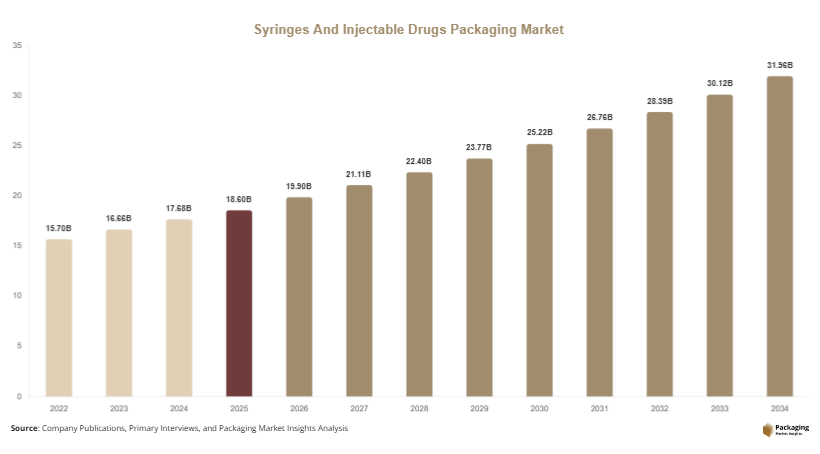
The global syringes and injectable drugs packaging market size was valued at USD 18.6 billion in 2025 and is expected to reach USD 19.9 billion in 2026. By 2034, the market is forecast to grow to USD 33.8 billion, registering a CAGR of 6.1% from 2025 to 2034. This consistent growth reflects the increasing reliance on injectable therapies across healthcare systems, particularly for chronic and life-threatening conditions. The syringes and injectable drugs packaging market continues to expand steadily due to the rising need for safe and efficient drug delivery systems.
The market is primarily driven by the growing adoption of biologics and biosimilars, which require advanced packaging formats such as prefilled syringes and sterile vials. These therapies demand high precision and contamination-free delivery, pushing manufacturers to innovate in materials and design. Another important factor is the rising prevalence of chronic diseases such as diabetes, cancer, and autoimmune disorders, all of which rely heavily on injectable drug administration. This has significantly increased the demand for reliable packaging systems that ensure drug integrity and patient safety.
Key Highlights
- Asia Pacific dominated the market with a 38.2% share in 2025, while Latin America is projected to grow at the fastest CAGR of 6.5%.
- Prefilled syringes led the type segment with a 31.4% share, while dual-chamber syringes are expected to grow at a CAGR of 6.8%.
- Plastic-based packaging dominated with a 54.7% share, while glass alternatives are forecasted to grow at a CAGR of 6.2%.
- Hospitals led the end-use segment with 45.3% share, while home healthcare is expected to grow at a CAGR of 6.6%.
- The United States remained the dominant country with a market size of USD 5.8 billion in 2025 and USD 6.2 billion in 2026.
Explore more data points, trends and opportunities Download Free Sample Report
Market Trends
Growing shift toward prefilled and ready-to-use syringe formats
The market is witnessing a clear shift toward prefilled and ready-to-use syringe systems as healthcare providers focus on improving efficiency and patient safety. These formats eliminate the need for manual drug preparation, which reduces the risk of dosing errors and contamination. Pharmaceutical companies are increasingly adopting these systems for biologics, vaccines, and specialty drugs that require precise dosing. The convenience offered by prefilled syringes also supports self-administration, making them suitable for home healthcare settings. This shift aligns with broader healthcare trends that emphasize patient-centric treatment and reduced hospital dependency. As healthcare systems continue to prioritize efficiency and safety, demand for these advanced formats is expected to increase steadily.
Adoption of advanced materials and digital packaging technologies
The integration of advanced materials and digital technologies is reshaping the syringes and injectable drugs packaging market. Materials such as cyclic olefin polymers are gaining attention due to their durability, chemical resistance, and transparency. These materials offer advantages over traditional glass by reducing breakage risks and improving compatibility with sensitive drugs. At the same time, digital packaging technologies are being introduced to enhance supply chain visibility and product authentication. Features such as temperature monitoring and tracking systems help maintain drug stability during transportation. These innovations are particularly important for biologics, which require strict storage conditions. As pharmaceutical companies invest in secure and efficient supply chains, the adoption of smart and advanced packaging solutions is expected to grow.
Market Drivers
Rising burden of chronic diseases and increased biologics usage
The increasing prevalence of chronic diseases is a major factor driving the syringes and injectable drugs packaging market. Conditions such as diabetes, cancer, and autoimmune disorders require regular injectable treatments, which creates sustained demand for packaging solutions. The growing use of biologics further supports this demand, as these drugs require specialized packaging to maintain stability and effectiveness. Biologics are often sensitive to environmental conditions, making advanced packaging essential. Additionally, the aging global population is contributing to higher healthcare needs, which increases the use of injectable therapies. As treatment approaches continue to evolve, the reliance on safe and efficient packaging systems is expected to grow significantly.
Expansion of immunization programs and vaccine distribution
Global vaccination programs play a crucial role in driving market growth. Governments and international health organizations are investing heavily in immunization initiatives to control infectious diseases. This has resulted in increased production and distribution of vaccines, which require reliable and sterile packaging systems. The experience of large-scale vaccination campaigns has highlighted the importance of efficient packaging solutions that can support rapid deployment. Routine immunization efforts also contribute to steady demand. In addition, advancements in cold chain logistics and packaging technologies are improving vaccine distribution efficiency. These factors collectively ensure that injectable drug packaging remains an essential component of global healthcare systems.
Market Restraint
Strict regulatory compliance and high production complexity
The syringes and injectable drugs packaging market faces challenges due to stringent regulatory requirements and complex manufacturing processes. Packaging solutions must meet strict standards related to sterility, material compatibility, and safety. Compliance with these standards often requires significant investment in quality control systems and advanced manufacturing technologies. Different regions have varying regulatory frameworks, which adds complexity for companies operating globally. Delays in regulatory approvals can slow down product launches and increase operational costs. Additionally, any failure in packaging quality can result in product recalls and financial losses. These factors create barriers for smaller manufacturers and limit the speed of innovation, affecting overall market expansion.
Market Opportunities
Increasing demand for home-based healthcare solutions
The growing preference for home healthcare is creating strong opportunities in the syringes and injectable drugs packaging market. Patients are increasingly opting for self-administration of drugs due to convenience and cost efficiency. This trend is driving demand for easy-to-use packaging formats such as prefilled syringes and auto-injectors. Manufacturers are focusing on designing products that enhance safety and usability, especially for elderly patients. The expansion of telemedicine and remote monitoring technologies is also supporting this shift. As healthcare systems aim to reduce hospital visits and improve patient outcomes, home-based treatment is expected to become more common, creating sustained demand for innovative packaging solutions.
Growth potential in emerging economies and local manufacturing
Emerging markets offer significant growth potential due to improving healthcare infrastructure and increasing pharmaceutical production. Countries in Asia Pacific, Latin America, and Africa are investing in healthcare facilities and expanding access to medical treatments. This has increased demand for injectable drugs and associated packaging solutions. Local manufacturing capabilities are also improving, reducing reliance on imports and supporting domestic industries. Rising disposable incomes and greater awareness of healthcare are encouraging the adoption of advanced drug delivery systems. Companies that establish strong distribution networks in these regions can benefit from long-term growth opportunities as demand continues to rise.
Report Scope
| Report Metric | Details |
|---|---|
| Market Size in 2025 | USD 18.6 Billion |
| Market Size in 2026 | USD 19.9 Billion |
| Market Size in 2034 | USD 33.8 Billion |
| CAGR | 6.1% (2026-2034) |
| Base Year for Estimation | 2025 |
| Historical Data | 2022-2024 |
| Forecast Period | 2026-2034 |
| Report Coverage | Revenue Forecast, Competitive Landscape, Supply Chain Disruption, Growth Factors, Environment & Regulatory Landscape and Trends |
| Geographies Covered | North America, Europe, APAC, Middle East and Africa, LATAM |
| Countries Covered | U.S., Canada, U.K., Germany, France, Spain, Italy, Russia, Nordic, Benelux, Rest of Europe, China, South Korea, Japan, India, Australia, Singapore, Taiwan, South East Asia, Rest of Asia-Pacific, UAE, Turky, Saudi Arabia, South Africa, Egypt, Nigeria, Rest of MEA, Brazil, Mexico, Argentina, Chile, Colombia, Rest of LATAM |
Explore more data points, trends and opportunities Download Free Sample Report
Segmental Analysis
By Type
Prefilled syringes held the largest share of the market in 2024, accounting for approximately 31.4%. These syringes offer several advantages, including accurate dosing, reduced contamination risk, and improved convenience. They are widely used for biologics, vaccines, and specialty drugs. Healthcare providers prefer these systems due to their efficiency and reduced preparation time. Pharmaceutical companies are continuously investing in advanced designs to improve drug stability and extend shelf life. The growing focus on patient safety and ease of use is expected to sustain the dominance of this segment.
Dual-chamber syringes are expected to register the fastest growth, with a CAGR of 6.8% during the forecast period. These systems allow separation of drug components until administration, ensuring stability and effectiveness. They are particularly useful for complex biologic therapies that require reconstitution. Advances in materials and design are improving functionality and user experience. The increasing demand for personalized medicine is also supporting the adoption of these syringes.
By Material
Plastic packaging dominated the market in 2024, holding a share of approximately 54.7%. Plastic materials are widely used due to their durability, lightweight nature, and cost efficiency. They are suitable for mass production and compatible with various drug types. The growing demand for disposable medical devices is further supporting this segment.
Glass alternatives are expected to grow at a CAGR of 6.2%, driven by the need for improved safety and performance. Advanced polymer materials offer resistance to breakage and better compatibility with sensitive drugs. These materials also reduce transportation costs due to their lightweight properties. Increasing innovation in material science is expected to support the growth of this segment.
By End-Use
Hospitals accounted for the largest share in 2024, with approximately 45.3%. The high volume of injectable drug usage in hospitals supports strong demand for packaging solutions. Surgical procedures, emergency treatments, and vaccination programs contribute to this demand. Hospitals also prioritize safety and regulatory compliance, which drives the adoption of high-quality packaging systems.
Home healthcare is projected to grow at a CAGR of 6.6%. The increasing preference for self-administration is driving demand for user-friendly packaging formats. Prefilled syringes and auto-injectors are widely used in this segment. Technological advancements and digital health solutions are enabling patients to manage treatments at home, supporting market growth.
Syringes And Injectable Drugs Packaging Market Segmentations
By Type
- Prefilled Syringes
- Conventional Syringes
- Dual-Chamber Syringes
- Cartridges
By Material
- Glass
- Plastic
- Polymer Alternatives
By End-Use
- Hospitals
- Clinics
- Home Healthcare
- Pharmaceutical Companies
Regional Analysis
North America
North America accounted for approximately 29.5% of the global market share in 2025 and is expected to grow at a CAGR of 5.8% during the forecast period. The region benefits from advanced healthcare infrastructure, high healthcare spending, and strong demand for biologics. Continuous innovation in pharmaceutical packaging and the presence of leading manufacturers further support market growth.
The United States dominates the regional market due to its large pharmaceutical industry and extensive vaccination programs. A key growth factor is the rapid adoption of self-injection devices, driven by increasing preference for home-based healthcare. This trend is encouraging companies to develop advanced packaging solutions that enhance safety and convenience.
Europe
Europe held around 24.7% of the market share in 2025 and is projected to grow at a CAGR of 5.6%. Strong regulatory standards and high demand for quality packaging solutions are key factors supporting growth. The region is also witnessing increasing investments in biologics and biosimilars, which require specialized packaging systems.
Germany leads the European market due to its well-established pharmaceutical manufacturing sector. A unique growth factor is the increasing focus on sustainable packaging materials. Companies are investing in recyclable and eco-friendly solutions to meet regulatory requirements and environmental goals.
Asia Pacific
Asia Pacific dominated the market with a 38.2% share in 2025 and is expected to grow at a CAGR of 6.4%. Rapid urbanization, increasing healthcare expenditure, and expanding pharmaceutical manufacturing are driving demand. The region’s large population base further contributes to the high consumption of injectable drugs.
China is the leading country in this region due to its strong manufacturing capabilities. Government initiatives supporting domestic pharmaceutical production are a key growth factor. These initiatives are encouraging investments in advanced packaging technologies and improving overall market competitiveness.
Middle East & Africa
The Middle East & Africa region held a market share of approximately 4.6% in 2025 and is projected to grow at a CAGR of 5.9%. Improving healthcare infrastructure and rising awareness about vaccination programs are supporting market expansion. Investments in healthcare facilities are also contributing to increased demand.
Saudi Arabia is a major contributor to the regional market. Government efforts to modernize healthcare systems and expand pharmaceutical manufacturing are driving demand for advanced packaging solutions. This focus on development is expected to support long-term market growth.
Latin America
Latin America accounted for around 3.0% of the market in 2025 and is expected to grow at a CAGR of 6.5%. Economic development and improved access to healthcare services are key factors driving demand. Increasing vaccination initiatives also contribute to market growth.
Brazil dominates the regional market due to its large population and expanding healthcare sector. The growth of local pharmaceutical manufacturing is a significant factor supporting demand for cost-effective packaging solutions. This trend is expected to continue during the forecast period.
Competitive Landscape
The syringes and injectable drugs packaging market is characterized by moderate competition, with several global and regional players focusing on innovation and expansion. Companies are investing in advanced manufacturing technologies and forming partnerships with pharmaceutical firms to develop customized packaging solutions. Product quality, regulatory compliance, and technological advancements are key competitive factors.
Becton, Dickinson and Company is a leading player in the market, offering a wide range of syringe and packaging solutions. The company has recently introduced safety-engineered products to improve patient and healthcare worker safety. Other major companies are focusing on sustainability and digital integration to strengthen their market positions.
Key Players List
- Becton, Dickinson and Company
- Gerresheimer AG
- Schott AG
- West Pharmaceutical Services, Inc.
- Nipro Corporation
- Terumo Corporation
- Stevanato Group
- AptarGroup, Inc.
- Catalent, Inc.
- Berry Global Inc.
- Amcor plc
- SGD Pharma
- DWK Life Sciences
- Vetter Pharma International
- WestRock Company