Paints Packaging Market Size and Growth
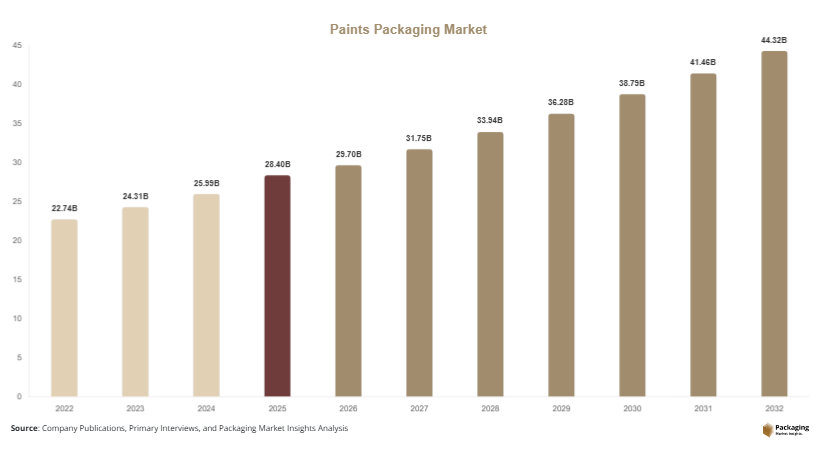
The global paints packaging market size is estimated at USD 28.4 billion in 2025, and it is projected to reach USD 29.7 billion in 2026. By 2034, the market is expected to attain approximately USD 51.2 billion, registering a compound annual growth rate (CAGR) of 6.9% during 2025–2034. This growth is supported by evolving packaging technologies, sustainability initiatives, and rising demand for safe, durable, and leak-proof packaging formats. The paints packaging market is witnessing steady expansion due to rising global construction activity, growth in industrial coatings demand, and increasing consumption of decorative paints in residential and commercial sectors.
One of the major growth factors is the expansion of the construction and infrastructure sector across emerging economies. Paint consumption is directly linked to housing development, commercial real estate expansion, and renovation activities, which in turn drives packaging demand. Another key factor is the rising adoption of eco-friendly packaging solutions, as manufacturers shift toward recyclable plastics, metal cans with reduced carbon footprint, and biodegradable liners. Additionally, growth in industrial coatings used in automotive, marine, and aerospace sectors is contributing to increased demand for specialized paint packaging formats that ensure chemical stability and long shelf life.
Key Highlights:
- Asia Pacific dominated the market with a 38.6% share in 2025.
- Latin America is projected to grow at the fastest CAGR of 7.3%.
- Metal cans led the material segment with a 46.8% share.
- Decorative paints dominated the application segment with a 52.4% share.
- Retail packaging channels accounted for a 55.2% share.
- The US remained the dominant country, with a market size of approximately USD 7.9 billion in 2025 and USD 8.4 billion in 2026.
Explore more data points, trends and opportunities Download Free Sample Report
Market Trends
Shift Toward Sustainable and Recyclable Packaging Solutions
Sustainability is a major trend shaping the paints packaging market as manufacturers adopt eco-friendly materials and circular economy models. Traditional packaging formats such as non-recyclable plastics are being replaced with recyclable metal cans, bio-based plastics, and reduced-thickness packaging materials. Governments are introducing stricter environmental regulations, encouraging paint manufacturers to reduce packaging waste and carbon emissions. Companies are also investing in refillable paint container systems, allowing consumers to reuse packaging multiple times. This trend is particularly strong in Europe and North America, where environmental compliance standards are strict. The push toward sustainability is also influencing branding strategies, as companies highlight green packaging to attract environmentally conscious consumers.
Rise of E-commerce and Direct-to-Consumer Paint Sales
Another important trend is the rapid growth of e-commerce in the paints industry, which is reshaping packaging requirements. Consumers are increasingly purchasing paints online, especially for home renovation and DIY projects. This shift requires packaging that is lightweight, leak-proof, and easy to ship over long distances. Manufacturers are designing compact containers, resealable lids, and protective secondary packaging to prevent leakage during transit. Digital retail platforms also demand standardized packaging sizes for efficient logistics and inventory management. This trend is driving innovation in packaging ergonomics and material strength, ensuring that paint products remain intact and usable even after long delivery cycles.
Market Drivers
Expansion of Construction and Infrastructure Activities
The growth of global construction activity is a major driver of the paints packaging market. Residential housing projects, commercial buildings, and infrastructure development all require significant volumes of decorative and protective paints. As urbanization increases, especially in Asia Pacific and Africa, demand for paints continues to rise, directly influencing packaging consumption. Large-scale government infrastructure projects, such as highways, airports, and smart cities, further contribute to industrial coating demand. This creates consistent demand for durable and cost-effective packaging solutions capable of handling bulk paint volumes while ensuring product integrity during transportation and storage.
Growth in Industrial Coatings and Automotive Sector
The expansion of industrial coatings used in automotive, aerospace, marine, and manufacturing sectors is another key driver. These coatings require specialized packaging to maintain chemical stability, prevent contamination, and ensure long shelf life. Automotive production growth, particularly in emerging economies, has increased demand for protective coatings, which in turn drives packaging innovation. Paint manufacturers are adopting corrosion-resistant metal cans and high-barrier plastic containers to meet industry requirements. Additionally, increasing exports of industrial coatings are pushing demand for robust packaging capable of withstanding long-distance logistics conditions.
Market Restraint
Volatility in Raw Material Prices and Supply Chain Disruptions
A major restraint in the paints packaging market is the volatility in raw material prices, particularly metals and petrochemical-based plastics. Fluctuations in steel and aluminum prices directly impact the cost of metal cans, which are widely used in paint packaging. Similarly, petroleum price variations affect plastic resin costs, making production planning difficult for manufacturers. Supply chain disruptions, such as shipping delays and geopolitical tensions, further increase operational costs and create uncertainty in raw material availability.
For example, small and medium-sized packaging manufacturers often struggle to maintain stable pricing contracts with paint companies due to unpredictable input costs. This leads to reduced profit margins and delays in production cycles. Additionally, transportation cost fluctuations further add to the pricing pressure. As a result, some paint manufacturers are exploring alternative packaging materials or local sourcing strategies to mitigate risks, but overall market stability remains affected by raw material dependency.
Market Opportunities
Development of Smart and Smart-Label Packaging Solutions
The integration of smart technologies presents a significant opportunity in the paints packaging market. Smart labels, QR codes, and RFID-enabled packaging are increasingly being used to provide product authentication, usage instructions, and inventory tracking. These technologies improve supply chain transparency and help reduce counterfeit products in the paint industry. Manufacturers are also exploring temperature and humidity indicators embedded in packaging to ensure product quality during storage and transportation. This trend is particularly relevant for premium paint products and industrial coatings, where quality assurance is critical.
Growth in Refillable and Reusable Packaging Systems
Refillable paint packaging systems are emerging as a strong opportunity due to increasing environmental awareness and cost-saving benefits. Consumers and commercial users are showing interest in bulk refill stations and reusable containers that reduce packaging waste. Paint companies are introducing durable containers designed for multiple reuse cycles, supported by standardized refill cartridges. This system reduces packaging material consumption and aligns with sustainability goals. It also offers long-term cost advantages for both manufacturers and consumers, especially in large-scale construction and industrial applications.
Report Scope
| Report Metric | Details |
|---|---|
| Market Size in 2025 | USD 28.4 Billion |
| Market Size in 2026 | USD 29.7 Billion |
| Market Size in 2034 | USD 51.2 Billion |
| CAGR | 6.9% (2026-2034) |
| Base Year for Estimation | 2025 |
| Historical Data | 2022-2024 |
| Forecast Period | 2026-2034 |
| Report Coverage | Revenue Forecast, Competitive Landscape, Supply Chain Disruption, Growth Factors, Environment & Regulatory Landscape and Trends |
| Geographies Covered | North America, Europe, APAC, Middle East and Africa, LATAM |
| Countries Covered | U.S., Canada, U.K., Germany, France, Spain, Italy, Russia, Nordic, Benelux, Rest of Europe, China, South Korea, Japan, India, Australia, Singapore, Taiwan, South East Asia, Rest of Asia-Pacific, UAE, Turky, Saudi Arabia, South Africa, Egypt, Nigeria, Rest of MEA, Brazil, Mexico, Argentina, Chile, Colombia, Rest of LATAM |
Explore more data points, trends and opportunities Download Free Sample Report
Segmental Analysis
By Packaging Material
Metal cans dominated the paints packaging market in 2024, accounting for 46.8% share. They are widely used due to their durability, chemical resistance, and ability to preserve paint quality over long periods. Metal packaging is especially preferred for industrial coatings and bulk paint storage. Their recyclability also supports sustainability goals, making them a widely accepted packaging solution across regions.
Plastic containers are the fastest-growing segment, with a CAGR of 7.1%. Growth is driven by their lightweight nature, cost efficiency, and flexibility in design. Plastic packaging is increasingly used in decorative paints and small retail-sized products. Manufacturers are developing high-barrier plastics that improve chemical resistance and reduce leakage risks.
By Application
Decorative paints dominated with a 52.4% share in 2024. This segment is driven by residential construction, renovation, and DIY consumer demand. Decorative paints require a wide range of packaging sizes, from small retail containers to medium-sized buckets, supporting strong market volume.
Industrial coatings are the fastest-growing segment with a CAGR of 7.0%. Growth is driven by automotive, aerospace, and marine industries. These coatings require specialized packaging that ensures chemical stability and prevents contamination during transportation and storage.
By Distribution Channel
Retail distribution dominated the market with a 55.2% share in 2024. Hardware stores, home improvement centers, and paint specialty shops remain the primary sales channels for paints, driving demand for consumer-friendly packaging.
Online distribution is the fastest-growing segment with a CAGR of 8.0%. Growth is driven by e-commerce expansion and increasing consumer preference for home delivery of paint products. Packaging designed for safe shipping and handling is essential for this segment.
Paints Packaging Market Segmentations
By Material Type
- Metal Cans
- Plastic Containers
- Flexible Pouches
- Composite Packaging Solutions
By Application
- Decorative Paints
- Industrial Coatings
- Automotive Paints
- Marine & Protective Coatings
By Distribution Channel
- Retail Stores
- Online/E-commerce Platforms
- Direct Sales (B2B)
- Wholesale & Distributors
Regional Analysis
North America
North America accounted for approximately 29.4% market share in 2025, with a projected CAGR of 6.5% during 2025–2034. The region benefits from strong demand for residential renovation and industrial coatings. Advanced packaging technologies and high adoption of sustainable materials further support growth.
The United States dominates the region due to its large construction and DIY consumer base. A key growth factor is the increasing trend of home improvement activities, which drives demand for small, easy-to-handle paint packaging formats suitable for retail consumers.
Europe
Europe held a 26.8% share in 2025, growing at a CAGR of 6.3%. The region is driven by strict environmental regulations and strong demand for eco-friendly packaging solutions. Sustainable packaging innovation is a key market characteristic.
Germany leads the region due to its strong industrial base. A unique growth factor is regulatory pressure from the EU Green Deal, which is accelerating adoption of recyclable and low-carbon packaging materials in the paints industry.
Asia Pacific
Asia Pacific dominated with a 38.6% share in 2025, growing at a CAGR of 7.5%. Rapid urbanization, infrastructure expansion, and growing construction activities are key drivers in the region.
China remains the dominant country due to massive construction activity and industrial expansion. A key growth factor is large-scale urban development projects, including smart cities and residential housing programs, which significantly increase paint consumption and packaging demand.
Middle East & Africa
MEA accounted for 3.8% share in 2025, with a CAGR of 6.8%. Growth is driven by infrastructure investments and commercial construction projects.
The UAE leads the region due to rapid urban development. A unique growth factor is the expansion of luxury real estate projects, which increases demand for premium decorative paints and specialized packaging solutions.
Latin America
Latin America held a 1.4% share in 2025, growing at the fastest CAGR of 7.3%. Growth is supported by construction recovery and industrial expansion.
Brazil dominates the region due to its large construction sector. A key growth factor is government investment in housing and infrastructure development, which boosts paint consumption and packaging demand.
Competitive Landscape
The paints packaging market is moderately fragmented, with several global and regional players competing on innovation, material quality, and sustainability. Key companies include Amcor Plc, Berry Global Inc., Greif Inc., Ball Corporation, and Silgan Holdings. Amcor Plc is a leading player due to its strong focus on sustainable packaging solutions and global manufacturing presence.
Recent developments include the introduction of recyclable metal cans, lightweight plastic containers, and smart labeling solutions. Companies are also investing in automation and digital printing technologies to improve packaging efficiency and branding capabilities.
Key Players List
- Amcor Plc
- Berry Global Inc.
- Greif Inc.
- Ball Corporation
- Silgan Holdings
- Crown Holdings Inc.
- Mauser Packaging Solutions
- DS Smith Plc
- Sonoco Products Company
- Huhtamaki Oyj
- PPG Industries Packaging Division
- AkzoNobel Packaging Solutions
- Kian Joo Group
- RPC Group (Berry Global Europe)
- BWAY Corporation