Next Generation Packaging Market Size and Growth
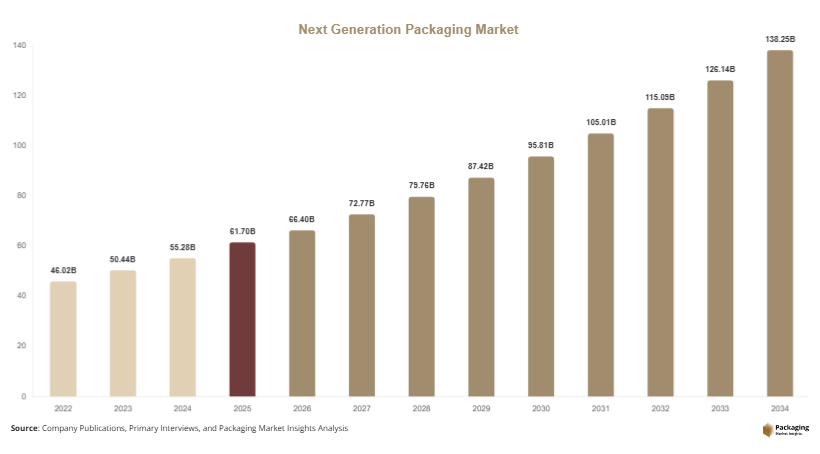
The global next generation packaging market size is estimated at USD 61.7 billion in 2025, increasing to approximately USD 66.4 billion in 2026. By 2034, the market is projected to reach nearly USD 138.2 billion, expanding at a CAGR of 9.6% during 2025–2034. The next generation packaging market is experiencing substantial growth due to rising demand for smart, sustainable, lightweight, and technology-enabled packaging solutions across industries including food & beverages, healthcare, consumer electronics, and e-commerce. Next generation packaging refers to advanced packaging systems that integrate intelligent tracking, active protection, biodegradable materials, digital connectivity, and enhanced barrier technologies to improve product safety, shelf life, traceability, and customer engagement.
One of the primary growth factors supporting market expansion is the increasing adoption of sustainable packaging materials and circular economy initiatives. Companies are investing in recyclable, compostable, and reusable packaging formats to comply with environmental regulations and changing consumer preferences. Another important factor is the rapid growth of smart packaging technologies, including QR-enabled labels, RFID tracking systems, and freshness-monitoring sensors. These technologies are improving supply chain transparency and reducing product waste across food and pharmaceutical sectors. Additionally, the rapid growth of global e-commerce and direct-to-consumer retail models is increasing demand for lightweight, durable, and digitally connected packaging solutions that improve shipping efficiency and customer interaction.
Key Highlights
- Asia Pacific dominated the market with a 40.6% share in 2025.
- Latin America is projected to grow at the fastest CAGR of 10.1%.
- Smart packaging led the type segment with a 34.9% share.
- Plastic-based advanced materials dominated with a 46.7% share.
- Food & beverage applications led the end-use segment with 41.3% share.
- The US remained the dominant country with a market size of USD 13.7 billion in 2025 and USD 14.8 billion in 2026.
Explore more data points, trends and opportunities Download Free Sample Report
Market Trends
Growing Adoption of Intelligent and Connected Packaging Technologies
The integration of intelligent technologies into packaging systems is becoming a major trend in the next generation packaging market. Companies are increasingly adopting QR codes, NFC tags, RFID labels, and IoT-enabled sensors to improve product traceability and consumer engagement. These technologies help brands monitor supply chains, verify product authenticity, and deliver real-time product information to consumers. For example, pharmaceutical companies are using smart labels to track temperature-sensitive drugs during transportation and storage. Food producers are also implementing freshness indicators to reduce spoilage and improve inventory management. Future advancements in connected packaging are expected to strengthen supply chain transparency and support personalized customer experiences through digital interaction and data-driven marketing strategies.
Rising Shift Toward Biodegradable and Compostable Packaging Materials
Sustainability-focused material innovation is another important trend influencing the next generation packaging market. Packaging manufacturers are increasingly developing biodegradable plastics, compostable films, and plant-based materials to reduce environmental impact. Governments and retailers are encouraging adoption of eco-friendly packaging by implementing restrictions on single-use plastics and promoting circular economy initiatives. For instance, food service providers and beverage companies are replacing traditional petroleum-based packaging with compostable alternatives made from starch blends and cellulose fibers. Future packaging development is expected to focus on balancing sustainability, durability, and barrier performance. Growing investment in bio-based polymers and renewable raw materials is likely to expand commercial applications across food, healthcare, and consumer goods industries.
Market Drivers
Expansion of E-commerce and Direct-to-Consumer Packaging Demand
The rapid expansion of global e-commerce is significantly driving demand for next generation packaging solutions. Online retail growth has increased the need for lightweight, durable, and digitally trackable packaging capable of protecting products during transportation while improving logistics efficiency. E-commerce companies are adopting intelligent labels, tamper-evident seals, and sustainable protective packaging to enhance customer satisfaction and reduce product returns. For example, major online retailers are integrating QR-enabled packaging systems that provide shipment tracking and recycling instructions to consumers. This shift toward advanced e-commerce packaging is encouraging manufacturers to develop stronger, lightweight, and environmentally compliant packaging materials capable of supporting high-volume distribution networks and evolving consumer expectations.
Increasing Focus on Food Safety and Shelf-Life Extension
The growing emphasis on food safety and product preservation is another major driver supporting market growth. Food manufacturers are increasingly adopting active and intelligent packaging technologies that help maintain freshness, reduce contamination risks, and extend shelf life. Oxygen scavengers, antimicrobial coatings, and moisture-control systems are widely used in packaged food applications to improve quality and reduce waste. For example, fresh produce and meat suppliers are integrating modified atmosphere packaging and freshness sensors to optimize storage conditions. Rising consumer demand for packaged convenience foods and stricter food safety regulations are accelerating investment in advanced packaging technologies. This trend is expected to strengthen demand for innovative packaging systems capable of improving food quality and reducing supply chain losses.
Market Restraint
High Development Costs and Complex Technology Integration
One of the major restraints affecting the next generation packaging market is the high cost associated with advanced material development and technology integration. Smart packaging systems incorporating RFID chips, sensors, antimicrobial coatings, and connected technologies require substantial investment in research, production infrastructure, and testing processes. Small and medium-sized packaging manufacturers may struggle to adopt these technologies due to limited financial resources and technical expertise. In addition, integrating intelligent packaging systems into existing supply chains often requires modifications in logistics, software infrastructure, and data management systems. For example, food and pharmaceutical companies implementing RFID-enabled packaging may face increased operational costs related to digital tracking platforms and compliance testing. The high price of biodegradable materials and specialty polymers also affects large-scale adoption in cost-sensitive industries. Furthermore, inconsistent global recycling infrastructure and limited standardization for smart packaging technologies create operational challenges for manufacturers. These factors collectively limit rapid adoption and create barriers for market expansion, particularly in developing economies where cost efficiency remains a key purchasing factor.
Market Opportunities
Expansion of Smart Healthcare and Pharmaceutical Packaging
The healthcare and pharmaceutical sectors present strong growth opportunities for the next generation packaging market. Intelligent pharmaceutical packaging systems are increasingly used for drug authentication, patient compliance monitoring, and temperature-sensitive medication tracking. Smart blister packs, connected labels, and NFC-enabled medicine packaging are improving medication adherence and reducing counterfeit drug risks. For example, pharmaceutical companies are introducing digital packaging solutions that provide dosage reminders and product verification through smartphone applications. The increasing demand for biologics, vaccines, and specialty medicines is expected to further strengthen demand for advanced packaging technologies. Future investment in connected healthcare ecosystems and remote patient monitoring systems will likely create additional opportunities for intelligent pharmaceutical packaging applications globally.
Growth of Sustainable Packaging in Food Service and Retail
The transition toward sustainable food service and retail packaging is creating major opportunities for market participants. Restaurants, supermarkets, and beverage companies are increasingly adopting compostable containers, recyclable flexible packaging, and reusable packaging systems to reduce environmental impact. Consumers are demanding packaging solutions that align with sustainability values without compromising convenience or product quality. For example, quick-service restaurant chains are replacing conventional plastic takeaway packaging with biodegradable fiber-based alternatives. Future advancements in barrier coatings and compostable material technologies are expected to improve the functionality of sustainable packaging products. The expansion of eco-conscious retail strategies and government restrictions on single-use plastics will continue supporting long-term growth opportunities across food service and retail packaging applications.
Report Scope
| Report Metric | Details |
|---|---|
| Market Size in 2025 | USD 61.7 Billion |
| Market Size in 2026 | USD 66.4 Billion |
| Market Size in 2034 | USD 138.2 Billion |
| CAGR | 9.6% (2026-2034) |
| Base Year for Estimation | 2025 |
| Historical Data | 2022-2024 |
| Forecast Period | 2026-2034 |
| Report Coverage | Revenue Forecast, Competitive Landscape, Supply Chain Disruption, Growth Factors, Environment & Regulatory Landscape and Trends |
| Geographies Covered | North America, Europe, APAC, Middle East and Africa, LATAM |
| Countries Covered | U.S., Canada, U.K., Germany, France, Spain, Italy, Russia, Nordic, Benelux, Rest of Europe, China, South Korea, Japan, India, Australia, Singapore, Taiwan, South East Asia, Rest of Asia-Pacific, UAE, Turky, Saudi Arabia, South Africa, Egypt, Nigeria, Rest of MEA, Brazil, Mexico, Argentina, Chile, Colombia, Rest of LATAM |
Explore more data points, trends and opportunities Download Free Sample Report
Segmental Analysis
By Type
Smart packaging dominated the next generation packaging market in 2024, accounting for approximately 34.9% of total revenue. This segment includes intelligent labels, RFID-enabled systems, QR-integrated packaging, and connected monitoring technologies used across food, healthcare, and retail applications. Companies are increasingly adopting smart packaging to improve product traceability, anti-counterfeiting protection, and consumer engagement. Food manufacturers use freshness indicators and temperature-monitoring systems to reduce spoilage and improve supply chain efficiency. Pharmaceutical companies are implementing connected packaging systems to enhance patient compliance and track medication authenticity. The growing integration of IoT and digital technologies into packaging systems continues to strengthen demand for smart packaging solutions across industrial and consumer markets globally.
Active packaging is expected to emerge as the fastest-growing type segment, registering a CAGR of 10.4% during the forecast period. Active packaging systems incorporate technologies such as oxygen scavengers, antimicrobial layers, moisture absorbers, and ethylene control systems to improve product preservation. Food and beverage manufacturers are increasingly using these solutions to extend shelf life and reduce food waste across transportation and retail operations. For example, meat and dairy producers are integrating antimicrobial packaging films to maintain freshness during extended distribution periods. Rising consumer demand for packaged convenience foods and stricter food safety regulations are expected to strengthen future growth. Ongoing innovation in nanotechnology-based active materials will likely expand application opportunities across healthcare and specialty food sectors.
By Material
Plastic-based advanced materials held the largest market share in 2024, representing approximately 46.7% of global revenue. Advanced plastics such as multilayer polymers, conductive plastics, and lightweight barrier films are widely used because they provide durability, flexibility, moisture resistance, and compatibility with smart packaging technologies. Food and pharmaceutical manufacturers rely on high-performance plastics for active packaging applications requiring extended shelf life and contamination protection. Plastic-based materials also support digital printing and intelligent label integration, making them suitable for connected packaging systems. Continued advancements in recyclable polymer formulations and lightweight packaging designs are helping maintain strong market demand across consumer goods, healthcare, and industrial packaging applications.
Biodegradable materials are anticipated to register the fastest CAGR of 10.8% during the forecast period. Growing environmental concerns and government restrictions on single-use plastics are accelerating adoption of compostable films, starch-based polymers, and cellulose packaging materials. Retailers and food service providers are increasingly transitioning toward biodegradable packaging to improve sustainability performance and meet consumer expectations. For example, beverage and takeaway food brands are replacing conventional plastic packaging with plant-based alternatives featuring improved barrier performance. Future investment in bio-based polymer technologies and industrial composting systems is expected to expand application scope. Increasing collaboration between packaging manufacturers and biotechnology companies will likely support continued innovation in sustainable packaging materials.
By End-Use
The food & beverage industry dominated the next generation packaging market in 2024, accounting for approximately 41.3% of total market revenue. Rising demand for food safety, shelf-life extension, and sustainable packaging solutions is supporting segment growth globally. Food producers are increasingly using intelligent labels, active packaging technologies, and recyclable materials to improve product quality and reduce waste. Ready-to-eat meal manufacturers and beverage companies are adopting smart packaging systems that provide freshness monitoring and digital product information. The expansion of online grocery delivery and convenience food consumption is also increasing demand for protective and lightweight packaging formats. Technological innovation in active packaging and antimicrobial coatings continues to strengthen adoption across food processing and retail distribution operations.
Healthcare packaging is expected to be the fastest-growing end-use segment, expanding at a CAGR of 10.6% during the forecast period. Pharmaceutical companies are increasingly adopting connected packaging technologies for drug authentication, patient adherence monitoring, and temperature-sensitive medicine transportation. Smart blister packs, tamper-evident seals, and RFID-enabled labels are becoming increasingly common across healthcare applications. Rising demand for biologics, vaccines, and specialty medicines is accelerating investment in advanced pharmaceutical packaging systems. For example, healthcare manufacturers are introducing NFC-enabled medicine packaging linked to mobile applications for dosage reminders and digital verification. Continued growth in telemedicine, remote patient care, and personalized healthcare solutions is expected to create additional opportunities for intelligent healthcare packaging technologies globally.
Next Generation Packaging Market Segmentations
By Type
- Smart Packaging
- Active Packaging
- Modified Atmosphere Packaging
- Edible Packaging
- Self-Heating & Self-Cooling Packaging
By Material
- Plastic-Based Advanced Materials
- Biodegradable Materials
- Paper & Paperboard
- Glass
- Metal
By End-User
- Food & Beverage
- Healthcare
- Consumer Electronics
- Personal Care
- Industrial Packaging
Regional Analysis
North America
North America accounted for approximately 29.4% of the global next generation packaging market share in 2025 and is expected to grow at a CAGR of 8.7% during the forecast period. The region benefits from advanced packaging technology adoption, strong e-commerce growth, and increasing investment in smart packaging systems. Food, pharmaceutical, and consumer electronics industries are major adopters of intelligent and sustainable packaging solutions. Rising demand for digital tracking technologies and environmentally responsible materials is further supporting market expansion. In addition, strong investment in packaging automation and connected supply chain infrastructure is increasing demand for advanced packaging technologies across the United States and Canada.
The United States dominates the North American market due to its strong packaging innovation ecosystem and high consumer demand for convenience products. One unique growth driver is the rapid expansion of connected retail and omnichannel commerce strategies. Retailers are increasingly integrating smart labels and interactive packaging technologies to improve inventory management and customer engagement. For example, several consumer goods companies are launching QR-enabled packaging that provides digital product information and recycling guidance. Growth in pharmaceutical packaging innovation and increased adoption of sustainable protective packaging solutions are also contributing to market development across the country.
Europe
Europe represented nearly 24.8% of the next generation packaging market in 2025 and is projected to expand at a CAGR of 8.9% through 2034. The market is strongly influenced by environmental regulations promoting recyclable and biodegradable packaging materials. European packaging manufacturers are investing heavily in compostable materials, digital printing technologies, and active packaging systems to support sustainability objectives. Food and beverage companies are increasingly using advanced packaging to reduce waste and improve shelf-life management. The region also benefits from strong research capabilities and government-backed circular economy programs aimed at reducing packaging waste across industrial and consumer sectors.
Germany remains the dominant country within the European market due to its advanced manufacturing sector and strong sustainability policies. A unique growth factor is the country’s leadership in industrial automation and smart factory integration. Packaging companies in Germany are increasingly implementing IoT-enabled production systems and intelligent labeling technologies to improve operational efficiency. For example, pharmaceutical manufacturers are using smart packaging with anti-counterfeiting features and digital traceability systems for export-oriented products. Increasing investment in biodegradable packaging materials and automated recycling infrastructure is expected to further strengthen market expansion in Germany.
Asia Pacific
Asia Pacific dominated the next generation packaging market with a 40.6% share in 2025 and is forecast to register a CAGR of 10.2% during the assessment period. Rapid industrialization, rising consumer spending, and expanding e-commerce activities are major growth drivers across the region. Countries such as China, Japan, India, and South Korea are increasing investment in sustainable packaging technologies and intelligent logistics systems. The growth of packaged food consumption and healthcare manufacturing is also supporting demand for advanced packaging materials. In addition, the region’s strong electronics manufacturing base is increasing the use of smart labels, conductive packaging materials, and active packaging technologies.
China leads the Asia Pacific market due to its large-scale packaging manufacturing industry and expanding digital retail ecosystem. One unique growth driver is the rapid development of smart logistics infrastructure linked to e-commerce growth. Packaging manufacturers in China are integrating QR codes, RFID systems, and digital authentication technologies into retail and food packaging applications. For example, food delivery companies are increasingly adopting intelligent tamper-proof packaging to improve customer trust and product safety. Government initiatives supporting recyclable materials and circular packaging systems are also accelerating market growth across industrial and consumer sectors.
Middle East & Africa
The Middle East & Africa next generation packaging market accounted for approximately 3.7% of global revenue in 2025 and is expected to grow at a CAGR of 9.0% during the forecast period. Rising urbanization, growth in organized retail, and increasing packaged food consumption are supporting market development in the region. Governments are also encouraging investment in sustainable packaging and waste management infrastructure to reduce environmental impact. Demand for advanced food packaging and temperature-sensitive pharmaceutical packaging is increasing steadily across major urban markets. Expansion of tourism and hospitality sectors is further contributing to demand for innovative and sustainable packaging solutions.
The United Arab Emirates dominates the Middle East & Africa market due to its advanced retail infrastructure and strong sustainability initiatives. One unique growth driver is the increasing use of premium packaging technologies in luxury retail and hospitality industries. Food service providers and cosmetic brands are adopting smart and eco-friendly packaging solutions to strengthen customer engagement and improve sustainability positioning. For instance, several retail chains are introducing reusable and digitally connected packaging systems for premium product categories. Growing investment in smart city infrastructure and sustainable logistics operations is expected to create additional opportunities for packaging manufacturers in the country.
Latin America
Latin America held approximately 1.5% of the global next generation packaging market share in 2025 and is projected to grow at the fastest CAGR of 10.1% through 2034. Increasing packaged food demand, growth in retail modernization, and rising environmental awareness are supporting market expansion across the region. Governments and consumer goods companies are introducing sustainable packaging initiatives to reduce waste generation and improve recycling rates. The expansion of e-commerce and cross-border trade activities is also increasing demand for lightweight and protective packaging solutions. Local packaging manufacturers are gradually adopting advanced materials and smart labeling technologies to improve competitiveness.
Brazil remains the dominant country in the Latin American market due to its expanding food processing and consumer goods industries. A unique growth factor is the increasing adoption of sustainable packaging in agricultural exports and beverage distribution networks. Packaging producers are introducing recyclable and biodegradable materials for food transportation and export applications. For example, beverage companies in Brazil are investing in connected packaging technologies that improve product traceability and customer interaction. Increasing investment in retail packaging modernization and logistics infrastructure is expected to support long-term market growth across the country.
Competitive Landscape
The global next generation packaging market is moderately competitive, with leading companies focusing on sustainability innovation, intelligent packaging technologies, and strategic partnerships. Amcor plc remains a major market leader due to its broad advanced packaging portfolio, global manufacturing presence, and investment in recyclable and smart packaging systems. The company recently introduced connected packaging solutions with integrated QR technologies for food and beverage applications.
Other prominent players include Sealed Air Corporation, Tetra Pak International S.A., Berry Global Inc., and Mondi Group. These companies are expanding production capacities and investing in biodegradable materials, active packaging systems, and intelligent labeling technologies. Sealed Air is focusing on digital packaging solutions for cold chain logistics, while Tetra Pak continues developing recyclable aseptic packaging formats. Berry Global is increasing investment in lightweight and recyclable flexible packaging materials for consumer goods applications. Strategic acquisitions, research partnerships, and smart packaging integration remain key competitive strategies across the industry.
Key Players List
- Amcor plc
- Sealed Air Corporation
- Tetra Pak International S.A.
- Berry Global Inc.
- Mondi Group
- Sonoco Products Company
- Smurfit Kappa Group
- WestRock Company
- Huhtamaki Oyj
- DS Smith plc
- AptarGroup Inc.
- Coveris Holdings S.A.
- Graphic Packaging International
- Constantia Flexibles
- UFlex Limited
- Ball Corporation