Nano Enabled Packaging Market Size and Growth
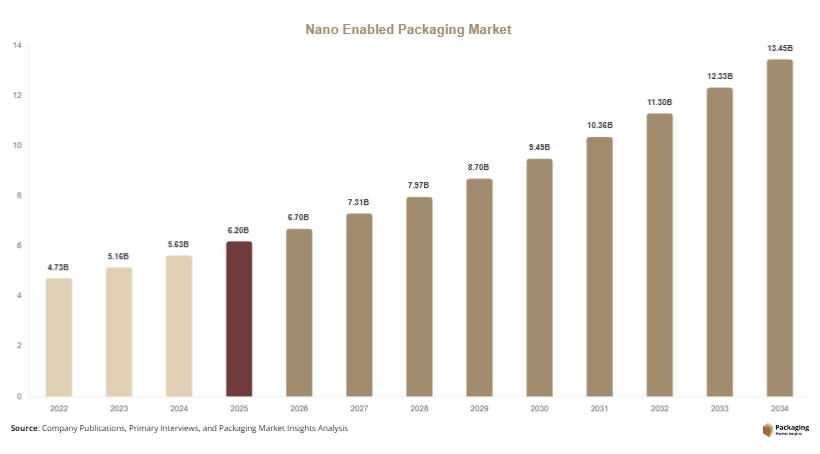
The nano enabled packaging market is witnessing steady expansion as industries increasingly adopt advanced packaging technologies that integrate nanomaterials to enhance barrier properties, shelf life, and product safety. In 2025, the market size is estimated at USD 6.2 billion, and it is projected to reach USD 6.7 billion in 2026. By 2034, the market is expected to grow to USD 14.5 billion, registering a CAGR of 9.1% during the forecast period (2025–2034). This growth reflects rising demand for intelligent, active, and high-performance packaging solutions across food, pharmaceutical, and industrial sectors.
Several key factors are driving the expansion of the nano enabled packaging market. First, increasing demand for extended shelf life of packaged food products is pushing manufacturers to adopt nano-barrier coatings that improve resistance to oxygen and moisture. Second, the pharmaceutical sector is adopting nanotechnology-based packaging to ensure drug stability, temperature resistance, and contamination prevention. Third, rapid growth in e-commerce and global supply chain complexity is increasing the need for durable and smart packaging solutions that can withstand environmental stress.
Key Highlights:
- The Nano Enabled Packaging Market reached a market size of USD 6.2 billion in 2025, reflecting steady expansion driven by increasing demand for advanced packaging solutions across food and pharmaceutical industries. This growth is supported by rising adoption of nano-barrier films, antimicrobial coatings, and smart packaging technologies that improve product safety and shelf life.
- The market is projected to reach USD 6.7 billion in 2026, driven by continuous innovation in nanomaterial-based packaging systems and growing integration of active packaging solutions. Manufacturers are increasingly focusing on high-performance materials that enhance durability, freshness retention, and contamination resistance in packaged goods.
- By 2034, the Nano Enabled Packaging Market is expected to attain a value of USD 14.5 billion, expanding at a CAGR of 9.1% during 2025–2034. This strong growth is fueled by rising demand from food, beverage, and pharmaceutical sectors, along with increasing investments in sustainable and intelligent packaging technologies.
- The market is witnessing strong adoption in food and pharmaceutical industries, as both sectors require advanced packaging solutions to maintain product integrity, extend shelf life, and ensure regulatory compliance. This is further supported by growing consumer awareness regarding product safety and quality standards.
- The industry is experiencing increasing use of nano-barrier and antimicrobial coatings, which help prevent oxygen and moisture penetration while reducing microbial contamination. These coatings are widely used in perishable food packaging and medical product protection applications.
- Additionally, there is a rising demand for smart and active packaging solutions, including nanosensors and intelligent indicators that monitor freshness, temperature, and contamination levels. This trend is reshaping the packaging industry by enabling real-time product monitoring and improved supply chain transparency.
Explore more data points, trends and opportunities Download Free Sample Report
Market Trends
Adoption of Nano-Barrier Coating Technologies
A major trend in the nano enabled packaging market is the increasing adoption of nano-barrier coating technologies. These coatings, often based on nanoclays, silicon dioxide, and metal oxide nanoparticles, significantly enhance packaging performance by improving resistance to oxygen, moisture, and UV radiation. Food and beverage manufacturers are increasingly using these coatings to extend product shelf life without relying on chemical preservatives. Pharmaceutical companies also benefit from improved drug stability, especially for moisture-sensitive medications. The integration of nano-barrier layers into flexible packaging films is becoming more cost-efficient due to advancements in roll-to-roll processing techniques, enabling large-scale adoption across multiple industries.
Rise of Smart and Active Nano-Packaging Systems
Another significant trend is the development of smart and active nano-enabled packaging systems. These systems incorporate nanosensors, antimicrobial nanoparticles, and freshness indicators that provide real-time information about product condition. In the nano enabled packaging market, this trend is particularly prominent in perishable food distribution and pharmaceutical logistics. Nanosensors embedded in packaging can detect gas changes, bacterial contamination, or temperature fluctuations, ensuring product integrity throughout the supply chain. Active packaging systems using silver or zinc oxide nanoparticles are also gaining traction due to their antimicrobial properties, reducing spoilage and enhancing safety standards across global distribution networks.
Market Drivers
Rising Demand for Extended Shelf Life in Food Products
A key driver of the nano enabled packaging market is the increasing demand for extended shelf life in packaged food products. Consumers are increasingly purchasing packaged and processed foods due to urbanization and changing lifestyles, which requires packaging solutions that maintain freshness for longer durations. Nano-enabled materials provide superior barrier properties that reduce oxygen and moisture penetration, thereby slowing down oxidation and microbial growth. Food manufacturers are increasingly integrating nanotechnology into multilayer films and coatings to reduce food waste and improve supply chain efficiency. This trend is particularly strong in frozen food, dairy, and ready-to-eat product categories.
Expanding Pharmaceutical and Healthcare Packaging Needs
The pharmaceutical industry is another major driver of the nano enabled packaging market. Increasing demand for temperature-sensitive drugs, biologics, and specialty pharmaceuticals requires packaging solutions that ensure stability and protection against environmental degradation. Nano-enabled coatings and films are being used to improve drug containment, prevent contamination, and enhance tamper resistance. Additionally, the rise of personalized medicine and injectable therapies is increasing the need for highly controlled packaging environments. Pharmaceutical companies are investing in advanced nano-materials that ensure compliance with strict regulatory standards while maintaining product integrity during transportation and storage.
Market Restraints
High Production Costs and Regulatory Uncertainty
A significant restraint affecting the nano enabled packaging market is the high cost associated with nanomaterial production and regulatory uncertainty surrounding their use in consumer packaging. Manufacturing nano-enabled materials requires advanced equipment, specialized raw materials, and controlled production environments, which increase overall costs. Additionally, regulatory frameworks governing the use of nanoparticles in food and pharmaceutical packaging are still evolving in several regions. Concerns regarding potential toxicity, environmental impact, and long-term exposure risks have led to cautious adoption. For example, food packaging applications using silver nanoparticles must undergo extensive safety testing, which slows down commercialization and increases time-to-market for new products.
Market Opportunities
Expansion of Sustainable Nano-Packaging Solutions
The growing focus on sustainability presents a major opportunity for the nano enabled packaging market. Companies are developing biodegradable nano-composites and bio-based films that reduce environmental impact while maintaining high performance. These materials combine natural polymers with nanoclay or cellulose-based nanoparticles to improve mechanical strength and barrier efficiency. The demand for eco-friendly packaging is particularly strong in Europe and North America, where regulatory pressures are driving the shift away from traditional plastic materials. This transition is encouraging innovation in recyclable nano-enabled packaging systems that meet both performance and sustainability requirements.
Growth in Emerging E-Commerce and Logistics Sector
The expansion of e-commerce and global logistics networks is creating new opportunities for nano-enabled packaging solutions. As product shipments increase, there is a growing need for durable packaging that can withstand long-distance transportation, temperature variations, and mechanical stress. In the nano enabled packaging market, nanomaterials are being used to enhance packaging strength, reduce leakage, and improve shock resistance. This is particularly important for fragile goods such as electronics, pharmaceuticals, and specialty foods. The rapid growth of online retail in Asia Pacific and Latin America is expected to significantly boost demand for advanced nano-enabled packaging materials.
Report Scope
| Report Metric | Details |
|---|---|
| Market Size in 2025 | USD 6.2 Billion |
| Market Size in 2026 | USD 6.7 Billion |
| Market Size in 2034 | USD 14.5 Billion |
| CAGR | 9.1% (2026-2034) |
| Base Year for Estimation | 2025 |
| Historical Data | 2022-2024 |
| Forecast Period | 2026-2034 |
| Report Coverage | Revenue Forecast, Competitive Landscape, Supply Chain Disruption, Growth Factors, Environment & Regulatory Landscape and Trends |
| Geographies Covered | North America, Europe, APAC, Middle East and Africa, LATAM |
| Countries Covered | U.S., Canada, U.K., Germany, France, Spain, Italy, Russia, Nordic, Benelux, Rest of Europe, China, South Korea, Japan, India, Australia, Singapore, Taiwan, South East Asia, Rest of Asia-Pacific, UAE, Turky, Saudi Arabia, South Africa, Egypt, Nigeria, Rest of MEA, Brazil, Mexico, Argentina, Chile, Colombia, Rest of LATAM |
Explore more data points, trends and opportunities Download Free Sample Report
Segmental Analysis
By Material Type
Polymer nanocomposites dominate the nano enabled packaging market, accounting for approximately 44% share in 2024. These materials are widely used due to their excellent mechanical strength, lightweight properties, and enhanced barrier performance. Industries such as food and beverage and pharmaceuticals rely heavily on polymer-based nano-packaging solutions to improve product stability and extend shelf life. Nanoclays and carbon nanotubes are commonly integrated into polymer matrices to enhance performance characteristics. Their widespread adoption is also supported by relatively lower production costs compared to metallic nanoparticle-based systems.
The fastest-growing subsegment is biodegradable nano-composites, projected to grow at a CAGR of 10.8%. Growth is driven by increasing environmental concerns and regulatory pressure to reduce plastic waste. These materials combine natural polymers with nanofillers to deliver both sustainability and high-performance packaging characteristics, making them highly attractive in eco-sensitive markets.
By Application
Food and beverage packaging holds the dominant 46% share in 2024 within the nano enabled packaging market. This segment benefits from rising demand for packaged and processed foods, along with increasing consumer awareness regarding food safety and shelf life extension. Nano-barrier films are widely used in dairy, meat, and beverage packaging to prevent spoilage and maintain freshness. The sector also benefits from active packaging technologies that regulate internal packaging environments.
The fastest-growing subsegment is ready-to-eat food packaging, expected to grow at a CAGR of 11.1%. Growth is driven by urbanization, busy lifestyles, and increasing demand for convenience foods. Nano-enabled packaging helps maintain freshness, prevent contamination, and improve product appeal in this segment.
By End-Use
The healthcare and pharmaceutical segment accounts for 41% share in 2024. It is driven by the need for sterile, stable, and contamination-free packaging solutions for drugs and medical products. Nano-coatings are used to enhance drug stability and protect sensitive formulations from environmental exposure.
The fastest-growing subsegment is biopharmaceutical packaging, projected to grow at a CAGR of 10.5%. This growth is supported by increasing demand for biologics, vaccines, and injectable therapies requiring advanced protective packaging systems.
Nano Enabled Packaging Market Segmentations
By Material Type
- Polymer Nanocomposites
- Metal-Based Nanomaterials
- Bio-Nanocomposites
- Hybrid Nanomaterials
By Application
- Food & Beverage Packaging
- Pharmaceuticals Packaging
- Electronics Packaging
- Industrial Packaging
By End-Use
- Healthcare & Pharmaceuticals
- Food Processing Industry
- E-commerce & Logistics
- Consumer Goods
Regional Analysis
North America
North America holds approximately 34% market share in 2025 in the nano enabled packaging market, supported by early adoption of nanotechnology-based packaging solutions across food, pharmaceutical, and healthcare industries. The region is expected to grow at a CAGR of 8.8% from 2025 to 2034, driven by rising demand for smart packaging systems and advanced barrier materials. Strong R&D investments from private companies and government-backed innovation programs continue to accelerate commercialization of nano-enabled packaging technologies across multiple end-use industries, particularly in high-value pharmaceutical applications.
The United States dominates the North American market due to its advanced healthcare infrastructure and strong presence of packaging innovation companies. A key growth factor in the country is the increasing adoption of cold-chain logistics integrated with nano-sensor-based packaging systems, which helps in monitoring temperature-sensitive drug shipments. Canada also contributes significantly, supported by increasing demand for sustainable food packaging and strict regulatory standards related to food safety and environmental protection.
Europe
Europe accounts for nearly 28% market share in 2025, with a projected CAGR of 9.0% during 2025–2034 in the nano enabled packaging market. Growth in this region is strongly influenced by stringent environmental regulations and circular economy initiatives promoting sustainable packaging solutions. European countries are increasingly shifting toward biodegradable nano-composites and recyclable barrier films, especially in food and beverage packaging applications. The demand for high-performance packaging with reduced environmental impact is accelerating adoption across multiple industries.
Germany leads the European market due to its strong chemical manufacturing base and advanced packaging engineering ecosystem. A unique growth driver in Germany is the rapid integration of nano-enabled antimicrobial coatings in pharmaceutical packaging, which enhances drug safety and shelf life. Additionally, countries like France and the United Kingdom are expanding smart packaging adoption for retail traceability, further supporting regional growth in the nano-enabled packaging ecosystem.
Asia Pacific
Asia Pacific holds approximately 26% market share in 2025 and is projected to grow at the highest CAGR of 10.2% from 2025 to 2034 in the nano enabled packaging market. Rapid industrialization, urbanization, and rising consumption of packaged food products are major factors fueling market expansion. The region also benefits from large-scale manufacturing capabilities and increasing investments in nanotechnology research and development. Growing e-commerce penetration is further boosting demand for advanced protective packaging solutions across food, pharmaceuticals, and electronics sectors.
China dominates the Asia Pacific market due to its strong manufacturing ecosystem and government support for nanotechnology innovation. A key growth factor is the expansion of large-scale food processing and pharmaceutical production facilities, which require high-performance packaging materials. India is also emerging as a high-growth market driven by increasing demand for affordable healthcare packaging and rapid expansion of the domestic food delivery and packaged goods industry.
Middle East & Africa
The Middle East & Africa region holds around 7% market share in 2025, with a projected CAGR of 8.5% during 2025–2034 in the nano enabled packaging market. Growth is supported by rising imports of packaged food and pharmaceuticals, along with increasing investment in modern healthcare infrastructure. Governments in several Gulf countries are focusing on improving food security and reducing waste, which is encouraging the adoption of advanced packaging technologies, including nano-enabled barrier solutions.
Saudi Arabia leads the regional market due to its ongoing healthcare modernization initiatives and strong investments in food preservation technologies. A unique growth factor in the country is the increasing use of nano-enabled packaging for long-distance food storage in extreme climate conditions, which helps maintain product quality and reduce spoilage. The United Arab Emirates also contributes to growth through its expanding logistics and pharmaceutical distribution networks.
Latin America
Latin America accounts for nearly 5% market share in 2025, with a projected CAGR of 8.7% from 2025 to 2034 in the nano enabled packaging market. Growth in this region is driven by rising consumption of packaged food, expansion of retail infrastructure, and increasing awareness of food safety standards. The region is also witnessing gradual adoption of advanced packaging technologies in pharmaceutical distribution and agricultural export sectors.
Brazil dominates the Latin American market due to its large food processing industry and expanding export-oriented packaging requirements. A key growth factor is the increasing demand for nano-enabled moisture-resistant packaging for agricultural and perishable food exports, which helps improve shelf life during long-distance transportation. Argentina and Mexico are also emerging markets supported by rising investments in food processing and pharmaceutical supply chains.
Competitive Landscape
The nano enabled packaging market is moderately fragmented, with key players focusing on material innovation, nanotechnology integration, and sustainability initiatives. Leading companies include Amcor plc, Sealed Air Corporation, DuPont de Nemours Inc., BASF SE, and Berry Global Inc.
Among these, Amcor plc holds a strong position due to its advanced packaging material portfolio and investments in nano-engineered barrier films. Recently, the company expanded its R&D initiatives focused on recyclable nano-laminates for food and pharmaceutical packaging applications, strengthening its global competitiveness.
Key Players List
- Amcor plc
- BASF SE
- DuPont de Nemours Inc.
- Berry Global Inc.
- Sealed Air Corporation
- 3M Company
- Mondi Group
- Smurfit Kappa Group
- Sonoco Products Company
- Uflex Ltd.
- Tetra Pak International
- Toyo Seikan Group
- Dow Inc.
- Mitsubishi Chemical Group
- Huhtamaki Oyj