AI In Sustainable Packaging Market Size and Growth
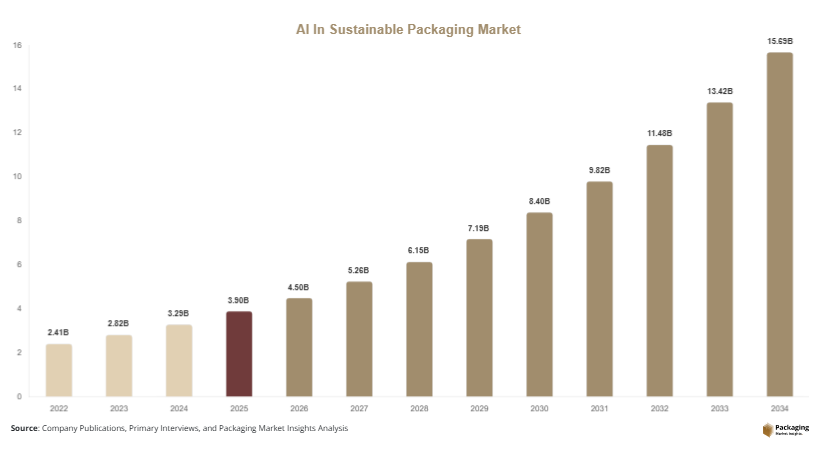
The global AI in sustainable packaging market was valued at USD 3.9 billion in 2025 and is estimated to reach USD 4.5 billion in 2026. The market is projected to reach USD 15.8 billion by 2034, expanding at a CAGR of 16.9% during the forecast period from 2025 to 2034. The market is experiencing rapid growth due to increasing adoption of artificial intelligence technologies across packaging design, recycling optimization, supply chain monitoring, and material efficiency applications. Companies across food & beverage, healthcare, retail, and logistics sectors are integrating AI-driven packaging systems to improve sustainability performance and reduce environmental impact.
Artificial intelligence is transforming sustainable packaging operations by enabling predictive analytics, automated material selection, waste reduction, and packaging lifecycle management. Packaging manufacturers are increasingly using AI-powered algorithms to optimize packaging dimensions, reduce raw material consumption, and improve packaging durability during transportation. These technologies help companies lower operational costs while meeting sustainability targets and regulatory requirements.
Key Market Insights
- Asia Pacific dominated the market with a 36.9% share in 2025.
- Latin America is projected to grow at the fastest CAGR of 18.2%.
- AI-powered packaging analytics solutions led the type segment with a 31.8% share.
- Biodegradable packaging materials dominated with a 42.7% share.
- Food & beverage applications led the end-use segment with 39.6% share.
- The US remained the dominant country in North America with a market size of USD 1.1 billion in 2025 and USD 1.3 billion in 2026.
Explore more data points, trends and opportunities Download Free Sample Report
Market Trends
Integration of AI-Based Waste Reduction and Material Optimization
The AI in sustainable packaging market is increasingly witnessing the adoption of AI-powered waste reduction and material optimization technologies. Packaging companies are using machine learning algorithms and predictive analytics tools to reduce excess packaging material usage while maintaining packaging performance and durability. AI systems analyze packaging dimensions, transportation conditions, and product protection requirements to identify material-efficient packaging solutions.
Several food and e-commerce companies are implementing AI-driven packaging software capable of automatically adjusting packaging sizes based on product dimensions and shipping conditions. This approach reduces raw material consumption, transportation emissions, and warehouse storage requirements. AI technologies are also helping manufacturers identify alternative biodegradable and recyclable materials suitable for sustainable packaging applications.
For example, packaging facilities in the United States and Germany are using AI-enabled production monitoring systems to reduce film waste and improve packaging line efficiency. Over the forecast period, the growing focus on carbon footprint reduction and resource efficiency is expected to accelerate demand for AI-powered packaging optimization solutions across global industries.
Expansion of AI-Enabled Recycling and Circular Packaging Systems
AI-enabled recycling technologies are becoming a major trend within the sustainable packaging industry. Recycling companies and packaging manufacturers are increasingly deploying AI-powered computer vision systems, robotic sorting technologies, and material recognition software to improve recycling accuracy and waste segregation efficiency. These technologies help improve recovery rates for plastics, paper, glass, and metal packaging materials.
AI-based recycling systems can identify material compositions, contamination levels, and packaging types more accurately than traditional sorting systems. Packaging manufacturers are also using AI to design recyclable packaging structures compatible with automated recycling facilities. Several packaging companies in Europe and Asia Pacific are integrating AI-supported digital watermarking systems to improve packaging traceability and recycling efficiency.
Future market growth is expected to benefit from rising investments in smart recycling infrastructure and circular economy initiatives. AI-enabled recycling platforms are likely to become increasingly important as governments and industries focus on reducing landfill waste and improving packaging material recovery rates worldwide.
Market Drivers
Increasing Corporate Sustainability Commitments
Rising corporate sustainability initiatives are significantly driving the AI in sustainable packaging market. Companies across food & beverage, healthcare, consumer goods, and logistics industries are implementing environmental targets focused on reducing packaging waste, lowering carbon emissions, and improving packaging recyclability. AI technologies help businesses achieve these objectives through data-driven packaging optimization and sustainability monitoring systems.
Packaging manufacturers are increasingly using AI-based analytics to reduce energy consumption, minimize material waste, and improve supply chain efficiency. Several multinational consumer goods companies are integrating AI into packaging design processes to develop lightweight and recyclable packaging solutions. AI-supported lifecycle assessment tools additionally help organizations evaluate packaging sustainability performance and regulatory compliance.
For example, global retail and beverage companies are investing in AI-enabled packaging automation systems to reduce packaging material usage and improve operational efficiency. The growing pressure from consumers, investors, and regulatory authorities regarding sustainable business practices is expected to continue accelerating adoption of AI technologies across packaging industries.
Rising Demand for Smart Packaging and Automation
The increasing demand for smart packaging systems and automated manufacturing operations is another major driver supporting market growth. Packaging companies are integrating AI technologies into production lines, quality inspection systems, and supply chain operations to improve efficiency and reduce environmental impact.
AI-powered packaging automation enables real-time monitoring, predictive maintenance, defect detection, and optimized production scheduling. These capabilities help manufacturers reduce operational downtime, energy usage, and packaging waste. Smart packaging technologies equipped with AI-based tracking systems also improve inventory management and product traceability across logistics networks.
Several pharmaceutical and food packaging companies across North America and Asia Pacific are deploying AI-integrated packaging machinery capable of adaptive production control and automated quality assurance. Future demand for intelligent packaging systems is expected to increase significantly as industrial manufacturers continue adopting Industry 4.0 technologies and digitally connected production environments.
Market Restraint
High Implementation Costs and Data Integration Challenges
High implementation costs and operational complexity remain significant restraints for the AI in sustainable packaging market. AI-based packaging systems often require substantial investments in software infrastructure, smart sensors, robotics, cloud computing platforms, and skilled workforce training. Small and medium-sized packaging manufacturers may face financial challenges when adopting advanced AI technologies within existing production facilities.
Integrating AI systems with traditional packaging machinery and supply chain operations can also create technical difficulties. Many packaging companies operate legacy equipment that lacks compatibility with AI-enabled monitoring and automation platforms. Data collection, system interoperability, and cybersecurity concerns further increase implementation complexity and operational risk.
For example, packaging manufacturers in developing regions may continue relying on conventional production systems due to limited digital infrastructure and high technology adoption costs. In addition, the lack of standardized sustainability data frameworks can reduce the effectiveness of AI-driven packaging analytics systems. Companies must also invest in continuous software upgrades, maintenance, and employee training to maximize operational performance.
These factors may slow market penetration among cost-sensitive packaging companies despite increasing global interest in sustainable packaging technologies. However, continued advancements in cloud-based AI platforms and declining sensor costs are expected to gradually improve technology accessibility during the forecast period.
Market Opportunities
Expansion of AI-Driven Smart Recycling Infrastructure
The expansion of smart recycling infrastructure presents substantial growth opportunities for the AI in sustainable packaging market. Governments and waste management companies are increasingly investing in AI-enabled recycling facilities designed to improve waste sorting accuracy, material recovery rates, and operational efficiency. AI technologies help recycling companies identify recyclable packaging materials more efficiently while reducing contamination within recycling streams.
Computer vision systems, robotic sorting technologies, and machine learning platforms are increasingly used in automated recycling plants to process complex packaging waste. Packaging companies are additionally collaborating with recycling providers to develop AI-compatible packaging formats designed for easier identification and material recovery.
Several municipalities across Europe and North America are implementing AI-supported waste management programs to improve recycling performance and reduce landfill dependency. Future opportunities are expected in smart city infrastructure, industrial waste management, and closed-loop packaging recycling systems. Companies specializing in AI-powered packaging traceability and recyclable material analytics are likely to benefit significantly from this transition.
Growth in AI-Based Sustainable Packaging Design Platforms
AI-powered sustainable packaging design platforms are creating new growth opportunities across the packaging industry. Packaging manufacturers and consumer goods companies are increasingly using AI software to simulate packaging performance, optimize material selection, and reduce product transportation emissions.
AI design systems analyze packaging strength, environmental conditions, and logistics efficiency to create lightweight and sustainable packaging structures. These platforms also help manufacturers evaluate recyclable and biodegradable material combinations based on performance requirements and environmental impact assessments.
Several packaging technology companies are launching AI-driven digital twin platforms that enable virtual testing of packaging solutions before physical production. Food, healthcare, and e-commerce companies are increasingly adopting these technologies to improve packaging sustainability and reduce development costs. Future demand for AI-supported packaging innovation tools is expected to rise as companies continue prioritizing environmentally responsible product packaging and resource-efficient manufacturing operations.
Report Scope
| Report Metric | Details |
|---|---|
| Market Size in 2025 | USD 3.9 Billion |
| Market Size in 2026 | USD 4.5 Billion |
| Market Size in 2034 | USD 15.8 Billion |
| CAGR | 16.9% (2026-2034) |
| Base Year for Estimation | 2025 |
| Historical Data | 2022-2024 |
| Forecast Period | 2026-2034 |
| Report Coverage | Revenue Forecast, Competitive Landscape, Supply Chain Disruption, Growth Factors, Environment & Regulatory Landscape and Trends |
| Geographies Covered | North America, Europe, APAC, Middle East and Africa, LATAM |
| Countries Covered | U.S., Canada, U.K., Germany, France, Spain, Italy, Russia, Nordic, Benelux, Rest of Europe, China, South Korea, Japan, India, Australia, Singapore, Taiwan, South East Asia, Rest of Asia-Pacific, UAE, Turky, Saudi Arabia, South Africa, Egypt, Nigeria, Rest of MEA, Brazil, Mexico, Argentina, Chile, Colombia, Rest of LATAM |
Explore more data points, trends and opportunities Download Free Sample Report
Segmental Analysis
By Type
AI-powered packaging analytics solutions dominated the AI in sustainable packaging market in 2024 with a market share of 31.8%. These solutions are widely used for packaging optimization, waste reduction, production monitoring, and sustainability performance analysis. Packaging manufacturers increasingly rely on AI-driven analytics platforms to evaluate packaging material efficiency, reduce operational waste, and improve packaging line productivity. These systems help companies optimize packaging dimensions, transportation efficiency, and raw material consumption using real-time data analysis and predictive modeling. Several food and beverage companies across North America and Europe are implementing AI packaging analytics systems to reduce carbon emissions and improve sustainable packaging compliance. The growing emphasis on data-driven manufacturing and environmental reporting continues supporting segment dominance across industrial packaging applications.
AI-driven recycling systems are expected to register the fastest CAGR of 19.1% during the forecast period due to rising investment in smart recycling infrastructure and circular economy initiatives. Recycling companies are increasingly deploying AI-enabled robotic sorting systems and computer vision technologies to improve material recovery efficiency and reduce contamination levels. AI recycling platforms can identify packaging materials more accurately and process higher waste volumes compared to conventional sorting systems. Several waste management facilities in Germany, Japan, and the United States are integrating machine learning technologies into recycling operations to improve packaging material segregation. Future growth opportunities are expected in smart city waste management systems, AI-enabled material traceability platforms, and automated industrial recycling facilities supporting sustainable packaging ecosystems.
By Material
Biodegradable packaging materials accounted for the largest market share of 42.7% in 2024 due to increasing consumer demand for environmentally responsible packaging solutions and rising regulatory pressure on conventional plastics. Packaging manufacturers are increasingly combining AI technologies with biodegradable material development to improve packaging performance and reduce environmental impact. AI-driven material analysis systems help companies identify sustainable raw material combinations based on durability, moisture resistance, and recyclability requirements. Food and beverage companies extensively use biodegradable packaging materials for eco-friendly retail packaging and food delivery applications. Several packaging manufacturers are additionally using AI-supported simulation platforms to optimize biodegradable packaging structures for transportation and storage efficiency. The rising adoption of compostable and bio-based packaging products continues supporting segment dominance globally.
Recyclable smart materials are projected to witness the fastest CAGR of 18.5% during the forecast period due to growing investment in circular packaging systems and intelligent recycling technologies. These materials are increasingly integrated with digital tracking systems, smart labels, and AI-compatible identification technologies to improve packaging traceability and recycling performance. Packaging companies across Europe and Asia Pacific are developing recyclable smart materials capable of supporting automated sorting and material recovery operations. Several electronics, healthcare, and retail packaging companies are adopting AI-enabled recyclable materials to meet sustainability targets and improve supply chain transparency. Future growth opportunities are expected in sensor-enabled packaging, digitally traceable packaging materials, and AI-driven smart recycling ecosystems.
By End-Use
Food & beverage applications dominated the AI in sustainable packaging market in 2024 with a market share of 39.6%. Food manufacturers and retailers are increasingly adopting AI-supported sustainable packaging technologies to reduce packaging waste, improve transportation efficiency, and enhance product shelf life. AI systems help optimize packaging dimensions, monitor packaging quality, and reduce material consumption within food processing operations. Several global beverage and packaged food companies are implementing AI-powered packaging analytics platforms to improve sustainability performance and reduce carbon emissions across supply chains. The rapid expansion of e-commerce grocery delivery and convenience food consumption is further increasing demand for intelligent sustainable packaging systems. Investments in smart labeling, recyclable packaging materials, and AI-supported packaging automation continue supporting segment dominance.
Healthcare packaging is expected to witness the fastest CAGR of 18.8% during the forecast period due to rising pharmaceutical production and increasing demand for traceable sustainable packaging solutions. AI technologies are increasingly used within healthcare packaging operations for defect detection, material optimization, and supply chain monitoring. Pharmaceutical companies are adopting AI-driven packaging inspection systems to improve packaging accuracy and regulatory compliance while reducing packaging waste. Several healthcare packaging manufacturers are also developing recyclable medical packaging materials integrated with digital traceability technologies. Future demand is expected to rise due to expansion of pharmaceutical exports, smart healthcare logistics, and sustainable medical packaging initiatives. AI-supported automation and predictive analytics are likely to become increasingly important within healthcare packaging operations worldwide.
AI In Sustainable Packaging Market Segmentations
By Type
- AI-Powered Packaging Analytics Solutions
- AI-Driven Recycling Systems
- Smart Packaging Automation Systems
- AI-Based Quality Inspection Systems
By Material
- Biodegradable Packaging Materials
- Recyclable Smart Materials
- Compostable Packaging Materials
- Paper-Based Sustainable Materials
By End-User
- Food & Beverage Packaging
- Healthcare Packaging
- Consumer Goods Packaging
- Retail & E-Commerce Packaging
- Industrial Packaging
Regional Analysis
North America
North America accounted for 28.4% of the global AI in sustainable packaging market share in 2025 and is projected to grow at a CAGR of 16.1% during the forecast period. The region benefits from strong technological infrastructure, rising sustainability investments, and rapid adoption of AI-driven industrial automation solutions. Packaging companies across the United States and Canada are increasingly implementing AI technologies to optimize packaging operations, improve recycling efficiency, and reduce carbon emissions. E-commerce expansion and growing consumer demand for eco-friendly packaging are further supporting regional market growth. The presence of advanced AI software providers and smart manufacturing companies also contributes to increasing deployment of intelligent packaging systems across food, healthcare, and logistics industries.
The United States remained the dominant country within North America due to high investment in AI innovation and sustainable manufacturing technologies. One major growth driver is the rapid adoption of AI-enabled supply chain optimization systems for packaging operations. Retail and logistics companies are increasingly using AI-powered packaging analytics to reduce packaging waste and improve shipping efficiency. Several American packaging manufacturers are additionally integrating robotic recycling technologies into material recovery facilities. Canada is also witnessing rising investments in smart recycling infrastructure and biodegradable packaging development programs.
Europe
Europe represented 25.1% of the global AI in sustainable packaging market share in 2025 and is forecast to expand at a CAGR of 16.4% through 2034. The region continues benefiting from strict environmental regulations, circular economy initiatives, and advanced packaging sustainability standards. Packaging manufacturers across Germany, France, Italy, and the United Kingdom are increasingly investing in AI-supported recycling systems and material optimization technologies to comply with evolving packaging waste regulations.
Germany emerged as the dominant country in Europe because of its strong industrial automation sector and advanced recycling infrastructure. One unique growth driver is the increasing deployment of AI-enabled digital watermarking systems for packaging traceability and sorting efficiency. German recycling companies are implementing computer vision technologies capable of identifying recyclable materials with high precision. France and the Netherlands are additionally supporting growth through investments in biodegradable packaging innovation and AI-supported waste management systems. The region’s strong focus on carbon neutrality and resource efficiency continues accelerating AI adoption within sustainable packaging operations.
Asia Pacific
Asia Pacific dominated the AI in sustainable packaging market with a 36.9% share in 2025 and is projected to register a CAGR of 17.6% during the forecast period. Rapid industrialization, increasing e-commerce activities, and expanding manufacturing automation are major growth factors supporting regional market expansion. Countries such as China, Japan, South Korea, and India are increasingly investing in AI-powered packaging technologies and sustainable manufacturing infrastructure.
China remained the dominant market within the region due to strong packaging manufacturing capabilities and rising smart factory investments. One important growth driver is the rapid expansion of AI-integrated recycling systems designed to improve waste management efficiency in urban areas. Chinese packaging companies are increasingly deploying AI-powered sorting technologies and intelligent packaging production systems to improve sustainability performance. Japan is also witnessing rising demand for robotic packaging automation and recyclable smart packaging materials. India continues experiencing increased adoption of AI-supported packaging analytics within food processing and pharmaceutical manufacturing industries.
Middle East & Africa
The Middle East & Africa accounted for 4.7% of the global AI in sustainable packaging market share in 2025 and is expected to grow at a CAGR of 15.8% through 2034. The market is benefiting from increasing sustainability awareness, industrial modernization initiatives, and expanding retail infrastructure across Gulf countries and South Africa. Packaging companies are gradually investing in AI-based production monitoring and waste reduction systems to improve operational efficiency and support environmental objectives.
Saudi Arabia remained the dominant country within the region because of growing investments in smart manufacturing and sustainable industrial development. One major growth driver is the increasing deployment of AI-supported packaging automation technologies in food and beverage production facilities. Packaging manufacturers in the country are adopting AI-driven predictive maintenance systems to reduce energy consumption and improve packaging line performance. The United Arab Emirates is additionally investing in smart recycling infrastructure and sustainable retail packaging initiatives. South Africa is witnessing gradual adoption of intelligent waste sorting systems within urban recycling operations.
Latin America
Latin America held 4.9% of the global AI in sustainable packaging market share in 2025 and is projected to witness the fastest CAGR of 18.2% during the forecast period. Rising digital transformation initiatives, growing retail packaging demand, and increasing environmental awareness are contributing to regional market expansion. Countries such as Brazil, Mexico, Argentina, and Chile are increasingly investing in smart manufacturing technologies and packaging sustainability programs.
Brazil emerged as the dominant market within Latin America due to rapid expansion of consumer goods manufacturing and packaging modernization activities. One important growth driver is the increasing use of AI-powered logistics optimization systems for sustainable packaging operations. Brazilian retail and packaging companies are deploying AI analytics platforms to reduce packaging waste and improve transportation efficiency. Mexico is additionally experiencing rising demand for AI-supported recycling technologies and automated packaging inspection systems. Government sustainability initiatives and increasing investment in digital industrial infrastructure continue supporting long-term regional market growth.
Competitive Landscape
The AI in sustainable packaging market is highly dynamic with the presence of packaging technology providers, AI software companies, recycling automation firms, and sustainable material developers focusing on intelligent packaging innovation and circular economy solutions. Companies continue investing in AI-powered analytics platforms, robotic recycling systems, and sustainable packaging optimization technologies to strengthen market competitiveness.
Amcor plc is considered one of the leading companies in the market due to its strong sustainable packaging portfolio and increasing investment in AI-supported packaging innovation. The company continues expanding recyclable packaging technologies integrated with digital packaging analytics systems.
Berry Global Inc. focuses on AI-enabled material optimization and lightweight packaging development for food and healthcare applications. Tetra Pak is investing heavily in AI-supported packaging automation and smart recycling technologies. Sealed Air Corporation continues expanding intelligent packaging systems designed to reduce packaging waste and improve logistics efficiency. Mondi plc is strengthening AI-driven packaging analytics and recyclable packaging material capabilities through digital manufacturing investments.
Companies are increasingly collaborating with AI software developers, recycling infrastructure providers, and consumer goods manufacturers to develop scalable sustainable packaging ecosystems supported by automation and data-driven sustainability monitoring.