Smart Packaging Market Size and Growth
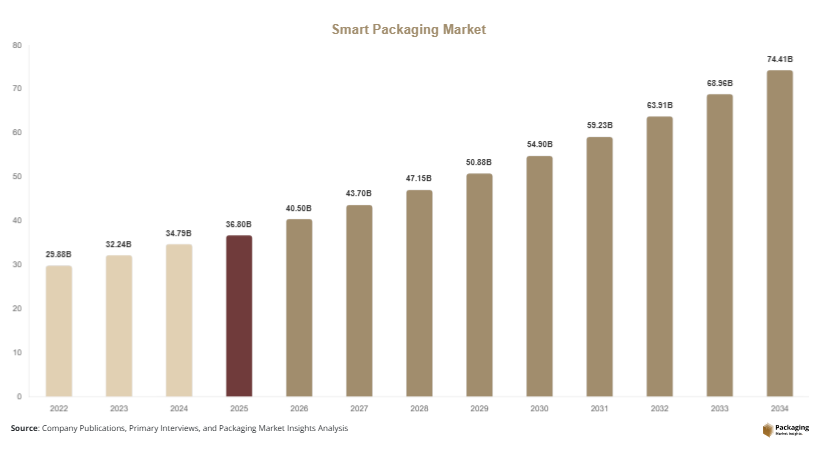
The Smart Packaging Market is experiencing significant growth as industries adopt advanced technologies to enhance product safety, traceability, and consumer engagement. The market size was valued at approximately USD 36.8 billion in 2025 and is projected to reach USD 40.5 billion in 2026. Over the forecast period from 2025 to 2034, the market is expected to expand at a CAGR of 7.9%, reaching an estimated value of USD 78.6 billion by 2034. This growth reflects the increasing integration of digital technologies with packaging solutions across sectors such as food and beverage, pharmaceuticals, and consumer goods.
One of the primary growth factors is the rising demand for improved supply chain transparency and product authentication. Smart packaging solutions, including RFID tags, QR codes, and sensors, enable real-time tracking and monitoring of products throughout the supply chain. Another key factor is the growing emphasis on food safety and quality assurance. Smart packaging technologies help detect spoilage, monitor temperature, and provide real-time data, ensuring product integrity. Additionally, increasing consumer demand for interactive and informative packaging is driving innovation in the market. Brands are leveraging smart packaging to enhance customer engagement through features such as augmented reality and digital content.
Key Highlights:
- Market size reached USD 36.8 billion in 2025
- Expected to grow to USD 78.6 billion by 2034
- CAGR of 7.9% from 2025 to 2034
- Increasing demand for supply chain transparency
- Rising adoption of smart technologies in packaging
Explore more data points, trends and opportunities Download Free Sample Report
Market Trends
Growing Adoption of Active and Intelligent Packaging Solutions
The smart packaging market is witnessing increased adoption of active and intelligent packaging solutions designed to enhance product quality and safety. Active packaging interacts with the product to extend shelf life, while intelligent packaging provides real-time information about product condition. Technologies such as oxygen scavengers, moisture absorbers, and freshness indicators are widely used. Intelligent packaging solutions include sensors and indicators that monitor temperature, humidity, and spoilage. This trend is driven by the need for improved product preservation and regulatory compliance. Industries such as food and pharmaceuticals are increasingly adopting these technologies to ensure quality and safety.
Integration of Digital Technologies and Consumer Engagement Tools
The integration of digital technologies is transforming the smart packaging market by enabling interactive and engaging packaging solutions. QR codes, NFC tags, and augmented reality features allow consumers to access product information, verify authenticity, and engage with brands. This trend is particularly prominent in the consumer goods sector, where companies use smart packaging to enhance brand loyalty and customer experience. Digital technologies also enable data collection and analytics, providing valuable insights into consumer behavior. This trend is expected to continue as companies focus on improving customer engagement and leveraging digital platforms.
Market Drivers
Increasing Demand for Supply Chain Visibility and Traceability
The growing need for supply chain visibility and traceability is a major driver of the smart packaging market. Companies are increasingly adopting smart packaging solutions to monitor the movement of products and ensure authenticity. Technologies such as RFID and GPS tracking provide real-time data on product location and condition. This is particularly important in industries such as pharmaceuticals and food, where product safety is critical. Enhanced traceability helps reduce counterfeiting, improve inventory management, and ensure regulatory compliance. As global supply chains become more complex, the demand for smart packaging solutions is expected to increase.
Rising Focus on Food Safety and Quality Assurance
The increasing focus on food safety and quality assurance is another key driver of the smart packaging market. Consumers and regulatory bodies are placing greater emphasis on the safety and freshness of food products. Smart packaging technologies enable real-time monitoring of product conditions, such as temperature and spoilage. This helps ensure that products remain safe for consumption throughout the supply chain. The adoption of these technologies is particularly high in the food and beverage industry. This driver is expected to support market growth as companies continue to prioritize product safety and quality.
Market Restraint
High Cost of Smart Packaging Technologies
The high cost associated with smart packaging technologies is a significant restraint for the smart packaging market. The integration of sensors, RFID tags, and other digital components increases the overall cost of packaging solutions. This can be a barrier for small and medium-sized enterprises that operate on limited budgets. For example, a small food manufacturer may find it challenging to implement smart packaging due to the high initial investment and maintenance costs. Additionally, the need for specialized infrastructure and expertise further adds to the cost. This restraint can limit the widespread adoption of smart packaging solutions, particularly in cost-sensitive markets.
Market Opportunities
Expansion of E-commerce and Digital Retail Channels
The expansion of e-commerce and digital retail channels presents a significant opportunity for the smart packaging market. Online retail platforms require efficient packaging solutions that ensure product safety and provide real-time tracking. Smart packaging technologies enable companies to monitor shipments and enhance customer experience. The integration of digital features also allows consumers to access product information and engage with brands. As e-commerce continues to grow, the demand for smart packaging solutions is expected to increase.
Development of Cost-Effective and Scalable Smart Packaging Solutions
The development of cost-effective and scalable smart packaging solutions offers substantial growth opportunities in the smart packaging market. Advances in technology are reducing the cost of sensors and digital components, making smart packaging more accessible. Companies are focusing on developing solutions that can be easily integrated into existing packaging systems. This opportunity is expected to drive market growth by enabling wider adoption across industries.
Report Scope
| Report Metric | Details |
|---|---|
| Market Size in 2025 | USD 36.8 Billion |
| Market Size in 2026 | USD 40.5 Billion |
| Market Size in 2034 | USD 78.6 Billion |
| CAGR | 7.9% (2026-2034) |
| Base Year for Estimation | 2025 |
| Historical Data | 2022-2024 |
| Forecast Period | 2026-2034 |
| Report Coverage | Revenue Forecast, Competitive Landscape, Supply Chain Disruption, Growth Factors, Environment & Regulatory Landscape and Trends |
| Geographies Covered | North America, Europe, APAC, Middle East and Africa, LATAM |
| Countries Covered | U.S., Canada, U.K., Germany, France, Spain, Italy, Russia, Nordic, Benelux, Rest of Europe, China, South Korea, Japan, India, Australia, Singapore, Taiwan, South East Asia, Rest of Asia-Pacific, UAE, Turky, Saudi Arabia, South Africa, Egypt, Nigeria, Rest of MEA, Brazil, Mexico, Argentina, Chile, Colombia, Rest of LATAM |
Explore more data points, trends and opportunities Download Free Sample Report
Segmental Analysis
By Technology
RFID-based packaging dominated the smart packaging market in 2024, accounting for approximately 38% of the total market share. RFID technology enables real-time tracking and monitoring of products throughout the supply chain. It is widely used in industries such as retail, logistics, and pharmaceuticals. The ability to provide accurate and timely data supports efficient inventory management and reduces losses. The adoption of RFID technology is expected to continue growing as companies seek to improve supply chain visibility.
Sensor-based packaging is expected to be the fastest-growing segment, with a CAGR of 8.5% during the forecast period. Sensors can monitor various parameters such as temperature, humidity, and spoilage. This makes them suitable for applications in food and pharmaceuticals. The increasing demand for quality assurance and product safety drives the growth of this segment.
By Application
Food and beverage applications dominated the smart packaging market in 2024, with a share of approximately 42%. The need for safe and high-quality food products drives the adoption of smart packaging solutions. Technologies such as freshness indicators and temperature sensors are widely used in this sector. The growth of the food industry further supports this segment.
Pharmaceutical applications are expected to grow at the highest CAGR of 8.2% during the forecast period. The need for product authentication and safety drives the adoption of smart packaging solutions in this sector. Technologies such as RFID and tamper-evident packaging are widely used. This segment is expected to contribute significantly to market growth.
By End-Use
The consumer goods segment dominated the smart packaging market in 2024, accounting for approximately 40% of the total market share. Companies use smart packaging to enhance product appeal and provide interactive features. The demand for innovative packaging solutions drives growth in this segment.
The healthcare segment is expected to grow at the fastest CAGR of 8.6% during the forecast period. The need for safe and secure packaging for medical products drives the adoption of smart packaging solutions. This segment is expected to witness significant growth.
Smart Packaging Market Segmentations
Technology
- RFID Packaging
- Sensor-Based Packaging
- NFC Packaging
- QR Code Packaging
Application
- Food & Beverage
- Pharmaceuticals
- Personal Care
- Consumer Goods
End-Use
- Retail
- Healthcare
- Logistics
- Manufacturing
Regional Analysis
North America
North America accounted for approximately 34% of the smart packaging market share in 2025 and is expected to grow at a CAGR of 7.2% during the forecast period. The region’s advanced technological infrastructure and strong presence of key market players support growth. High adoption of smart packaging solutions in food and pharmaceutical industries drives demand.
The United States dominates the regional market due to its large consumer base and technological capabilities. A unique growth factor is the increasing use of smart packaging in e-commerce, which enhances supply chain efficiency and customer experience.
Europe
Europe held around 27% of the market share in 2025 and is projected to grow at a CAGR of 7.0% through 2034. The region’s focus on sustainability and regulatory compliance influences the adoption of smart packaging solutions. Companies are investing in eco-friendly and intelligent packaging technologies.
Germany leads the European market, supported by its strong manufacturing sector. A key growth factor is the emphasis on product traceability, which drives the adoption of smart packaging solutions.
Asia Pacific
Asia Pacific accounted for approximately 28% of the market share in 2025 and is expected to grow at the fastest CAGR of 8.8% during the forecast period. Rapid industrialization and increasing consumer demand drive market growth in this region.
China dominates the Asia Pacific market due to its large population and expanding retail sector. A unique growth factor is the growth of e-commerce platforms, which increases demand for smart packaging solutions.
Middle East & Africa
The Middle East & Africa region held about 6% of the market share in 2025 and is projected to grow at a CAGR of 7.3% over the forecast period. The market is driven by increasing investments in retail and logistics infrastructure.
UAE leads the regional market, supported by its growing e-commerce sector. A key growth factor is the adoption of advanced technologies in packaging solutions.
Latin America
Latin America accounted for nearly 5% of the market share in 2025 and is expected to grow at a CAGR of 7.5% through 2034. Economic development and increasing consumer awareness contribute to market growth.
Brazil dominates the Latin American market due to its expanding retail industry. A unique growth factor is the increasing demand for packaged food products, which drives the adoption of smart packaging.
Competitive Landscape
The smart packaging market is moderately competitive, with several global and regional players focusing on innovation and technological advancements. Companies are investing in research and development to create advanced packaging solutions that meet industry requirements. Strategic collaborations and partnerships are common strategies used to expand market presence.
Amcor plc is considered a leading player in the market due to its focus on sustainable and intelligent packaging solutions. The company has recently introduced new smart packaging technologies designed for food and pharmaceutical applications. Other major players such as Avery Dennison Corporation, Sealed Air Corporation, 3M Company, and Zebra Technologies Corporation are also investing in advanced technologies and expanding their product portfolios. The competitive landscape is expected to remain dynamic as companies adapt to evolving market trends.
Key Players List
- Amcor plc
- Avery Dennison Corporation
- Sealed Air Corporation
- 3M Company
- Zebra Technologies Corporation
- Smurfit Kappa Group
- Honeywell International Inc.
- Thin Film Electronics ASA
- CCL Industries Inc.
- Coveris Holdings S.A.
- DuPont de Nemours Inc.
- Tetra Pak International
- WestRock Company
- International Paper Company
- Huhtamaki Oyj