Patient Centric Packaging Market Size and Growth
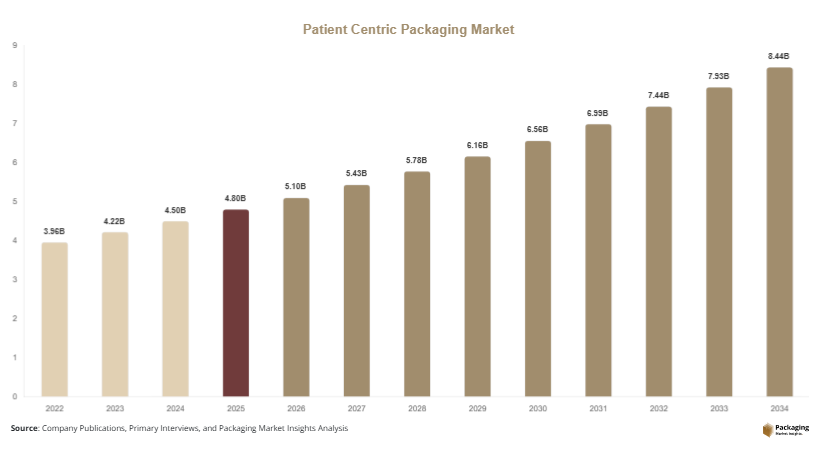
The global patient centric packaging market is projected to witness robust growth over the forecast period, with an estimated market size of USD 4.8 billion in 2025. By 2026, the market is expected to reach approximately USD 5.1 billion, progressing steadily toward a forecasted value of USD 9.0 billion by 2034, representing a CAGR of 6.5% between 2025 and 2034. The growth trajectory is primarily driven by the increasing emphasis on patient safety, medication adherence, and user-friendly packaging designs across healthcare systems globally.
Patient centric packaging is designed to simplify medication administration, reduce dosing errors, and provide easy-to-open, portable, and informative packaging solutions. Pharmaceutical companies are increasingly investing in packaging that ensures compliance with prescription instructions and supports elderly or visually impaired patients. Additionally, the rise of self-medication and home healthcare has created demand for packaging that combines clarity, convenience, and safety features.
Key Highlights:
- The global patient centric packaging market is projected to reach USD 9.0 billion by 2034, reflecting steady growth across all regions. This increase is driven by expanding adoption in pharmaceutical, home healthcare, and medical device sectors.
- A CAGR of 6.5% is anticipated from 2025 to 2034, indicating consistent year-on-year growth. The market is supported by rising awareness of patient safety, adherence solutions, and innovative packaging technologies.
- There is increasing demand for medication adherence and safety-focused packaging solutions. Features such as easy-to-read labels, pre-measured doses, and tamper-evident designs help reduce dosing errors and enhance therapeutic outcomes.
- Rising adoption in home healthcare and self-medication sectors is driving market expansion. Consumers increasingly prefer packaging that is convenient, easy to use, and supports independent management of chronic therapies.
- Regulatory authorities are emphasizing patient-friendly, child-resistant, and error-preventive packaging. Compliance with these regulations ensures safety, reduces risks, and encourages pharmaceutical companies to innovate in packaging design.
Explore more data points, trends and opportunities Download Free Sample Report
Market Trends
Integration of Digital Features in Packaging
A notable trend shaping the patient centric packaging market is the integration of digital technologies such as QR codes, NFC chips, and smart labels in medication packaging. These digital features enable patients to access detailed drug information, dosage reminders, and instructional videos via smartphones or wearable devices. The incorporation of digital technologies not only enhances patient engagement but also improves medication adherence and safety. Pharmaceutical companies are increasingly partnering with technology providers to implement these solutions, particularly for chronic disease treatments requiring long-term medication management. The trend is expected to expand as healthcare digitization accelerates and patient-centric approaches gain prominence globally.
Emphasis on Sustainability and Eco-Friendly Packaging
Another key trend is the adoption of sustainable materials and recyclable packaging designs in patient centric solutions. Manufacturers are increasingly using biodegradable polymers, recyclable cartons, and minimalistic packaging to align with environmental regulations and consumer preferences. This trend is evident in developed markets, where hospitals and pharmacies prioritize eco-friendly materials without compromising functionality or patient safety. Sustainable patient centric packaging not only reduces environmental impact but also resonates with healthcare providers and patients seeking responsible healthcare solutions. Companies investing in green packaging solutions are likely to gain a competitive edge over the forecast period.
Market Drivers
Rising Need for Medication Adherence
A primary driver of the patient centric packaging market is the global emphasis on improving medication adherence. Non-adherence to prescribed medications contributes significantly to treatment failure, hospitalizations, and increased healthcare costs. Patient centric packaging, which includes pre-dosed blister packs, color-coded instructions, and easy-to-read labels, mitigates these risks by providing patients with clear guidance on dosage schedules. As chronic diseases such as diabetes, cardiovascular disorders, and respiratory illnesses rise worldwide, pharmaceutical companies are investing heavily in packaging solutions that support adherence, particularly for elderly patients who may struggle with complex medication regimens.
Aging Population and Chronic Disease Prevalence
The increasing prevalence of chronic diseases and the growth of the aging population worldwide are significant growth drivers. Older adults often face challenges in handling medications due to reduced dexterity, visual impairment, or cognitive decline. Patient centric packaging is designed to address these challenges with easy-to-open containers, large print instructions, and safety mechanisms that prevent accidental ingestion. This demographic shift is particularly pronounced in North America and Europe, where aging populations drive the demand for user-friendly and compliance-oriented packaging. Pharmaceutical companies are leveraging these solutions to enhance patient safety and therapeutic efficacy.
Market Restraint
High Production Costs and Customization Complexity
One of the key restraints affecting the patient centric packaging market is the high production cost associated with specialized packaging solutions. Patient centric packaging often requires customization, including tailored blister packs, color-coded labeling, child-resistant features, and digital integrations. The increased complexity of production lines and additional materials contribute to higher manufacturing costs, which can be a barrier for small and mid-sized pharmaceutical manufacturers. Additionally, regulatory compliance and quality assurance requirements add to the operational burden. For instance, implementing child-resistant packaging in multi-dose blister packs requires sophisticated machinery and testing protocols. While demand is growing, the initial investment and complexity may limit widespread adoption in price-sensitive markets, particularly in emerging economies.
Market Opportunities
Expansion in Emerging Markets
Emerging economies in Asia Pacific, Latin America, and the Middle East present significant growth opportunities for the patient centric packaging market. Rising healthcare expenditure, expanding pharmacy networks, and increased awareness of patient safety are driving demand for user-friendly packaging solutions. Companies entering these regions can capitalize on the growing need for easy-to-use medication packaging for chronic and self-administered therapies. Governments are also promoting modernized healthcare systems, which further encourages the adoption of patient-centric approaches. Partnerships with local distributors and tailored packaging solutions designed for regional needs offer long-term market expansion potential.
Integration with Smart Healthcare Systems
The integration of patient centric packaging with smart healthcare systems, telemedicine, and remote patient monitoring represents another major opportunity. Packaging solutions embedded with digital tracking, automated refill notifications, and dosage reminders align with the global trend toward connected healthcare. As hospitals, pharmacies, and healthcare providers increasingly adopt telehealth and IoT-enabled systems, pharmaceutical companies can offer packaging that enhances patient engagement and ensures adherence. This intersection of packaging and digital health not only strengthens market demand but also opens avenues for innovation, product differentiation, and long-term growth in both developed and developing regions.
Report Scope
| Report Metric | Details |
|---|---|
| Market Size in 2025 | USD 4.8 Billion |
| Market Size in 2026 | USD 5.1 Billion |
| Market Size in 2034 | USD 9.0 Billion |
| CAGR | 6.5% (2026-2034) |
| Base Year for Estimation | 2025 |
| Historical Data | 2022-2024 |
| Forecast Period | 2026-2034 |
| Report Coverage | Revenue Forecast, Competitive Landscape, Supply Chain Disruption, Growth Factors, Environment & Regulatory Landscape and Trends |
| Geographies Covered | North America, Europe, APAC, Middle East and Africa, LATAM |
| Countries Covered | U.S., Canada, U.K., Germany, France, Spain, Italy, Russia, Nordic, Benelux, Rest of Europe, China, South Korea, Japan, India, Australia, Singapore, Taiwan, South East Asia, Rest of Asia-Pacific, UAE, Turky, Saudi Arabia, South Africa, Egypt, Nigeria, Rest of MEA, Brazil, Mexico, Argentina, Chile, Colombia, Rest of LATAM |
Explore more data points, trends and opportunities Download Free Sample Report
Segmental Analysis
Type Segment
The patient centric packaging market by type includes blister packs, bottles & jars, pouches, and unit-dose solutions. Blister packs dominate the market, accounting for approximately 42% of the market share in 2024. Their ability to provide unit-dose management, child-resistance, tamper-evidence, and clear labeling makes them highly suitable for hospitals and retail pharmacies. Blister packs reduce dosing errors and support patient adherence, making them a preferred choice for chronic medications. Additionally, they are cost-effective for mass production and allow easy integration of digital labels for enhanced patient engagement.
Unit-dose solutions are the fastest-growing subsegment, with a projected CAGR of 7.4% from 2025–2034. Growth is driven by increasing demand for hospital and home-care medications that require precise dosage administration. Unit-dose packaging enhances patient safety, prevents medication errors, and simplifies administration for elderly and visually impaired patients. Digital integration with smart healthcare systems further supports adoption, particularly in developed countries with advanced healthcare infrastructure.
Application Segment
By application, the market is segmented into hospital, retail pharmacy, home healthcare, and long-term care facilities. Hospitals dominate the application segment, accounting for 45% of market share in 2024. Hospitals prioritize patient centric packaging solutions that reduce errors, improve medication management, and support nursing staff efficiency. Features such as unit-dose blister packs, pre-filled syringes, and color-coded labeling are increasingly integrated to ensure proper administration and patient adherence.
Home healthcare is the fastest-growing application segment, projected to expand at a CAGR of 7.2% between 2025–2034. The rise in self-medication, aging populations, and chronic disease prevalence has driven demand for easy-to-use packaging at home. Solutions such as simplified bottles, pre-measured doses, and integrated dosage reminders improve patient compliance and safety. Technological innovations such as smart labels and QR code integration further enhance the growth prospects of this segment.
End-Use Segment
The end-use segment includes pharmaceuticals, nutraceuticals, and medical devices. Pharmaceuticals dominate the market with 60% share in 2024, driven by growing chronic disease prevalence, aging populations, and the need for medication adherence solutions. Patient centric packaging in this sector includes blister packs, child-resistant bottles, pre-filled syringes, and tamper-evident cartons designed to improve safety and adherence.
Medical devices represent the fastest-growing subsegment with a CAGR of 7.0% from 2025–2034. Growth is fueled by increasing home care, hospital automation, and the need for device-specific user-friendly packaging. Devices such as insulin pens, inhalers, and diagnostic kits require packaging solutions that are secure, easy to use, and informative, which drives innovation and adoption in the sector.
Patient Centric Packaging Market Segmentations
By Type:
- Blister Packs
- Bottles & Jars
- Pouches
- Unit-Dose Solutions
By Application:
- Hospitals
- Retail Pharmacy
- Home Healthcare
- Long-Term Care Facilities
By End-Use:
- Pharmaceuticals
- Nutraceuticals
- Medical Devices
Regional Analysis
North America
North America held approximately 34% of the global patient centric packaging market share in 2025, with a projected CAGR of 5.9% during 2025–2034. The market growth is largely driven by the presence of established pharmaceutical manufacturers and stringent regulatory frameworks promoting patient safety and adherence. The region’s mature healthcare system emphasizes packaging solutions that reduce medication errors and support self-administration. Additionally, hospitals and pharmacies increasingly demand packaging that combines convenience, safety, and information accessibility, further supporting market expansion.
The United States dominates the North American market due to a large aging population and rising prevalence of chronic diseases. A unique growth factor is the rapid adoption of digital healthcare solutions, enabling integration with patient centric packaging for dosage tracking and educational content. The combination of regulatory mandates and advanced healthcare infrastructure accelerates innovation and adoption in this region.
Europe
Europe accounted for roughly 28% of the global market in 2025 and is expected to grow at a CAGR of 6.2% through 2034. The demand is driven by well-established pharmaceutical industries, patient awareness programs, and government initiatives promoting safe and sustainable packaging. Patient centric solutions such as unit-dose packaging, multi-compartment blister packs, and clearly labeled instructions are increasingly common in hospitals and retail pharmacies, ensuring medication adherence and patient safety.
Germany is the dominant country in Europe, benefiting from a strong regulatory focus on medication safety and elderly care programs. A unique growth factor is the country’s emphasis on patient education through interactive packaging and connected healthcare platforms. These measures support widespread adoption of patient centric packaging, enhancing compliance and treatment outcomes across the region.
Asia Pacific
Asia Pacific held approximately 22% of the global market in 2025, with a forecasted CAGR of 7.1% during 2025–2034. Rapid urbanization, increased healthcare expenditure, and growing awareness of patient safety drive market growth in countries such as India, China, and Japan. The expanding pharmaceutical industry and home healthcare trends further fuel adoption of convenient, easy-to-use packaging solutions.
China dominates the Asia Pacific market, with a unique growth factor being the increasing prevalence of chronic diseases and aging population. The government’s focus on modernized healthcare infrastructure, coupled with rising e-pharmacy adoption, is creating significant opportunities for patient centric packaging. Customizable and digital-integrated solutions are increasingly implemented to meet local healthcare demands.
Middle East & Africa
The Middle East & Africa contributed roughly 7% to the global market in 2025 and is expected to expand at a CAGR of 6.5% through 2034. Growth is supported by rising healthcare investment, modernization of hospitals, and increasing pharmaceutical imports. Patient centric packaging solutions are gaining traction as hospitals and pharmacies aim to reduce medication errors and improve patient experience.
The UAE dominates the regional market, with a unique growth factor being the rapid adoption of advanced hospital systems and e-health initiatives. Patient centric solutions integrated with digital healthcare platforms are increasingly deployed, ensuring medication adherence and improving therapeutic outcomes. Government-led healthcare modernization projects further reinforce growth prospects.
Latin America
Latin America accounted for nearly 5% of the global market share in 2025, projected to grow at a CAGR of 6.8% during the forecast period. The market is driven by growing awareness of patient safety, increasing chronic disease prevalence, and expanding pharmaceutical distribution channels. Retail pharmacies and hospitals are increasingly adopting packaging solutions designed for convenience and adherence, particularly for self-administered medications.
Brazil dominates the Latin American market, with a unique growth factor being government initiatives to improve rural healthcare access. Patient centric packaging for community pharmacies and public health programs ensures safe medication use, creating significant market opportunities for international and local manufacturers.
Competitive Landscape
The patient centric packaging market is moderately consolidated with top players including WestRock Company, Gerresheimer AG, Amcor plc, Berry Global, and AptarGroup, Inc. WestRock Company is recognized as a market leader, recently launching a range of smart blister packs integrated with QR codes to provide dosage instructions and patient education materials. Other major players focus on innovation in unit-dose solutions, child-resistant bottles, and sustainable packaging. Strategic partnerships, acquisitions, and expansion into emerging markets are common practices to enhance global presence. Technological advancements and integration with digital healthcare systems remain key differentiators for companies aiming to capture market share and provide patient-focused solutions.
Key Players List
- WestRock Company
- Gerresheimer AG
- Amcor plc
- Berry Global
- AptarGroup, Inc.
- RPC Group
- Catalent, Inc.
- Sharp Packaging Services
- Schott AG
- Constantia Flexibles
- Sonoco Products Company
- Uhlmann Pac-Systeme GmbH & Co. KG
- Klockner Pentaplast
- Globalpharma Packaging
- Flex Films Ltd.