Multi Functional Packaging Market Size and Growth
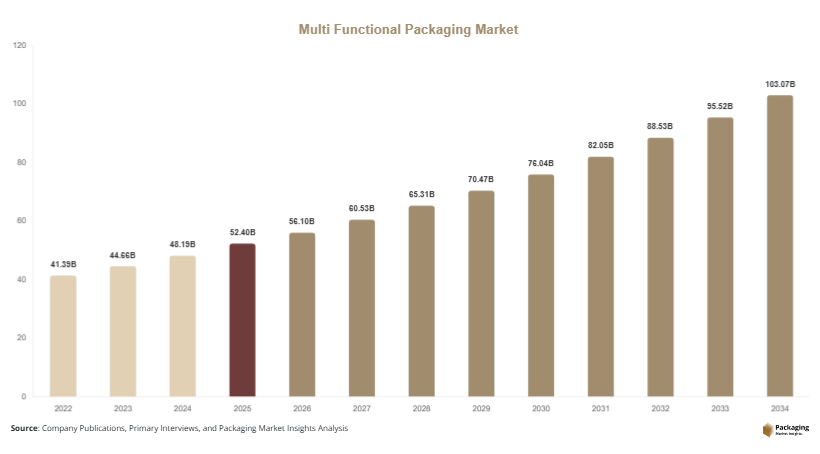
The global multi functional packaging market size was valued at USD 52.4 billion in 2025 and is projected to reach USD 56.1 billion in 2026, further expanding to approximately USD 103.7 billion by 2034, registering a CAGR of 7.9% during 2025–2034. The growing demand for packaging that enhances product performance while improving user experience is a key driver of market expansion. The global multi functional packaging market is gaining traction as industries seek packaging solutions that go beyond basic containment and protection. These packaging systems integrate multiple functionalities such as barrier protection, extended shelf life, convenience features, smart tracking, and sustainability attributes.
One of the major growth factors is the increasing demand for convenience packaging across food, beverage, and personal care industries. Consumers prefer packaging that is easy to open, resealable, portable, and portion-controlled. Multi functional packaging solutions address these needs by integrating features such as zip locks, spouts, and dispensing mechanisms, thereby improving product usability and reducing waste.
Key Highlights:
- Asia Pacific dominated the market with a 36.5% share in 2025, while Latin America is projected to grow at the fastest CAGR of 8.6%.
- Flexible packaging led the type segment with a 49.2% share, while rigid packaging is expected to grow at a CAGR of 7.4%.
- Plastic materials dominated with a 53.1% share, while biodegradable materials are forecasted to grow at a CAGR of 9.3%.
- Food and beverage applications led the segment with 38.7% share, while healthcare packaging is expected to grow at a CAGR of 8.2%.
- China remained the dominant country with a market size of USD 9.1 billion in 2025 and USD 9.8 billion in 2026.
Explore more data points, trends and opportunities Download Free Sample Report
Market Trends
Growing Integration of Smart and Connected Packaging Features
The multi functional packaging market is witnessing increasing integration of smart technologies that enhance product functionality and consumer interaction. Packaging solutions embedded with QR codes, RFID tags, and NFC chips are enabling real-time tracking, authentication, and supply chain transparency. These features allow manufacturers and retailers to monitor product movement, ensure quality control, and reduce counterfeiting risks. In addition, consumers can access product information, usage instructions, and promotional content through connected packaging. The adoption of smart packaging is particularly strong in pharmaceutical and food industries, where safety and traceability are critical. This trend is expected to continue as digital transformation accelerates across industries.
Rising Adoption of Sustainable Multi Functional Materials
Sustainability is becoming a key focus in the multi functional packaging market, with companies developing materials that combine multiple functions while minimizing environmental impact. Biodegradable plastics, compostable films, and recyclable mono-material structures are gaining popularity. Manufacturers are also designing packaging that reduces material usage without compromising performance. For example, lightweight flexible packaging solutions are replacing heavier rigid formats, resulting in lower transportation costs and reduced carbon emissions. The push for circular economy practices is encouraging the use of reusable and refillable packaging systems. This trend is driving innovation in material science and reshaping the market landscape.
Market Drivers
Increasing Demand for Convenience and User-Friendly Packaging
The growing demand for convenient and user-friendly packaging is a major driver of the multi functional packaging market. Consumers are seeking packaging solutions that offer ease of use, portability, and resealability. Features such as easy-open seals, spouts, and portion control are becoming standard in many product categories. These functionalities enhance the overall user experience and reduce product waste. The rise of on-the-go consumption and busy lifestyles is further driving the demand for convenient packaging solutions. Manufacturers are responding by developing innovative designs that meet evolving consumer preferences, thereby supporting market growth.
Expansion of E-commerce and Modern Retail Channels
The rapid growth of e-commerce and modern retail channels is significantly influencing the multi functional packaging market. Products sold online require packaging that can withstand handling, transportation, and storage conditions. Multi functional packaging solutions provide enhanced durability, protection, and tamper evidence, ensuring product integrity during transit. Additionally, packaging plays a crucial role in branding and customer experience in online sales. Companies are investing in visually appealing and functional packaging to create a positive impression and encourage repeat purchases. This trend is driving demand for advanced packaging solutions across various industries.
Market Restraint
Complexity in Design and Higher Production Costs
The complexity involved in designing multi functional packaging solutions can act as a restraint for market growth. Integrating multiple features such as barrier protection, smart technology, and sustainability into a single packaging system requires advanced engineering and material expertise. This increases production costs and may limit adoption among small and medium-sized enterprises. Additionally, the use of advanced materials and technologies can lead to higher initial investment and longer development cycles. For example, incorporating RFID tags into packaging requires additional components and manufacturing processes, which can increase costs. These factors can create challenges for companies looking to adopt multi functional packaging solutions, particularly in cost-sensitive markets.
Market Opportunities
Growth in Smart Packaging Applications Across Industries
The expanding application of smart packaging technologies presents significant opportunities for the multi functional packaging market. Industries such as pharmaceuticals, food, and consumer electronics are increasingly adopting smart packaging to improve product safety, traceability, and consumer engagement. The integration of sensors and digital interfaces enables real-time monitoring of product conditions, such as temperature and humidity. This capability is particularly valuable in cold chain logistics and high-value product shipments. Companies that invest in smart packaging technologies can gain a competitive advantage by offering enhanced functionality and value-added services.
Development of Lightweight and High-Performance Packaging Solutions
Advancements in material science are creating opportunities for the development of lightweight and high-performance packaging solutions. These materials offer improved barrier properties, durability, and flexibility, making them suitable for a wide range of applications. Lightweight packaging reduces transportation costs and environmental impact, aligning with sustainability goals. Additionally, high-performance materials enable the integration of multiple functions, such as moisture resistance and extended shelf life, into a single packaging solution. This trend is expected to drive innovation and growth in the market.
Report Scope
| Report Metric | Details |
|---|---|
| Market Size in 2025 | USD 52.4 Billion |
| Market Size in 2026 | USD 56.1 Billion |
| Market Size in 2034 | USD 103.7 Billion |
| CAGR | 7.9% (2026-2034) |
| Base Year for Estimation | 2025 |
| Historical Data | 2022-2024 |
| Forecast Period | 2026-2034 |
| Report Coverage | Revenue Forecast, Competitive Landscape, Supply Chain Disruption, Growth Factors, Environment & Regulatory Landscape and Trends |
| Geographies Covered | North America, Europe, APAC, Middle East and Africa, LATAM |
| Countries Covered | U.S., Canada, U.K., Germany, France, Spain, Italy, Russia, Nordic, Benelux, Rest of Europe, China, South Korea, Japan, India, Australia, Singapore, Taiwan, South East Asia, Rest of Asia-Pacific, UAE, Turky, Saudi Arabia, South Africa, Egypt, Nigeria, Rest of MEA, Brazil, Mexico, Argentina, Chile, Colombia, Rest of LATAM |
Explore more data points, trends and opportunities Download Free Sample Report
Segmental Analysis
By Type
Flexible packaging dominated the market, accounting for 49.2% share in 2024. It is widely used due to its lightweight nature, cost efficiency, and versatility. Flexible packaging solutions can incorporate multiple functionalities such as resealability and barrier protection.
Rigid packaging is expected to be the fastest-growing segment, with a CAGR of 7.4%. It offers superior durability and is preferred for products requiring strong protection. The growth of premium packaging is driving this segment.
By Material
Plastic materials dominated the market with a 53.1% share in 2024, due to their flexibility, durability, and cost-effectiveness. Plastics are widely used in multi functional packaging applications.
Biodegradable materials are the fastest-growing segment, with a CAGR of 9.3%. The increasing focus on sustainability is driving the adoption of eco-friendly materials.
By Application
Food and beverage applications dominated the market, accounting for 38.7% share in 2024. The need for extended shelf life and convenience packaging is driving demand.
Healthcare applications are expected to be the fastest-growing segment, with a CAGR of 8.2%. The demand for safe and secure packaging solutions is contributing to growth.
Multi Functional Packaging Market Segmentations
By Type
- Flexible Packaging
- Rigid Packaging
By Material
- Plastic
- Paper & Paperboard
- Metal
- Biodegradable Materials
By Application
- Food & Beverage
- Healthcare
- Personal Care
- Industrial
Regional Analysis
North America
North America accounted for approximately 29.7% of the market share in 2025 and is expected to grow at a CAGR of 7.3%. The region benefits from advanced packaging technologies and strong demand from food, healthcare, and consumer goods industries. The presence of established market players further supports growth.
The United States dominates the regional market due to its large consumer base and well-developed retail infrastructure. A unique growth factor is the increasing adoption of smart packaging technologies in e-commerce and healthcare sectors.
Europe
Europe held a market share of 23.8% in 2025 and is projected to grow at a CAGR of 7.5%. The region is characterized by stringent environmental regulations and a strong focus on sustainability. The demand for eco-friendly packaging solutions is driving market growth.
Germany is the leading country in the European market, supported by its strong manufacturing base. A unique growth factor is the widespread adoption of recyclable and biodegradable packaging materials.
Asia Pacific
Asia Pacific accounted for 36.5% of the market share in 2025 and is expected to grow at the fastest CAGR of 8.1%. Rapid urbanization, industrialization, and increasing consumer demand are driving market growth.
China is the dominant country in the region, driven by its large population and expanding manufacturing sector. A key growth factor is the increasing demand for packaged food and consumer goods.
Middle East & Africa
The Middle East & Africa region accounted for a 5.2% share in 2025 and is expected to grow at a CAGR of 7.8%. The market is expanding due to increasing investments in infrastructure and retail sectors.
The United Arab Emirates leads the regional market, supported by its growing logistics and retail industries. A unique growth factor is the rising demand for premium packaging solutions.
Latin America
Latin America held a market share of 4.8% in 2025 and is projected to grow at a CAGR of 8.6%. The region is witnessing increasing demand for packaged products and modern retail formats.
Brazil is the dominant country in the region, supported by its large population and expanding consumer base. A key growth factor is the growth of e-commerce and retail sectors.
Competitive Landscape
The multi functional packaging market is characterized by intense competition, with key players focusing on innovation, sustainability, and strategic partnerships. Companies are investing in research and development to create packaging solutions that offer multiple functionalities while meeting regulatory requirements.
Amcor plc is a leading player in the market, known for its advanced packaging solutions. The company recently introduced sustainable multi functional packaging products to reduce environmental impact. Other major players such as Berry Global Inc., Sealed Air Corporation, Mondi Group, and Sonoco Products Company are also expanding their product portfolios and strengthening their global presence.
Key Players List
- Amcor plc
- Berry Global Inc.
- Sealed Air Corporation
- Mondi Group
- Sonoco Products Company
- Smurfit Kappa Group
- DS Smith plc
- Huhtamaki Oyj
- Coveris Holdings S.A.
- Constantia Flexibles
- Winpak Ltd.
- Tetra Pak International S.A.
- WestRock Company
- ProAmpac LLC
- UFlex Ltd.