Generative AI In Packaging Market Size and Growth
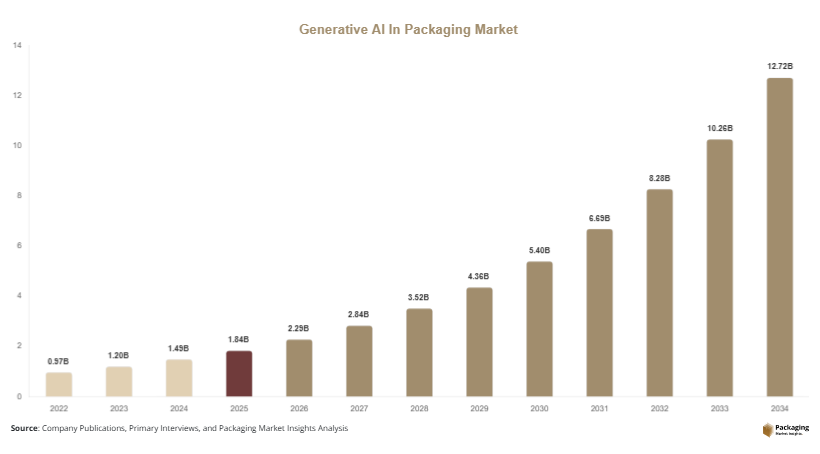
The global generative AI in packaging market was valued at approximately USD 1.84 billion in 2025 and is projected to reach USD 2.29 billion in 2026. By 2034, the market is expected to grow to nearly USD 12.76 billion, registering a robust CAGR of 23.9% during 2025–2034. The growing integration of AI-driven automation across packaging design, material optimization, predictive analytics, and supply chain operations is contributing significantly to market growth. The generative AI in packaging market is experiencing rapid expansion as packaging manufacturers, consumer goods companies, and logistics providers increasingly adopt artificial intelligence technologies to improve design efficiency, operational productivity, and customer engagement.
One of the primary growth factors driving the generative AI in packaging market is the increasing demand for personalized and visually appealing packaging solutions. Consumer brands are using generative AI platforms to create customized packaging layouts, graphics, and branding concepts with shorter development cycles. AI tools help companies generate multiple design prototypes rapidly while reducing design costs and improving marketing flexibility. Another major growth factor is the rising adoption of automation in manufacturing and packaging operations. Generative AI solutions are being integrated into smart factories to optimize packaging formats, improve material usage, and reduce production waste.
Key Highlights
- North America dominated the market with a 36.8% share in 2025.
- Asia Pacific is projected to grow at the fastest CAGR of 25.7%.
- Design optimization software led the solution segment with a 33.5% share.
- Cloud-based deployment dominated with a 61.2% share.
- Food & beverage applications led the market with 38.4% share.
- The US remained the dominant country with a market size of USD 620 million in 2025 and USD 760 million in 2026.
Explore more data points, trends and opportunities Download Free Sample Report
Market Trends
Rising Use of AI-Generated Sustainable Packaging Designs
Sustainability has become a major trend in the generative AI in packaging market as companies seek to reduce environmental impact and improve packaging efficiency. Generative AI tools are being used to simulate material performance, optimize packaging dimensions, and reduce unnecessary material consumption. Packaging manufacturers are leveraging AI algorithms to identify recyclable and biodegradable alternatives while maintaining structural integrity and transportation durability. Brands are also using AI-generated packaging concepts to meet sustainability regulations and consumer expectations. This trend is encouraging companies to adopt digital product development workflows that reduce physical prototyping costs and accelerate environmentally responsible packaging innovation across food, healthcare, and retail sectors.
Integration of Generative AI With Smart Packaging Technologies
Another significant trend is the integration of generative AI with smart packaging systems and connected technologies. Companies are embedding QR codes, NFC tags, and intelligent labels into packaging solutions supported by AI-driven personalization platforms. These technologies improve customer engagement through interactive packaging experiences and targeted marketing campaigns. AI-powered analytics are also helping manufacturers collect real-time consumer insights from connected packaging systems. In addition, smart packaging integrated with AI models can improve supply chain visibility, traceability, and anti-counterfeiting measures. This trend is particularly strong in premium consumer goods and pharmaceutical packaging applications where customer interaction and product authenticity are increasingly important.
Market Drivers
Growing Demand for Packaging Automation and Operational Efficiency
The increasing need for automation and operational efficiency is a major driver of the generative AI in packaging market. Packaging manufacturers are adopting AI-powered solutions to automate repetitive design and production tasks while reducing human error. Generative AI systems can create packaging templates, optimize printing layouts, and improve machine calibration processes with minimal manual intervention. These capabilities help businesses lower operational costs and reduce packaging waste. Additionally, manufacturers can accelerate product launches by shortening packaging development timelines. The integration of AI into production facilities is also improving quality control and predictive maintenance capabilities, further supporting widespread market adoption across industrial packaging operations.
Expansion of E-commerce and Personalized Consumer Packaging
The rapid expansion of e-commerce platforms and direct-to-consumer business models is driving demand for personalized and adaptive packaging solutions. Online retailers increasingly require packaging designs optimized for shipping efficiency, product safety, and customer experience. Generative AI enables brands to create customized packaging graphics, promotional messaging, and product-specific packaging formats at scale. Companies are also using AI-driven analytics to understand consumer preferences and improve brand engagement. The rise of digital commerce and social media marketing is encouraging businesses to invest in innovative packaging designs that differentiate products while maintaining cost efficiency and sustainability performance.
Market Restraint
High Implementation Costs and Data Integration Challenges
One of the major restraints affecting the generative AI in packaging market is the high implementation cost associated with advanced AI technologies and digital infrastructure integration. Small and medium-sized packaging companies often face financial limitations when adopting AI-powered design software, cloud computing systems, and machine learning platforms. In addition to software investment, businesses may require workforce training, cybersecurity upgrades, and integration with existing enterprise systems. Data management challenges also create barriers because AI systems rely heavily on accurate and large-scale datasets for effective performance. For example, packaging manufacturers operating with fragmented production data may experience difficulties integrating generative AI models into legacy manufacturing environments. Inconsistent data quality can reduce prediction accuracy and operational efficiency, limiting the effectiveness of AI deployment. Furthermore, concerns regarding intellectual property ownership and data privacy may slow adoption among companies handling sensitive product information and proprietary packaging designs.
Market Opportunities
Expansion of AI-Driven Packaging Customization Services
The growing demand for personalized consumer experiences is creating strong opportunities for AI-driven packaging customization services. Brands across food, cosmetics, and retail industries are increasingly seeking packaging designs tailored to regional preferences, seasonal campaigns, and customer demographics. Generative AI platforms can quickly produce multiple design concepts and localized packaging variations without increasing production complexity. This capability is particularly beneficial for companies launching limited-edition products or targeted marketing campaigns. As digital printing technologies become more accessible, manufacturers are expected to integrate generative AI systems into packaging production lines to support large-scale customization initiatives and improve consumer engagement.
Growing Adoption of AI in Sustainable Supply Chain Optimization
Another major opportunity lies in the use of generative AI for sustainable supply chain management and packaging optimization. AI models can analyze transportation routes, material consumption patterns, and packaging dimensions to reduce logistics costs and carbon emissions. Packaging companies are increasingly adopting AI-powered simulations to minimize excess packaging and improve warehouse efficiency. These solutions also support regulatory compliance by helping businesses monitor sustainability targets and waste reduction metrics. The rising emphasis on environmentally responsible operations is expected to create long-term opportunities for AI software providers and packaging manufacturers investing in intelligent supply chain technologies.
Report Scope
| Report Metric | Details |
|---|---|
| Market Size in 2025 | USD 1.84 Billion |
| Market Size in 2026 | USD 2.29 Billion |
| Market Size in 2034 | USD 12.76 Billion |
| CAGR | 23.9% (2026-2034) |
| Base Year for Estimation | 2025 |
| Historical Data | 2022-2024 |
| Forecast Period | 2026-2034 |
| Report Coverage | Revenue Forecast, Competitive Landscape, Supply Chain Disruption, Growth Factors, Environment & Regulatory Landscape and Trends |
| Geographies Covered | North America, Europe, APAC, Middle East and Africa, LATAM |
| Countries Covered | U.S., Canada, U.K., Germany, France, Spain, Italy, Russia, Nordic, Benelux, Rest of Europe, China, South Korea, Japan, India, Australia, Singapore, Taiwan, South East Asia, Rest of Asia-Pacific, UAE, Turky, Saudi Arabia, South Africa, Egypt, Nigeria, Rest of MEA, Brazil, Mexico, Argentina, Chile, Colombia, Rest of LATAM |
Explore more data points, trends and opportunities Download Free Sample Report
Segmental Analysis
By Solution Type
Design optimization software dominated the generative AI in packaging market in 2024, accounting for approximately 33.5% of the global market share. These platforms are widely used by packaging manufacturers and consumer brands to automate packaging design creation, structural modeling, and material selection processes. Generative AI-powered software can quickly generate multiple packaging prototypes while reducing development time and production costs. Companies are increasingly using these tools to improve visual branding consistency, reduce packaging waste, and optimize transportation efficiency. Integration with digital printing systems and computer-aided design platforms has further strengthened adoption across food, cosmetics, pharmaceutical, and industrial packaging applications.
Predictive analytics platforms are expected to register the fastest CAGR of 26.4% during the forecast period. Businesses are increasingly adopting AI-driven analytics solutions to forecast packaging demand, optimize inventory management, and improve production scheduling. Predictive models help manufacturers reduce operational disruptions and identify inefficiencies across supply chain operations. Packaging companies are also using predictive AI systems to monitor equipment performance and minimize downtime through preventive maintenance strategies. Rising demand for real-time operational insights and data-driven decision-making is expected to accelerate adoption of predictive analytics technologies across global packaging operations.
By Deployment Mode
Cloud-based deployment dominated the market in 2024 with a market share of approximately 61.2%. Cloud platforms provide scalability, remote accessibility, and lower infrastructure costs, making them attractive for packaging companies implementing AI-driven solutions. Businesses can integrate cloud-based generative AI tools with enterprise resource planning systems, digital printing technologies, and production management software. Cloud deployment also enables real-time collaboration between packaging designers, suppliers, and marketing teams located across different geographic regions. The growing adoption of software-as-a-service business models and industrial cloud computing infrastructure continues to support expansion of this deployment segment.
Hybrid deployment models are anticipated to grow at the fastest CAGR of 24.9% through 2034. Companies operating with sensitive production data are increasingly combining on-premise infrastructure with cloud-based AI capabilities to improve security and operational flexibility. Hybrid systems allow manufacturers to manage critical packaging design and production data internally while leveraging cloud computing for analytics and scalability. This approach is particularly beneficial for pharmaceutical and high-value consumer goods packaging applications where data protection and compliance requirements are essential. Growing concerns related to cybersecurity and intellectual property protection are expected to encourage wider adoption of hybrid deployment architectures.
By End-Use Industry
The food and beverage industry dominated the market in 2024, representing approximately 38.4% of total market share. Companies in this sector are increasingly adopting generative AI technologies to develop attractive packaging designs, improve shelf visibility, and optimize packaging materials. AI-powered solutions are helping food manufacturers create packaging tailored to consumer preferences while reducing production waste and transportation costs. Smart labeling systems and personalized branding strategies are also gaining traction within packaged food and beverage applications. Rising demand for sustainable and interactive food packaging solutions continues to support growth in this segment.
Pharmaceutical packaging is expected to register the fastest CAGR of 25.3% during the forecast period. Pharmaceutical companies are increasingly implementing AI-powered packaging systems to improve traceability, regulatory compliance, and patient safety. Generative AI tools are helping manufacturers design tamper-evident packaging, optimize labeling accuracy, and improve serialization processes. The growing demand for temperature-sensitive drug packaging and personalized medicine solutions is also supporting adoption of advanced AI technologies. Expansion of healthcare infrastructure and increasing pharmaceutical production across emerging economies are expected to further accelerate growth in this segment.
Generative AI In Packaging Market Segmentations
By Solution Type
- Design Optimization Software
- Predictive Analytics Platforms
- AI-Based Quality Inspection Systems
- Packaging Automation Software
By Deployment Mode
- Cloud-Based
- On-Premise
- Hybrid
By End-Use Industry
- Food & Beverage
- Pharmaceuticals
- Personal Care & Cosmetics
- Consumer Electronics
- Industrial Goods
Regional Analysis
North America
North America accounted for approximately 36.8% of the global generative AI in packaging market share in 2025 and is projected to grow at a CAGR of 22.1% during the forecast period. The region benefits from advanced digital infrastructure, high technology adoption, and strong investment in AI research and development. Consumer goods companies and packaging manufacturers across the United States and Canada are increasingly implementing AI-powered design and automation solutions. The expansion of smart manufacturing and Industry 4.0 initiatives is also contributing significantly to regional market growth.
The United States dominates the North American market due to its strong technology ecosystem and presence of major AI software developers. A unique growth factor in the country is the rapid adoption of AI-driven packaging personalization for e-commerce and retail branding applications. Companies are increasingly using generative AI tools to create customized product packaging and improve customer engagement through digital marketing integration and interactive packaging technologies.
Europe
Europe represented nearly 26.2% of the global market share in 2025 and is anticipated to grow at a CAGR of 21.4% through 2034. The region is characterized by strict sustainability regulations and increasing demand for eco-friendly packaging solutions. European packaging companies are adopting generative AI technologies to optimize material usage, improve recycling compatibility, and reduce production waste. Governments across the region are also supporting digital transformation initiatives that encourage industrial automation and intelligent manufacturing practices.
Germany remains the leading country in the European generative AI in packaging market due to its advanced industrial base and strong packaging machinery sector. A unique growth factor is the integration of AI-driven design software into automated manufacturing systems used by consumer goods and automotive packaging companies. German manufacturers are increasingly investing in predictive analytics and digital twins to improve packaging efficiency and sustainability performance.
Asia Pacific
Asia Pacific held a market share of approximately 24.7% in 2025 and is expected to register the fastest CAGR of 25.7% during the forecast period. Rapid industrialization, expanding e-commerce activities, and increasing adoption of smart manufacturing technologies are supporting market growth across the region. Countries including China, Japan, South Korea, and India are witnessing rising investment in AI infrastructure and digital packaging technologies. The growing consumer goods industry is also increasing demand for packaging automation and personalized branding solutions.
China dominates the Asia Pacific market due to its large manufacturing sector and extensive packaging production capacity. A unique growth factor is the rapid deployment of AI-powered packaging inspection and design optimization systems in export-oriented industries. Local manufacturers are increasingly integrating generative AI tools with industrial robotics and digital printing technologies to improve operational efficiency and product customization capabilities.
Middle East & Africa
The Middle East & Africa region accounted for approximately 5.1% of the global market share in 2025 and is projected to grow at a CAGR of 20.3% over the forecast period. Increasing investment in digital transformation and smart manufacturing infrastructure is supporting regional market development. Governments across the Gulf countries are promoting AI adoption across industrial sectors, including packaging and logistics. Growth in food processing, pharmaceuticals, and retail industries is also contributing to rising demand for intelligent packaging technologies.
The United Arab Emirates remains the dominant country in the regional market due to its strong focus on advanced technology adoption and industrial diversification initiatives. A unique growth factor is the expansion of AI-enabled retail and e-commerce ecosystems requiring innovative packaging automation solutions. Companies operating in the country are increasingly investing in smart packaging platforms to improve operational efficiency and customer engagement.
Latin America
Latin America represented around 7.2% of the global generative AI in packaging market share in 2025 and is forecast to grow at a CAGR of 22.9% during the forecast period. The region is experiencing increasing adoption of AI technologies across manufacturing and logistics operations. Consumer goods companies are implementing AI-powered packaging systems to improve supply chain efficiency and support digital marketing strategies. Expansion of retail distribution channels and online commerce platforms is also contributing to regional market growth.
Brazil dominates the Latin American market due to its large consumer goods and food processing industries. A unique growth factor is the growing use of AI-based packaging design tools by regional food and beverage companies seeking faster product launches and localized branding strategies. Packaging manufacturers are increasingly adopting cloud-based AI platforms to improve operational flexibility and reduce production costs.
Competitive Landscape
The global generative AI in packaging market is moderately competitive, with technology providers, packaging software developers, and industrial automation companies actively investing in artificial intelligence capabilities. Market participants are focusing on cloud-based AI platforms, predictive analytics tools, and intelligent packaging design solutions to strengthen their competitive positions. Strategic partnerships between packaging manufacturers and AI software companies are becoming increasingly common as businesses seek integrated digital transformation solutions.
Adobe Inc. remains one of the leading companies in the market due to its advanced generative design capabilities and strong adoption across branding and packaging applications. The company recently introduced enhanced AI-driven packaging visualization tools integrated with digital marketing platforms to improve product customization efficiency. Other key participants include Microsoft Corporation, IBM Corporation, Autodesk Inc., and SAP SE. These companies are expanding investments in machine learning, industrial automation, and cloud infrastructure to support packaging industry applications. Product innovation, mergers, and AI-focused research initiatives are expected to shape future market competition.
Key Players List
- Adobe Inc.
- Microsoft Corporation
- IBM Corporation
- Autodesk Inc.
- SAP SE
- Oracle Corporation
- Dassault Systèmes
- Siemens AG
- NVIDIA Corporation
- Google LLC
- Amazon Web Services Inc.
- Packaging Corporation of America
- Avery Dennison Corporation
- Esko Graphics BV
- HP Inc.