Edible Packaging Market Size and Growth
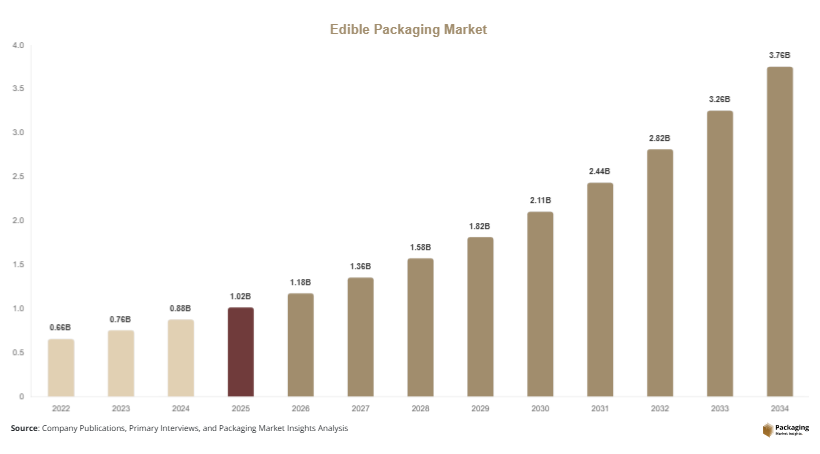
The edible packaging market size was valued at USD 1.02 billion in 2025 and is projected to reach USD 3.78 billion by 2034, expanding at a CAGR of 15.6% from 2025 to 2034. The market is experiencing notable growth as food and beverage manufacturers increasingly adopt biodegradable and sustainable packaging alternatives to reduce environmental impact. Edible packaging solutions are designed from natural polymers such as seaweed, starch, gelatin, and proteins, enabling packaging that can either be consumed with the product or safely decompose after use.
A significant global factor supporting the growth of the edible packaging market is the intensifying regulatory pressure to reduce single-use plastics across food packaging industries. Governments across several developed and developing economies are implementing strict plastic reduction policies and promoting biodegradable packaging materials. These regulations are encouraging food manufacturers, retailers, and packaging companies to explore edible packaging technologies as a viable alternative.
Key Highlights
- Europe dominated the edible packaging market with a 34.2% share in 2025, while Asia Pacific is projected to grow at the fastest CAGR of 17.9% through 2034.
- Films & Coatings emerged as the leading type segment with a 48.6% market share, whereas Dissolvable Packaging is projected to grow at the fastest CAGR of 18.7%.
- Polysaccharides dominated the material segment with a 41.5% share, while Seaweed-based materials are expected to grow at the fastest CAGR of 19.1%.
- Food & Beverage application accounted for the largest share of 62.3%, while Ready-to-eat meals are projected to grow at the fastest CAGR of 17.4%.
- The United States led the market with USD 258 million in 2025 and is estimated to reach USD 296 million in 2026.
Explore more data points, trends and opportunities Download Free Sample Report
Market Trends
Rising Adoption of Seaweed-Based Packaging
Seaweed-based edible packaging is emerging as a prominent trend in the edible packaging market due to its biodegradable characteristics and abundant raw material availability. Seaweed polymers possess strong film-forming capabilities, making them suitable for applications such as beverage capsules, food wraps, and sachets. Additionally, seaweed cultivation has a lower environmental footprint compared with traditional packaging materials, as it requires no fertilizers or freshwater.
Food and beverage companies are increasingly collaborating with biotech startups to develop seaweed-based packaging solutions that dissolve in water or can be safely consumed. These materials also demonstrate natural antimicrobial properties, which can enhance food shelf life. As research institutions continue to optimize seaweed polymer extraction technologies, the scalability of seaweed-based edible packaging is expected to increase across commercial food supply chains.
Development of Functional Edible Coatings
Another emerging trend shaping the edible packaging market is the development of functional edible coatings that extend product shelf life and maintain freshness. Edible coatings made from proteins, lipids, and polysaccharides are being engineered to control moisture loss, prevent oxidation, and inhibit microbial growth.
Food producers are integrating active compounds such as antioxidants, vitamins, and antimicrobial agents into edible coatings to enhance product protection. These coatings are gaining traction in fresh produce, bakery products, and dairy applications. As food manufacturers focus on minimizing food waste and improving supply chain efficiency, functional edible coatings are becoming an important technological advancement within edible packaging solutions.
Market Drivers
Increasing Demand for Sustainable Packaging Solutions
The rising demand for environmentally responsible packaging is a key driver of the edible packaging market. Traditional plastic packaging contributes significantly to global waste generation, prompting industries to explore sustainable alternatives that reduce environmental impact.
Edible packaging materials derived from natural polymers offer biodegradable characteristics and eliminate the need for disposal in certain applications. This attribute is particularly beneficial in the food service industry, where single-use packaging is widely utilized. As sustainability initiatives gain prominence across global supply chains, edible packaging is increasingly being incorporated into corporate environmental strategies.
Growth in Convenience and On-the-Go Food Consumption
Rapid urbanization and changing lifestyles are contributing to increased demand for convenience foods and ready-to-eat products. This shift in consumption patterns is supporting the expansion of the edible packaging market, as food producers seek packaging formats that enhance convenience while minimizing waste.
Edible packaging enables innovative product formats such as dissolvable beverage pods, edible sachets, and single-serving wraps. These packaging solutions align with consumer preferences for portable, minimal-waste food options. As the global convenience food sector continues to expand, edible packaging technologies are expected to play a greater role in product packaging strategies.
Market Restraint
Limited Mechanical Strength and Shelf-Life Stability
One of the primary challenges facing the edible packaging market is the limited mechanical strength and moisture resistance of edible materials compared with conventional plastic packaging. Many edible films and coatings are highly sensitive to environmental factors such as humidity and temperature, which can affect their durability and structural stability.
This limitation restricts the use of edible packaging in certain food products that require extended shelf life or protection from external contamination. In addition, the development of edible packaging materials that maintain product freshness while providing adequate barrier properties remains technically complex. These factors may slow the widespread commercialization of edible packaging solutions in large-scale food packaging operations.
Market Opportunities
Expansion of Edible Packaging in Beverage Applications
The beverage industry presents a significant opportunity for the edible packaging market. Innovations in dissolvable capsules and edible beverage pods are gaining attention as alternatives to traditional plastic bottles and single-use packaging.
Companies are experimenting with edible containers made from seaweed and plant-based polymers to package water, juices, and sports drinks. These packaging formats can be consumed along with the beverage or decomposed naturally, reducing packaging waste. As beverage companies explore sustainable packaging strategies, edible packaging solutions are likely to gain adoption in niche product segments.
Integration of Nutritional and Functional Ingredients
Another emerging opportunity within the edible packaging market lies in the integration of nutritional components into packaging materials. Edible films and coatings can potentially incorporate vitamins, minerals, probiotics, or flavor enhancers that complement the packaged food product.
This concept enables packaging to serve not only as a protective barrier but also as an additional nutritional component. Food companies exploring value-added product differentiation are increasingly investigating functional edible packaging materials that enhance the overall consumer experience.
Report Scope
| Report Metric | Details |
|---|---|
| Market Size in 2025 | USD 1.02 Billion |
| Market Size in 2026 | USD 1.18 Billion |
| Market Size in 2034 | USD 3.78 Billion |
| CAGR | 15.6% (2026-2034) |
| Base Year for Estimation | 2025 |
| Historical Data | 2022-2024 |
| Forecast Period | 2026-2034 |
| Report Coverage | Revenue Forecast, Competitive Landscape, Supply Chain Disruption, Growth Factors, Environment & Regulatory Landscape and Trends |
| Geographies Covered | North America, Europe, APAC, Middle East and Africa, LATAM |
| Countries Covered | U.S., Canada, U.K., Germany, France, Spain, Italy, Russia, Nordic, Benelux, Rest of Europe, China, South Korea, Japan, India, Australia, Singapore, Taiwan, South East Asia, Rest of Asia-Pacific, UAE, Turky, Saudi Arabia, South Africa, Egypt, Nigeria, Rest of MEA, Brazil, Mexico, Argentina, Chile, Colombia, Rest of LATAM |
Explore more data points, trends and opportunities Download Free Sample Report
Segmental Analysis
By Type
Films and coatings represented the dominant subsegment in the edible packaging market, accounting for 48.6% of the market share in 2025. These packaging formats are widely used to protect fresh produce, dairy products, and confectionery items from moisture loss and microbial contamination. Edible films provide a thin protective layer that preserves food freshness while maintaining product quality.
Dissolvable packaging is projected to emerge as the fastest-growing type segment with a CAGR of 18.7% through 2034. This growth will be driven by the increasing development of edible capsules and pods used for beverage and condiment packaging. These formats enable consumers to dissolve the packaging directly in water or consume it with the product, reducing packaging waste and improving convenience.
By Material
Polysaccharides dominated the material segment with 41.5% share in 2025 within the edible packaging market. Materials such as starch, cellulose, and alginate are widely used due to their natural film-forming ability and compatibility with food products. Polysaccharide-based packaging materials also provide moderate oxygen barriers, making them suitable for various food applications.
Seaweed-based materials will witness the fastest CAGR of 19.1% during the forecast period. The growth of this subsegment will be supported by the increasing availability of seaweed biomass and improvements in polymer extraction technologies. Seaweed-derived materials possess strong structural properties and natural biodegradability, which will make them attractive alternatives to traditional plastic packaging.
By Application
Food and beverage applications accounted for the largest share of 62.3% in 2025 in the edible packaging market. Edible films and coatings are commonly used to package confectionery products, bakery goods, fruits, and ready-to-eat items. The ability of edible packaging to reduce waste while maintaining product freshness makes it suitable for multiple food product categories.
Ready-to-eat meals will grow at the fastest CAGR of 17.4% during the forecast period. This growth will be influenced by the expanding global market for convenience foods and portable meal solutions. Edible packaging materials designed for ready-to-eat products will provide packaging formats that simplify consumption while minimizing waste generation.
Edible Packaging Market Segmentations
Type
- Films & Coatings
- Dissolvable Packaging
- Edible Containers
Material
- Polysaccharides
- Proteins
- Lipids
- Seaweed-Based Materials
Application
- Food Products
- Beverages
- Ready-to-Eat Meals
Regional Analysis
North America
North America accounted for 27.8% of the edible packaging market share in 2025. The region is expected to witness a CAGR of 14.6% from 2025 to 2034. The market expansion is influenced by the presence of established food processing industries and growing investments in sustainable packaging technologies. Companies across the region are exploring biodegradable packaging formats to align with evolving environmental standards and corporate sustainability commitments.
The United States represented the dominant country within the regional market. One notable growth factor is the increasing investment in food technology startups specializing in alternative packaging materials. Research institutions and private companies are collaborating to develop advanced edible film technologies that enhance shelf life and food safety. These initiatives are contributing to ongoing innovation in edible packaging materials within the U.S. market.
Europe
Europe held 34.2% of the global edible packaging market in 2025, making it the largest regional market. The region will expand at a CAGR of 15.1% through 2034. Growth is associated with stringent environmental policies targeting plastic waste reduction and encouraging biodegradable packaging alternatives across the food and beverage sector.
Germany emerged as the dominant country in the European edible packaging landscape. The country has a strong food processing industry and an active research environment focused on sustainable materials. German companies are increasingly integrating edible coatings for fresh produce and bakery products to enhance product shelf life. The adoption of eco-friendly packaging solutions by retail chains has also contributed to the expansion of edible packaging technologies within the country.
Asia Pacific
Asia Pacific represented 22.6% of the edible packaging market in 2025 and is projected to grow at the fastest CAGR of 17.9% between 2025 and 2034. Rapid urbanization, population growth, and expansion of the food manufacturing sector are supporting the adoption of innovative packaging technologies across the region.
China dominated the regional market due to its large-scale food production industry and growing focus on biodegradable materials. Local research institutes are actively exploring edible packaging materials derived from plant starch and seaweed. Additionally, the expansion of convenience food consumption across major Chinese cities is encouraging food manufacturers to experiment with alternative packaging formats.
Middle East & Africa
The Middle East & Africa accounted for 8.1% of the global edible packaging market share in 2025 and is expected to expand at a CAGR of 13.2% through 2034. Increasing awareness of sustainable food packaging and the development of modern food retail networks are supporting gradual market growth in the region.
The United Arab Emirates represented the leading country within the regional market. One key factor contributing to market development is the expansion of sustainable food service initiatives within hospitality and tourism industries. Restaurants and catering companies are exploring biodegradable and edible packaging solutions to reduce waste generated by takeaway packaging.
Latin America
Latin America captured 7.3% of the edible packaging market in 2025 and will grow at a CAGR of 13.8% from 2025 to 2034. Market growth is associated with increasing agricultural production and expanding food processing industries across the region.
Brazil dominated the regional market due to its extensive agricultural resources and growing interest in bio-based materials. Brazilian researchers are exploring edible packaging derived from cassava starch and other plant-based polymers. These locally sourced materials provide opportunities for developing sustainable packaging solutions tailored to regional food products.
Competitive Landscape
The edible packaging market is characterized by the presence of innovative startups, biotechnology firms, and established packaging companies exploring biodegradable materials. Market participants are focusing on product innovation, strategic collaborations, and investments in research and development to enhance edible packaging technologies.
Notpla is recognized as a leading company within the market due to its pioneering work in seaweed-based edible packaging solutions. The company has introduced dissolvable sachets and edible beverage capsules designed for water and beverage applications. Recent developments include partnerships with food service companies to commercialize seaweed-based packaging formats.
Other market participants are actively investing in biopolymer research to improve packaging durability, moisture resistance, and shelf life. As the demand for sustainable packaging continues to increase, companies are expected to accelerate innovation and commercialization of edible packaging technologies.
Key Players
- Notpla
- MonoSol LLC
- Devro PLC
- Tate & Lyle PLC
- TIPA Corp
- JRF Technology LLC
- Lactips
- Evoware
- Nagase America LLC
- Watson Inc.
- Mantrose-Haeuser Co. Inc.
- Amtrex Nature Care Pvt Ltd
- Skipping Rocks Lab
- Xampla Ltd
- BluWrap