Adhesive Films Market Size
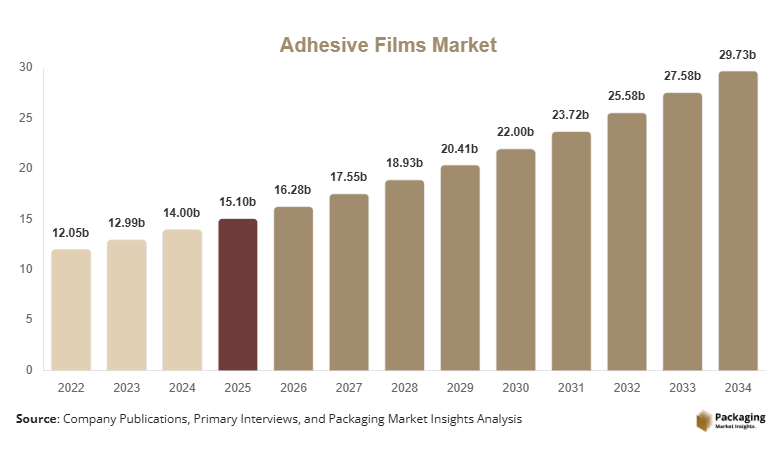
Adhesive Films market size is projected at USD 16.28 billion in 2026 and is expected to hit USD 29.74 billion by 2034 with a CAGR of 7.82%. Growing demand for lightweight bonding materials, advanced electronics assembly, medical device manufacturing, and automotive component integration continues to support market expansion. The report delivers detailed analysis of production volumes, segmentation, regional performance, technological developments, and the competitive landscape.
The adhesive films market comprises pressure-sensitive and specialty adhesive films used for permanent and temporary bonding across industrial applications. Global production surpassed 27.4 billion square meters during 2025, with acrylic adhesive films contributing approximately 54% of total output. Automotive applications represented nearly 34% of global consumption, while electronics accounted for approximately 29%. Rising industrial automation and lightweight manufacturing continue strengthening the adhesive films market.
Explore more data points, trends and opportunities Download Free Sample Report
Adhesive Films Market Trends
Increasing Adoption of Lightweight Bonding Technologies
Manufacturers are replacing mechanical fasteners with adhesive films to reduce component weight and improve structural performance. More than 14.8 billion square meters of acrylic adhesive films were produced during 2025, while demand from electric vehicle manufacturers increased by approximately 24% year-over-year. Automated lamination technologies improved production efficiency by nearly 18%, supporting continued expansion across the adhesive films market.
Rapid advances in flexible electronics, wearable devices, and high-performance medical products are accelerating demand for specialty adhesive films. Silicone adhesive film production exceeded 4.6 billion square meters, while smart manufacturing adoption increased beyond 63% among leading producers. Continuous product innovation and sustainable formulations continue driving the adhesive films market.
Adhesive Films Drivers
Growing Demand from Automotive and Electronics Industries
Automotive lightweighting and miniaturized electronic devices continue increasing demand for advanced adhesive bonding solutions. More than 72% of electric vehicle manufacturers utilize adhesive films for battery assembly and interior applications, while electronics production expanded by approximately 11% during 2025. These developments continue supporting adhesive films market growth.
Adhesive Films Restraints
Volatility in Raw Material Prices
Petrochemical-derived polymers, silicone compounds, and specialty adhesives remain vulnerable to raw material price fluctuations. Resin costs increased by approximately 13% during 2025, while high-performance silicone materials experienced price increases exceeding 15%. These cost pressures challenge profitability across the adhesive films market.
Adhesive Films Opportunities
Expansion of Electric Vehicles and Medical Devices
Electric vehicle battery manufacturing and advanced healthcare equipment continue creating significant opportunities for high-performance adhesive films. Medical adhesive film demand increased by approximately 17%, while EV battery applications expanded by nearly 26% during 2025. Growing investments in sustainable manufacturing continue supporting the adhesive films market.
Challenges in Adhesive Films Market
Maintaining Long-Term Adhesion Under Extreme Conditions
Manufacturers must develop adhesive films capable of withstanding high temperatures, chemicals, humidity, and UV exposure. Advanced formulations improve durability by approximately 27%, although production costs increase by nearly 14%. Balancing long-term performance, sustainability, and regulatory compliance remains a major challenge for the adhesive films market.
Report Scope
| Report Metric | Details |
|---|---|
| Market Size in 2025 | USD 15.10 billion |
| Market Size in 2026 | USD 16.28 billion |
| Market Size in 2034 | USD 29.74 billion |
| CAGR | 7.82% (2026-2034) |
| Base Year for Estimation | 2025 |
| Historical Data | 2022-2024 |
| Forecast Period | 2026-2034 |
| Report Coverage | Revenue Forecast, Competitive Landscape, Supply Chain Disruption, Growth Factors, Environment & Regulatory Landscape and Trends |
| Geographies Covered | North America, Europe, APAC, Middle East and Africa, LATAM |
| Countries Covered | U.S., Canada, U.K., Germany, France, Spain, Italy, Russia, Nordic, Benelux, Rest of Europe, China, South Korea, Japan, India, Australia, Singapore, Taiwan, South East Asia, Rest of Asia-Pacific, UAE, Turky, Saudi Arabia, South Africa, Egypt, Nigeria, Rest of MEA, Brazil, Mexico, Argentina, Chile, Colombia, Rest of LATAM |
Explore more data points, trends and opportunities Download Free Sample Report
Adhesive Films Market Segmentation
The market is segmented by type and application, with acrylic adhesive films accounting for approximately 54% of total demand due to superior bonding performance and durability. Automotive applications contribute nearly 34% of overall consumption because of increasing lightweight vehicle production.
By Type
Acrylic Adhesive Films
Acrylic adhesive films dominate the market with approximately 54% share and annual production exceeding 14.8 billion square meters. These films provide excellent UV resistance, weatherability, chemical stability, and long-term bonding performance across industrial applications.
Rubber Adhesive Films
Rubber adhesive films represent approximately 29% of market demand, with production exceeding 7.9 billion square meters annually. They provide high initial tack, flexibility, and strong adhesion for packaging, construction, and industrial assembly.
Silicone Adhesive Films
Silicone adhesive films account for approximately 17% of total production, exceeding 4.6 billion square meters annually. These products offer exceptional temperature resistance, electrical insulation, and medical-grade performance.
By Application
Automotive
Automotive applications account for approximately 34% of total demand, consuming more than 9.3 billion square meters annually. Adhesive films are extensively used in vehicle interiors, battery systems, body panels, trim assembly, and lightweight structural bonding.
Electronics
Electronics contribute approximately 29% of market consumption, with annual demand exceeding 7.9 billion square meters. Applications include display assembly, semiconductor packaging, flexible circuits, and wearable electronic devices.
Medical
Medical applications represent approximately 19% of total demand, consuming more than 5.2 billion square meters annually. Adhesive films support wound care, wearable monitoring devices, diagnostic equipment, and medical device manufacturing.
Adhesive Films Market Segmentations
Type
- Acrylic Adhesive Films
- Rubber Adhesive Films
- Silicone Adhesive Films
Application
- Automotive
- Electronics
- Medical
Adhesive Films Regional Outlook
North America
North America accounted for approximately 29% of global demand during 2025. The United States contributed nearly 82% of regional production, supported by automotive manufacturing, aerospace applications, and medical technology industries, producing over 7.9 billion square meters annually.
Europe
Europe represented approximately 27% of global consumption. Germany, France, Italy, the United Kingdom, and Sweden collectively produced more than 7.4 billion square meters, driven by electric vehicle production and industrial manufacturing.
Asia-Pacific
Asia-Pacific held approximately 38% market share and remained the fastest-growing regional market. China, Japan, South Korea, India, and Taiwan produced over 10.4 billion square meters, supported by electronics manufacturing and expanding industrial production.
Latin America, Middle East & Africa
These regions collectively accounted for approximately 6% of global demand. Brazil, Mexico, UAE, Saudi Arabia, and South Africa produced more than 1.7 billion square meters, supported by industrial expansion and automotive investments.
Top players in Adhesive Films Market
- 3M Company
- Nitto Denko Corporation
- Tesa SE
- Avery Dennison Corporation
- Lintec Corporation
- Henkel AG & Co. KGaA
- Saint-Gobain S.A.
- Berry Global Inc.
- Scapa Group plc
- DuPont de Nemours, Inc.
- LINTEC of America, Inc.
- Lohmann GmbH & Co. KG
- Adchem Corporation
- ORAFOL Europe GmbH
- Arkema S.A.
3M Company
-
Estimated global market share of approximately 15%.
-
Leading supplier of industrial, automotive, electronics, and medical adhesive film solutions.
-
Extensive global manufacturing and R&D capabilities.
-
Continuous investments in acrylic adhesive technologies, sustainable materials, precision coating, and advanced lamination systems strengthen its competitive position across high-performance industrial bonding applications worldwide.
Nitto Denko Corporation
-
Estimated global market share of approximately 12%.
-
Strong portfolio of specialty adhesive films for electronics and automotive industries.
-
Significant presence across Asia-Pacific, Europe, and North America.
-
Ongoing investments in optical films, semiconductor materials, medical adhesive products, and environmentally friendly manufacturing technologies continue enhancing its market leadership.