Gelatin Zein Blend Biocomposites Films Market Size and Growth
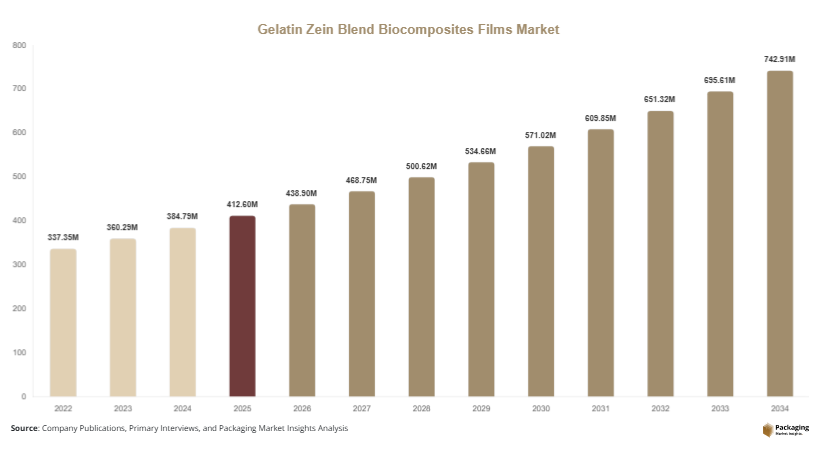
In 2025, the global gelatin zein blend biocomposites films market size is estimated at USD 412.6 million, with growth to approximately USD 438.9 million in 2026. The market is projected to reach USD 789.4 million by 2034, registering a CAGR of 6.8% during the forecast period (2025–2034). This growth reflects increasing industry efforts to replace petroleum-based plastics with bio-derived film solutions that offer improved environmental performance without compromising functional properties. The gelatin zein blend biocomposites films market is witnessing steady expansion driven by the rising demand for sustainable and biodegradable packaging materials across food, pharmaceutical, and consumer goods industries.
One of the primary growth factors is the increasing regulatory pressure against single-use plastics, which has accelerated the adoption of biodegradable films in packaging applications. Governments across regions are implementing policies that encourage bio-based alternatives, pushing manufacturers toward gelatin and zein blend formulations due to their compostable nature. Another factor is the growing demand from the food packaging sector, where these films provide oxygen barrier properties, extend shelf life, and maintain product freshness. Additionally, advancements in biopolymer blending technologies are enhancing the mechanical strength, flexibility, and moisture resistance of gelatin-zein films, making them more viable for commercial-scale deployment.
Key Highlights:
- Asia Pacific dominated the market with a 36.8% share in 2025, while Latin America is projected to grow at the fastest CAGR of 7.2%.
- Food packaging led the application segment with a 41.5% share, while pharmaceutical applications are expected to grow at a CAGR of 7.4%.
- Flexible films dominated the product type segment with a 54.2% share, while multilayer films are forecasted to grow at a CAGR of 6.9%.
- Consumer goods packaging accounted for 38.7% share, while biomedical applications are expected to grow at a CAGR of 7.6%.
- China remained the dominant country with a market size of USD 96.4 million in 2025 and USD 102.1 million in 2026.
Explore more data points, trends and opportunities Download Free Sample Report
Market Trends
Increasing Integration of Functional Additives in Biocomposite Films
A key trend shaping the gelatin zein blend biocomposites films market is the integration of functional additives such as antimicrobial agents, antioxidants, and UV blockers into film formulations. These additives enhance the performance characteristics of the films, making them more suitable for high-value applications such as active food packaging and pharmaceutical coatings. Manufacturers are focusing on embedding natural extracts and bioactive compounds to improve shelf life and safety of packaged goods. This trend is particularly relevant in the food sector, where extended shelf life and reduced spoilage are critical factors. As research advances, these multifunctional films are becoming increasingly cost-effective and scalable.
Shift Toward Advanced Processing Technologies
Another emerging trend is the adoption of advanced processing technologies such as extrusion, electrospinning, and solvent casting to improve the structural integrity and scalability of gelatin-zein films. Traditional film production methods often resulted in limited durability and moisture sensitivity. However, newer techniques are enabling manufacturers to achieve consistent thickness, enhanced tensile strength, and improved barrier properties. This shift is facilitating broader adoption across industries, including packaging and healthcare. The ability to customize film properties through processing innovations is also enabling product differentiation, which is contributing to competitive growth in the market.
Market Drivers
Rising Demand for Sustainable Packaging Solutions
The increasing global emphasis on sustainability is a major driver for the gelatin zein blend biocomposites films market. Industries are actively seeking alternatives to conventional plastic packaging due to environmental concerns and regulatory mandates. Gelatin and zein, being biodegradable and derived from renewable resources, offer a viable solution. Companies are incorporating these materials into packaging solutions to meet sustainability targets and appeal to environmentally conscious consumers. This shift is particularly evident in the food and beverage industry, where eco-friendly packaging has become a key differentiator for brands.
Expanding Applications in Pharmaceutical and Biomedical Sectors
Another significant driver is the growing use of gelatin-zein films in pharmaceutical and biomedical applications. These films are biocompatible, non-toxic, and capable of controlled drug release, making them suitable for drug delivery systems and wound care products. The increasing prevalence of chronic diseases and the demand for advanced healthcare solutions are boosting the adoption of such materials. Additionally, research in biomaterials is expanding the scope of applications, further driving market growth. The versatility of gelatin-zein blends allows for customization according to specific medical requirements, enhancing their adoption in the healthcare sector.
Market Restraint
High Production Costs and Limited Scalability
One of the primary restraints affecting the gelatin zein blend biocomposites films market is the relatively high production cost compared to conventional plastic films. The extraction and purification processes for gelatin and zein, along with the blending and processing technologies, can be expensive. This cost factor limits adoption, especially among small and medium enterprises that operate on tight budgets. Additionally, scalability remains a challenge, as large-scale production requires significant investment in specialized equipment and infrastructure. For instance, manufacturers attempting to replace plastic packaging with biocomposite films often face difficulties in maintaining consistent quality at higher volumes. This limitation impacts the overall market penetration and slows down widespread adoption across industries.
Market Opportunities
Growth in Emerging Economies
Emerging economies present significant growth opportunities for the gelatin zein blend biocomposites films market. Rapid industrialization, urbanization, and increasing disposable incomes are driving demand for packaged goods, which in turn boosts the need for sustainable packaging solutions. Countries in Asia Pacific and Latin America are witnessing increased investments in biodegradable materials and eco-friendly technologies. Governments in these regions are also promoting sustainable practices through incentives and regulations. As awareness about environmental issues grows, manufacturers have the opportunity to expand their presence and tap into these high-growth markets.
Development of Hybrid Biocomposite Films
The development of hybrid biocomposite films that combine gelatin-zein blends with other biopolymers or nanomaterials is another promising opportunity. These hybrid films offer enhanced mechanical strength, thermal stability, and barrier properties, making them suitable for a wider range of applications. Research and development activities are focusing on improving the performance characteristics of these films to match or exceed those of conventional plastics. This innovation is expected to open new avenues in industries such as electronics packaging, agriculture, and healthcare. As technological advancements continue, hybrid films are likely to play a crucial role in expanding the market scope.
Report Scope
| Report Metric | Details |
|---|---|
| Market Size in 2025 | USD 412.6 Million |
| Market Size in 2026 | USD 438.9 Million |
| Market Size in 2034 | USD 789.4 Million |
| CAGR | 6.8% (2026-2034) |
| Base Year for Estimation | 2025 |
| Historical Data | 2022-2024 |
| Forecast Period | 2026-2034 |
| Report Coverage | Revenue Forecast, Competitive Landscape, Supply Chain Disruption, Growth Factors, Environment & Regulatory Landscape and Trends |
| Geographies Covered | North America, Europe, APAC, Middle East and Africa, LATAM |
| Countries Covered | U.S., Canada, U.K., Germany, France, Spain, Italy, Russia, Nordic, Benelux, Rest of Europe, China, South Korea, Japan, India, Australia, Singapore, Taiwan, South East Asia, Rest of Asia-Pacific, UAE, Turky, Saudi Arabia, South Africa, Egypt, Nigeria, Rest of MEA, Brazil, Mexico, Argentina, Chile, Colombia, Rest of LATAM |
Explore more data points, trends and opportunities Download Free Sample Report
Segmental Analysis
By Type
Flexible films dominated the gelatin zein blend biocomposites films market in 2024, accounting for approximately 54.2% of the total market share. These films are widely used in packaging applications due to their adaptability, ease of processing, and cost-effectiveness. Flexible films offer good barrier properties against oxygen and moisture, making them suitable for food packaging. Additionally, they are lightweight and can be easily customized to meet specific requirements, which further enhances their adoption across industries.
Multilayer films are projected to be the fastest-growing segment, with a CAGR of 6.9% during the forecast period. These films combine multiple layers of materials to enhance performance characteristics such as strength, durability, and barrier properties. The growing demand for high-performance packaging solutions is driving the adoption of multilayer films. Additionally, advancements in layering technologies are enabling manufacturers to develop films with improved functionality, supporting market growth.
By Application
Food packaging emerged as the dominant application segment in 2024, accounting for 41.5% of the market share. Gelatin-zein films are widely used in food packaging due to their ability to extend shelf life and maintain product quality. These films provide effective barriers against oxygen and moisture, which helps in preserving food freshness. The increasing demand for packaged food products is driving the growth of this segment.
Pharmaceutical applications are expected to grow at the fastest CAGR of 7.4% during the forecast period. The use of gelatin-zein films in drug delivery systems and medical packaging is increasing due to their biocompatibility and biodegradability. The growing demand for advanced healthcare solutions is supporting the growth of this segment. Additionally, ongoing research is expanding the scope of applications, further driving market growth.
By End-Use
Consumer goods packaging dominated the market in 2024, accounting for 38.7% of the total share. The increasing demand for sustainable packaging solutions in consumer goods industries is driving the adoption of gelatin-zein films. These films are used for packaging a wide range of products, including personal care items and household goods. The shift toward eco-friendly packaging is supporting the growth of this segment.
Biomedical applications are projected to be the fastest-growing segment, with a CAGR of 7.6% during the forecast period. The use of gelatin-zein films in medical applications such as wound dressings and tissue engineering is increasing. These films offer excellent biocompatibility and controlled degradation, making them suitable for biomedical use. The growing demand for advanced medical materials is driving the growth of this segment.
Gelatin Zein Blend Biocomposites Films Market Segmentations
By Type
- Flexible Films
- Multilayer Films
- Coated Films
By Application
- Food Packaging
- Pharmaceutical
- Agriculture
- Others
By End-Use
- Consumer Goods
- Healthcare
- Industrial
- Others
Regional Analysis
North America
North America accounted for approximately 24.6% of the gelatin zein blend biocomposites films market share in 2025 and is projected to grow at a CAGR of 6.3% during the forecast period. The region’s growth is supported by stringent environmental regulations and increasing demand for sustainable packaging solutions. The presence of advanced research facilities and strong investment in biopolymer technologies further enhances market growth. Industries are actively adopting biodegradable films to reduce their carbon footprint, contributing to steady expansion.
The United States dominates the North American market due to its well-established packaging and pharmaceutical industries. A unique growth factor in the region is the strong collaboration between academic institutions and industry players, which accelerates innovation in biocomposite materials. This collaboration enables the development of high-performance films that meet industry standards, supporting market growth.
Europe
Europe held a market share of 22.1% in 2025 and is expected to grow at a CAGR of 6.5% through 2034. The region is characterized by strict regulations on plastic usage and a strong emphasis on circular economy practices. Countries across Europe are adopting biodegradable materials to meet sustainability goals, driving demand for gelatin-zein films. The presence of established packaging industries further supports market growth.
Germany leads the European market, driven by its advanced manufacturing capabilities and focus on sustainable technologies. A unique growth factor in the region is the implementation of extended producer responsibility (EPR) policies, which encourage manufacturers to adopt eco-friendly materials. This policy framework is significantly boosting the adoption of biocomposite films.
Asia Pacific
Asia Pacific dominated the market with a 36.8% share in 2025 and is projected to grow at a CAGR of 7.0% during the forecast period. The region’s growth is fueled by rapid industrialization, increasing population, and rising demand for packaged goods. Governments are promoting sustainable materials, which is encouraging the adoption of gelatin-zein films across industries.
China is the leading country in the region, supported by its large manufacturing base and growing investment in biodegradable materials. A unique growth factor is the expansion of the food processing industry, which drives demand for eco-friendly packaging solutions. This trend is expected to sustain market growth in the region.
Middle East & Africa
The Middle East & Africa accounted for 7.9% of the market share in 2025 and is projected to grow at a CAGR of 6.1%. The region is gradually adopting sustainable packaging solutions as awareness about environmental issues increases. Governments are implementing policies to reduce plastic waste, which is supporting the growth of biocomposite films.
South Africa leads the market in this region due to its developing packaging industry. A unique growth factor is the increasing investment in sustainable infrastructure and waste management systems. These initiatives are encouraging the adoption of biodegradable materials, contributing to market growth.
Latin America
Latin America held a market share of 8.6% in 2025 and is expected to grow at the fastest CAGR of 7.2%. The region is experiencing increasing demand for sustainable packaging solutions due to rising environmental awareness. Governments are promoting the use of biodegradable materials, which is driving market growth.
Brazil dominates the Latin American market, supported by its expanding food and beverage industry. A unique growth factor is the increasing export of agricultural products, which requires efficient and sustainable packaging solutions. This demand is boosting the adoption of gelatin-zein films in the region.
Competitive Landscape
The gelatin zein blend biocomposites films market is moderately fragmented, with several key players focusing on product innovation and strategic partnerships to strengthen their market position. Leading companies are investing in research and development to enhance the performance characteristics of biocomposite films and expand their application scope.
One of the leading players in the market is Cargill, Incorporated, which has been actively involved in developing sustainable biopolymer solutions. The company recently expanded its product portfolio by introducing advanced gelatin-based films for packaging applications. Other companies are also focusing on collaborations and acquisitions to enhance their capabilities and market reach. The competitive landscape is characterized by continuous innovation and a strong emphasis on sustainability.
Key Players List
- Cargill, Incorporated
- Archer Daniels Midland Company
- Gelita AG
- Tate & Lyle PLC
- Ingredion Incorporated
- Kerry Group
- Roquette Frères
- DuPont de Nemours, Inc.
- Ashland Global Holdings Inc.
- FMC Corporation
- Darling Ingredients Inc.
- Nitta Gelatin Inc.
- Ajinomoto Co., Inc.
- BASF SE
- DSM-Firmenich