High Barrier Packaging Films Market Size and Growth
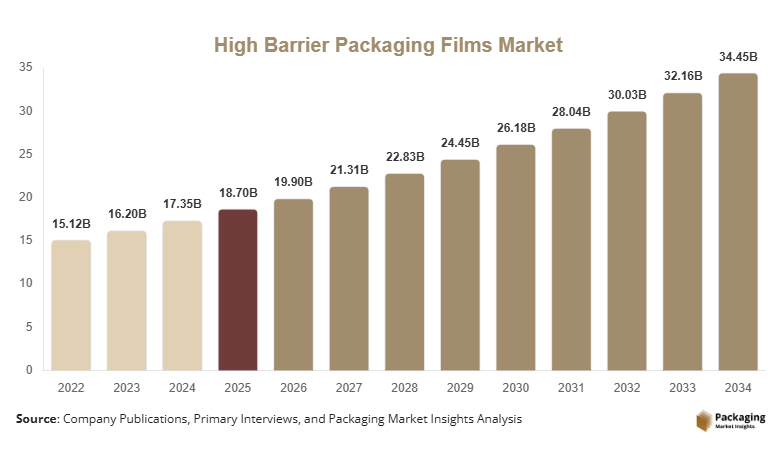
The global high barrier packaging films market size was valued at approximately USD 18.7 billion in 2025 and is expected to reach USD 19.9 billion in 2026. The market is projected to achieve nearly USD 34.5 billion by 2034, expanding at a CAGR of 7.1% during 2025–2034. The high barrier packaging films market is witnessing consistent growth due to rising demand for advanced packaging solutions that enhance product shelf life, preserve freshness, and protect products from moisture, oxygen, light, and contaminants. High barrier packaging films are widely used across food, pharmaceutical, industrial, and personal care industries because of their superior protective properties and lightweight structure. These films are commonly manufactured using materials such as polyethylene, polypropylene, polyamide, ethylene vinyl alcohol, and polyester, often combined in multilayer structures for enhanced barrier performance.
One of the major factors driving market growth is the increasing consumption of packaged and processed food products globally. Consumers are demanding packaging solutions that maintain food quality, reduce spoilage, and improve convenience. Another key growth factor is the rapid expansion of the pharmaceutical industry, where high barrier films are used for medical devices, blister packs, and drug packaging requiring moisture and oxygen protection. In addition, growing e-commerce activity is encouraging manufacturers to adopt durable packaging materials that provide product safety during transportation and storage.
Key Highlights
- Asia Pacific dominated the market with a 38.6% share in 2025.
- Latin America is projected to grow at the fastest CAGR of 7.5%.
- Multilayer films led the product type segment with a 49.3% share.
- Polyethylene materials dominated the market with a 31.8% share.
- Food & beverage applications accounted for 52.6% market share.
- The US remained the dominant country with a market size of USD 4.9 billion in 2025 and USD 5.2 billion in 2026.
Explore more data points, trends and opportunities Download Free Sample Report
Market Trends
Increasing Adoption of Recyclable High Barrier Films
Sustainability is becoming a major trend within the high barrier packaging films market as manufacturers and brand owners seek environmentally responsible packaging solutions. Companies are increasingly replacing traditional multilayer mixed-material structures with recyclable mono-material films that maintain strong oxygen and moisture barrier properties. Food and beverage producers are adopting recyclable high barrier films to align with regulatory requirements and consumer expectations regarding packaging waste reduction. Packaging converters are also investing in advanced coating technologies and recyclable barrier resins that improve performance without compromising sustainability goals. This trend is expected to continue as circular economy initiatives and recycling infrastructure expand across developed and emerging markets.
Rising Demand for Lightweight Flexible Packaging
The market is witnessing growing demand for lightweight flexible packaging formats due to their cost efficiency and transportation advantages. High barrier films are increasingly used in pouches, sachets, vacuum packaging, and stand-up bags because they reduce overall packaging weight while extending product shelf life. Manufacturers are focusing on downgauging technologies that use thinner films without reducing protective performance. Food processors and pharmaceutical companies prefer lightweight flexible packaging because it lowers logistics costs and improves storage efficiency. The expansion of e-commerce and retail-ready packaging solutions is further supporting the adoption of lightweight high barrier films across multiple industries.
Market Drivers
Growth of Packaged Food Consumption
The increasing global demand for packaged and convenience foods is a major factor driving the high barrier packaging films market. Urbanization, changing lifestyles, and rising disposable income levels are encouraging consumers to purchase ready-to-eat meals, snacks, frozen foods, and packaged beverages. High barrier films help maintain freshness, flavor, and nutritional quality by protecting products from oxygen and moisture exposure. Food manufacturers rely on these films to improve shelf stability and reduce food waste during transportation and storage. In addition, supermarkets and retail chains increasingly require durable packaging solutions that support extended shelf life and product visibility, further strengthening market demand.
Expanding Pharmaceutical Packaging Industry
The pharmaceutical sector is another major driver supporting market growth. High barrier packaging films are widely used for blister packs, medical devices, diagnostic kits, and pharmaceutical pouches because they provide protection against environmental contamination and moisture penetration. Rising healthcare expenditure, increasing pharmaceutical production, and growing demand for temperature-sensitive medications are contributing to higher consumption of advanced barrier films. Pharmaceutical manufacturers are also adopting multilayer film structures to comply with strict product safety regulations and improve drug stability. As healthcare infrastructure expands globally, demand for reliable pharmaceutical packaging materials is expected to increase steadily.
Market Restraint
High Production Costs of Advanced Barrier Film Technologies
One of the key restraints affecting the high barrier packaging films market is the high production cost associated with advanced multilayer and specialty barrier technologies. Manufacturing high barrier films often requires complex extrusion, coating, and lamination processes involving multiple raw materials and sophisticated equipment. These costs can create pricing challenges for small and medium-sized packaging manufacturers, particularly in price-sensitive developing markets. For example, pharmaceutical-grade barrier films with moisture-resistant coatings and oxygen protection layers are significantly more expensive than conventional flexible packaging materials. In addition, recycling multilayer structures remains technically challenging in some regions, increasing waste management concerns and operational expenses. Fluctuating raw material prices for specialty polymers such as EVOH and polyamide can also impact profit margins and limit market penetration among cost-conscious end users.
Market Opportunities
Development of Bio-Based Barrier Films
The increasing focus on sustainable packaging solutions is creating major opportunities for bio-based high barrier films. Manufacturers are investing in renewable raw materials such as cellulose, polylactic acid, and bio-based polyethylene to develop environmentally responsible packaging solutions with effective barrier properties. Food brands and retailers are increasingly seeking packaging materials that reduce carbon emissions while maintaining shelf life performance. Technological improvements in bio-based coatings and compostable barrier structures are expanding commercial applications across food and healthcare industries. As regulations supporting sustainable packaging become stricter, demand for bio-based high barrier films is expected to rise significantly over the forecast period.
Expansion of High Barrier Films in E-commerce Packaging
The rapid growth of e-commerce platforms is generating strong opportunities for high barrier packaging film manufacturers. Online retail channels require protective packaging solutions that prevent moisture damage, contamination, and product spoilage during transportation. High barrier flexible films are increasingly used for packaged foods, pharmaceuticals, nutraceuticals, and personal care products sold through digital platforms. E-commerce retailers are also prioritizing lightweight packaging formats to reduce shipping costs and improve operational efficiency. The expansion of temperature-controlled logistics and direct-to-consumer delivery models is expected to further strengthen demand for durable and high-performance barrier film packaging solutions globally.
Report Scope
| Report Metric | Details |
|---|---|
| Market Size in 2025 | USD 18.7 Billion |
| Market Size in 2026 | USD 19.9 Billion |
| Market Size in 2034 | USD 34.5 Billion |
| CAGR | 7.1% (2026-2034) |
| Base Year for Estimation | 2025 |
| Historical Data | 2022-2024 |
| Forecast Period | 2026-2034 |
| Report Coverage | Revenue Forecast, Competitive Landscape, Supply Chain Disruption, Growth Factors, Environment & Regulatory Landscape and Trends |
| Geographies Covered | North America, Europe, APAC, Middle East and Africa, LATAM |
| Countries Covered | U.S., Canada, U.K., Germany, France, Spain, Italy, Russia, Nordic, Benelux, Rest of Europe, China, South Korea, Japan, India, Australia, Singapore, Taiwan, South East Asia, Rest of Asia-Pacific, UAE, Turky, Saudi Arabia, South Africa, Egypt, Nigeria, Rest of MEA, Brazil, Mexico, Argentina, Chile, Colombia, Rest of LATAM |
Explore more data points, trends and opportunities Download Free Sample Report
Segmental Analysis
By Product Type
Multilayer films dominated the high barrier packaging films market in 2024 and accounted for approximately 49.3% of total market share. These films combine multiple material layers to provide enhanced resistance against oxygen, moisture, aroma, and light exposure. Food manufacturers widely use multilayer films for vacuum packaging, frozen foods, snack packaging, and ready-to-eat meals because they improve shelf stability and reduce spoilage. Pharmaceutical companies also prefer multilayer structures for blister packs and medical packaging applications requiring high protective performance. In addition, multilayer films support lightweight packaging designs while maintaining mechanical strength and sealing efficiency across various commercial applications.
Recyclable barrier films are projected to register the fastest CAGR of 8.1% during the forecast period. Increasing environmental regulations and corporate sustainability goals are encouraging packaging manufacturers to develop recyclable high barrier solutions compatible with existing recycling systems. Food and beverage companies are adopting recyclable barrier films to reduce packaging waste and improve sustainability reporting. Technological advancements in mono-material structures and barrier coatings are improving oxygen and moisture protection while maintaining recyclability. Growing consumer preference for environmentally responsible packaging solutions is expected to further accelerate demand for recyclable high barrier films globally.
By Material
Polyethylene materials accounted for the largest market share of 31.8% in 2024 because of their flexibility, sealability, and cost efficiency. Polyethylene-based high barrier films are widely used in food packaging, industrial packaging, and pharmaceutical applications due to their strong moisture resistance and compatibility with multilayer film structures. Manufacturers prefer polyethylene because it supports efficient processing and lightweight flexible packaging designs. In addition, polyethylene films are increasingly being integrated with recyclable packaging technologies, supporting sustainability objectives among packaging producers and brand owners.
EVOH films are expected to witness the fastest CAGR of 7.9% during the forecast period. Ethylene vinyl alcohol materials offer superior oxygen barrier performance, making them highly suitable for food preservation and pharmaceutical packaging applications. Rising demand for extended shelf life products and advanced flexible packaging solutions is driving adoption of EVOH films globally. Food manufacturers are increasingly using EVOH layers in vacuum-sealed meat packaging, dairy packaging, and ready-to-eat food applications. Technological developments improving recyclability and multilayer compatibility are expected to support further expansion of the EVOH film segment.
By Application
Food & beverage applications dominated the market in 2024 and accounted for approximately 52.6% of the total market share. High barrier packaging films are widely used in packaged foods, dairy products, beverages, snacks, frozen meals, and vacuum-packed products because they extend shelf life and maintain product freshness. Rising consumption of convenience foods and changing dietary habits are increasing demand for durable and lightweight packaging materials. Food manufacturers are also using high barrier films to improve product safety and reduce waste throughout supply chains. Growth in organized retail and e-commerce grocery platforms is further supporting segment expansion.
Pharmaceutical packaging is projected to register the fastest CAGR of 7.7% during the forecast period. Pharmaceutical manufacturers require advanced barrier films that protect medicines and medical products from oxygen, humidity, and contamination. Increasing healthcare expenditure and rising pharmaceutical production are contributing to higher demand for protective packaging materials. Blister packaging, medical device packaging, and sterile pharmaceutical pouches are among the major applications driving growth. In addition, stricter healthcare regulations and rising demand for temperature-sensitive medications are encouraging wider adoption of advanced high barrier packaging technologies.
High Barrier Packaging Films Market Segmentations
By Product Type
- Multilayer Films
- Metallized Films
- Transparent Barrier Films
- Recyclable Barrier Films
By Material
- Polyethylene
- Polypropylene
- Polyamide
- EVOH
- Polyester
By Application
- Food & Beverage
- Pharmaceutical Packaging
- Personal Care Packaging
- Industrial Packaging
- Agricultural Packaging
Regional Analysis
North America
North America accounted for approximately 29.7% of the global high barrier packaging films market share in 2025 and is projected to grow at a CAGR of 6.5% during the forecast period. Strong demand from food processing, healthcare, and retail sectors is driving regional market growth. Manufacturers are increasingly investing in recyclable high barrier films and lightweight flexible packaging solutions. The presence of advanced packaging technology providers and rising consumption of packaged food products are also contributing to market expansion across the region.
The United States dominates the North American market due to its large packaged food and pharmaceutical industries. A unique growth factor in the country is the increasing adoption of vacuum-sealed flexible packaging for protein-rich food products and frozen meals. Food producers are using advanced barrier films to improve shelf life, reduce spoilage, and strengthen retail distribution efficiency across national supply chains.
Europe
Europe held around 26.8% of the global market share in 2025 and is expected to expand at a CAGR of 6.7% through 2034. Strict environmental regulations and strong consumer demand for sustainable packaging are influencing regional market growth. Packaging companies are increasingly adopting recyclable multilayer films and mono-material barrier solutions to align with circular economy goals. Growth in pharmaceutical manufacturing and premium packaged food consumption is also supporting demand for advanced barrier film technologies across European markets.
Germany leads the European market because of its strong industrial packaging sector and advanced packaging innovation capabilities. A unique growth factor is the country’s increasing investment in recyclable flexible packaging research. Packaging manufacturers are developing barrier films compatible with mechanical recycling systems while maintaining oxygen and moisture protection standards for food and pharmaceutical applications.
Asia Pacific
Asia Pacific represented approximately 38.6% of the global market share in 2025 and is projected to register the fastest-growing regional demand over the forecast period. Rapid urbanization, rising disposable incomes, and increasing packaged food consumption are driving strong market expansion across the region. Growth in pharmaceutical manufacturing and retail modernization is also contributing to increased use of high barrier packaging films. Packaging producers are expanding production capacity to meet rising domestic and export demand.
China dominates the Asia Pacific market due to its extensive food processing and flexible packaging manufacturing industries. A unique growth factor is the rapid expansion of e-commerce grocery delivery services, which require durable and moisture-resistant packaging materials. High barrier films are increasingly used for vacuum-packed foods, ready-to-eat meals, and pharmaceutical products distributed through online retail channels.
Middle East & Africa
The Middle East & Africa region accounted for approximately 5.2% of the global high barrier packaging films market share in 2025 and is expected to grow at a CAGR of 5.9% during the forecast period. Increasing urban population, rising food imports, and expanding healthcare infrastructure are supporting regional market growth. Flexible packaging demand is increasing in retail food distribution, beverage packaging, and pharmaceutical applications. Investment in cold chain logistics is also encouraging adoption of advanced barrier packaging solutions.
Saudi Arabia dominates the regional market because of its expanding food processing and pharmaceutical sectors. A unique growth factor is the growing demand for temperature-resistant packaging solutions suitable for harsh climatic conditions. Food manufacturers are increasingly adopting multilayer high barrier films to improve shelf stability and product safety during transportation and storage.
Latin America
Latin America accounted for nearly 6.1% of the global market share in 2025 and is projected to grow at a CAGR of 7.5% during the forecast period. Rising demand for packaged foods, snacks, and healthcare products is driving regional market expansion. Retail modernization and growth of supermarket chains are increasing the need for advanced flexible packaging solutions with improved barrier performance. Manufacturers are also focusing on lightweight packaging materials to reduce logistics costs and improve sustainability performance.
Brazil dominates the Latin American market due to its large food and beverage industry. A unique growth factor is the growing export of processed meat and agricultural products that require moisture-resistant and oxygen-protective packaging solutions. Food exporters are increasingly using high barrier films to maintain freshness and comply with international packaging standards.
Competitive Landscape
The high barrier packaging films market is moderately consolidated, with major companies focusing on product innovation, sustainable material development, and production expansion strategies. Packaging manufacturers are investing heavily in recyclable multilayer structures, advanced coating technologies, and bio-based barrier films to strengthen market competitiveness. Strategic collaborations with food processors and pharmaceutical companies are also supporting long-term business growth.
Amcor plc remains one of the leading companies in the market because of its broad flexible packaging portfolio and strong global manufacturing network. In 2024, the company introduced a recyclable high barrier flexible packaging solution designed for dry food and healthcare applications. Other major players include Berry Global Inc., Sealed Air Corporation, Mondi Group, and Toray Industries Inc. These companies are expanding research activities related to lightweight packaging, sustainable film structures, and improved oxygen barrier technologies. Investments in digital printing compatibility and high-performance flexible packaging are expected to remain key competitive strategies across the industry.
Key Players List
- Amcor plc
- Berry Global Inc.
- Sealed Air Corporation
- Mondi Group
- Toray Industries Inc.
- Toppan Holdings Inc.
- Mitsubishi Chemical Group
- Winpak Ltd.
- Cosmo Films Ltd.
- UFlex Ltd.
- Coveris Holdings S.A.
- Huhtamaki Oyj
- Constantia Flexibles
- Sonoco Products Company
- DuPont de Nemours, Inc.