Packaging Tapes Market Size and Growth
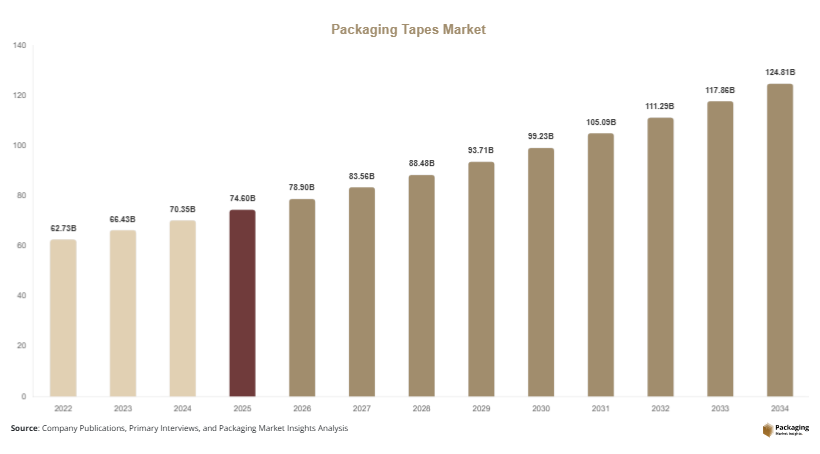
The global packaging tapes market size was valued at approximately USD 74.6 billion in 2025 and is projected to reach around USD 78.9 billion in 2026. By 2034, the market is forecasted to attain nearly USD 124.8 billion, expanding at a CAGR of 5.9% during 2025–2034. Rising consumption of packaged goods and increasing shipping activities are among the primary factors contributing to long-term market growth. Packaging companies and logistics providers are increasingly adopting advanced pressure-sensitive tapes with higher durability, stronger adhesion, and improved environmental performance.
One of the major growth drivers is the rapid expansion of the e-commerce sector globally. Online retailers require efficient packaging systems capable of handling high-volume parcel shipments while maintaining package integrity during transportation. Another key factor is increasing demand from food and beverage manufacturers for tamper-resistant and moisture-resistant packaging tape solutions. Additionally, rising industrial production and warehouse automation are driving the use of machine-compatible packaging tapes in manufacturing and logistics operations.
Key Highlights:
- Asia Pacific dominated the market with a 39.8% share in 2025.
- Latin America is projected to grow at the fastest CAGR of 6.8%.
- Pressure-sensitive tapes led the type segment with a 44.6% share.
- Polypropylene material dominated with a 49.2% share.
- E-commerce and logistics applications led the end-use segment with 41.7% share.
- The US remained the dominant country with a market size of USD 14.1 billion in 2025 and USD 14.9 billion in 2026.
Explore more data points, trends and opportunities Download Free Sample Report
Market Trends
Rising Adoption of Sustainable and Recyclable Packaging Tapes
Sustainability has become a major trend shaping the packaging tapes market. Manufacturers are increasingly introducing recyclable paper tapes, biodegradable adhesives, and solvent-free tape technologies to reduce environmental impact. Companies operating in e-commerce and consumer goods industries are prioritizing eco-friendly packaging materials to meet regulatory requirements and corporate sustainability goals. For example, online retailers are increasingly replacing traditional plastic tapes with paper-based water-activated tapes that improve recyclability while maintaining sealing strength. Packaging suppliers are also developing compostable adhesive systems for lightweight shipping applications. Future market growth is expected to benefit from rising consumer awareness regarding sustainable packaging and increasing government regulations restricting plastic waste generation.
Integration of Smart and Customized Packaging Tape Solutions
The market is also witnessing growing adoption of customized and smart packaging tape technologies. Companies are increasingly using printed tapes with branding, QR codes, and tracking information to improve product visibility and supply chain efficiency. Smart packaging tapes integrated with tamper-evident features and digital tracking capabilities are gaining popularity in pharmaceutical and high-value consumer goods packaging. For instance, logistics providers are adopting barcode-enabled packaging tapes to improve inventory tracking and reduce package handling errors. Future developments are expected to include RFID-enabled tapes and intelligent monitoring systems capable of supporting automated warehouse operations and real-time shipment tracking across global supply chains.
Market Drivers
Expansion of Global E-Commerce and Logistics Operations
The rapid expansion of e-commerce and logistics industries is a major growth driver for the packaging tapes market. Rising online shopping activity has significantly increased parcel shipment volumes worldwide, creating strong demand for durable carton sealing solutions. E-commerce companies require packaging tapes capable of supporting automated packaging systems while ensuring product safety during transportation. For example, major fulfillment centers are increasingly using machine-grade pressure-sensitive tapes to improve operational speed and package reliability. Growing cross-border trade and warehouse automation are also accelerating packaging tape consumption. As online retail penetration continues expanding globally, demand for high-performance adhesive tapes is expected to increase steadily.
Increasing Demand from Food and Pharmaceutical Packaging Industries
The growing use of packaging tapes in food and pharmaceutical industries is another important market driver. Food manufacturers rely on moisture-resistant and tamper-evident tapes for secure transportation of packaged goods. Pharmaceutical companies are increasingly adopting specialty tapes designed for contamination prevention and regulatory compliance. For instance, medical supply packaging facilities commonly use reinforced adhesive tapes for cold-chain shipping and healthcare product distribution. Rising consumption of packaged foods, healthcare products, and temperature-sensitive shipments is contributing significantly to market demand. Increasing investment in pharmaceutical logistics infrastructure is also supporting long-term industry growth.
Market Restraint
One of the major restraints affecting the packaging tapes market is the volatility in raw material prices, particularly petroleum-based materials used in plastic backing films and adhesives. Fluctuations in polypropylene, PVC, and acrylic adhesive prices directly impact production costs and profit margins for manufacturers. In addition, increasing environmental concerns regarding plastic waste and non-recyclable packaging materials are creating regulatory challenges for the industry. For example, several countries are implementing restrictions on single-use plastic packaging products, encouraging companies to transition toward paper-based alternatives. Small and mid-sized manufacturers may face difficulties adapting to evolving sustainability standards due to higher production and material transition costs. These factors could limit short-term market expansion in certain regions.
Market Opportunities
Growth of Sustainable Paper-Based Packaging Tape Solutions
The increasing demand for sustainable packaging solutions presents significant growth opportunities for the packaging tapes market. Paper-based tapes with water-activated adhesives are gaining popularity due to their recyclability and reduced environmental impact. E-commerce companies and consumer goods manufacturers are increasingly shifting toward eco-friendly packaging materials to meet sustainability targets. For example, several retail brands are adopting recyclable kraft paper tapes for parcel shipping and carton sealing operations. Future opportunities are expected to emerge from advancements in biodegradable adhesive formulations and high-strength paper tape technologies. Growing environmental regulations worldwide are likely to accelerate adoption of sustainable tape products across multiple industries.
Expansion of Automated Packaging and Warehouse Systems
The increasing use of automated packaging and warehouse systems is creating substantial opportunities for advanced packaging tape solutions. Manufacturing facilities and logistics centers are adopting high-speed carton sealing equipment requiring machine-grade adhesive tapes with consistent performance characteristics. For instance, automated distribution centers increasingly use pressure-sensitive tapes compatible with robotic packaging operations and conveyor-based handling systems. Future growth is expected to be supported by Industry 4.0 integration and expansion of smart warehouse infrastructure globally. Companies developing durable, high-speed compatible, and digitally trackable tape products are likely to benefit from rising automation investments across logistics and manufacturing industries.
Report Scope
| Report Metric | Details |
|---|---|
| Market Size in 2025 | USD 74.6 Billion |
| Market Size in 2026 | USD 78.9 Billion |
| Market Size in 2034 | USD 124.8 Billion |
| CAGR | 5.9% (2026-2034) |
| Base Year for Estimation | 2025 |
| Historical Data | 2022-2024 |
| Forecast Period | 2026-2034 |
| Report Coverage | Revenue Forecast, Competitive Landscape, Supply Chain Disruption, Growth Factors, Environment & Regulatory Landscape and Trends |
| Geographies Covered | North America, Europe, APAC, Middle East and Africa, LATAM |
| Countries Covered | U.S., Canada, U.K., Germany, France, Spain, Italy, Russia, Nordic, Benelux, Rest of Europe, China, South Korea, Japan, India, Australia, Singapore, Taiwan, South East Asia, Rest of Asia-Pacific, UAE, Turky, Saudi Arabia, South Africa, Egypt, Nigeria, Rest of MEA, Brazil, Mexico, Argentina, Chile, Colombia, Rest of LATAM |
Explore more data points, trends and opportunities Download Free Sample Report
Segmental Analysis
Type Segment
Pressure-sensitive tapes dominated the type segment with approximately 44.6% market share in 2024. These tapes are widely preferred because of their ease of application, strong adhesion properties, and compatibility with automated carton sealing systems. Industries including e-commerce, food packaging, and logistics rely heavily on pressure-sensitive tapes for high-volume shipping operations. For example, fulfillment centers commonly use acrylic and hot-melt adhesive tapes capable of supporting rapid packaging line speeds and varying transportation conditions. The dominance of this segment is also supported by availability in different thicknesses, widths, and adhesive formulations suitable for industrial and retail packaging applications. Their ability to maintain strong sealing performance during long-distance transportation further supports widespread market adoption across multiple industries.
Water-activated tapes are projected to emerge as the fastest-growing subsegment with a CAGR of 6.9% during 2025–2034. Growth is driven by increasing sustainability initiatives and rising demand for tamper-evident packaging solutions. Water-activated tapes provide stronger bonding performance and improved carton security compared to conventional plastic tapes. For example, e-commerce retailers are increasingly adopting kraft paper-based water-activated tapes for recyclable shipping operations and branded packaging applications. Future growth is expected to be supported by stricter environmental regulations limiting plastic packaging waste and increasing consumer preference for eco-friendly packaging materials. Advancements in reinforced paper tape technologies are also likely to accelerate adoption in industrial logistics operations.
Material Segment
Polypropylene material dominated the material segment with approximately 49.2% share in 2024. Polypropylene-based tapes are widely used because they offer cost efficiency, flexibility, durability, and strong adhesion performance. These tapes are commonly utilized in carton sealing, bundling, and industrial shipping applications across manufacturing and retail sectors. For example, logistics companies frequently use polypropylene tapes for automated packaging systems due to their compatibility with high-speed dispensing equipment. The material’s lightweight structure and moisture resistance further contribute to its extensive usage in transportation packaging operations. Strong availability of polypropylene films and relatively low production costs continue supporting dominance within the packaging tapes industry.
Paper-based materials are expected to witness the fastest CAGR of 6.5% during the forecast period. Growth is primarily driven by rising demand for recyclable and biodegradable packaging solutions. Retailers and e-commerce companies are increasingly replacing plastic-based tapes with kraft paper alternatives to improve packaging sustainability. For instance, food delivery companies and consumer goods brands are adopting paper tapes compatible with recyclable corrugated packaging systems. Future market expansion is expected to benefit from innovations in water-resistant paper coatings and biodegradable adhesive technologies. Increasing global focus on circular economy practices is likely to accelerate adoption of paper-based packaging tapes across industrial and commercial applications.
End-Use Segment
E-commerce and logistics applications dominated the end-use segment with approximately 41.7% market share in 2024. The rapid increase in online retail shipments and warehouse operations has significantly boosted demand for reliable carton sealing solutions. Packaging tapes are essential for protecting products during transportation, reducing shipping damage, and improving package handling efficiency. For example, large fulfillment centers process millions of shipments annually using machine-grade pressure-sensitive tapes designed for automated packaging lines. The segment’s dominance is also supported by increasing cross-border trade and expansion of third-party logistics operations worldwide. Growing investments in smart warehouses and automated parcel handling systems continue supporting strong demand for industrial-grade packaging tapes.
Pharmaceutical packaging is expected to register the fastest CAGR of 6.7% through 2034. Growth is driven by increasing pharmaceutical exports, rising healthcare spending, and growing demand for secure medical product transportation. Pharmaceutical companies require tamper-evident and contamination-resistant packaging tapes capable of maintaining package integrity throughout complex distribution networks. For example, cold-chain medical shipments commonly utilize reinforced adhesive tapes designed for temperature-sensitive transportation conditions. Future market growth is expected to be supported by expansion of healthcare logistics infrastructure and increasing adoption of specialty packaging materials for medical applications. Technological advancements in smart labeling and tracking-enabled tape systems are also likely to strengthen segment demand globally.
Packaging Tapes Market Segmentations
By Type
- Pressure-Sensitive Tapes
- Water-Activated Tapes
- Hot-Melt Packaging Tapes
- Acrylic Packaging Tapes
- Reinforced Packaging Tapes
By Material
- Polypropylene
- PVC
- Paper-Based Materials
- Polyester
- Biodegradable Materials
By End-User
- E-Commerce & Logistics
- Food & Beverage
- Pharmaceutical Packaging
- Consumer Goods Packaging
- Industrial Packaging
Regional Analysis
North America
North America accounted for approximately 26.1% share of the packaging tapes market in 2025 and is expected to grow at a CAGR of 5.4% during 2025–2034. The region benefits from a highly developed logistics sector, strong e-commerce penetration, and advanced packaging manufacturing infrastructure. Demand for packaging tapes is increasing due to rising parcel shipment volumes and expansion of warehouse automation systems. Food processing and healthcare industries are also contributing significantly to regional growth through increasing use of tamper-resistant and durable packaging solutions. The adoption of sustainable paper-based tapes and recyclable packaging materials is becoming increasingly common across the region, supporting steady market expansion.
The United States dominates the North American market due to its large retail distribution network and advanced industrial packaging sector. A key growth driver is the rapid growth of same-day delivery and fulfillment center operations. For example, large e-commerce companies are expanding automated packaging facilities that require machine-compatible carton sealing tapes with high durability. Canada is also witnessing growing adoption of recyclable packaging tapes driven by environmental regulations and increasing investment in sustainable packaging technologies. Future regional growth is expected to be supported by digital supply chain integration and expansion of pharmaceutical distribution infrastructure.
Europe
Europe represented nearly 23.4% market share in 2025 and is projected to expand at a CAGR of 5.7% during the forecast period. The region is characterized by strict environmental regulations, increasing adoption of recyclable packaging materials, and strong industrial manufacturing activity. Packaging tape manufacturers are increasingly focusing on solvent-free adhesives and biodegradable tape solutions to comply with regional sustainability standards. Demand for customized packaging tapes is also increasing across food, cosmetics, and luxury goods industries. The region continues to witness strong growth in industrial automation and logistics modernization projects supporting packaging tape consumption.
Germany leads the European market due to its advanced manufacturing base and strong packaging machinery sector. A unique growth driver is the increasing adoption of paper-based packaging systems across industrial and retail packaging operations. For example, German logistics providers are transitioning toward recyclable carton sealing solutions integrated with automated packaging lines. France and the United Kingdom are also contributing significantly to market growth through expansion of e-commerce and pharmaceutical logistics operations. Future market expansion is expected to remain strong due to circular economy initiatives and sustainable packaging investments.
Asia Pacific
Asia Pacific dominated the packaging tapes market with approximately 39.8% share in 2025 and is projected to register the highest CAGR of 6.4% during 2025–2034. Rapid industrialization, growing e-commerce activity, and rising packaged goods consumption are driving substantial market demand across the region. Countries such as China, India, Japan, and South Korea are witnessing increasing investments in packaging manufacturing and logistics infrastructure. Expansion of food processing, electronics, and consumer goods industries is also contributing to rising demand for durable and cost-effective packaging tapes. The region benefits from strong manufacturing capabilities and competitive raw material availability.
China dominates the Asia Pacific market due to its large packaging manufacturing industry and extensive export-driven economy. A major growth driver is the rapid expansion of cross-border e-commerce shipments requiring high-volume packaging tape consumption. For example, Chinese logistics companies are increasingly adopting reinforced pressure-sensitive tapes for automated warehouse operations. India is emerging as another significant market due to growth in retail packaging and pharmaceutical exports. Japan remains important because of its advanced adhesive technology development and high adoption of specialty industrial tapes. Future regional growth is expected to be supported by rising retail penetration and manufacturing investments.
Middle East & Africa
The Middle East & Africa region accounted for approximately 4.9% market share in 2025 and is expected to grow at a CAGR of 5.8% during the forecast period. Growth is supported by rising retail packaging demand, expansion of food imports, and increasing industrial development activities. Packaging tapes are increasingly used across logistics, construction material packaging, and consumer goods distribution channels. Countries within the Gulf region are investing in warehouse modernization and automated packaging infrastructure to support trade diversification initiatives. Rising consumption of packaged foods and healthcare products is also supporting regional market demand.
Saudi Arabia dominates the regional market due to its growing logistics sector and industrial diversification programs. A unique growth driver is the increasing establishment of regional distribution hubs supporting retail and consumer goods trade. For example, large-scale warehouse developments in Riyadh and Jeddah are increasing demand for industrial packaging and carton sealing solutions. South Africa is also witnessing steady growth due to expansion of retail packaging operations and food distribution networks. Future market growth is expected to be supported by infrastructure development and increasing investments in industrial packaging systems.
Latin America
Latin America held approximately 5.8% market share in 2025 and is projected to grow at a CAGR of 6.8% during 2025–2034. The market is benefiting from increasing e-commerce activity, rising packaged food consumption, and expansion of regional logistics infrastructure. Packaging tapes are widely used across food exports, beverage packaging, and retail distribution operations. The growth of supermarket chains and online retail channels is supporting rising demand for durable and low-cost carton sealing products. Manufacturers are increasingly introducing customized tape products designed for humid and high-temperature transportation environments common across the region.
Brazil dominates the Latin American market due to its extensive food processing and retail packaging industries. A key growth driver is the increasing demand for industrial packaging materials in agricultural exports and beverage distribution operations. For example, Brazilian logistics companies are investing in automated carton sealing systems to improve shipping efficiency and reduce product damage during transportation. Mexico is also experiencing rising demand for pharmaceutical and electronics packaging applications. Future regional growth is expected to be driven by retail modernization, export packaging demand, and investment in automated logistics infrastructure.
Competitive Landscape
The packaging tapes market is highly competitive, with companies focusing on sustainable materials, adhesive innovation, and automation-compatible tape technologies to strengthen market position. Manufacturers are increasingly investing in recyclable backing films, biodegradable adhesives, and smart packaging solutions to meet changing customer and regulatory requirements.
3M Company remains one of the leading players due to its extensive adhesive technology portfolio and strong global distribution network. The company continues expanding high-performance industrial and packaging tape solutions designed for e-commerce and logistics applications. Tesa SE is focusing on sustainable packaging tape innovations including solvent-free adhesives and recyclable paper tape products. Avery Dennison Corporation is strengthening its position through customized labeling and smart packaging integration technologies.
Other major companies are emphasizing mergers, regional production expansion, and advanced adhesive development to improve competitiveness. Automation-compatible packaging tapes and environmentally responsible products are expected to remain key strategic priorities across the industry. Increasing investment in digital supply chain infrastructure is also influencing future product development trends.
Key Players List
- 3M Company
- Tesa SE
- Avery Dennison Corporation
- Intertape Polymer Group Inc.
- Nitto Denko Corporation
- Scapa Group plc
- Shurtape Technologies LLC
- Berry Global Inc.
- Lohmann GmbH & Co. KG
- LINTEC Corporation
- Nichiban Co., Ltd.
- Saint-Gobain Performance Plastics
- CCT Tapes
- Advance Tapes International Ltd.
- Vibac Group S.p.A.