Seam Tapes Market Size
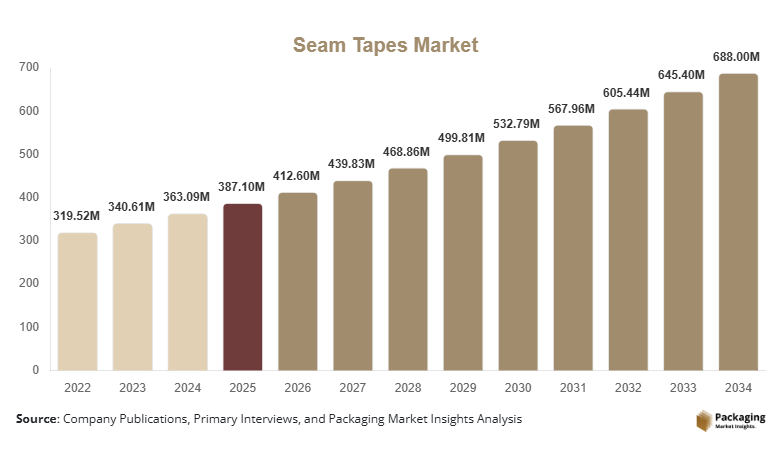
Seam tape market size is projected at USD 412.6 million in 2026 and is expected to hit USD 689.8 million by 2034 with a CAGR of 6.6%. The report provides an in-depth assessment of production capacity, supply chain performance, pricing analysis, market segmentation, and the competitive landscape across major regional markets. It also evaluates technological developments, manufacturing investments, and consumption trends shaping the industry throughout the forecast period.
Seam tapes are specialized adhesive sealing materials applied over stitched seams to provide waterproofing, air resistance, and enhanced durability in technical textiles, protective garments, footwear, and outdoor apparel. Global production exceeded 5.4 billion meters during 2025, while apparel applications accounted for approximately 56% of total consumption. Multi-layer seam tapes represented nearly 47% of production volume, industrial protective clothing contributed 21%, and footwear applications accounted for 23%. Automated seam sealing technology achieved adoption across 64% of large-scale manufacturing facilities, reinforcing the seam tapes market.
Explore more data points, trends and opportunities Download Free Sample Report
Seam Tapes Market Trends
Rising Adoption of High-Performance Waterproof Textiles
Manufacturers continue developing lightweight, stretchable, and eco-friendly seam tapes to meet demand from outdoor apparel and sportswear industries. More than 2.3 billion meters of waterproof seam tapes were produced during 2025, while recycled polyurethane tape adoption increased by 18% year-over-year. Approximately 59% of premium outdoor garments incorporated advanced seam-sealing technologies, strengthening the seam tape market.
Automation and Sustainable Manufacturing
Advanced hot-air seam sealing systems and automated application technologies continue improving manufacturing efficiency and product consistency. Automated production lines manufactured over 3.2 billion meters of seam tapes annually, while solvent-free adhesive technologies were adopted by 53% of newly established production facilities. Demand for industrial safety clothing increased by 8.4%, supporting the seam tapes market.
Seam Tapes Market Drivers
Growing Demand for Waterproof Technical Apparel
The increasing popularity of outdoor sports, industrial safety regulations, and military protective clothing continues driving demand for seam tapes. Global technical textile production exceeded 39 million metric tons during 2025, while waterproof apparel demand increased by 7.8%. Protective clothing represented approximately 21% of seam tape consumption, supporting continued expansion of the seam tape market.
Seam Tapes Market Restraints
Volatility in Raw Material Prices
Fluctuations in polyurethane, thermoplastic polyurethane (TPU), and specialty adhesive prices continue impacting manufacturing costs. Raw materials account for approximately 58% of production expenses, while energy contributes nearly 13%. Material prices fluctuated between 10% and 18% during 2025, creating procurement challenges for manufacturers producing over 150 million meters annually. These cost pressures remain a restraint for the seam tape market.
Seam Tapes Market Opportunities
Expansion of Sustainable Textile Manufacturing
Growing investment in recyclable textiles and environmentally friendly adhesive technologies creates significant market opportunities. Sustainable seam tape production exceeded 680 million meters during 2025, while investments in solvent-free coating technologies surpassed USD 280 million. Consumer demand for sustainable outdoor apparel increased by 22%, creating new opportunities across the seam-tape market.
Challenges in Seam Tapes Market
Performance Requirements Across Diverse Textile Applications
Manufacturers must develop seam tapes capable of maintaining adhesion under varying environmental conditions while remaining compatible with multiple textile substrates. Product testing standards increased by 16%, while nearly 42% of new product development budgets were allocated to performance validation. Continuous innovation remains essential to address evolving requirements within the seam tape market.
Report Scope
| Report Metric | Details |
|---|---|
| Market Size in 2025 | USD 387.1 Million |
| Market Size in 2026 | USD 412.6 Million |
| Market Size in 2034 | USD 689.8 Million |
| CAGR | 6.6% (2026-2034) |
| Base Year for Estimation | 2025 |
| Historical Data | 2022-2024 |
| Forecast Period | 2026-2034 |
| Report Coverage | Revenue Forecast, Competitive Landscape, Supply Chain Disruption, Growth Factors, Environment & Regulatory Landscape and Trends |
| Geographies Covered | North America, Europe, APAC, Middle East and Africa, LATAM |
| Countries Covered | U.S., Canada, U.K., Germany, France, Spain, Italy, Russia, Nordic, Benelux, Rest of Europe, China, South Korea, Japan, India, Australia, Singapore, Taiwan, South East Asia, Rest of Asia-Pacific, UAE, Turkey, Saudi Arabia, South Africa, Egypt, Nigeria, Rest of MEA, Brazil, Mexico, Argentina, Chile, Colombia, Rest of LATAM |
Explore more data points, trends and opportunities Download Free Sample Report
Seam Tapes Market Segmentation
The market is segmented by product type and end-use industry, with multi-layer seam tapes accounting for approximately 47% of total production, while apparel applications contribute nearly 56% of worldwide consumption. Global production exceeded 5.4 billion meters during 2025, supported by increasing demand for waterproof and protective textile applications.
By Product Type
Single-layer seam tapes account for approximately 31% of market volume, with production exceeding 1.7 billion meters annually. These tapes provide reliable waterproof sealing for lightweight garments, offering excellent flexibility, adhesion strength, and processing efficiency.
Multi-layer seam tapes dominate the market with nearly a 47% share and production exceeding 2.5 billion meters annually. These products provide superior waterproofing, enhanced tensile strength above 35 N/cm, and excellent resistance to repeated washing and environmental exposure.
Custom Seam Tapes represent approximately 22% of total production, exceeding 1.2 billion meters annually. Customized products support specialized industrial garments, military uniforms, footwear, and high-performance sportswear requiring application-specific sealing properties.
By End-use Industry
Apparel dominates with approximately 56% of total demand, consuming over 3 billion meters annually. Applications include outdoor jackets, rainwear, sportswear, ski apparel, and performance garments requiring waterproof seam protection and long-term durability.
Footwear accounts for approximately 23% of market demand, with production exceeding 1.2 billion meters annually. Seam tapes improve water resistance, structural integrity, and durability across hiking boots, athletic footwear, and work shoes.
Industrial protective clothing represents nearly 21% of total consumption, with production exceeding 1.1 billion meters annually. These applications include chemical-resistant suits, firefighting apparel, healthcare protective garments, and military uniforms requiring superior seam integrity.
Seam Tapes Market Segmentations
Product Type
- Single Layer Seam Tapes
- Multi-Layer Seam Tapes
- Custom Seam Tapes
End-use Industry
- Apparel
- Footwear
- Industrial Protective Clothing
Seam Tapes Regional Outlook
North America
North America accounts for approximately 27% of global demand, producing more than 1.4 billion meters annually. The United States contributes nearly 80% of regional output, supported by protective clothing, military textiles, and premium outdoor apparel manufacturing.
Europe
Europe represents approximately 29% of worldwide consumption, with production exceeding 1.6 billion meters annually. Germany, Italy, France, and the United Kingdom collectively contribute over 72% of regional manufacturing, supported by technical textile innovation and sustainability initiatives.
Asia-Pacific
The Asia-Pacific dominates the market with approximately a 38% share and production exceeding 2.1 billion meters annually. China contributes nearly 49% of regional output, followed by India, Vietnam, South Korea, and Japan through extensive apparel and footwear manufacturing industries.
Latin America
Latin America accounts for approximately 4% of global demand. Brazil and Mexico together contribute nearly 66% of regional production, supported by expanding textile manufacturing and industrial safety equipment production.
Middle East & Africa
The Middle East & Africa represent approximately 2% of worldwide demand. Saudi Arabia, the UAE, and South Africa account for over 60% of regional consumption, driven by industrial protective clothing and infrastructure projects.
Top Players In The Seam Tapes Market
- Bemis Associates Inc.
- Loxy AS
- Sealon Co., Ltd.
- H.B. Fuller Company
- Gerlinger Industries GmbH
- Toray Industries, Inc.
- Framis Italia S.p.A.
- San Chemicals Ltd.
- Hengxin Polyurethane Co., Ltd.,
- Traxx Corporation
- Huangshan Meiao Composite Materials Co., Ltd.
- DingZing Advanced Materials Inc.
Bemis Associates Inc. Estimated global market presence of 13–15% in high-performance seam tape manufacturing. Operates advanced manufacturing facilities serving apparel, footwear, and industrial protective clothing industries. Focuses on solvent-free adhesives, recyclable materials, and lightweight seam sealing technologies. Maintains strong partnerships with global apparel brands while continuously investing in automation, product innovation, and sustainable manufacturing capabilities. Sealon Co., Ltd. Estimated market presence of 9–11% across global seam tape production. Maintains a strong position in waterproof garment and technical textile applications. Invests significantly in TPU seam tape technology, automated coating systems, and environmentally friendly adhesive solutions. Continues expanding manufacturing capacity and research capabilities while serving premium apparel and industrial protective clothing manufacturers worldwide.