Agricultural Films And Bonding Market Size and Growth
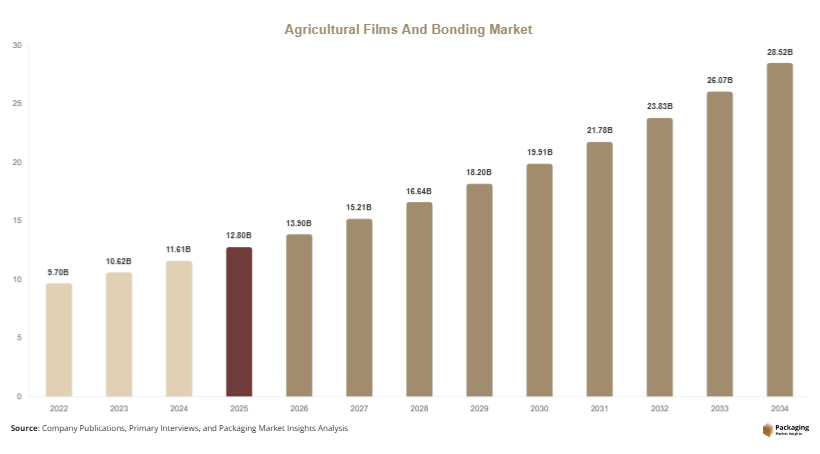
The global agricultural films and bonding market size is estimated at approximately USD 12.8 billion in 2025, which is projected to reach around USD 13.9 billion in 2026. By 2034, the market is expected to attain nearly USD 28.6 billion, expanding at a CAGR of 9.4% during 2025–2034. The agricultural films and bonding market is experiencing steady expansion, supported by rising global food demand, climate-controlled farming practices, and the increasing adoption of protected cultivation systems.
Growth in this market is primarily driven by the shift toward high-efficiency agriculture systems such as greenhouse farming and mulching techniques. Farmers are increasingly using agricultural films to improve soil moisture retention, regulate temperature, and reduce weed growth. Additionally, bonding materials used in crop protection films and greenhouse structures are improving durability and performance, enabling better yield optimization. Rising concerns over water scarcity and climate variability are also encouraging adoption of film-based agricultural solutions across developed and emerging economies.
Key Highlights
- Asia Pacific dominated the market with a 34.8% share in 2025.
- Europe accounted for a 24.3% share in 2025.
- North America held a 28.6% share in 2025.
- Asia Pacific is projected to grow at the fastest CAGR of 10.2% (2025–2034).
- Mulch films led the type segment with a 41.5% share in 2024.
- Horticulture dominated the application segment with a 45.2% share in 2024.
- LDPE-based films held the largest material share with 38.9% in 2024.
- Biodegradable polymers are projected to grow at the fastest CAGR of 10.8% (2025–2034).
- The US remained the leading country with strong adoption of controlled agriculture systems and greenhouse farming expansion.
Explore more data points, trends and opportunities Download Free Sample Report
Market Trends
Shift Toward Biodegradable and Eco-Friendly Agricultural Films
One of the most significant trends shaping the agricultural films and bonding market is the growing shift toward biodegradable and environmentally friendly films. Traditional polyethylene-based films are increasingly being replaced by bio-based alternatives derived from starch, PLA, and other renewable sources. This transition is driven by strict environmental regulations and rising awareness about plastic pollution in agricultural land. Biodegradable films are gaining traction because they eliminate the need for manual removal after crop cycles, reducing labor costs and soil contamination. Manufacturers are investing in R&D to enhance durability, UV resistance, and decomposition rates of these films, making them more suitable for diverse climatic conditions. Governments in Europe and parts of Asia are actively promoting sustainable farming inputs, further accelerating adoption.
Increasing Integration of Smart and Functional Agricultural Films
Another major trend is the integration of smart functionalities into agricultural films. These advanced films are designed with features such as light diffusion control, infrared radiation management, and anti-drip coatings. Such enhancements improve crop yield by optimizing light exposure and temperature regulation inside greenhouses. Additionally, bonding technologies are being used to combine multiple functional layers into a single film structure, improving performance efficiency. This trend is particularly strong in high-tech greenhouse farming regions such as the Netherlands, Japan, and Israel. The growing use of precision agriculture tools is further supporting the demand for films that interact with environmental conditions to improve productivity.
Market Drivers
Rising Demand for Food Production and Protected Agriculture
A primary driver of the agricultural films and bonding market is the increasing global demand for food production due to population growth. As arable land becomes limited, farmers are adopting protected agriculture techniques such as greenhouse farming, mulching, and tunnel cultivation. Agricultural films play a critical role in these systems by maintaining optimal soil temperature, reducing water evaporation, and improving crop yield efficiency. Bonding materials enhance the structural integrity of multi-layer films used in greenhouses and tunnels, ensuring durability against environmental stress. Countries with high agricultural intensity, such as India, China, and the United States, are significantly contributing to market expansion due to large-scale adoption of modern farming practices.
Technological Advancements in Polymer and Film Manufacturing
Another key driver is the rapid advancement in polymer science and film manufacturing technologies. Innovations in multi-layer extrusion, nano-coating, and UV stabilization are significantly improving film performance and lifespan. Bonding agents are also evolving, enabling stronger adhesion between multiple film layers without compromising flexibility. These technological improvements allow agricultural films to perform efficiently under extreme weather conditions. Additionally, the development of recyclable and reusable films is gaining traction, especially in regions with strict environmental policies. The integration of advanced manufacturing processes is reducing production costs and making high-performance agricultural films more accessible to farmers across different regions.
Market Restraint
High Environmental Concerns and Disposal Challenges
A major restraint in the agricultural films and bonding market is the environmental concern associated with plastic waste generated by conventional agricultural films. Although these films significantly enhance agricultural productivity, improper disposal after use leads to soil contamination and environmental degradation. In many developing regions, lack of proper recycling infrastructure makes it difficult to manage agricultural plastic waste effectively. Farmers often burn or bury used films, which creates long-term environmental hazards. Even though biodegradable alternatives exist, their higher cost and limited availability restrict widespread adoption. Additionally, variability in decomposition rates under different climatic conditions creates uncertainty among end users. Regulatory pressure is increasing, but implementation remains inconsistent across regions, which continues to challenge market growth.
Market Opportunities
Expansion of Smart Greenhouse Farming Systems
The expansion of smart greenhouse farming presents a significant opportunity for the agricultural films and bonding market. Smart greenhouses rely heavily on advanced agricultural films that can regulate temperature, humidity, and light transmission. These systems are increasingly being adopted in regions with extreme weather conditions and limited arable land. Agricultural films integrated with sensors and climate-responsive coatings are expected to see higher demand in the coming years. Bonding technologies will play a critical role in enhancing multi-layer film systems used in automated greenhouse structures. Countries investing heavily in controlled environment agriculture, such as China, the Netherlands, and the UAE, are expected to drive strong demand for advanced agricultural films.
Growth in Sustainable and Recyclable Material Innovations
Another key opportunity lies in the development of sustainable and recyclable agricultural film materials. Manufacturers are focusing on bio-based polymers, compostable materials, and recyclable multilayer structures to meet environmental regulations. Governments are offering incentives and subsidies for adopting sustainable agricultural inputs, encouraging farmers to transition from conventional plastic films. Bonding technologies that support easy separation and recycling of multilayer films are gaining importance. As sustainability becomes a global priority, companies investing in green material innovation are expected to capture a significant share of the market. This shift is also creating opportunities for partnerships between agricultural technology firms and polymer manufacturers.
Report Scope
| Report Metric | Details |
|---|---|
| Market Size in 2025 | USD 12.8 Billion |
| Market Size in 2026 | USD 13.9 Billion |
| Market Size in 2034 | USD 28.6 Billion |
| CAGR | 9.4% (2026-2034) |
| Base Year for Estimation | 2025 |
| Historical Data | 2022-2024 |
| Forecast Period | 2026-2034 |
| Report Coverage | Revenue Forecast, Competitive Landscape, Supply Chain Disruption, Growth Factors, Environment & Regulatory Landscape and Trends |
| Geographies Covered | North America, Europe, APAC, Middle East and Africa, LATAM |
| Countries Covered | U.S., Canada, U.K., Germany, France, Spain, Italy, Russia, Nordic, Benelux, Rest of Europe, China, South Korea, Japan, India, Australia, Singapore, Taiwan, South East Asia, Rest of Asia-Pacific, UAE, Turky, Saudi Arabia, South Africa, Egypt, Nigeria, Rest of MEA, Brazil, Mexico, Argentina, Chile, Colombia, Rest of LATAM |
Explore more data points, trends and opportunities Download Free Sample Report
Segmental Analysis
By Type
The type segment is dominated by mulch films, accounting for approximately 41.5% share in 2024. Mulch films are widely used across agricultural fields to improve soil moisture retention, suppress weed growth, and enhance crop productivity. They are particularly popular in vegetable and fruit cultivation due to their cost-effectiveness and ease of application. Their ability to improve crop yield while reducing water usage makes them a core component of modern farming systems.
Mulch films are extensively used in both developed and developing agricultural economies. Their demand is particularly strong in Asia Pacific, where small and medium-scale farmers rely on low-cost solutions to improve yield efficiency. Additionally, advancements in UV-resistant and multi-season mulch films are extending product lifespan and increasing adoption rates across commercial farming operations.
The fastest-growing subsegment is greenhouse films, projected to grow at a CAGR of 10.4% through 2034. Growth is driven by increasing investment in controlled environment agriculture systems. These films provide superior light transmission, temperature control, and humidity regulation, making them essential for high-value crop production. Rising adoption of hydroponics and vertical farming systems is further supporting demand.
By Application
The application segment is led by horticulture, accounting for approximately 45.2% share in 2024. Agricultural films are widely used in horticulture to improve yield quality, protect crops from environmental stress, and enhance production efficiency. Fruits, vegetables, and ornamental plants benefit significantly from film-based cultivation systems.
Horticultural farming is expanding rapidly due to rising global demand for fresh produce. Agricultural films help maintain optimal growing conditions and reduce dependency on chemical inputs. This makes them highly suitable for organic farming practices, which are gaining popularity worldwide.
The fastest-growing subsegment is protected cultivation, projected to grow at a CAGR of 10.1% through 2034. This segment includes greenhouse farming, tunnel cultivation, and controlled environment systems. Increasing demand for year-round crop production and climate-resilient farming methods is driving adoption of advanced agricultural films and bonding solutions.
By Material
The material segment is dominated by LDPE-based films, accounting for approximately 38.9% share in 2024. LDPE is widely used due to its flexibility, durability, and cost efficiency. It is suitable for mulch films, greenhouse covers, and silage applications.
LDPE remains popular in developing economies due to its affordability and wide availability. However, environmental concerns are pushing manufacturers to develop recyclable alternatives and improved formulations with better durability and reduced environmental impact.
The fastest-growing subsegment is biodegradable polymers, projected to grow at a CAGR of 10.8% through 2034. Growth is driven by environmental regulations and sustainability initiatives. These materials decompose naturally, reducing plastic waste in agricultural fields. Increasing adoption in Europe and North America is accelerating innovation and commercialization of biodegradable agricultural film solutions.
Agricultural Films And Bonding Market Segmentations
By Type
- Mulch Films
- Greenhouse Films
- Silage Films
- Stretch Films
By Application
- Horticulture
- Protected Cultivation
- Field Crops
- Floriculture
By Material
- LDPE-Based Films
- LLDPE Films
- Biodegradable Polymers
- Recycled Plastic Films
Regional Analysis
North America
North America holds approximately 28.6% share in 2025, and is projected to expand at a CAGR of 9.1% during 2025–2034 in the agricultural films and bonding market. The region benefits from highly mechanized farming practices, large commercial agricultural operations, and early adoption of precision farming technologies. The United States dominates the regional landscape due to its extensive greenhouse farming systems, strong agritech investment ecosystem, and increasing use of controlled-environment agriculture. Canada also contributes steadily, supported by expanding horticulture production and sustainable farming initiatives across provinces.
A major growth factor in North America is the rapid shift toward technology-driven agriculture systems. Farmers are increasingly adopting greenhouse structures, drip irrigation integration, and soil protection systems that rely heavily on agricultural films. These films help improve moisture retention, regulate temperature, and increase crop yield efficiency across large-scale farming operations. Additionally, strong investment in biodegradable agricultural materials is shaping market demand, particularly in states with strict environmental policies such as California.
Another supporting factor is the rising focus on export-quality crop production. High-value crops such as fruits, vegetables, and specialty horticultural products require controlled cultivation environments, boosting demand for advanced agricultural films and bonding solutions. The presence of large agribusiness companies further strengthens adoption across commercial farming applications.
Europe
Europe accounts for around 24.3% share in 2025, with a projected CAGR of 9.6% through 2034. The region is one of the most regulated markets globally in terms of environmental protection, which directly influences agricultural input materials. Germany leads the market due to its advanced greenhouse farming infrastructure and strong agricultural engineering base. France, Italy, Spain, and the Netherlands also contribute significantly, particularly in horticulture and floriculture production systems.
A key growth driver in Europe is the strict regulatory framework under the European Green Deal and circular economy initiatives. These policies are pushing farmers and agribusinesses to adopt biodegradable, recyclable, and low-carbon agricultural films. As a result, manufacturers are focusing on developing compostable mulch films and sustainable bonding solutions to comply with regulatory requirements. This shift is accelerating innovation in eco-friendly polymer technologies.
Another important factor is the expansion of greenhouse-based farming, especially in the Netherlands and Spain. These countries are global leaders in controlled environment agriculture, where agricultural films are critical for optimizing light diffusion, humidity control, and temperature regulation. Increasing demand for organic and pesticide-free food production is also driving adoption of advanced agricultural film systems across the region.
Asia Pacific
Asia Pacific dominates the global market with approximately 34.8% share in 2025, and is expected to grow at the fastest CAGR of 10.2% through 2034. The region’s dominance is attributed to large agricultural economies, rising food demand, and increasing adoption of modern farming techniques. China leads the market due to its massive agricultural base and strong government support for protected cultivation systems. India is another high-growth market, driven by rapid population growth and increasing need for higher crop productivity. Japan and South Korea contribute through advanced agricultural technologies.
A key growth factor in Asia Pacific is the rapid expansion of greenhouse farming and mulching practices across developing economies. Farmers are increasingly using agricultural films to improve yield efficiency, reduce water consumption, and protect crops from extreme weather conditions. Government subsidies for modern agriculture are also encouraging widespread adoption of film-based solutions in rural farming regions.
Another major factor is the rising export demand for fruits, vegetables, and horticultural products. Countries like China, India, and Thailand are expanding export-oriented farming, requiring high-quality cultivation systems supported by advanced agricultural films and bonding technologies. Increasing investments in agritech startups and foreign collaborations are further strengthening regional market growth.
Middle East & Africa
The Middle East & Africa (MEA) region holds approximately 6.1% share in 2025, with a projected CAGR of 8.5% through 2034. The region’s growth is supported by increasing investments in agricultural modernization, particularly in countries facing water scarcity and harsh climatic conditions. The UAE and Saudi Arabia lead the regional market due to strong government initiatives focused on food security and controlled agriculture systems. South Africa also contributes significantly through commercial farming expansion.
A key growth driver is the adoption of greenhouse farming technologies to overcome environmental limitations. Agricultural films are widely used to maintain optimal growing conditions, reduce evaporation, and improve crop yield in arid regions. These systems are essential for ensuring stable food production in desert climates.
Another supporting factor is government-led food security programs and diversification initiatives. Countries in the Gulf region are heavily investing in agritech solutions and sustainable farming infrastructure. However, limited recycling infrastructure remains a challenge, although awareness of sustainable agricultural materials is gradually increasing.
Latin America
Latin America accounts for approximately 6.2% share in 2025, and is projected to grow at a CAGR of 8.8% through 2034. Brazil dominates the regional market due to its large agricultural production base, followed by Mexico, Argentina, and Chile. The region’s agriculture sector is highly export-oriented, especially in fruits, vegetables, and grains.
A key growth factor is the increasing adoption of protected cultivation systems. Farmers are using agricultural films to enhance productivity, reduce crop losses, and improve yield quality. Rising demand from international markets is pushing farmers to adopt advanced cultivation techniques supported by agricultural films.
Another factor is the modernization of agricultural practices across large-scale farming operations. Government support for agritech adoption and increasing foreign investment in agricultural infrastructure are further strengthening market growth across the region.
Competitive Landscape
The agricultural films and bonding market is moderately consolidated, with major players focusing on innovation, sustainability, and product expansion. Key companies include Berry Global Inc., BASF SE, Dow Inc., ExxonMobil Chemical, and Kuraray Co. Ltd. Berry Global Inc. is considered a leading player due to its extensive portfolio of agricultural film solutions and strong global distribution network. The company has recently expanded its biodegradable film production capacity to meet rising demand for sustainable agricultural materials.
Other players are investing heavily in R&D to develop multi-layer films with enhanced durability and climate control properties. Strategic partnerships with agricultural technology companies are also increasing. Companies are focusing on reducing production costs while improving environmental performance to gain competitive advantage.
Key Players List
- Berry Global Inc.
- BASF SE
- Dow Inc.
- ExxonMobil Chemical
- Kuraray Co. Ltd.
- Amcor plc
- SABIC
- Sigma Plastics Group
- RKW Group
- Plastika Kritis S.A.
- Coveris Holdings
- Armando Alvarez Group
- Barbier Group
- Trioplast Industries
- FKuR Kunststoff GmbH