Barrier Packaging Market Size and Growth
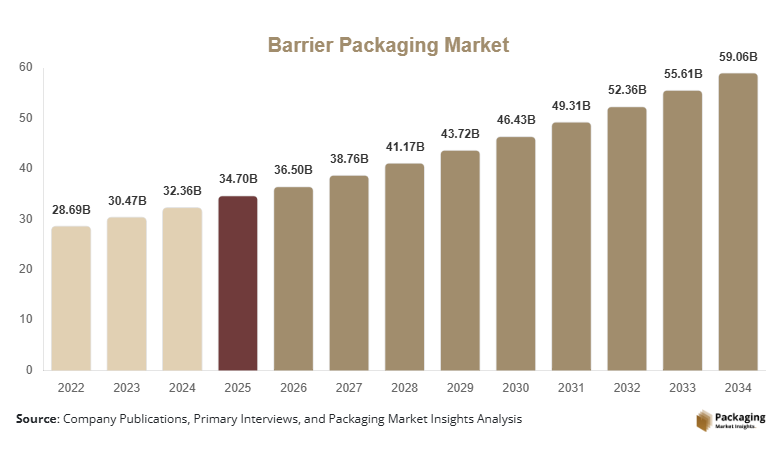
The global barrier packaging market size is estimated at USD 34.7 billion in 2025, while the market is projected to reach approximately USD 36.5 billion in 2026. By 2034, the market is forecasted to attain nearly USD 58.9 billion, expanding at a CAGR of 6.2% during 2025–2034. The barrier packaging market is experiencing stable growth due to rising demand for protective packaging solutions across food & beverages, pharmaceuticals, electronics, and industrial sectors. Barrier packaging materials are designed to protect products from external elements such as moisture, oxygen, light, contaminants, and gases, thereby extending shelf life and maintaining product quality. These packaging solutions include films, pouches, trays, containers, and laminates manufactured using materials such as polyethylene, polypropylene, polyamide, aluminum foil, and ethylene vinyl alcohol.
One of the key growth factors driving the market is the increasing consumption of packaged food products worldwide. Barrier packaging helps maintain freshness, flavor, and nutritional value while reducing food waste during storage and transportation. Another major factor is the growing pharmaceutical industry, where high-barrier packaging materials are essential for protecting sensitive drugs and medical products from moisture and contamination. Additionally, the rapid expansion of e-commerce and retail distribution networks is increasing demand for durable packaging solutions capable of preserving product quality during shipping and handling.
Key Highlights
- Asia Pacific dominated the market with a 38.6% share in 2025.
- Latin America is projected to grow at the fastest CAGR of 6.9%.
- Flexible barrier packaging led the product segment with a 44.1% share.
- Plastic-based barrier materials dominated with a 51.4% share.
- Food & beverage applications led the market with a 48.3% share.
- The US remained the dominant country with a market size of USD 6.2 billion in 2025 and USD 6.5 billion in 2026.
Explore more data points, trends and opportunities Download Free Sample Report
Market Trends
Rising Demand for Sustainable Barrier Packaging Solutions
Sustainability has become a major trend shaping the barrier packaging market as governments and consumers increasingly focus on reducing packaging waste and environmental impact. Packaging manufacturers are investing in recyclable mono-material films, biodegradable barrier coatings, and compostable packaging structures to meet sustainability goals. Demand for lightweight packaging materials with reduced carbon footprints is also increasing across food and consumer goods industries. Companies are replacing traditional multilayer non-recyclable materials with recyclable high-barrier solutions that maintain product protection while supporting circular economy initiatives. In addition, growing regulatory pressure regarding plastic waste reduction is encouraging manufacturers to develop environmentally responsible barrier packaging technologies suitable for large-scale commercial applications.
Increasing Adoption of Smart and Active Packaging Technologies
The integration of smart and active packaging technologies is gaining momentum within the barrier packaging market. Packaging companies are developing advanced barrier systems capable of monitoring freshness, absorbing oxygen, controlling moisture, and improving shelf life. Active packaging solutions using oxygen scavengers and antimicrobial layers are increasingly used in food and pharmaceutical packaging applications. Smart packaging technologies such as QR codes, freshness indicators, and RFID-enabled labels are also supporting product traceability and supply chain transparency. These innovations are helping manufacturers improve product safety and reduce spoilage during transportation and storage. Demand for intelligent barrier packaging is expected to increase as industries prioritize product quality and operational efficiency.
Market Drivers
Growth in Packaged Food and Beverage Consumption
The increasing consumption of packaged food and beverages worldwide is a major driver for the barrier packaging market. Urbanization, changing lifestyles, and growing demand for convenience foods are encouraging food manufacturers to adopt advanced barrier packaging materials that maintain freshness and prevent contamination. Barrier films and pouches provide protection against oxygen, moisture, and light exposure, helping extend product shelf life and reduce food waste. In addition, the growth of online grocery shopping and food delivery services is increasing demand for durable and lightweight packaging solutions capable of maintaining product quality during transportation and storage operations.
Expansion of Pharmaceutical and Healthcare Industries
The rapid growth of pharmaceutical and healthcare sectors is significantly supporting market expansion. Pharmaceutical products such as tablets, biologics, vaccines, and medical devices require high-barrier packaging systems to protect against environmental exposure and maintain efficacy. Increasing global healthcare expenditure and rising production of specialty medicines are driving demand for advanced barrier materials with strong moisture and oxygen resistance properties. Regulatory standards regarding pharmaceutical packaging safety and product stability are also encouraging manufacturers to adopt innovative packaging technologies. Furthermore, increasing investment in healthcare infrastructure across emerging economies is expected to strengthen long-term demand for barrier packaging products.
Market Restraint
Complex Recycling Challenges for Multilayer Packaging Materials
One of the key restraints affecting the barrier packaging market is the complexity associated with recycling multilayer packaging materials. High-barrier packaging often combines different polymers, aluminum layers, and specialty coatings to achieve superior protection properties. However, these multilayer structures can be difficult to separate and recycle through conventional waste management systems. As environmental regulations become stricter, packaging manufacturers face increasing pressure to develop recyclable alternatives while maintaining barrier performance. For example, flexible food packaging using multilayer laminates may provide excellent oxygen and moisture protection but can create recycling challenges due to mixed material composition. Companies are therefore required to invest in advanced recycling technologies and sustainable material development, which can increase production costs and operational complexity. In some regions, consumers and regulators are discouraging the use of non-recyclable packaging materials, which may slow adoption of certain traditional barrier packaging formats and impact market growth in environmentally sensitive markets.
Market Opportunities
Development of Recyclable High-Barrier Materials
The increasing demand for sustainable packaging solutions presents strong opportunities for recyclable high-barrier materials within the barrier packaging market. Packaging manufacturers are developing mono-material films and recyclable barrier coatings that provide effective protection while supporting circular economy goals. Food and beverage companies are increasingly adopting recyclable flexible packaging to meet sustainability commitments and consumer expectations. In addition, technological advancements in polymer science are enabling manufacturers to improve oxygen and moisture resistance without compromising recyclability. Companies investing in eco-friendly barrier packaging innovations are expected to strengthen market position and expand partnerships with global consumer goods and retail brands.
Growth in Pharmaceutical Cold Chain Packaging
The expansion of pharmaceutical cold chain logistics is creating substantial opportunities for advanced barrier packaging solutions. Temperature-sensitive medicines, vaccines, and biologics require packaging materials that offer strong protection against moisture, oxygen, and contamination during transportation and storage. Pharmaceutical companies are increasingly investing in high-performance barrier films, insulated pouches, and multilayer packaging structures to maintain product integrity. Emerging healthcare markets are also improving cold chain infrastructure, increasing demand for reliable pharmaceutical packaging solutions. Furthermore, rising global biologics production is expected to generate long-term opportunities for manufacturers specializing in high-barrier healthcare packaging technologies.
Report Scope
| Report Metric | Details |
|---|---|
| Market Size in 2025 | USD 34.7 Billion |
| Market Size in 2026 | USD 36.5 Billion |
| Market Size in 2034 | USD 58.9 Billion |
| CAGR | 6.2% (2026-2034) |
| Base Year for Estimation | 2025 |
| Historical Data | 2022-2024 |
| Forecast Period | 2026-2034 |
| Report Coverage | Revenue Forecast, Competitive Landscape, Supply Chain Disruption, Growth Factors, Environment & Regulatory Landscape and Trends |
| Geographies Covered | North America, Europe, APAC, Middle East and Africa, LATAM |
| Countries Covered | U.S., Canada, U.K., Germany, France, Spain, Italy, Russia, Nordic, Benelux, Rest of Europe, China, South Korea, Japan, India, Australia, Singapore, Taiwan, South East Asia, Rest of Asia-Pacific, UAE, Turky, Saudi Arabia, South Africa, Egypt, Nigeria, Rest of MEA, Brazil, Mexico, Argentina, Chile, Colombia, Rest of LATAM |
Explore more data points, trends and opportunities Download Free Sample Report
Segmental Analysis
By Product Type
Flexible barrier packaging dominated the barrier packaging market in 2024, accounting for approximately 44.1% of the total market share. Flexible packaging solutions such as pouches, films, and sachets are widely preferred because they provide strong barrier protection while remaining lightweight and cost efficient. These materials help protect products from moisture, oxygen, and contamination, making them suitable for food, pharmaceutical, and consumer goods applications. Flexible barrier packaging also supports convenient storage and transportation while reducing material usage compared to rigid alternatives. Additionally, advancements in multilayer film technologies are improving durability, printability, and sustainability across flexible packaging formats.
Recyclable high-barrier films are expected to be the fastest-growing subsegment, expanding at a CAGR of 7.2% during the forecast period. Increasing environmental regulations and consumer demand for sustainable packaging are encouraging manufacturers to develop recyclable barrier materials with strong moisture and oxygen protection capabilities. Food and beverage companies are increasingly replacing conventional multilayer laminates with recyclable mono-material films that support circular economy initiatives. In addition, technological advancements in polymer engineering are enabling improved barrier performance without compromising recyclability. This trend is expected to strengthen demand for sustainable barrier film solutions across multiple industries.
By Material
Plastic-based barrier materials dominated the market in 2024 with a share of approximately 51.4%. Polyethylene, polypropylene, polyethylene terephthalate, and ethylene vinyl alcohol are widely used due to their excellent barrier properties, lightweight structure, and cost efficiency. Plastic-based materials are commonly used in flexible food packaging, pharmaceutical blister packs, and industrial packaging applications. Manufacturers continue to prefer plastic materials because they offer versatility, high durability, and compatibility with various packaging formats. In addition, improvements in multilayer plastic film technologies are enhancing moisture resistance and extending shelf life performance.
Bio-based barrier materials are projected to witness the fastest growth, registering a CAGR of 7.5% during the forecast period. Rising environmental concerns and stricter packaging waste regulations are encouraging manufacturers to develop sustainable alternatives derived from renewable resources. Bio-based barrier materials help reduce dependence on fossil fuel-derived plastics while supporting biodegradability and recyclability goals. Food and beverage companies are increasingly adopting compostable and plant-based packaging solutions to strengthen sustainability initiatives and improve consumer perception. Technological advancements in bio-polymers are also improving the barrier performance and commercial viability of these materials.
By Application
Food & beverage applications accounted for the dominant market share of approximately 48.3% in 2024 within the barrier packaging market. The food industry relies heavily on barrier packaging materials to maintain freshness, flavor, and nutritional quality while preventing contamination and spoilage. High-barrier films and pouches are widely used in dairy products, snacks, frozen foods, beverages, and ready-to-eat meals. Rising demand for convenience foods and online grocery retailing is increasing the need for durable and lightweight packaging solutions capable of extending shelf life. Food safety regulations are also encouraging manufacturers to adopt advanced barrier technologies for improved product protection.
Pharmaceutical packaging is expected to register the fastest CAGR of 6.8% during the forecast period. Increasing production of biologics, vaccines, and specialty medicines is driving demand for high-performance barrier materials with strong moisture and oxygen resistance. Pharmaceutical companies require reliable packaging solutions that maintain drug stability and comply with strict healthcare regulations. In addition, rising investment in healthcare infrastructure and pharmaceutical exports is supporting market growth. Packaging manufacturers are increasingly developing advanced barrier films, blister packs, and cold chain packaging systems to improve product safety and transportation reliability across pharmaceutical supply chains.
Barrier Packaging Market Segmentations
By Product Type
- Flexible Barrier Packaging
- Rigid Barrier Packaging
- Barrier Films
- Barrier Pouches
- Barrier Trays
By Material
- Plastic-Based Materials
- Aluminum Foil
- Paper & Paperboard
- Bio-Based Materials
By Application
- Food & Beverage
- Pharmaceuticals
- Electronics
- Industrial Goods
- Consumer Products
Regional Analysis
North America
North America accounted for approximately 28.1% of the global barrier packaging market share in 2025 and is projected to grow at a CAGR of 5.8% during the forecast period. The region benefits from advanced food processing industries, strong pharmaceutical manufacturing capabilities, and increasing adoption of sustainable packaging solutions. Rising demand for convenience foods and e-commerce packaging is supporting market expansion. In addition, strict food safety and healthcare packaging regulations are encouraging companies to adopt high-performance barrier materials capable of improving shelf life and product protection.
The United States dominates the North American market due to its extensive packaged food and pharmaceutical industries. One unique growth factor is the rapid growth of sustainable flexible packaging manufacturing supported by investments in recyclable packaging technologies. Companies across the country are increasingly using advanced barrier films and eco-friendly laminates to improve packaging performance while complying with environmental regulations and consumer sustainability preferences.
Europe
Europe represented nearly 25.4% of the global market share in 2025 and is expected to expand at a CAGR of 5.7% during the forecast period. Growth in the region is supported by strict environmental regulations, increasing pharmaceutical exports, and strong demand for premium packaged foods. European manufacturers are focusing on recyclable barrier materials and lightweight flexible packaging systems to reduce carbon emissions and improve packaging efficiency. Demand for high-barrier pharmaceutical packaging is also increasing as healthcare companies prioritize product stability and regulatory compliance.
Germany remains the dominant country in the European market because of its strong chemical manufacturing base and advanced packaging industry. A unique growth factor is the increasing adoption of mono-material recyclable packaging structures supported by sustainability initiatives. German companies are investing in innovative barrier coating technologies and recyclable polymer films to meet environmental targets while maintaining high product protection standards.
Asia Pacific
Asia Pacific dominated the barrier packaging market with a 38.6% share in 2025 and is projected to grow at a CAGR of 6.8% during the forecast period. Rapid urbanization, population growth, and rising packaged food consumption are major factors supporting market expansion. Countries such as China, India, Japan, and South Korea are witnessing strong demand for flexible packaging solutions across food, healthcare, and electronics industries. In addition, increasing investments in retail distribution and e-commerce infrastructure are contributing to higher consumption of barrier packaging products.
China dominates the regional market due to its large-scale packaging manufacturing sector and expanding consumer goods industry. One unique growth factor is the rapid expansion of processed food exports requiring advanced moisture-resistant and oxygen-barrier packaging materials. Packaging manufacturers in China are increasingly investing in multilayer film technologies and recyclable barrier materials to strengthen export competitiveness and meet international packaging standards.
Middle East & Africa
The Middle East & Africa region accounted for approximately 3.9% of the global market share in 2025 and is projected to grow at a CAGR of 6.0% during the forecast period. Rising urban populations, expanding food processing industries, and increasing pharmaceutical imports are supporting regional market growth. Governments are investing in industrial diversification programs and local manufacturing capabilities, encouraging higher demand for advanced packaging materials. Demand for heat-resistant and moisture-resistant barrier packaging is particularly increasing due to harsh climatic conditions across several countries in the region.
Saudi Arabia leads the regional market due to growing packaged food demand and expanding healthcare infrastructure. One unique growth factor is the increasing use of high-barrier packaging for food preservation in high-temperature environments. Local packaging manufacturers are focusing on advanced barrier technologies capable of maintaining product freshness and reducing spoilage during transportation and storage operations.
Latin America
Latin America held nearly 4.0% of the global barrier packaging market share in 2025 and is expected to register the fastest CAGR of 6.9% through 2034. Growth in the region is supported by rising packaged food consumption, improving healthcare systems, and expansion of retail distribution networks. Packaging companies are increasingly adopting flexible barrier packaging solutions to improve shelf life and reduce transportation costs. Furthermore, increasing urbanization and growth in processed food exports are contributing to strong market demand across regional economies.
Brazil dominates the Latin American market because of its large food processing industry and expanding packaging manufacturing sector. A unique growth factor is the increasing export of packaged agricultural products requiring high-barrier packaging materials for extended shelf stability. Manufacturers in Brazil are investing in advanced multilayer films and protective packaging coatings to improve product quality during international transportation and storage.
Competitive Landscape
The barrier packaging market is moderately competitive, with leading companies focusing on sustainable material innovation, advanced multilayer technologies, and strategic partnerships to strengthen market position. Manufacturers are increasingly investing in recyclable barrier films, lightweight packaging solutions, and smart packaging technologies to meet changing consumer and regulatory requirements. Companies are also expanding production facilities and research capabilities to support rising demand from food, healthcare, and industrial sectors.
Amcor plc remains one of the leading players in the market due to its broad packaging product portfolio and strong international presence. In 2024, the company introduced a recyclable high-barrier flexible packaging solution designed for food and pharmaceutical applications. Other major participants include Berry Global Inc., Sealed Air Corporation, Mondi Group, and Sonoco Products Company. These companies are actively focusing on sustainable packaging technologies, mergers, acquisitions, and global expansion strategies to strengthen their competitive positioning within the market.
Key Players List
- Amcor plc
- Berry Global Inc.
- Sealed Air Corporation
- Mondi Group
- Sonoco Products Company
- Huhtamaki Oyj
- Constantia Flexibles
- Winpak Ltd.
- Coveris Holdings S.A.
- Transcontinental Inc.
- Uflex Ltd.
- DS Smith Plc
- ProAmpac LLC
- Bemis Manufacturing Company
- Toppan Holdings Inc.