Converted Flexible Packaging Market Size and Growth
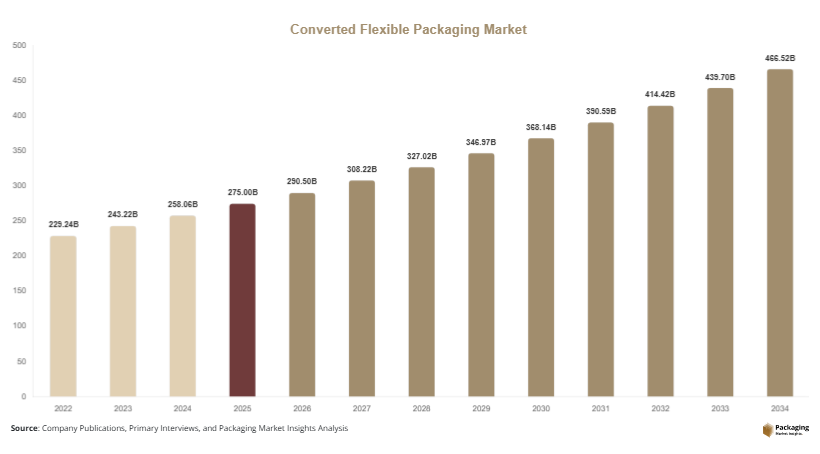
The converted flexible packaging market is witnessing steady expansion due to increasing demand for lightweight, cost-effective, and high-performance packaging solutions across various industries. The market size was valued at approximately USD 275.0 billion in 2025 and is expected to reach USD 290.5 billion in 2026. With rising consumption of packaged goods and advancements in packaging technologies, the market is projected to reach USD 465.0 billion by 2034, registering a CAGR of 6.1% during 2025–2034. This growth reflects the growing importance of flexible packaging in enhancing product shelf life and reducing transportation costs.
Converted flexible packaging refers to packaging materials that have undergone processes such as printing, laminating, coating, and sealing to create finished packaging products. These products include pouches, bags, wraps, and films used across food, beverage, pharmaceutical, and personal care industries. The flexibility, durability, and adaptability of these materials make them suitable for a wide range of applications.
One of the key growth factors is the increasing demand for convenience packaging. Consumers prefer easy-to-use, resealable, and portable packaging formats, which has led to the widespread adoption of converted flexible packaging solutions. Another significant factor is the growing emphasis on sustainability. Manufacturers are developing recyclable and biodegradable flexible packaging materials to meet environmental regulations and consumer expectations.
Additionally, the expansion of the e-commerce sector is driving demand for durable and lightweight packaging solutions. Flexible packaging reduces shipping costs and improves logistics efficiency, making it a preferred choice for online retail businesses. Technological advancements in printing and barrier properties are also contributing to market growth by enhancing product protection and visual appeal.
Key Highlights:
- The Converted Flexible Packaging Market is projected to reach USD 465.0 billion by 2034, growing at a CAGR of 6.1% during 2025–2034.
- Growth is driven by strong demand from food and beverage industries along with an increasing focus on sustainable packaging solutions.
- Additionally, the rapid expansion of e-commerce is further supporting the adoption of flexible packaging formats.
Explore more data points, trends and opportunities Download Free Sample Report
Market Trends
Increasing Adoption of Sustainable Flexible Packaging
The converted flexible packaging market is experiencing a significant shift toward sustainable packaging solutions. Manufacturers are focusing on developing recyclable, compostable, and mono-material packaging to reduce environmental impact. This trend is driven by regulatory pressures and growing consumer awareness regarding sustainability. Companies are investing in research and development to create materials that maintain performance while being environmentally friendly. The adoption of sustainable flexible packaging is particularly strong in the food and beverage sector, where companies aim to reduce their carbon footprint and meet sustainability goals.
Growth of High-Barrier Packaging Technologies
Another key trend in the market is the development of high-barrier packaging technologies. These solutions provide enhanced protection against moisture, oxygen, and contaminants, extending product shelf life. High-barrier flexible packaging is widely used in food, pharmaceuticals, and healthcare industries, where product integrity is critical. Advances in material science and coating technologies are enabling manufacturers to produce packaging with improved barrier properties. This trend is expected to continue as industries demand packaging solutions that ensure product quality and safety.
Market Drivers
Rising Demand for Convenience and Ready-to-Use Packaging
The growing demand for convenience packaging is a major driver of the converted flexible packaging market. Consumers increasingly prefer packaging that is easy to handle, store, and dispose of. Features such as resealable zippers, spouts, and lightweight designs enhance user experience and drive adoption. This trend is particularly evident in urban areas, where busy lifestyles create demand for ready-to-use packaging solutions. Manufacturers are responding by developing innovative packaging designs that meet consumer needs.
Expansion of Food and Beverage Industry
The rapid growth of the food and beverage industry is significantly contributing to market expansion. Flexible packaging is widely used in this sector due to its ability to preserve freshness and extend shelf life. The increasing demand for packaged and processed foods is driving the adoption of converted flexible packaging solutions. Additionally, the rise of online food delivery services is further boosting demand for durable and lightweight packaging materials.
Market Restraint
Environmental Concerns and Recycling Challenges
One of the primary restraints in the converted flexible packaging market is the environmental impact associated with flexible packaging materials. Many flexible packaging products are made from multi-layer materials that are difficult to recycle. This creates challenges in waste management and contributes to environmental pollution. Regulatory bodies are increasingly imposing restrictions on non-recyclable packaging, which can impact market growth.
For example, multi-layer plastic packaging used in food products often cannot be easily separated for recycling, leading to landfill accumulation. This issue has prompted calls for more sustainable alternatives, but transitioning to recyclable materials can be complex and costly. Manufacturers must invest in new technologies and processes to address these challenges, which may increase production costs and affect profitability.
Market Opportunities
Development of Recyclable and Biodegradable Materials
The development of recyclable and biodegradable materials presents a significant opportunity for the converted flexible packaging market. Innovations in material science are enabling the production of flexible packaging that can be easily recycled or composted. These advancements are helping manufacturers meet regulatory requirements and consumer expectations for sustainability. Companies that invest in eco-friendly materials are likely to gain a competitive advantage in the market.
Growth in Emerging Markets
Emerging markets offer substantial growth opportunities for the converted flexible packaging market. Rapid urbanization, increasing disposable income, and expanding retail sectors are driving demand for packaged goods in these regions. As consumer awareness of sustainability increases, there is a growing demand for advanced packaging solutions. Companies entering these markets can benefit from rising consumption and establish strong market presence.
Report Scope
| Report Metric | Details |
|---|---|
| Market Size in 2025 | USD 275.0 Billion |
| Market Size in 2026 | USD 290.5 Billion |
| Market Size in 2034 | USD 465.0 Billion |
| CAGR | 6.1% (2026-2034) |
| Base Year for Estimation | 2025 |
| Historical Data | 2022-2024 |
| Forecast Period | 2026-2034 |
| Report Coverage | Revenue Forecast, Competitive Landscape, Supply Chain Disruption, Growth Factors, Environment & Regulatory Landscape and Trends |
| Geographies Covered | North America, Europe, APAC, Middle East and Africa, LATAM |
| Countries Covered | U.S., Canada, U.K., Germany, France, Spain, Italy, Russia, Nordic, Benelux, Rest of Europe, China, South Korea, Japan, India, Australia, Singapore, Taiwan, South East Asia, Rest of Asia-Pacific, UAE, Turky, Saudi Arabia, South Africa, Egypt, Nigeria, Rest of MEA, Brazil, Mexico, Argentina, Chile, Colombia, Rest of LATAM |
Explore more data points, trends and opportunities Download Free Sample Report
Segmental Analysis
By Material Type
The plastic segment dominated the converted flexible packaging market in 2024, accounting for approximately 62% of the market share. Plastic materials such as polyethylene and polypropylene are widely used due to their flexibility, durability, and cost-effectiveness. These materials are commonly applied in food packaging, where moisture resistance and lightweight properties are essential.
The biodegradable materials segment is expected to be the fastest-growing, with a CAGR of 7.5% during the forecast period. The growth is driven by increasing demand for sustainable packaging solutions. Innovations in biodegradable materials are enabling manufacturers to produce eco-friendly packaging without compromising performance.
By Product Type
The pouches segment held the largest market share in 2024, accounting for approximately 48%. Pouches are widely used due to their convenience, flexibility, and ability to preserve product freshness. The demand for stand-up pouches and resealable packaging is driving segment growth.
The films segment is expected to grow at the fastest CAGR of 6.8% during the forecast period. The increasing use of films in food and pharmaceutical packaging is contributing to segment growth. Films offer excellent barrier properties and are suitable for a wide range of applications.
By End-Use Industry
The food and beverage industry dominated the market in 2024, with a share of approximately 55%. The demand for packaged and processed foods is driving the adoption of flexible packaging solutions. This segment benefits from the need for efficient packaging that ensures product quality and safety.
The pharmaceutical industry is projected to grow at the fastest CAGR of 6.9% during the forecast period. The increasing demand for secure and protective packaging in the healthcare sector is driving segment growth. Flexible packaging solutions offer advantages such as improved barrier properties and reduced weight.
Converted Flexible Packaging Market Segmentations
Material Type
- Plastic
- Paper
- Aluminum Foil
- Biodegradable Materials
Product Type
- Pouches
- Bags
- Films
- Wraps
End-Use Industry
- Food & Beverage
- Pharmaceuticals
- Personal Care
- Industrial
Regional Analysis
North America
North America accounted for approximately 29% of the converted flexible packaging market share in 2025 and is expected to grow at a CAGR of 5.8% during the forecast period. The region benefits from advanced packaging technologies and strong demand from food and beverage industries. The presence of major market players is also contributing to growth.
The United States dominates the regional market due to its large consumer base and well-established retail sector. A key growth factor is the increasing adoption of sustainable packaging solutions by major companies, driven by regulatory requirements and consumer preferences.
Europe
Europe held a market share of around 27% in 2025 and is projected to grow at a CAGR of 6.3% through 2034. The region is characterized by strict environmental regulations and a strong focus on sustainability. The adoption of recyclable packaging solutions is driving market growth.
Germany leads the European market due to its advanced manufacturing sector and focus on innovation. A unique growth factor is the widespread implementation of circular economy practices, encouraging the use of sustainable packaging materials.
Asia Pacific
Asia Pacific accounted for approximately 30% of the market share in 2025 and is expected to register the fastest CAGR of 7.2% during the forecast period. Rapid industrialization and urbanization are driving demand for flexible packaging solutions in the region.
China dominates the Asia Pacific market due to its large manufacturing base and growing demand for packaged goods. A key growth factor is the expansion of the e-commerce sector, which is increasing demand for lightweight and durable packaging solutions.
Middle East & Africa
The Middle East & Africa region held a market share of around 7% in 2025 and is projected to grow at a CAGR of 5.5% during the forecast period. The market is gradually expanding as awareness of advanced packaging solutions increases.
The United Arab Emirates is a leading country in the region, driven by its focus on innovation and infrastructure development. A unique growth factor is the growth of the retail and hospitality sectors, which is increasing demand for flexible packaging.
Latin America
Latin America accounted for approximately 7% of the market share in 2025 and is expected to grow at a CAGR of 6.0% through 2034. The region is experiencing steady growth due to increasing demand for packaged food products.
Brazil dominates the regional market due to its large consumer base and growing food industry. A key growth factor is the rising adoption of flexible packaging solutions to improve product shelf life and reduce costs.
Competitive Landscape
The converted flexible packaging market is characterized by strong competition, with several global and regional players focusing on innovation and sustainability. Companies are investing in research and development to enhance product performance and reduce environmental impact. Strategic partnerships and acquisitions are common strategies used to strengthen market position.
Amcor Plc is a leading player in the market, known for its extensive portfolio of flexible packaging solutions. The company recently introduced new sustainable packaging products designed to improve recyclability and reduce environmental impact. Other key players are also expanding their product offerings to meet growing demand.
Key Players List
- Amcor Plc
- Berry Global Inc.
- Mondi Group
- Sealed Air Corporation
- Sonoco Products Company
- Huhtamaki Oyj
- Coveris Holdings S.A.
- Constantia Flexibles
- Uflex Ltd.
- Winpak Ltd.
- Clondalkin Group
- ProAmpac
- Transcontinental Inc.
- Sigma Plastics Group
- Bischof + Klein SE & Co. KG