Tapes Market Size
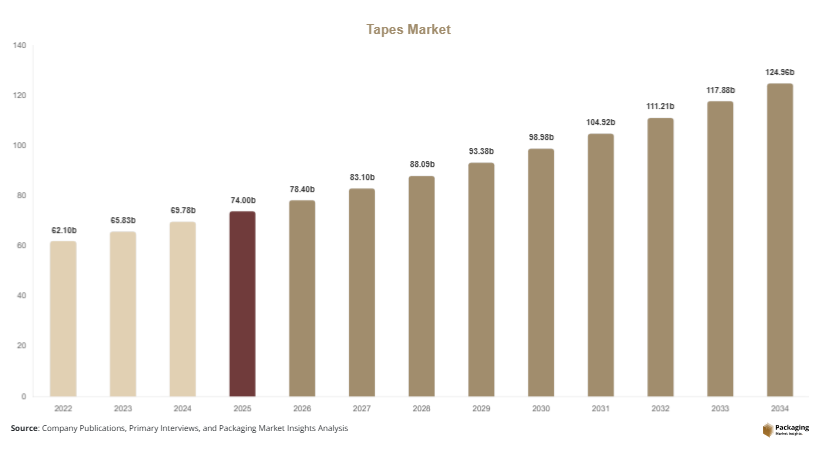
Tapes market size is projected at USD 78.4 billion in 2026 and is expected to hit USD 124.6 billion by 2034 with a CAGR of 6.0%.
The report provides detailed analysis of market segmentation, production capacity, demand patterns, competitive landscape, technological developments, and regional performance. It evaluates key factors influencing the global tapes industry across packaging, automotive, electronics, healthcare, construction, and industrial applications.
The study includes historical analysis from 2022–2024, base year assessment of 2025, and forecast analysis from 2026–2034 to identify growth opportunities, investment trends, and emerging demand areas.
The global tapes industry includes adhesive-based solutions manufactured from substrates such as paper, plastic films, foam, fabric, and metalized materials. In 2025, global tapes production exceeded 32 billion square meters, supported by rising demand from packaging, construction, automotive manufacturing, and electronics assembly sectors. Packaging applications accounted for nearly 38% of total consumption, while industrial and automotive applications contributed around 27%.
Increasing adoption of high-performance adhesive technologies, lightweight materials, and sustainable tape solutions has expanded penetration across manufacturing sectors. Asia Pacific contributed approximately 46% of global production volume, driven by large-scale manufacturing activities in China, India, Japan, and South Korea. Growing demand for efficient bonding solutions continues to strengthen the global tapes market.
Explore more data points, trends and opportunities Download Free Sample Report
Tapes Market Trends
Shift Toward Sustainable and High-Performance Adhesive Solutions
The tapes market is witnessing strong demand for eco-friendly adhesive products, with sustainable tapes accounting for nearly 18% of new product launches in 2025. Manufacturers are developing recyclable paper tapes, bio-based adhesive tapes, and solvent-free solutions to reduce environmental impact. More than 65% of packaging companies are evaluating sustainable adhesive alternatives due to regulatory pressure and consumer preferences.
Advanced acrylic, silicone, and hot-melt adhesive technologies are improving durability, temperature resistance, and bonding strength. Automotive and electronics sectors are increasing adoption of specialty tapes, with industrial-grade tapes representing over 12 billion square meters of annual consumption. These developments continue to support tapes market expansion.
Rising Demand From Packaging and Electronics Industries
Packaging remains the largest application segment, consuming over 12 billion square meters of tapes annually in 2025. E-commerce growth, flexible packaging adoption, and automated packaging systems have increased demand for carton sealing, labeling, and protective tapes.
Electronics manufacturing is another major growth area, where precision tapes with thickness ranges from 20 microns to 500 microns are increasingly used for component mounting and thermal management. More than 70% of consumer electronics manufacturers utilize specialized adhesive tapes, supporting long-term tapes market growth.
Tapes Market Drivers
Expansion of Packaging and E-Commerce Activities
The rapid expansion of global e-commerce shipments is driving demand for packaging tapes, with more than 160 billion parcels shipped globally in 2025. Packaging applications represent approximately 38% of total tapes consumption, while automated warehouses have increased tape usage by nearly 22% over the last five years. Growing demand for secure packaging, lightweight materials, and efficient logistics solutions continues to strengthen the tapes market.
Tapes Market Restraints
Fluctuating Raw Material Prices Impact Production Costs
Volatility in raw materials such as polypropylene, acrylic polymers, rubber compounds, and resins remains a key challenge. Raw material expenses account for nearly 45% of total manufacturing costs, while petroleum-based adhesive price fluctuations of 8–12% annually affect profit margins. Manufacturers face pressure to maintain competitive pricing while investing in sustainable alternatives, influencing tapes market development.
Tapes Market Opportunities
Growth of Smart Adhesive and Specialty Tape Applications
Advanced specialty tapes are creating new opportunities across electronics, healthcare, and automotive sectors. Demand for electrically conductive, thermal management, and medical-grade tapes is growing at more than 9% annually. Electric vehicle production exceeding 18 million units globally in 2025 has increased demand for battery insulation and bonding tapes, creating significant opportunities in the tapes market.
Challenges in Tapes Market
Environmental Regulations and Recycling Limitations
Strict environmental regulations regarding synthetic polymers and chemical adhesives are challenging manufacturers. Nearly 35% of conventional tape products rely on non-recyclable plastic substrates, increasing pressure for alternative materials. Companies must invest in advanced recycling technologies and sustainable production methods to address regulatory requirements while maintaining performance standards in the tapes market.
Report Scope
| Report Metric | Details |
|---|---|
| Market Size in 2025 | USD 74.0 billion |
| Market Size in 2026 | USD 78.4 billion |
| Market Size in 2034 | USD 124.6 billion |
| CAGR | 6.0% (2026-2034) |
| Base Year for Estimation | 2025 |
| Historical Data | 2022-2024 |
| Forecast Period | 2026-2034 |
| Report Coverage | Revenue Forecast, Competitive Landscape, Supply Chain Disruption, Growth Factors, Environment & Regulatory Landscape and Trends |
| Geographies Covered | North America, Europe, APAC, Middle East and Africa, LATAM |
| Countries Covered | U.S., Canada, U.K., Germany, France, Spain, Italy, Russia, Nordic, Benelux, Rest of Europe, China, South Korea, Japan, India, Australia, Singapore, Taiwan, South East Asia, Rest of Asia-Pacific, UAE, Turky, Saudi Arabia, South Africa, Egypt, Nigeria, Rest of MEA, Brazil, Mexico, Argentina, Chile, Colombia, Rest of LATAM |
Explore more data points, trends and opportunities Download Free Sample Report
Tapes Market Segmentation
The tapes market segmentation is based on type and application. Single-sided tapes dominate the market with approximately 52% share due to extensive use in packaging and industrial applications. Double-sided tapes account for around 28% share, supported by automotive and electronics bonding requirements, while specialty tapes contribute nearly 20% share with increasing adoption in advanced industries.
By Type
Single-Sided Tapes
Single-sided tapes represent the largest segment with nearly 52% market share and global consumption exceeding 16 billion square meters in 2025. These tapes are widely used for carton sealing, masking, insulation, and surface protection. Available thickness ranges from 25 microns to more than 150 microns, offering flexibility across industrial applications. Paper-based and polypropylene single-sided tapes account for over 70% of production volume, driven by packaging demand.
Double-Sided Tapes
Double-sided tapes contribute approximately 28% share of the global tapes market. These products are manufactured using acrylic, foam, tissue, and film carriers with thickness specifications between 50 microns and 2 millimeters. Automotive manufacturers use double-sided tapes for interior component assembly, representing nearly 35% of industrial consumption. Increasing lightweight vehicle production is expected to increase demand for high-strength bonding solutions.
Specialty Tapes
Specialty tapes account for around 20% share and include electrical tapes, thermal tapes, medical tapes, and high-temperature resistant solutions. The segment produces more than 5 billion square meters annually, with electronics and healthcare applications representing nearly 60% of demand. Advanced specialty tapes provide resistance against heat, moisture, chemicals, and vibration, supporting industrial innovation.
By Application
Packaging
Packaging is the dominant application segment, contributing nearly 38% of global tapes demand. More than 12 billion square meters of packaging tapes are consumed annually for carton sealing, logistics, and protective packaging. E-commerce fulfillment centers have increased tape usage by approximately 25%, while food and beverage packaging industries continue adopting high-performance adhesive solutions.
Automotive
Automotive applications account for around 18% market share, supported by vehicle manufacturing and electric vehicle growth. More than 90 million vehicles produced annually require adhesive tapes for interior assembly, wire harness fixing, and component mounting. Lightweight vehicle designs are increasing demand for structural bonding tapes with improved durability.
Electronics
Electronics applications represent approximately 15% share of global tapes consumption. Smartphone, semiconductor, and consumer electronics manufacturers use precision tapes for display assembly, thermal control, and component fixing. Over 70% of electronics producers utilize specialty adhesive tapes, driving demand for advanced thin-film solutions.
Tapes Market Segmentations
Type
- Single-Sided Tapes
- Double-Sided Tapes
- Specialty Tapes
Application
- Packaging
- Automotive
- Electronics
- Construction & Industrial
Tapes Market Regional Outlook
North America
North America holds approximately 24% share of the global tapes market, with the United States contributing nearly 80% of regional demand. Packaging, automotive, and aerospace industries consume more than 7 billion square meters annually. Rising electric vehicle production and industrial automation are increasing demand for specialty adhesive tapes.
Europe
Europe accounts for nearly 22% market share, supported by Germany, France, the United Kingdom, and Italy. The region consumes more than 6 billion square meters of tapes annually, with automotive and sustainable packaging applications representing major demand areas. Environmental regulations have accelerated adoption of recyclable and bio-based tape products.
Asia Pacific
Asia Pacific dominates with approximately 46% market share and production exceeding 15 billion square meters annually. China contributes nearly 55% of regional output, followed by Japan, India, and South Korea. Electronics manufacturing, automotive production, and packaging industries are major contributors to regional tapes demand.
Latin America
Latin America represents nearly 5% share, with Brazil and Mexico accounting for over 70% of regional consumption. Growing manufacturing activities and expanding retail sectors are supporting demand for packaging and industrial tapes.
Middle East & Africa
The Middle East & Africa region contributes around 3% market share. Infrastructure development, construction projects, and industrial packaging requirements are increasing adoption of adhesive tapes across emerging markets.
Top players in Tapes Market
- 3M Company
- Tesa SE
- Nitto Denko Corporation
- Avery Dennison Corporation
- Intertape Polymer Group
- Berry Global Inc.
- Scapa Group
- Lintec Corporation
- Shurtape Technologies LLC
- H.B. Fuller Company
3M Company
-
Holds an estimated 12–15% share of the global tapes market.
-
Maintains strong positioning through diversified adhesive technologies across automotive, healthcare, electronics, and industrial applications.
-
Offers thousands of tape solutions, including specialty bonding and insulation products.
-
Focuses heavily on innovation, sustainability, and advanced polymer technologies.
Tesa SE
-
Accounts for approximately 6–8% market share globally.
-
Strong presence in automotive, electronics, and industrial bonding applications.
-
Invests significantly in sustainable adhesive technologies and customized solutions.
-
Expanding production capabilities across global manufacturing hubs.