Packaging Primers Market Size and Growth
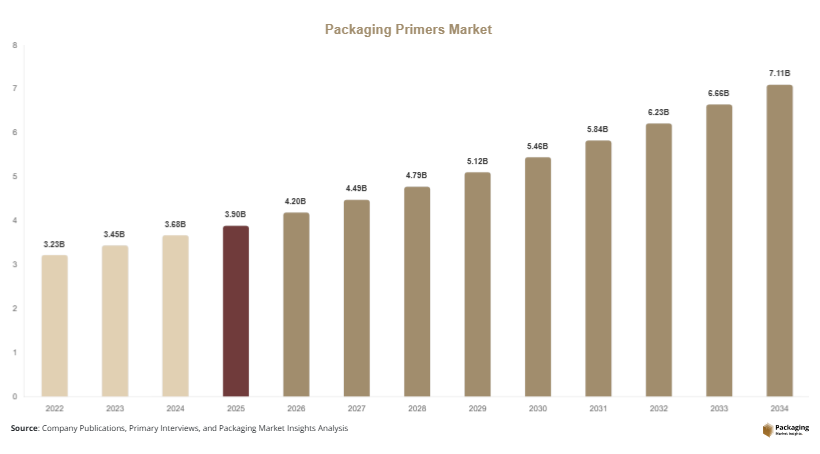
The global packaging primers market size is estimated at USD 3.9 billion in 2025, while the market is projected to reach approximately USD 4.2 billion in 2026. By 2034, the market is forecast to achieve nearly USD 7.1 billion, expanding at a CAGR of 6.8% during 2025–2034. The packaging primers market is experiencing consistent growth due to increasing demand for high-performance packaging materials across food, beverage, pharmaceutical, personal care, and industrial applications. Packaging primers are widely used to improve adhesion between substrates and coatings, inks, laminates, or adhesives, ensuring durability, print quality, and barrier performance.
The growth of the packaging industry is one of the major factors driving demand for packaging primers. Flexible packaging manufacturers are increasingly using primers to improve surface compatibility and bonding strength for multilayer packaging structures. Another important growth factor is the rapid expansion of food delivery and e-commerce sectors, which require durable and high-quality packaging capable of maintaining structural integrity during transportation. Additionally, the rising use of sustainable and recyclable packaging materials has increased the need for specialized primers that support adhesion on biodegradable films, paper substrates, and low-energy surfaces.
Key Highlights
- Asia Pacific dominated the market with a 39.1% share in 2025.
- Latin America is projected to grow at the fastest CAGR of 7.2%.
- Water-based primers led the type segment with a 36.8% share.
- Flexible packaging dominated with a 48.6% share.
- Polyethylene substrates led the material segment with 33.9% share.
- The US remained the dominant country with a market size of USD 1.1 billion in 2025 and USD 1.2 billion in 2026.
Explore more data points, trends and opportunities Download Free Sample Report
Market Trends
Increasing Adoption of Sustainable and Water-Based Primer Technologies
The growing emphasis on sustainable packaging is significantly influencing the packaging primers market. Manufacturers are increasingly replacing solvent-based products with water-based and low-VOC primer technologies to comply with environmental regulations and corporate sustainability initiatives. Water-based primers provide improved adhesion while reducing emissions and workplace hazards during manufacturing operations. Packaging companies are also focusing on recyclable and compostable materials, which require advanced primer systems capable of maintaining performance on paper, biofilms, and lightweight substrates. This trend is particularly visible in food and beverage packaging, where brand owners are prioritizing environmentally compliant packaging formats. The transition toward greener production methods is expected to support long-term demand for sustainable primer technologies.
Expansion of Digital Printing in Packaging Applications
Digital printing technologies are becoming increasingly common across packaging operations, creating new demand for specialized packaging primers. Digital printing requires consistent surface energy and strong ink adhesion, especially on plastic films, metalized surfaces, and coated paper materials. Packaging converters are using primers to improve print quality, color accuracy, and resistance against abrasion or moisture exposure. Short production runs and customized packaging solutions are also encouraging the adoption of digital printing systems, particularly in e-commerce and promotional packaging. As brands continue to seek flexible and visually appealing packaging formats, primer manufacturers are developing products optimized for high-speed digital printing equipment and multiple substrate combinations.
Market Drivers
Rising Demand for Flexible Packaging Solutions
The rapid expansion of flexible packaging applications is a major driver for the packaging primers market. Flexible packaging formats such as pouches, sachets, wraps, and laminated films require strong adhesion between substrates, coatings, and inks. Packaging primers improve bonding performance and help maintain packaging durability during transportation and storage. Food and beverage manufacturers are increasingly adopting flexible packaging because of its lightweight structure, cost efficiency, and extended shelf-life capabilities. In addition, rising urbanization and changing consumer lifestyles are driving demand for packaged and convenience foods globally. These factors continue to increase consumption of packaging primers across flexible packaging manufacturing operations.
Growth of Pharmaceutical and Healthcare Packaging
The pharmaceutical and healthcare sectors are contributing significantly to the growth of the packaging primers market. Drug manufacturers require packaging materials with high barrier protection, chemical resistance, and reliable print quality for labeling and compliance purposes. Packaging primers improve adhesion on blister packs, medical pouches, and sterile packaging films, ensuring consistent product performance. The increase in vaccine distribution, biologics transportation, and medical device packaging has further accelerated demand for advanced packaging materials. Regulatory requirements for traceability and contamination prevention are also encouraging healthcare packaging companies to invest in high-performance primer technologies capable of supporting durable and secure packaging systems.
Market Restraint
Volatility in Raw Material Prices and Regulatory Compliance Challenges
One of the major restraints affecting the packaging primers market is the volatility in raw material prices combined with increasingly strict environmental regulations. Packaging primers are manufactured using chemical compounds derived from petrochemical feedstocks, including resins, solvents, and specialty additives. Fluctuations in crude oil prices can directly impact production costs, creating pricing pressure for manufacturers and converters. At the same time, regulatory agencies in North America and Europe are implementing tighter restrictions on VOC emissions and hazardous substances used in coatings and primers. Compliance with these standards often requires additional investment in research, reformulation, and manufacturing upgrades.
Smaller companies may face challenges in adapting to evolving environmental requirements because of limited financial resources and technical capabilities. For example, solvent-based primer manufacturers operating in industrial packaging applications may experience declining demand as customers transition toward water-based alternatives. These factors can reduce profit margins and delay new product launches. In addition, supply chain disruptions affecting raw material availability can further impact production timelines and operational efficiency across the market.
Market Opportunities
Growing Use of Bio-Based and Recyclable Packaging Materials
The increasing adoption of bio-based and recyclable packaging materials presents a significant opportunity for the packaging primers market. Packaging manufacturers are actively developing sustainable solutions that support circular economy goals and reduce plastic waste. However, recyclable films, biodegradable plastics, and paper-based materials often require specialized primers to achieve effective ink adhesion and lamination performance. This creates demand for innovative primer formulations compatible with environmentally friendly substrates. Food and beverage companies are especially investing in sustainable packaging to meet consumer preferences and regulatory expectations. As a result, primer manufacturers have opportunities to expand product portfolios focused on eco-compatible applications and advanced substrate technologies.
Expansion of Packaging Manufacturing in Emerging Economies
Emerging economies across Asia Pacific, Latin America, and Africa are witnessing rapid growth in packaging production, creating favorable opportunities for packaging primer suppliers. Rising disposable incomes, urbanization, and industrial development are increasing demand for packaged consumer goods and healthcare products. Governments are also investing in manufacturing infrastructure and food processing industries, which further supports packaging consumption. Local packaging converters are adopting advanced printing and lamination technologies that require high-performance primers for improved efficiency and quality. The growth of export-oriented manufacturing sectors in countries such as India, Brazil, and Vietnam is expected to generate additional demand for packaging primers during the forecast period.
Report Scope
| Report Metric | Details |
|---|---|
| Market Size in 2025 | USD 3.9 Billion |
| Market Size in 2026 | USD 4.2 Billion |
| Market Size in 2034 | USD 7.1 Billion |
| CAGR | 6.8% (2026-2034) |
| Base Year for Estimation | 2025 |
| Historical Data | 2022-2024 |
| Forecast Period | 2026-2034 |
| Report Coverage | Revenue Forecast, Competitive Landscape, Supply Chain Disruption, Growth Factors, Environment & Regulatory Landscape and Trends |
| Geographies Covered | North America, Europe, APAC, Middle East and Africa, LATAM |
| Countries Covered | U.S., Canada, U.K., Germany, France, Spain, Italy, Russia, Nordic, Benelux, Rest of Europe, China, South Korea, Japan, India, Australia, Singapore, Taiwan, South East Asia, Rest of Asia-Pacific, UAE, Turky, Saudi Arabia, South Africa, Egypt, Nigeria, Rest of MEA, Brazil, Mexico, Argentina, Chile, Colombia, Rest of LATAM |
Explore more data points, trends and opportunities Download Free Sample Report
Segmental Analysis
By Type
Water-based primers dominated the packaging primers market in 2024, accounting for approximately 36.8% of total market share. These primers are widely used because they offer lower VOC emissions, improved environmental compliance, and strong adhesion performance across multiple packaging substrates. Food and beverage packaging manufacturers increasingly prefer water-based systems to meet sustainability requirements and workplace safety standards. They are commonly used in flexible packaging, labels, and paperboard applications because of their compatibility with modern printing technologies. In addition, regulatory pressure against solvent-heavy formulations is encouraging manufacturers to expand production of water-based primer products globally.
UV-curable primers are projected to be the fastest-growing subsegment, registering a CAGR of 7.5% during the forecast period. These primers provide rapid curing speed, enhanced abrasion resistance, and high production efficiency for packaging converters. UV-curable systems are gaining popularity in digital printing and specialty packaging applications where faster processing times are essential. Growth in premium consumer packaging and decorative labeling is also supporting adoption. Furthermore, the ability of UV-curable primers to reduce energy consumption and production downtime is encouraging packaging companies to integrate these technologies into high-speed manufacturing lines.
By Application
Flexible packaging dominated the market in 2024 with a share of approximately 48.6%. Flexible packaging formats are widely used in food, beverage, pharmaceutical, and personal care industries because of their lightweight structure and cost efficiency. Packaging primers are essential in flexible packaging applications to improve lamination strength, print adhesion, and barrier coating performance. Increasing consumer demand for convenience foods and portable packaging solutions continues to support growth in this segment. In addition, packaging manufacturers are using advanced multilayer films that require specialized primers for enhanced compatibility and durability during storage and transportation.
Pharmaceutical packaging is expected to be the fastest-growing application segment with a CAGR of 7.1% through 2034. The increasing distribution of temperature-sensitive drugs, biologics, and medical devices is creating demand for high-performance packaging systems. Primers are used extensively in blister packs, medical pouches, and sterile packaging films to ensure adhesion reliability and contamination resistance. Regulatory compliance requirements for traceability and labeling accuracy are also encouraging pharmaceutical companies to adopt advanced coating and printing solutions. Rising healthcare spending and expansion of pharmaceutical manufacturing facilities globally are expected to accelerate growth in this segment.
By Substrate Material
Polyethylene substrates accounted for the largest market share in 2024 at approximately 33.9%. Polyethylene is widely used in flexible films, pouches, and industrial packaging because of its durability, moisture resistance, and low production cost. However, its low surface energy requires specialized primers to improve adhesion performance for inks, laminates, and coatings. Packaging converters are increasingly using primer systems optimized for polyethylene films to ensure print consistency and structural strength. Growth in food packaging and consumer goods packaging continues to support demand for polyethylene-based packaging materials globally.
Biodegradable substrates are projected to witness the fastest growth, with a CAGR of 7.4% during the forecast period. Rising environmental concerns and government regulations targeting plastic waste are encouraging the adoption of compostable and recyclable materials. These substrates often present adhesion challenges, creating opportunities for advanced primer technologies designed specifically for eco-friendly applications. Food service packaging, retail packaging, and sustainable shipping materials are key areas driving demand. Packaging manufacturers are increasingly investing in biodegradable films and coated paper materials, which is expected to support strong growth for compatible packaging primers over the coming years.
Packaging Primers Market Segmentations
By Type
- Water-Based Primers
- Solvent-Based Primers
- UV-Curable Primers
By Application
- Flexible Packaging
- Rigid Packaging
- Pharmaceutical Packaging
- Industrial Packaging
By Substrate Material
- Polyethylene
- Polypropylene
- Paper & Paperboard
- Biodegradable Materials
By End-Use Industry
- Food & Beverage
- Healthcare & Pharmaceuticals
- Personal Care & Cosmetics
- Consumer Goods
- Industrial Products
Regional Analysis
North America
North America accounted for approximately 27.8% of the global packaging primers market share in 2025 and is expected to grow at a CAGR of 5.9% during the forecast period. The region benefits from strong demand across food packaging, pharmaceutical packaging, and consumer goods industries. Increasing investments in sustainable packaging technologies and advanced printing systems are supporting market expansion. Packaging converters in the United States and Canada are also adopting water-based primer systems to comply with environmental regulations and improve production efficiency.
The United States dominates the regional market due to its large packaging manufacturing sector and advanced coating technologies. A unique growth factor in the country is the increasing demand for digitally printed packaging in e-commerce and retail industries. Brand owners are focusing on customized packaging formats and shorter production cycles, which is driving the use of high-performance primers for superior print adhesion and durability.
Europe
Europe held nearly 24.1% of the packaging primers market share in 2025 and is forecast to grow at a CAGR of 5.7% through 2034. Strict environmental regulations and sustainability initiatives are strongly influencing market trends across the region. Packaging manufacturers are increasingly transitioning toward recyclable and compostable materials, which require specialized primer technologies. Growth in pharmaceutical packaging and premium food packaging applications is also contributing to steady market demand in European countries.
Germany remains the dominant country in the European market because of its strong industrial manufacturing and packaging innovation capabilities. One unique growth factor is the widespread adoption of solvent-free and UV-curable primer technologies in industrial packaging operations. German manufacturers are investing in energy-efficient production systems and sustainable coating technologies, creating opportunities for advanced packaging primer suppliers.
Asia Pacific
Asia Pacific dominated the packaging primers market with a 39.1% share in 2025 and is projected to expand at a CAGR of 7.3% during the forecast period. Rapid industrialization, urbanization, and increasing packaged food consumption are driving market growth across the region. Expanding e-commerce operations and rising healthcare spending are also increasing demand for flexible and protective packaging materials. Packaging manufacturers in the region are adopting advanced printing technologies that require improved substrate adhesion performance.
China is the leading country in Asia Pacific due to its large-scale packaging production and export-oriented manufacturing sector. A unique growth factor is the rapid expansion of food delivery and online retail industries, which require durable and visually appealing packaging formats. This trend is increasing the demand for primers used in multilayer flexible packaging and digitally printed packaging applications.
Middle East & Africa
The Middle East & Africa region represented approximately 4.9% of the global market share in 2025 and is anticipated to grow at a CAGR of 6.1% over the forecast period. The expansion of food processing, healthcare, and industrial packaging sectors is contributing to market development. Governments in several countries are investing in manufacturing infrastructure and logistics capabilities, supporting packaging industry growth. Increasing imports of packaged consumer goods are also encouraging local packaging production activities.
The United Arab Emirates dominates the regional market due to its advanced logistics infrastructure and expanding packaging conversion industry. A unique growth factor is the rising demand for premium packaged food products and luxury consumer goods. Companies operating in the UAE are increasingly adopting advanced coating and printing technologies, which is supporting demand for high-performance packaging primers across multiple applications.
Latin America
Latin America accounted for nearly 4.1% of the packaging primers market share in 2025 and is projected to register the fastest CAGR of 7.2% through 2034. The region is witnessing growing demand for packaged food, beverages, and healthcare products due to urbanization and changing consumer lifestyles. Investments in flexible packaging manufacturing and labeling technologies are also contributing to market growth. Additionally, the increasing penetration of organized retail channels is supporting packaging demand across the region.
Brazil leads the Latin American market because of its expanding food processing and consumer goods industries. One unique growth factor is the increasing export of processed agricultural products, which requires durable packaging solutions capable of maintaining product quality during transportation. This trend is driving adoption of advanced packaging primers in flexible films, laminates, and industrial packaging materials.
Competitive Landscape
The global packaging primers market is moderately competitive, with leading manufacturers focusing on product innovation, sustainability, and expansion of regional distribution networks. Companies are investing in research and development to create low-VOC, water-based, and UV-curable primer solutions that align with evolving environmental standards. Strategic collaborations between packaging converters and coating manufacturers are also increasing as demand for customized primer formulations continues to grow.
PPG Industries remains one of the leading players in the market because of its extensive coatings portfolio and strong presence across industrial packaging applications. In 2024, the company introduced a new water-based primer range designed for recyclable flexible packaging films, supporting sustainability initiatives among packaging manufacturers.
Other major companies include Akzo Nobel N.V., BASF SE, Dow Inc., and Siegwerk Druckfarben AG & Co. KGaA. These firms are focusing on acquisitions, product launches, and technology partnerships to strengthen market share. Many companies are also expanding manufacturing capacities in Asia Pacific and Latin America to address increasing regional demand for advanced packaging solutions.
Key Players List
- PPG Industries
- Akzo Nobel N.V.
- BASF SE
- Dow Inc.
- Siegwerk Druckfarben AG & Co. KGaA
- Sherwin-Williams Company
- Arkema S.A.
- Michelman Inc.
- Toyo Ink SC Holdings Co., Ltd.
- Flint Group
- Sun Chemical Corporation
- ALTANA AG
- Coim Group
- INX International Ink Co.
- Ashland Global Holdings Inc.