Unidirectional Tapes (UD) Tapes Market Size and Growth
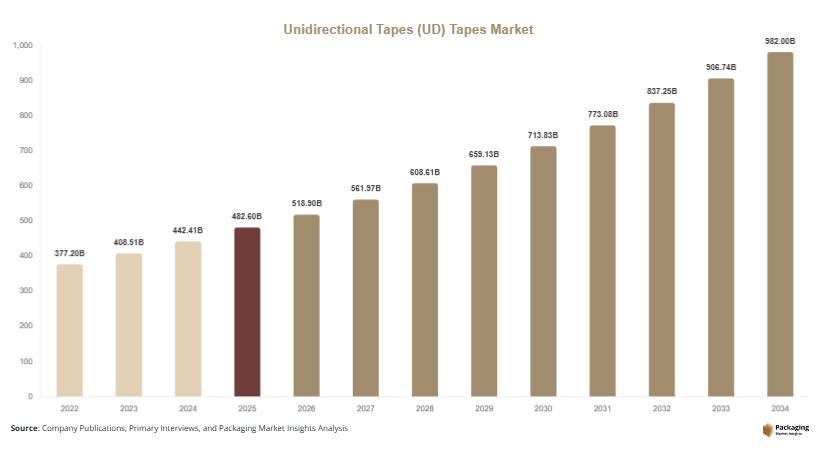
The global unidirectional tapes (UD) tapes market size is estimated at USD 482.6 million in 2026, rising to approximately USD 518.9 million in 2026. By 2034, the market is projected to reach nearly USD 982.4 million, registering a CAGR of 8.3% during 2025–2034. The unidirectional tapes (UD) tapes market is experiencing steady growth due to increasing demand for lightweight, high-strength composite materials across automotive, aerospace, sporting goods, and industrial applications. Unidirectional tapes consist of continuous fiber reinforcements aligned in a single direction, offering superior mechanical strength, stiffness, and weight reduction compared to traditional materials. These tapes are widely used in structural components, pressure vessels, automotive body parts, aircraft interiors, wind turbine blades, and high-performance sporting equipment.
One of the primary growth factors supporting the market is the increasing adoption of lightweight materials in the automotive sector to improve fuel efficiency and support electric vehicle performance. Automakers are integrating carbon fiber and glass fiber UD tapes into structural and semi-structural vehicle components to reduce overall vehicle weight. Another major growth factor is the expansion of the aerospace industry, where manufacturers increasingly use advanced composite materials to improve aircraft efficiency and lower operational costs. Additionally, rising investments in renewable energy infrastructure, particularly wind energy projects, are increasing demand for durable composite reinforcement materials such as UD tapes.
Key Highlights:
- Asia Pacific dominated the market with a 41.2% share in 2025.
- Latin America is projected to grow at the fastest CAGR of 8.7%.
- Thermoplastic UD tapes led the type segment with a 54.6% share.
- Carbon fiber materials dominated with a 48.9% share.
- Automotive applications led the market with 36.4% share.
- The US remained the dominant country with a market size of USD 118.4 million in 2025 and USD 126.3 million in 2026.
Explore more data points, trends and opportunities Download Free Sample Report
Market Trends
Increasing Adoption of Thermoplastic Composite UD Tapes
The market is witnessing strong adoption of thermoplastic composite UD tapes due to their recyclability, lightweight properties, and faster manufacturing cycles. Thermoplastic UD tapes offer advantages such as high impact resistance, weldability, and shorter processing times compared to traditional thermoset materials. Automotive manufacturers increasingly use thermoplastic carbon fiber tapes in electric vehicle battery enclosures, seat structures, and underbody components to improve efficiency and reduce vehicle weight. For example, several European electric vehicle producers are integrating thermoplastic composite materials into structural vehicle parts to support sustainability targets. Future advancements in automated composite manufacturing technologies are expected to accelerate adoption of thermoplastic UD tapes across aerospace, transportation, and industrial sectors.
Growing Use of Automated Fiber Placement Technologies
Automated fiber placement and robotic composite manufacturing technologies are becoming important trends in the unidirectional tapes (UD) tapes market. Manufacturers are investing in automation systems capable of precisely placing composite tapes for complex structural applications in aerospace, automotive, and wind energy sectors. These technologies improve production speed, reduce material waste, and enhance structural consistency in composite parts. For instance, aircraft manufacturers increasingly use robotic tape placement systems for lightweight fuselage and interior component production. The trend is expected to strengthen further as industries seek cost-efficient high-volume composite manufacturing solutions. Continued advancements in digital manufacturing and smart factory systems are likely to improve the scalability of UD tape production globally.
Market Drivers
Rising Demand for Lightweight Automotive Components
The increasing focus on lightweight vehicle manufacturing is a major factor driving growth in the unidirectional tapes (UD) tapes market. Automotive manufacturers are adopting carbon fiber and glass fiber composite materials to reduce vehicle weight and improve fuel efficiency. Electric vehicle manufacturers especially require lightweight structural components to improve battery performance and driving range. For example, automotive companies are integrating UD tapes into door panels, seat frames, underbody shields, and battery housing systems. Government regulations supporting lower vehicle emissions and improved fuel economy standards are further accelerating demand for advanced lightweight composite materials across global automotive production networks.
Expansion of Aerospace Composite Applications
The aerospace industry is another major driver supporting the market due to increasing use of composite materials in aircraft manufacturing. Aerospace manufacturers rely on unidirectional tapes for structural reinforcement, interior panels, and lightweight cabin components because of their high strength-to-weight ratio. For instance, aircraft producers are incorporating carbon fiber UD tapes into fuselage structures and aircraft floor systems to reduce operational fuel consumption. Growing global air travel demand and increasing aircraft production rates are creating long-term demand for advanced composite reinforcement materials. Additionally, defense modernization programs and rising investments in next-generation aircraft technologies are expected to support further market expansion.
Market Restraint
High Production Costs and Complex Manufacturing Processes
One of the major restraints affecting the unidirectional tapes (UD) tapes market is the high production cost associated with advanced composite materials and manufacturing technologies. Carbon fiber UD tapes, in particular, require specialized processing equipment, high-quality raw materials, and precise production conditions, increasing overall manufacturing expenses. Small and medium-sized manufacturers often face challenges in adopting advanced automated composite technologies due to significant capital investment requirements. For example, aerospace-grade carbon fiber tapes involve stringent quality standards and complex fabrication procedures that increase production costs compared to traditional metal alternatives. In addition, limited recycling infrastructure for certain composite materials and fluctuations in raw material prices can affect profitability for manufacturers. These cost-related challenges may restrict broader adoption of UD tapes in price-sensitive industrial applications, particularly across developing economies where conventional materials remain more affordable and accessible.
Market Opportunities
Growing Wind Energy Infrastructure Investments
The expansion of renewable energy infrastructure presents strong opportunities for the unidirectional tapes (UD) tapes market. Wind turbine manufacturers increasingly use glass fiber and carbon fiber composite tapes in turbine blades to improve durability, reduce weight, and enhance energy generation efficiency. Larger offshore wind projects require advanced lightweight composite materials capable of withstanding harsh environmental conditions. For example, wind blade manufacturers are integrating high-strength UD tapes into long-span blade structures to improve aerodynamic performance and structural reliability. Future investments in renewable energy capacity expansion across Asia Pacific, Europe, and North America are expected to create significant demand for advanced composite reinforcement materials during the forecast period.
Expansion of Sporting Goods Composite Applications
The growing use of advanced composites in sports and recreational products is creating additional opportunities for market expansion. Manufacturers of bicycles, golf clubs, hockey sticks, fishing rods, and protective sports equipment increasingly use UD tapes to improve product strength and reduce weight. Carbon fiber composite materials are particularly popular in premium sporting goods due to their durability and lightweight characteristics. For instance, high-performance bicycle manufacturers are incorporating thermoplastic UD tapes into racing bike frames and wheel structures to improve speed and maneuverability. Rising consumer spending on premium sports equipment and increasing participation in fitness and recreational activities are expected to support long-term growth opportunities for UD tape manufacturers globally.
Report Scope
| Report Metric | Details |
|---|---|
| Market Size in 2025 | USD 482.6 Billion |
| Market Size in 2026 | USD 518.9 Billion |
| Market Size in 2034 | USD 982.4 Billion |
| CAGR | 8.3% (2026-2034) |
| Base Year for Estimation | 2025 |
| Historical Data | 2022-2024 |
| Forecast Period | 2026-2034 |
| Report Coverage | Revenue Forecast, Competitive Landscape, Supply Chain Disruption, Growth Factors, Environment & Regulatory Landscape and Trends |
| Geographies Covered | North America, Europe, APAC, Middle East and Africa, LATAM |
| Countries Covered | U.S., Canada, U.K., Germany, France, Spain, Italy, Russia, Nordic, Benelux, Rest of Europe, China, South Korea, Japan, India, Australia, Singapore, Taiwan, South East Asia, Rest of Asia-Pacific, UAE, Turky, Saudi Arabia, South Africa, Egypt, Nigeria, Rest of MEA, Brazil, Mexico, Argentina, Chile, Colombia, Rest of LATAM |
Explore more data points, trends and opportunities Download Free Sample Report
Segmental Analysis
By Type
Thermoplastic UD tapes dominated the global unidirectional tapes (UD) tapes market in 2024, accounting for approximately 54.6% of the total market share. Thermoplastic tapes are widely preferred because they offer high impact resistance, recyclability, rapid processing capability, and improved design flexibility. These tapes are increasingly used in automotive structural components, aerospace interiors, and industrial applications where lightweight and durable materials are essential. Automotive manufacturers particularly favor thermoplastic carbon fiber tapes for electric vehicle battery enclosures and seat structures due to their superior strength-to-weight ratio. For example, several electric vehicle manufacturers are integrating thermoplastic UD tapes into underbody systems to reduce vehicle mass and improve energy efficiency. In addition, thermoplastic composites support automated manufacturing technologies such as robotic tape placement and thermoforming, improving production efficiency. Growing demand for recyclable composite materials and sustainable lightweight solutions continues supporting the dominance of thermoplastic UD tapes globally.
Thermoset UD tapes are projected to witness the fastest growth, registering a CAGR of 8.5% during the forecast period. Thermoset composite tapes offer excellent thermal stability, mechanical strength, and chemical resistance, making them highly suitable for aerospace, wind energy, and industrial structural applications. Aerospace manufacturers increasingly use thermoset carbon fiber tapes in aircraft fuselage structures, cabin floor systems, and interior components due to their long-term durability and fatigue resistance. For instance, wind turbine manufacturers are incorporating thermoset glass fiber tapes into large offshore blade structures to improve operational reliability under harsh environmental conditions. The future growth of renewable energy infrastructure and next-generation aerospace technologies is expected to strengthen demand for thermoset composite materials. In addition, ongoing advancements in resin technologies and curing processes are likely to improve manufacturing efficiency and broaden industrial adoption of thermoset UD tapes over the forecast period.
By Material
Carbon fiber materials dominated the unidirectional tapes (UD) tapes market in 2024 with a market share of approximately 48.9%. Carbon fiber UD tapes are widely used across aerospace, automotive, sporting goods, and industrial applications because they provide exceptional stiffness, lightweight properties, and high tensile strength. Aerospace manufacturers increasingly rely on carbon fiber composites to reduce aircraft weight and improve fuel efficiency. Similarly, premium automotive manufacturers are integrating carbon fiber reinforcement materials into structural vehicle parts and electric vehicle battery systems. For example, sports equipment manufacturers use carbon fiber tapes in high-performance bicycles, tennis rackets, and hockey sticks to improve durability and reduce product weight. The material also supports advanced automated manufacturing technologies that improve production precision and structural consistency. Rising investments in lightweight transportation systems and high-performance industrial applications continue supporting the dominance of carbon fiber materials within the global market.
Glass fiber materials are expected to grow at the fastest CAGR of 8.2% during the forecast period. Glass fiber UD tapes are gaining popularity because they offer cost-effective reinforcement performance and excellent durability for industrial, wind energy, and transportation applications. Wind turbine manufacturers increasingly use glass fiber composites in blade structures due to their high strength, corrosion resistance, and lower cost compared to carbon fiber alternatives. For instance, renewable energy companies are adopting advanced glass fiber tapes for long-span offshore wind blades to improve operational efficiency and structural stability. In addition, automotive and industrial equipment manufacturers are using glass fiber composites for semi-structural lightweight components requiring cost-efficient reinforcement materials. Future growth in renewable energy capacity expansion and infrastructure modernization projects is expected to create strong demand for glass fiber UD tapes globally.
By End-Use
Automotive applications dominated the global unidirectional tapes (UD) tapes market in 2024 and accounted for nearly 36.4% of total market revenue. The automotive sector continues increasing its use of lightweight composite materials to improve fuel efficiency, reduce emissions, and support electric vehicle performance. UD tapes are widely integrated into structural reinforcements, seat frames, underbody systems, battery enclosures, and interior components because they provide high strength while reducing overall vehicle weight. Major automotive manufacturers across Europe, North America, and Asia Pacific are investing in thermoplastic composite technologies to support mass production of lightweight electric vehicles. For example, electric vehicle manufacturers are increasingly adopting carbon fiber reinforced UD tapes in battery protection systems to improve safety and driving range. Growing regulatory pressure regarding vehicle emission reduction and increasing investments in sustainable transportation technologies continue driving the dominance of automotive applications in the global market.
Aerospace applications are projected to register the fastest CAGR of 8.9% during the forecast period. The aerospace sector increasingly relies on advanced composite materials to reduce aircraft weight, improve fuel efficiency, and enhance structural performance. Aircraft manufacturers are using carbon fiber and thermoset UD tapes in fuselage structures, interior cabin systems, floor panels, and cargo compartments. For instance, commercial aircraft producers are expanding the use of automated fiber placement technologies to manufacture lightweight structural components with improved production efficiency. The growing demand for fuel-efficient aircraft and increasing global air passenger traffic are expected to accelerate composite adoption across the aviation industry. In addition, rising investments in military aircraft modernization programs and next-generation urban air mobility systems are expected to create long-term growth opportunities for UD tape manufacturers. Continuous innovation in lightweight aerospace composites and automated manufacturing systems will further strengthen the segment’s future outlook.
Unidirectional Tapes (UD) Tapes Market Segmentations
By Type
- Thermoplastic UD Tapes
- Thermoset UD Tapes
By Material
- Carbon Fiber
- Glass Fiber
- Aramid Fiber
- Others
By End-User
- Automotive
- Aerospace
- Wind Energy
- Sporting Goods
- Industrial
- Marine
Regional Analysis
North America
North America accounted for approximately 28.4% of the global unidirectional tapes (UD) tapes market share in 2025 and is projected to grow at a CAGR of 7.9% during the forecast period. The region benefits from strong aerospace manufacturing capabilities, increasing electric vehicle production, and rising investments in advanced lightweight materials. Automotive manufacturers across the United States and Canada are integrating carbon fiber and thermoplastic UD tapes into structural vehicle applications to improve fuel efficiency and reduce emissions. In addition, aerospace companies continue expanding the use of advanced composite materials for aircraft interiors and lightweight structural components. Government support for renewable energy infrastructure and industrial automation technologies is also contributing to sustained regional market expansion.
The United States dominates the North American unidirectional tapes (UD) tapes market due to its extensive aerospace manufacturing sector and advanced automotive composite research capabilities. One unique growth driver in the country is the increasing adoption of lightweight composite materials in defense and military aircraft modernization programs. Aerospace manufacturers are increasingly using automated fiber placement technologies and carbon fiber UD tapes for advanced fighter aircraft structures and lightweight cabin systems. In addition, major electric vehicle manufacturers in the United States are investing in thermoplastic composite technologies for battery enclosures and lightweight vehicle platforms. Strong industrial innovation and rising investments in advanced manufacturing technologies continue supporting long-term market growth.
Europe
Europe held approximately 26.1% of the global unidirectional tapes (UD) tapes market share in 2025 and is expected to register a CAGR of 8.1% during the forecast period. The region is characterized by strong automotive engineering, advanced aerospace production, and increasing sustainability initiatives focused on lightweight materials. European automotive manufacturers are actively replacing conventional metal components with composite alternatives to meet stringent emission reduction targets. Wind energy expansion across countries such as Germany, Denmark, and Spain is also supporting demand for glass fiber and carbon fiber UD tapes used in turbine blade production. Additionally, increasing investments in recyclable thermoplastic composites are encouraging broader industrial adoption across transportation and industrial sectors.
Germany remains the dominant country in the European market due to its advanced automotive manufacturing base and strong industrial composite research ecosystem. A unique growth factor in Germany is the rapid development of electric mobility infrastructure requiring lightweight composite vehicle structures. Automotive companies are increasingly incorporating carbon fiber UD tapes into battery housings, structural reinforcements, and underbody protection systems for electric vehicles. In addition, German industrial manufacturers are investing in robotic tape placement technologies to improve production efficiency and reduce material waste. The country’s strong engineering capabilities and focus on sustainable mobility solutions continue strengthening market demand for advanced composite materials.
Asia Pacific
Asia Pacific dominated the global unidirectional tapes (UD) tapes market with a 41.2% share in 2025 and is forecast to grow at a CAGR of 8.6% during the forecast period. Rapid industrialization, expanding automotive production, and increasing aerospace investments are driving strong regional demand for advanced composite materials. Countries such as China, Japan, South Korea, and India are witnessing rising adoption of lightweight materials across electric vehicles, sporting goods, industrial equipment, and renewable energy infrastructure. The region also benefits from lower manufacturing costs and expanding composite production facilities supporting high-volume industrial applications. Furthermore, increasing government investments in renewable energy and transportation modernization projects continue accelerating market growth across Asia Pacific.
China dominates the Asia Pacific unidirectional tapes (UD) tapes market because of its large-scale automotive manufacturing industry and expanding wind energy infrastructure. One unique growth driver in the country is the rapid expansion of domestic electric vehicle production requiring lightweight composite materials for enhanced battery efficiency and vehicle performance. Chinese manufacturers are increasingly integrating thermoplastic UD tapes into electric vehicle body panels, structural supports, and battery housing systems. In addition, growing investments in offshore wind energy projects are supporting demand for durable composite reinforcement materials in wind turbine blade manufacturing. The expansion of domestic aerospace manufacturing activities is also contributing to long-term market growth across China.
Middle East & Africa
The Middle East & Africa region accounted for approximately 2.9% of the global unidirectional tapes (UD) tapes market in 2025 and is expected to grow at a CAGR of 7.6% during the forecast period. Increasing industrial diversification, infrastructure modernization, and renewable energy development are contributing to market expansion across the region. Governments in Gulf countries are investing in advanced manufacturing technologies and lightweight materials to support transportation, energy, and construction industries. Wind energy and industrial automation projects are also increasing demand for composite reinforcement materials. In addition, rising interest in high-performance sporting equipment and industrial composite applications is supporting gradual adoption of UD tapes across selected regional markets.
Saudi Arabia dominates the Middle East & Africa market due to its growing industrial diversification strategy and renewable energy investments. One unique growth driver in the country is the increasing development of large-scale wind and clean energy projects requiring advanced lightweight composite materials. Energy infrastructure developers are increasingly using glass fiber UD tapes for wind turbine blade manufacturing and industrial structural reinforcement applications. In addition, government initiatives supporting domestic industrial manufacturing and advanced material research are encouraging investment in composite technologies. Expanding transportation infrastructure projects and industrial modernization programs are expected to support future market growth in Saudi Arabia.
Latin America
Latin America represented approximately 1.4% of the global unidirectional tapes (UD) tapes market share in 2025 and is projected to expand at a CAGR of 8.7% during the forecast period. The regional market is benefiting from increasing automotive production, renewable energy investments, and growing industrial manufacturing activities. Countries across Latin America are gradually adopting lightweight composite materials in transportation and energy infrastructure applications to improve operational efficiency and reduce maintenance requirements. Wind energy projects in Brazil, Mexico, and Chile are increasing demand for glass fiber reinforcement materials used in turbine blade manufacturing. In addition, rising imports of premium sporting equipment and industrial composite technologies are supporting market development across the region.
Brazil dominates the Latin American unidirectional tapes (UD) tapes market because of its growing renewable energy infrastructure and automotive manufacturing capabilities. One unique growth factor in Brazil is the rapid expansion of wind power generation projects requiring durable lightweight composite materials for large turbine blades. Wind turbine manufacturers are increasingly adopting glass fiber UD tapes to improve structural performance and operational lifespan in coastal wind installations. In addition, Brazil’s expanding sporting goods manufacturing industry is contributing to rising demand for carbon fiber composite materials in bicycles and performance sports equipment. Growing investments in industrial modernization are expected to further support future market expansion across the country.
Competitive Landscape
The global unidirectional tapes (UD) tapes market is moderately consolidated, with leading companies focusing on product innovation, automation technologies, strategic partnerships, and expansion of composite manufacturing capacity. Major players are investing heavily in thermoplastic composite development and automated fiber placement systems to improve production efficiency and meet rising demand from automotive, aerospace, and renewable energy industries. Companies are also emphasizing recyclable composite materials and lightweight engineering solutions to support sustainability initiatives across transportation and industrial sectors.
Toray Industries, Inc. remains one of the leading companies in the market due to its broad portfolio of advanced carbon fiber composite materials and strong global manufacturing presence. The company continues investing in lightweight automotive and aerospace composite technologies to strengthen its market position. In a recent development, Toray expanded its thermoplastic composite production capabilities in Asia to support rising electric vehicle demand and high-volume industrial applications.
Other major participants including Hexcel Corporation, Teijin Limited, SABIC, and Solvay S.A. are actively developing high-performance UD tapes with improved strength, thermal resistance, and processability. Several companies are collaborating with automotive manufacturers and aircraft producers to accelerate adoption of automated composite manufacturing technologies. In addition, manufacturers are expanding regional production facilities and research centers to improve supply chain efficiency and support growing global demand for advanced lightweight composite materials. Strategic acquisitions, sustainable material innovation, and customized composite solutions remain important competitive strategies shaping the market landscape.
Key Players List
- Toray Industries, Inc.
- Hexcel Corporation
- Teijin Limited
- SABIC
- Solvay S.A.
- SGL Carbon SE
- Victrex plc
- Covestro AG
- Evonik Industries AG
- Celanese Corporation
- Mitsubishi Chemical Group Corporation
- TCR Composites
- Barrday Inc.
- Royal Ten Cate B.V.
- Gurit Holding AG
- Park Aerospace Corp.
- Syensqo
- BASF SE