Self-Fusing Silicone Tape Market Size
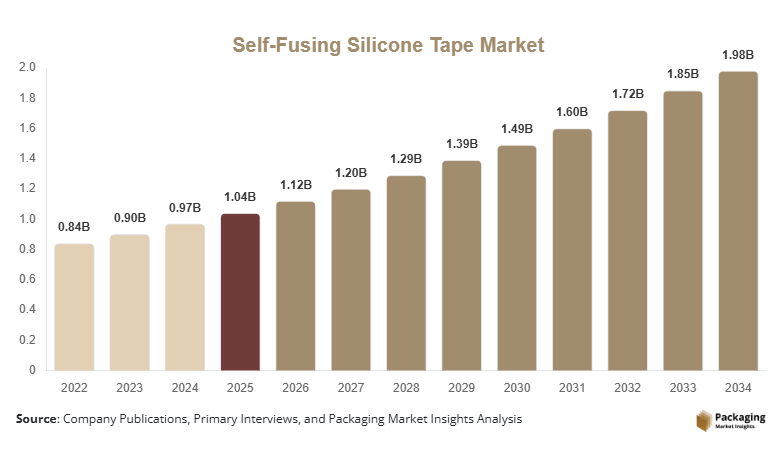
The self-fusing silicone tape market size is projected at USD 1.12 billion in 2026 and is expected to hit USD 1.98 billion by 2034 with a CAGR of 7.4%. The report analyzes production capacity, raw material utilization, application trends, pricing patterns, competitive positioning, and technological developments across global markets. It also provides comprehensive segmentation and regional analysis to support strategic business decisions.
The self-fusing silicone tape market consists of non-adhesive silicone rubber tapes that bond to themselves under tension, providing electrical insulation, leak sealing, corrosion protection, and high-temperature resistance. Global production exceeded 425 million rolls in 2026, while manufacturing utilization averaged 82.5% across leading production facilities. Electrical insulation applications contributed approximately 46.3% of total demand, plumbing and pipe repair accounted for 29.5%, and automotive & aerospace represented 24.2%. Industrial adoption exceeded 68%, reinforcing the Self-Fusing Silicone Tape Market.
Explore more data points, trends and opportunities Download Free Sample Report
Self-Fusing Silicone Tape Market Trends
Increasing Demand for High-Performance Electrical Insulation Materials
Manufacturers continue expanding production of high-temperature silicone tapes capable of operating between -60°C and 260°C while providing dielectric strength above 400 volts/mil. High-performance tape production exceeded 165 million rolls in 2026, increasing by 18% year over year. Automated calendering and curing technologies improved production efficiency by 16%, strengthening the self-fusing silicone tape market.
Growing investments in renewable energy, automotive electrification, and industrial maintenance continue driving product demand. Electrical infrastructure projects expanded by 14% globally, while industrial maintenance spending exceeded USD 420 billion. More than 61% of industrial users adopted self-fusing silicone tapes for emergency sealing and insulation, supporting the self-fusing silicone tape market.
Self-Fusing Silicone Tape Market Drivers
Expansion of Electrical Infrastructure and Industrial Maintenance
Global investments in power transmission and distribution exceeded USD 380 billion during 2026. Electrical equipment maintenance activities increased by 13%, while industrial repair operations grew by 11%. Demand for high-voltage insulation and weather-resistant sealing solutions continues supporting self-fusing silicone tape market growth.
Self-Fusing Silicone Tape Market Restraints
Higher Material Costs Compared with Conventional Insulation Tapes
Silicone elastomer prices fluctuated between 12% and 19% during 2026, while premium self-fusing products remained 25–40% more expensive than PVC electrical tapes. Raw material costs account for approximately 63% of total manufacturing expenses, limiting adoption among price-sensitive customers within the self-fusing silicone tape market.
Self-Fusing Silicone Tape Market Opportunities
Growing Adoption in Renewable Energy and Electric Vehicles
Renewable energy installations increased by 17%, while electric vehicle production exceeded 22 million units globally in 2026. Demand for high-temperature insulation materials expanded by 21%, and investments in advanced silicone manufacturing exceeded USD 640 million, creating attractive opportunities across the self-fusing silicone tape market.
Challenges in the Self-Fusing Silicone Tape Market
Maintaining Product Performance Under Extreme Operating Conditions
Manufacturers must consistently achieve elongation exceeding 300%, tensile strength above 8 MPa, and UV resistance for more than 10 years. Production rejection rates average 3.5%, while quality testing expenses account for nearly 7% of manufacturing costs. Maintaining consistent product performance remains a significant challenge for the self-fusing silicone tape market.
Report Scope
| Report Metric | Details |
|---|---|
| Market Size in 2025 | USD 1.04 Billion |
| Market Size in 2026 | USD 1.12 Billion |
| Market Size in 2034 | USD 1.98 Billion |
| CAGR | 7.4% (2026-2034) |
| Base Year for Estimation | 2025 |
| Historical Data | 2022-2024 |
| Forecast Period | 2026-2034 |
| Report Coverage | Revenue Forecast, Competitive Landscape, Supply Chain Disruption, Growth Factors, Environment & Regulatory Landscape and Trends |
| Geographies Covered | North America, Europe, APAC, Middle East and Africa, LATAM |
| Countries Covered | U.S., Canada, U.K., Germany, France, Spain, Italy, Russia, Nordic, Benelux, Rest of Europe, China, South Korea, Japan, India, Australia, Singapore, Taiwan, South East Asia, Rest of Asia-Pacific, UAE, Turky, Saudi Arabia, South Africa, Egypt, Nigeria, Rest of MEA, Brazil, Mexico, Argentina, Chile, Colombia, Rest of LATAM |
Explore more data points, trends and opportunities Download Free Sample Report
Self-Fusing Silicone Tape Market Segmentation
The market is segmented by type and application. Standard self-fusing tapes account for approximately 48% of total production, while electrical insulation dominates with nearly 46% of global demand due to extensive industrial and utility applications.
By Type
Standard self-fusing tape accounted for approximately 48% of production, exceeding 204 million rolls annually. These tapes provide excellent insulation, waterproof sealing, and dielectric performance for general industrial, plumbing, and maintenance applications.
High-Temperature Self-Fusing Tape represented nearly 33% of production, exceeding 140 million rolls annually. These products withstand operating temperatures up to 260°C, making them suitable for aerospace, power generation, and heavy industrial applications.
Colored self-fusing tape contributed approximately 19% of production with over 81 million rolls manufactured annually. These tapes enable phase identification, cable coding, and maintenance safety while maintaining identical insulation characteristics.
By Application
Electrical insulation remained the largest application with approximately 46% share. Annual consumption exceeded 195 million rolls, while utility and industrial penetration surpassed 74% due to increasing investments in electrical infrastructure.
Plumbing & pipe repair accounted for nearly 30% of market demand, exceeding 127 million rolls annually. The products provide immediate leak sealing, corrosion resistance, and pressure tolerance for residential and industrial piping systems.
Automotive & Aerospace represented approximately 24% of global demand with consumption exceeding 102 million rolls annually. High thermal stability, vibration resistance, and moisture protection make these tapes suitable for wiring harnesses and engine compartment applications.
Self-Fusing Silicone Tape Market Segmentations
Type
- Standard Self-Fusing Tape
- High-Temperature Self-Fusing Tape
- Colored Self-Fusing Tape
Application
- Electrical Insulation
- Plumbing & Pipe Repair
- Automotive & Aerospace
Self-Fusing Silicone Tape Market Regional Outlook
North America
North America accounted for approximately 31% of global demand, producing more than 132 million rolls annually. The United States contributed nearly 81% of regional consumption due to strong utility infrastructure, industrial maintenance activities, and aerospace manufacturing.
Europe
Europe represented approximately 28% of the market. Germany, France, the United Kingdom, and Italy generated nearly 69% of regional production. Demand continues to increase through renewable energy projects, automotive manufacturing, and electrical infrastructure modernization.
Asia-Pacific
The Asia-Pacific region led the market with approximately 34% share and production exceeding 145 million rolls annually. China accounted for nearly 49% of regional manufacturing, followed by Japan, India, and South Korea. Industrial automation and electronics manufacturing continue supporting regional demand.
Latin America
Latin America represented approximately 4% of global demand. Brazil and Mexico contributed more than 67% of regional production, supported by utility expansion, mining operations, and industrial maintenance activities.
Middle East & Africa
The Middle East & Africa accounted for approximately 3% of global demand. Saudi Arabia, the UAE, and South Africa remained major regional markets owing to oil & gas infrastructure, electrical utilities, and industrial development.
Top Players In The Self-Fusing Silicone Tape Market
- 3M Company
- Nitto Denko Corporation
- Saint-Gobain Performance Plastics
- Tesa SE
- Scapa Group plc
- Berry Global Inc.
- Shurtape Technologies LLC
- HelaTape (HellermannTyton)
- RESQ-TAPE
- CS Hyde Company
- Plymouth Rubber Europa S.A.
- Permatex LLC
3M Company
- Estimated global market share: 14–16%
- Global leader in industrial tapes and insulation solutions.
- 3M manufactures advanced self-fusing silicone tapes designed for electrical insulation, cable splicing, moisture sealing, and high-temperature industrial applications. The company operates global manufacturing facilities supported by strong R&D investments in silicone elastomers and specialty materials. Its diversified customer base spans utilities, automotive, aerospace, telecommunications, and industrial maintenance sectors, reinforcing its leadership position.
Nitto Denko Corporation
- Estimated global market share: 10–12%
- Leading supplier of specialty adhesive and insulation products.
- Nitto Denko develops high-performance silicone tapes offering superior dielectric strength, chemical resistance, and thermal stability. The company continues expanding manufacturing capacity for industrial and electrical insulation applications while investing in material innovation and sustainable production technologies. Its broad international distribution network supports customers across electronics, automotive, infrastructure, and energy industries.