Rubber Tapes Market Size
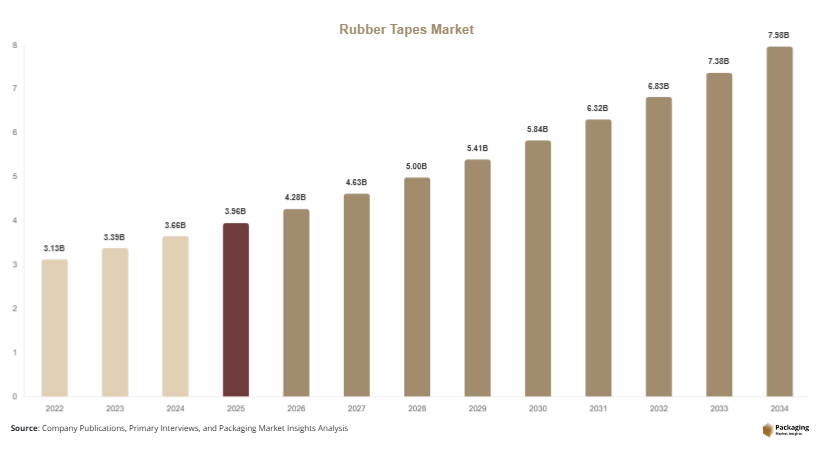
The rubber tape market size is projected at USD 4.28 billion in 2026 and is expected to hit USD 7.96 billion by 2034 with a CAGR of 8.1%. Increasing demand for high-performance insulation, sealing, bonding, and protective solutions across electrical, automotive, and construction industries is supporting market expansion. The report provides comprehensive production analysis, market segmentation, regional assessment, and competitive landscape for informed strategic decision-making.
The rubber tape market comprises pressure-sensitive adhesive tapes manufactured using natural rubber, synthetic rubber, and butyl rubber for electrical insulation, waterproofing, sealing, masking, and industrial protection. Global production exceeded 31.5 billion square meters in 2026, supported by more than 3.6 million metric tons of rubber-based adhesive materials. Electrical and electronics applications contributed approximately 38% of total consumption, while synthetic rubber tapes accounted for nearly 46% of production. Adoption among industrial manufacturers exceeded 69%, reinforcing long-term expansion of the rubber tapes market.
Explore more data points, trends and opportunities Download Free Sample Report
Rubber Tapes Market Trends
Increasing Adoption of High-Performance Insulation Materials
Manufacturers are investing in advanced adhesive technologies and flame-retardant formulations to improve insulation efficiency and durability. Global production surpassed 31.5 billion square meters, while over 58% of new manufacturing lines utilize solvent-free adhesive systems. Nearly 64% of industrial buyers now prefer high-temperature-resistant rubber tapes for electrical applications. These technological improvements continue strengthening the rubber tape market.
Expansion of Waterproof and Automotive Sealing Applications
Growing vehicle production and infrastructure development have accelerated demand for butyl and synthetic rubber tapes. More than 12.8 billion square meters of rubber tape were consumed by construction and automotive sectors during 2026. Waterproof sealing products recorded adoption above 61%, while automated coating technologies improved manufacturing productivity by 19%. Continuous innovation supports the rubber tapes market.
Rubber Tapes Market Drivers
Growing Demand from Electrical Infrastructure and Industrial Manufacturing
Expansion of power transmission projects, renewable energy installations, and industrial automation is driving demand for rubber insulation tapes. More than 75% of utility maintenance contractors utilize rubber insulating tapes, while industrial consumption increased by 13% year-over-year. Global production investments exceeded USD 620 million, supporting long-term development of the rubber tapes market.
Rubber Tapes Market Restraints
Volatility in Raw Material Prices
Fluctuating prices of natural rubber, synthetic elastomers, and petroleum-derived adhesives continue affecting production costs. Raw material expenses account for nearly 57% of manufacturing costs, while annual price fluctuations remain between 12% and 18%. Profit margins of small manufacturers declined by approximately 6%, creating pricing challenges across the rubber tapes market.
Rubber Tapes Market Opportunities
Rapid Expansion of Green Building and Electric Vehicle Manufacturing
Increasing investments in sustainable construction and electric mobility present substantial opportunities. Electric vehicle production exceeded 18 million units, while green construction projects increased by 16% globally during 2026. Waterproof sealing tapes and electrical insulation tapes experienced demand growth above 14%, creating attractive opportunities for the Rubber Tapes Market.
Challenges in Rubber Tapes Market
Maintaining Adhesion Performance under Extreme Operating Conditions
Industrial applications require consistent adhesion under temperatures ranging from -40°C to 120°C, creating technical challenges for manufacturers. More than 8% of annual revenue is allocated to research and development, while product qualification testing exceeds 3,000 performance cycles per batch. These technical requirements continue shaping innovation within the rubber tapes market.
Report Scope
| Report Metric | Details |
|---|---|
| Market Size in 2025 | USD 3.96 Billion |
| Market Size in 2026 | USD 4.28 Billion |
| Market Size in 2034 | USD 7.96 Billion |
| CAGR | 8.1% (2026-2034) |
| Base Year for Estimation | 2025 |
| Historical Data | 2022-2024 |
| Forecast Period | 2026-2034 |
| Report Coverage | Revenue Forecast, Competitive Landscape, Supply Chain Disruption, Growth Factors, Environment & Regulatory Landscape and Trends |
| Geographies Covered | North America, Europe, APAC, Middle East and Africa, LATAM |
| Countries Covered | U.S., Canada, U.K., Germany, France, Spain, Italy, Russia, Nordic, Benelux, Rest of Europe, China, South Korea, Japan, India, Australia, Singapore, Taiwan, South East Asia, Rest of Asia-Pacific, UAE, Turky, Saudi Arabia, South Africa, Egypt, Nigeria, Rest of MEA, Brazil, Mexico, Argentina, Chile, Colombia, Rest of LATAM |
Explore more data points, trends and opportunities Download Free Sample Report
Rubber Tapes Market Segmentation
The market is segmented by type and application to evaluate production trends and end-user demand. Synthetic rubber tapes account for approximately 46% of total production, while electrical and electronics applications contribute nearly 38% of overall market consumption. Global manufacturing exceeds 31.5 billion square meters annually.
By Type
Natural rubber tapes represent a rubber tape market. market volume. Annual production exceeds 10 billion square meters, offering excellent flexibility and strong initial adhesion. These tapes are widely used for electrical insulation, cable wrapping, and general industrial applications due to their high dielectric strength and tensile performance.
Synthetic rubber tapes dominate with nearly 46% market share. Production exceeds 14.5 billion square meters annually and incorporates advanced elastomer compounds for enhanced chemical resistance, temperature stability, and long-term durability. Industrial automation and automotive manufacturing continue supporting this segment.
Butyl rubber tapes account for approximately 22% of global production, exceeding 7 billion square meters annually. These tapes provide exceptional waterproofing, weather resistance, and air-tight sealing, making them suitable for roofing systems, HVAC installations, and infrastructure projects.
By Application
Electrical and electronics represent the largest application with approximately 38% market share. Annual consumption exceeds 12 billion square meters, supported by increasing power infrastructure investments and electronics manufacturing. Rubber tapes provide electrical insulation, arc resistance, and moisture protection across multiple voltage applications.
Automotive applications contribute nearly 34% of market demand with consumption exceeding 10.7 billion square meters annually. Rubber tapes are extensively utilized for wiring harnesses, vibration damping, sealing, and thermal insulation. Vehicle electrification continues increasing penetration across passenger and commercial vehicles.
Building and construction account for approximately 28% of global demand. Annual utilization exceeds 8.8 billion square meters, supported by waterproof roofing, glazing, HVAC insulation, façade sealing, and infrastructure maintenance. Growth in commercial construction continues driving product adoption.
Rubber Tapes Market Segmentations
Type
- Natural Rubber Tape
- Synthetic Rubber Tape
- Butyl Rubber Tape
Application
- Electrical & Electronics
- Automotive
- Building & Construction
Rubber Tapes: Regional/Counties Outlook
North America
North America accounts for approximately 29% of global demand, supported by production exceeding 8.7 billion square meters annually. The United States contributes nearly 81% of regional consumption, driven by electrical infrastructure upgrades, automotive manufacturing, and industrial maintenance.
Europe
Europe represents approximately 27% of global market demand. Germany, France, Italy, and the United Kingdom contribute more than 72% of regional production. Annual manufacturing exceeds 8 billion square meters, supported by automotive production and sustainable construction activities.
Asia-Pacific
The Asia-Pacific dominates the market with approximately a 36% share. China, India, Japan, and South Korea account for nearly 79% of regional production. Manufacturing exceeds 11.5 billion square meters, driven by electronics production, industrialization, and expanding infrastructure investments.
Latin America
Latin America contributes nearly 5% of global consumption. Brazil and Mexico collectively account for over 67% of regional production, supported by increasing automotive manufacturing and commercial construction projects.
Middle East & Africa
The Middle East & Africa account for approximately 3% of worldwide demand. GCC countries and South Africa continue expanding infrastructure and energy investments, supporting increasing demand for waterproof and electrical insulation tapes.
Top players in the rubber tapes market
- 3M Company
- Nitto Denko Corporation
- tesa SE
- Avery Dennison Corporation
- Intertape Polymer Group Inc.
- Shurtape Technologies LLC
- Scapa Group plc
- Saint-Gobain Performance Plastics
- Berry Global Inc.
- LINTEC Corporation
- Lohmann GmbH & Co. KG
- Advance Tapes International Ltd.
- Pro Tapes & Specialties Inc.
- Denka Company Limited
- Sekisui Chemical Co., Ltd.
3M Company
- Estimated market presence: 10–12%
- Global leader in industrial adhesive and insulation technologies.
- Extensive manufacturing and distribution network across North America, Europe, and Asia-Pacific.
- Strong portfolio of electrical insulation, industrial sealing, and automotive tapes.
- Continuous investments in sustainable adhesive technologies, automation, and product innovation support high-volume manufacturing exceeding billions of square meters annually. The company maintains strategic partnerships across automotive, construction, electronics, and industrial sectors while strengthening its global leadership through research-driven product development.
Nitto Denko Corporation
- Estimated market presence: 8–10%
- Leading supplier of advanced adhesive and industrial tape solutions.
- Strong manufacturing presence across Japan, China, Southeast Asia, Europe, and North America.
- Focus on high-performance insulation, waterproof sealing, and electronic component applications.
- Continuous investment in environmentally friendly adhesive formulations and precision coating technologies enhances product quality and manufacturing efficiency. The company maintains long-term relationships with global electronics and automotive manufacturers, strengthening its competitive position in premium rubber tape applications.