Packaging Coating Additives Market Size and Growth
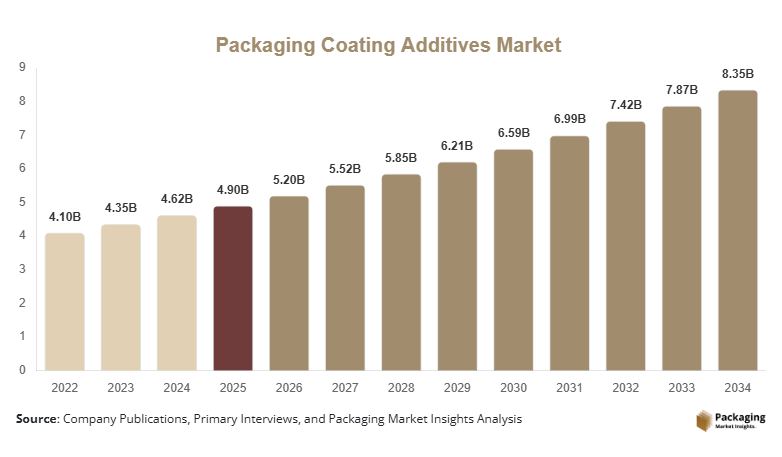
The global packaging coating additives market size is estimated at USD 4.9 billion in 2025, while the market is projected to reach approximately USD 5.2 billion in 2026. By 2034, the market is forecasted to attain nearly USD 8.9 billion, registering a CAGR of 6.1% during 2025–2034. The packaging coating additives market is experiencing consistent growth due to increasing demand for high-performance packaging materials across food & beverage, healthcare, consumer goods, and industrial sectors. Packaging coating additives are specialized chemical substances added to coatings to improve properties such as scratch resistance, slip control, anti-blocking performance, antimicrobial protection, UV stability, and moisture resistance. These additives play an important role in enhancing the durability, appearance, and functionality of packaging products while supporting regulatory compliance and sustainability requirements.
One of the major growth factors driving the market is the increasing demand for packaged food and beverages worldwide. Manufacturers are using coating additives to improve barrier protection, maintain product freshness, and extend shelf life. Another important growth factor is the expansion of e-commerce packaging, where coated packaging materials are required to provide improved scratch resistance and moisture protection during transportation. Additionally, rising sustainability initiatives are encouraging the development of water-based and low-VOC coating additives that align with environmental regulations.
Key Highlights
- Asia Pacific dominated the market with a 39.1% share in 2025.
- Latin America is projected to grow at the fastest CAGR of 6.8%.
- Slip additives led the type segment with a 28.7% share.
- Water-based coating additives dominated with a 46.3% share.
- Food & beverage applications led the market with a 43.8% share.
- The US remained the dominant country with a market size of USD 1.3 billion in 2025 and USD 1.4 billion in 2026.Market Trends
Explore more data points, trends and opportunities Download Free Sample Report
Rising Adoption of Sustainable and Low-VOC Additives
Sustainability has become a major trend influencing the packaging coating additives market as manufacturers focus on reducing environmental impact and complying with stricter regulations. Packaging producers are increasingly adopting water-based and low-VOC coating additives to minimize emissions during manufacturing processes. Demand for bio-based additives derived from renewable materials is also increasing across food and healthcare packaging applications. Companies are investing in environmentally friendly coating technologies that maintain performance while reducing dependence on petroleum-based chemicals. Additionally, regulatory pressure regarding packaging waste and chemical safety is encouraging innovation in recyclable coating systems. This trend is expected to support long-term market growth as industries continue prioritizing sustainable packaging solutions.
Increasing Demand for Functional and Smart Packaging Coatings
The growing use of functional packaging solutions is driving demand for advanced coating additives with specialized properties. Packaging manufacturers are integrating antimicrobial, anti-fog, anti-static, and UV-resistant additives into coating systems to improve product safety and consumer convenience. Smart packaging technologies are also gaining popularity, especially in food and pharmaceutical sectors where packaging performance directly affects product quality. Advanced coating additives help improve printability, durability, and shelf appeal while supporting supply chain efficiency. In addition, increasing consumer preference for high-quality packaging aesthetics is encouraging companies to develop multifunctional coating solutions that combine protection and visual enhancement within a single formulation.
Market Drivers
Growth in Packaged Food and Beverage Consumption
The increasing global consumption of packaged food and beverages is a significant driver for the packaging coating additives market. Urbanization, changing lifestyles, and rising demand for convenience products are encouraging food manufacturers to invest in durable and protective packaging solutions. Coating additives improve moisture resistance, gloss retention, anti-fog performance, and barrier protection in food packaging materials. These properties help maintain product freshness and extend shelf life during storage and transportation. Additionally, growth in online grocery retailing is increasing the need for coated packaging materials that can withstand handling and shipping conditions without compromising product integrity or appearance.
Expansion of E-commerce and Flexible Packaging Industries
Rapid expansion of the e-commerce sector is driving demand for advanced packaging materials with enhanced durability and surface performance. Packaging used in online retail logistics requires improved scratch resistance, abrasion protection, and print quality to ensure product safety and brand visibility during transportation. Coating additives help manufacturers improve these characteristics while reducing packaging defects. Furthermore, the increasing adoption of flexible packaging across consumer goods and healthcare sectors is supporting demand for additives that enhance sealability, slip control, and heat resistance. Flexible packaging manufacturers are continuously seeking innovative coating technologies to improve functionality and production efficiency.
Market Restraint
Volatility in Raw Material Prices and Regulatory Compliance Challenges
One of the major restraints affecting the packaging coating additives market is the volatility in raw material prices combined with increasingly strict environmental regulations. Many coating additives are derived from petrochemical-based materials, making manufacturing costs sensitive to fluctuations in crude oil prices and supply chain disruptions. Rising costs of specialty chemicals can reduce profit margins for additive manufacturers and packaging producers. In addition, regulatory agencies across North America and Europe are imposing stricter restrictions on volatile organic compounds and chemical emissions used in packaging coatings. For example, some solvent-based additives face limitations due to environmental concerns regarding air pollution and recyclability. Companies are therefore required to invest in reformulation, testing, and compliance measures to meet regulatory standards. These additional operational costs can slow adoption of certain coating technologies, particularly in price-sensitive markets where manufacturers prioritize low-cost packaging solutions over advanced performance additives.
Market Opportunities
Expansion of Pharmaceutical and Healthcare Packaging
The growing pharmaceutical and healthcare industries are creating substantial opportunities for the packaging coating additives market. Medical packaging requires specialized coating additives that provide antimicrobial protection, chemical resistance, and contamination prevention. Increasing production of medicines, vaccines, and medical devices is driving demand for high-performance packaging coatings capable of maintaining hygiene and product stability. Healthcare companies are also adopting advanced coating systems that improve packaging durability and traceability during transportation. Furthermore, rising healthcare investments in emerging economies are expected to increase demand for pharmaceutical packaging materials with enhanced protective properties and regulatory compliance capabilities.
Development of Bio-Based and Recyclable Coating Technologies
The increasing focus on sustainable packaging is creating strong opportunities for bio-based and recyclable coating additives. Packaging manufacturers are seeking environmentally friendly solutions that support circular economy goals without compromising performance. Companies are investing in plant-derived additives, biodegradable coating technologies, and recyclable formulations suitable for food and consumer packaging applications. Demand for eco-friendly coatings is particularly increasing in developed regions where governments are implementing stricter environmental policies regarding plastic waste and emissions. Manufacturers capable of developing high-performance sustainable additives are expected to strengthen market position and expand partnerships with global packaging companies.
Report Scope
| Report Metric | Details |
|---|---|
| Market Size in 2025 | USD 4.9 Billion |
| Market Size in 2026 | USD 5.2 Billion |
| Market Size in 2034 | USD 8.9 Billion |
| CAGR | 6.1% (2026-2034) |
| Base Year for Estimation | 2025 |
| Historical Data | 2022-2024 |
| Forecast Period | 2026-2034 |
| Report Coverage | Revenue Forecast, Competitive Landscape, Supply Chain Disruption, Growth Factors, Environment & Regulatory Landscape and Trends |
| Geographies Covered | North America, Europe, APAC, Middle East and Africa, LATAM |
| Countries Covered | U.S., Canada, U.K., Germany, France, Spain, Italy, Russia, Nordic, Benelux, Rest of Europe, China, South Korea, Japan, India, Australia, Singapore, Taiwan, South East Asia, Rest of Asia-Pacific, UAE, Turky, Saudi Arabia, South Africa, Egypt, Nigeria, Rest of MEA, Brazil, Mexico, Argentina, Chile, Colombia, Rest of LATAM |
Explore more data points, trends and opportunities Download Free Sample Report
Segmental Analysis
By Type
Slip additives dominated the packaging coating additives market in 2024, accounting for approximately 28.7% of the total market share. These additives are widely used to reduce friction between packaging surfaces and improve handling efficiency during manufacturing and transportation. Slip additives help prevent sticking and scratching in flexible packaging applications while improving machinability and surface smoothness. Food and consumer goods manufacturers rely heavily on these additives to maintain packaging quality and production speed. Additionally, increasing use of multilayer packaging films is driving demand for advanced slip additives capable of maintaining performance under varying environmental conditions.
Antimicrobial additives are projected to be the fastest-growing subsegment, expanding at a CAGR of 7.1% during the forecast period. Rising consumer awareness regarding hygiene and food safety is increasing demand for antimicrobial packaging coatings across healthcare and food industries. These additives help reduce microbial growth on packaging surfaces and improve product protection during storage and transportation. Pharmaceutical manufacturers are also adopting antimicrobial coating technologies to maintain sterility and reduce contamination risks. In addition, growing demand for longer shelf life in packaged food products is encouraging wider adoption of antimicrobial coating systems.
By Formulation
Water-based coating additives dominated the formulation segment in 2024 with a market share of approximately 46.3%. These additives are increasingly preferred due to their lower environmental impact, reduced VOC emissions, and compatibility with sustainable packaging initiatives. Water-based formulations provide good adhesion, gloss retention, and surface protection while supporting regulatory compliance in food and healthcare packaging applications. Packaging manufacturers are shifting toward water-based technologies as governments implement stricter environmental regulations on solvent-based coatings. Furthermore, improvements in water-based coating performance are making these systems suitable for high-speed packaging production operations.
Bio-based additives are expected to witness the fastest growth, registering a CAGR of 7.4% during the forecast period. The increasing focus on sustainable packaging materials is driving demand for additives derived from renewable resources such as plant oils and natural polymers. Bio-based coating additives help reduce dependence on fossil fuel-derived chemicals while supporting recyclability and biodegradability goals. Food and consumer goods companies are increasingly adopting environmentally friendly coating solutions to strengthen sustainability branding and comply with packaging waste regulations. Technological advancements in renewable chemistry are also improving the performance characteristics of bio-based formulations.
By Application
Food & beverage packaging held the dominant share of approximately 43.8% in 2024 within the packaging coating additives market. Packaging coatings used in this sector require strong moisture resistance, gloss enhancement, printability, and anti-fog performance to maintain product freshness and consumer appeal. Rising consumption of packaged foods, frozen products, and beverages is increasing demand for high-performance coating additives. In addition, growth in online food delivery and retail distribution is encouraging manufacturers to improve packaging durability and transportation resistance. Food safety regulations are also supporting the adoption of specialty coating additives that enhance barrier protection and hygiene.
Pharmaceutical packaging is expected to register the fastest CAGR of 6.9% during the forecast period. The increasing production of medicines, vaccines, and medical devices is driving demand for protective coating technologies that maintain sterility and product integrity. Pharmaceutical packaging requires advanced additives with chemical resistance, antimicrobial properties, and moisture protection capabilities. Growing investment in healthcare infrastructure and biologics manufacturing is further strengthening demand for specialized coating systems. Packaging manufacturers are also focusing on traceability and tamper-resistant coating technologies to support pharmaceutical supply chain security.
Packaging Coating Additives Market Segmentations
By Type
- Slip Additives
- Anti-block Additives
- Antimicrobial Additives
- UV Stabilizers
- Anti-fog Additives
By Formulation
- Water-Based Additives
- Solvent-Based Additives
- Powder Coating Additives
- Bio-Based Additives
By Application
- Food & Beverage Packaging
- Pharmaceutical Packaging
- Consumer Goods Packaging
- Industrial Packaging
- Flexible Packaging
Regional Analysis
North America
North America accounted for approximately 26.4% of the global packaging coating additives market share in 2025 and is projected to grow at a CAGR of 5.5% during the forecast period. The region benefits from advanced packaging manufacturing infrastructure, strong demand for packaged food products, and growing pharmaceutical production. Increasing focus on sustainable packaging solutions and low-emission coating technologies is also supporting market growth. In addition, rising e-commerce activity is encouraging packaging manufacturers to adopt advanced coating additives that improve durability and transportation performance.
The United States dominates the North American market due to its large food processing and healthcare industries. One unique growth factor is the rapid expansion of sustainable flexible packaging production supported by investments in recyclable packaging technologies. Packaging companies in the country are increasingly using water-based coating additives and specialty surface modifiers to improve product protection while meeting environmental compliance requirements.
Europe
Europe held nearly 24.7% of the global market share in 2025 and is expected to register a CAGR of 5.4% through 2034. Growth in the region is supported by strict environmental regulations, increasing demand for recyclable packaging, and strong pharmaceutical exports. European packaging manufacturers are focusing on eco-friendly coating additives that reduce VOC emissions and improve recyclability. Demand for premium consumer packaging with enhanced visual appearance and barrier performance is also contributing to market expansion across food and cosmetic applications.
Germany remains the dominant country in the European market because of its advanced chemical manufacturing sector and strong packaging industry. A unique growth factor is the increasing development of bio-based coating additives supported by government sustainability initiatives. German manufacturers are investing in renewable raw materials and advanced coating technologies to strengthen environmentally responsible packaging production while maintaining high-performance standards.
Asia Pacific
Asia Pacific dominated the market with a 39.1% share in 2025 and is projected to expand at a CAGR of 6.7% during the forecast period. Rapid urbanization, industrialization, and increasing consumption of packaged products are major drivers in the region. Countries such as China, India, Japan, and South Korea are witnessing strong growth in food processing, pharmaceuticals, and e-commerce sectors. Rising investments in flexible packaging production are also supporting demand for advanced coating additives with improved surface performance and protection properties.
China dominates the regional market due to its extensive packaging manufacturing industry and expanding consumer goods sector. One unique growth factor is the rapid growth of online retail logistics requiring durable and moisture-resistant packaging materials. Packaging manufacturers in China are increasingly using specialty coating additives to improve packaging strength, printability, and transportation durability for domestic and export applications.
Middle East & Africa
The Middle East & Africa region accounted for around 4.5% of the global market share in 2025 and is projected to grow at a CAGR of 5.9% during the forecast period. Increasing urbanization, rising packaged food demand, and expanding healthcare infrastructure are supporting regional market growth. Governments are investing in domestic manufacturing capabilities and industrial diversification programs, which are encouraging growth in packaging production. Demand for moisture-resistant and heat-resistant coating additives is also increasing due to challenging climatic conditions across the region.
Saudi Arabia leads the regional market because of expanding food processing industries and increasing pharmaceutical imports. One unique growth factor is the growing adoption of temperature-resistant packaging coatings for packaged food transportation and storage in high-temperature environments. This trend is encouraging manufacturers to develop specialized coating additive solutions suitable for harsh climatic conditions.
Latin America
Latin America represented approximately 5.3% of the global packaging coating additives market share in 2025 and is expected to grow at the fastest CAGR of 6.8% during the forecast period. Growth in the region is supported by increasing consumption of packaged foods, rising pharmaceutical demand, and expansion of retail distribution networks. Packaging companies are investing in flexible packaging technologies to improve product shelf life and reduce transportation costs. In addition, economic development and urban population growth are supporting higher demand for consumer packaged goods.
Brazil dominates the Latin American market due to its strong food and beverage industry and expanding packaging manufacturing sector. A unique growth factor is the increasing export of processed food products requiring advanced moisture-resistant and anti-fog packaging coatings. Manufacturers are adopting high-performance additives to improve packaging durability and maintain product quality during international transportation.
Competitive Landscape
The packaging coating additives market is moderately competitive, with leading companies focusing on product innovation, sustainability initiatives, and strategic partnerships to strengthen market presence. Major manufacturers are investing in low-VOC formulations, multifunctional additives, and bio-based coating technologies to address changing industry requirements. Companies are also expanding production facilities and research capabilities to support rising global demand from packaging, healthcare, and consumer goods industries.
BASF SE remains one of the leading players in the market due to its broad specialty chemicals portfolio and strong global distribution network. In 2024, the company introduced a new water-based coating additive designed for recyclable flexible packaging applications. Other major participants include Arkema S.A., Evonik Industries AG, Clariant AG, and Dow Inc. These companies are actively focusing on mergers, acquisitions, and advanced material development to strengthen their positions within the global packaging additives industry.
Key Players List
- BASF SE
- Arkema S.A.
- Evonik Industries AG
- Clariant AG
- Dow Inc.
- BYK Additives & Instruments
- Croda International Plc
- Elementis Plc
- Solvay S.A.
- Lubrizol Corporation
- Eastman Chemical Company
- Michelman Inc.
- Ashland Global Holdings Inc.
- Akzo Nobel N.V.
- DSM-Firmenich