Packaging Inks And Coatings Market Size and Growth
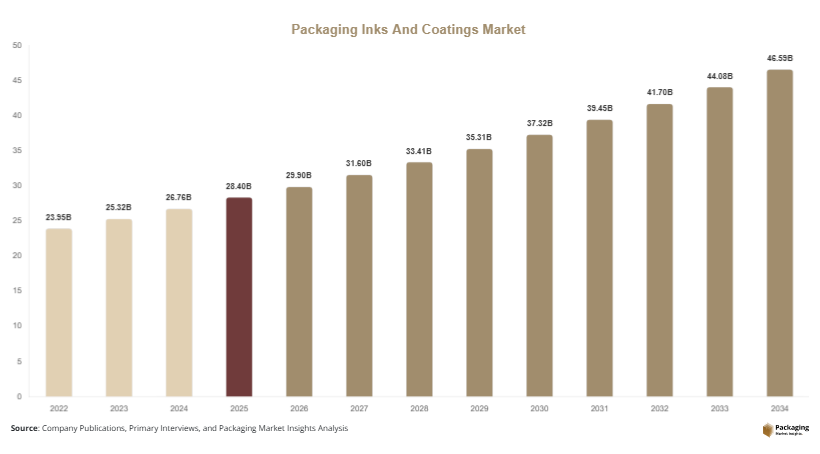
The global packaging inks and coatings market was valued at approximately USD 28.4 billion in 2025 and is projected to reach nearly USD 29.9 billion in 2026. The market is forecast to reach around USD 46.7 billion by 2034, expanding at a CAGR of 5.7% during 2025–2034. Growth is being supported by rapid expansion in flexible packaging, increasing packaged food consumption, and rising demand for sustainable low-VOC inks and coatings.
The global packaging inks and coatings market is witnessing stable expansion due to rising demand for attractive packaging designs, increasing consumption of packaged products, and growing adoption of sustainable printing technologies. Packaging inks and coatings play a critical role in enhancing product appearance, durability, barrier protection, and branding effectiveness across food & beverage, pharmaceuticals, cosmetics, industrial goods, and consumer packaging industries. These solutions improve print quality, resistance against moisture and chemicals, and shelf appeal while supporting regulatory compliance and product safety standards.
Key Highlights
- Asia Pacific dominated the market with a 38.2% share in 2025.
- Latin America is projected to grow at the fastest CAGR of 6.4%.
- Solvent-based inks led the type segment with a 34.7% share.
- Flexible packaging dominated the substrate segment with a 41.6% share.
- Food & beverage applications led the end-use segment with 48.9% share.
- The US remained the dominant country with a market size of USD 5.8 billion in 2025 and USD 6.1 billion in 2026.
Explore more data points, trends and opportunities Download Free Sample Report
Market Trends
Growing Adoption of Sustainable and Low-VOC Ink Technologies
The transition toward sustainable and low-VOC ink technologies is becoming a major trend in the packaging inks and coatings market. Packaging manufacturers are increasingly adopting water-based, UV-curable, and bio-based inks to comply with environmental regulations and corporate sustainability goals. Traditional solvent-based inks release volatile organic compounds that can negatively impact air quality and worker safety. As environmental standards become stricter, food and consumer goods companies are demanding safer and recyclable printing solutions. Water-based coatings and low-migration inks are gaining popularity in food packaging applications because they reduce contamination risks and improve recyclability. Investments in eco-friendly formulations are expected to continue growing across global packaging supply chains.
Expansion of Digital Printing in Packaging Applications
Digital printing technologies are rapidly transforming the packaging inks and coatings market due to increasing demand for customization, shorter production runs, and faster turnaround times. Packaging companies are using digital printing for labels, cartons, flexible packaging, and promotional campaigns because it enables high-resolution graphics and variable data printing. Brands are increasingly adopting personalized packaging strategies to improve customer engagement and product differentiation. Digital inks also reduce material waste and setup costs compared to traditional printing methods. The growing popularity of smart packaging, QR code integration, and interactive branding is further supporting the adoption of advanced digital printing solutions across food, cosmetics, and pharmaceutical packaging industries.
Market Drivers
Rising Demand for Packaged Food and Consumer Goods
The increasing consumption of packaged food, beverages, and consumer goods is a major driver supporting the packaging inks and coatings market. Food manufacturers require durable and visually appealing packaging solutions to attract consumers and maintain product freshness. Packaging inks are widely used for branding, labeling, nutritional information, and promotional graphics on cartons, pouches, and containers. Coatings improve moisture resistance, abrasion protection, and shelf durability. Rapid urbanization, changing lifestyles, and rising disposable income are increasing demand for packaged and convenience foods globally. This trend is creating consistent growth opportunities for packaging ink and coating suppliers serving retail and food processing industries.
Growth of Flexible Packaging Industry
The rapid expansion of flexible packaging is another important driver for the market. Flexible packaging formats such as pouches, sachets, wraps, and films require specialized inks and coatings to maintain print clarity, adhesion, and barrier performance. Flexible packaging offers advantages including lightweight structure, lower transportation costs, and extended shelf life. Manufacturers are increasingly using high-performance inks compatible with plastic films, laminates, and recyclable substrates. The growth of snack foods, personal care products, and pharmaceutical packaging is significantly increasing demand for advanced flexible packaging printing solutions worldwide.
Market Restraint
Regulatory Challenges Related to Chemical Safety and VOC Emissions
One of the primary restraints affecting the packaging inks and coatings market is the increasing regulatory pressure regarding chemical safety and VOC emissions. Governments and environmental agencies are imposing stricter regulations on solvent-based inks and coatings due to concerns regarding environmental pollution, worker exposure, and food safety risks. Compliance with evolving regulations often requires manufacturers to invest heavily in research, testing, and reformulation activities. Smaller companies may face operational and financial challenges while transitioning to low-emission technologies.
For example, packaging companies supplying food and pharmaceutical products must comply with strict migration standards for inks and coatings used on food-contact materials. Failure to meet these standards can lead to product recalls, legal liabilities, and reputational damage. In addition, transitioning from solvent-based systems to water-based or UV-curable technologies may require modifications in printing equipment and production processes, increasing capital expenditure for manufacturers.
Market Opportunities
Rising Demand for Smart and Interactive Packaging
The growing adoption of smart and interactive packaging solutions presents significant opportunities for the packaging inks and coatings market. Brands are increasingly integrating QR codes, augmented reality elements, and track-and-trace technologies into packaging designs to improve customer engagement and supply chain visibility. Advanced inks with conductive and security features are gaining importance in anti-counterfeit and connected packaging applications. Digital printing technologies enable customized packaging campaigns and variable printing for targeted marketing. As consumer brands continue focusing on interactive experiences and transparency, demand for innovative inks and specialty coatings is expected to rise steadily.
Expansion of Sustainable Packaging Materials
The increasing use of recyclable and biodegradable packaging materials is creating new opportunities for ink and coating manufacturers. Packaging producers are developing formulations compatible with paper-based packaging, compostable films, and recyclable substrates. Water-based coatings and low-migration inks are becoming essential for sustainable packaging applications requiring food safety compliance and recyclability. Companies investing in renewable raw materials and eco-friendly coating technologies are expected to gain competitive advantages. Growing demand for sustainable packaging across retail, food service, and healthcare industries is likely to create long-term growth opportunities for innovative ink and coating suppliers.
Report Scope
| Report Metric | Details |
|---|---|
| Market Size in 2025 | USD 28.4 Billion |
| Market Size in 2026 | USD 29.9 Billion |
| Market Size in 2034 | USD 46.7 Billion |
| CAGR | 5.7% (2026-2034) |
| Base Year for Estimation | 2025 |
| Historical Data | 2022-2024 |
| Forecast Period | 2026-2034 |
| Report Coverage | Revenue Forecast, Competitive Landscape, Supply Chain Disruption, Growth Factors, Environment & Regulatory Landscape and Trends |
| Geographies Covered | North America, Europe, APAC, Middle East and Africa, LATAM |
| Countries Covered | U.S., Canada, U.K., Germany, France, Spain, Italy, Russia, Nordic, Benelux, Rest of Europe, China, South Korea, Japan, India, Australia, Singapore, Taiwan, South East Asia, Rest of Asia-Pacific, UAE, Turky, Saudi Arabia, South Africa, Egypt, Nigeria, Rest of MEA, Brazil, Mexico, Argentina, Chile, Colombia, Rest of LATAM |
Explore more data points, trends and opportunities Download Free Sample Report
Segmental Analysis
By Type
Solvent-based inks dominated the type segment in 2024, accounting for approximately 34.7% of total market share. These inks are widely used in flexible packaging, labels, and industrial packaging applications because they provide strong adhesion, high print quality, and fast drying performance. Solvent-based formulations are compatible with multiple substrates including plastic films, foils, and laminates commonly used in food and consumer goods packaging. Packaging manufacturers continue using solvent-based systems for applications requiring durability and chemical resistance. However, environmental concerns and emission regulations are encouraging gradual transition toward sustainable alternatives across several regions.
Water-based inks are projected to witness the fastest growth during the forecast period, registering a CAGR of 6.9%. These inks are gaining popularity because they emit lower volatile organic compounds and support environmentally responsible packaging practices. Food and beverage companies increasingly prefer water-based inks for paperboard cartons, corrugated packaging, and flexible packaging applications due to their improved safety profile and recyclability compatibility. Technological advancements in resin systems and pigment dispersion are improving print quality and drying efficiency. Growing regulatory pressure regarding solvent emissions is expected to further accelerate adoption of water-based ink technologies globally.
By Substrate
Flexible packaging dominated the substrate segment in 2024 with approximately 41.6% share. Flexible packaging materials including plastic films, laminates, and pouches require high-performance inks and coatings capable of maintaining print quality and adhesion under varying storage conditions. Food, beverage, and personal care industries extensively use flexible packaging because it offers lightweight performance, extended shelf life, and reduced transportation costs. Advanced coatings improve moisture resistance, heat sealing, and abrasion protection for flexible packaging products. Packaging companies are investing in specialty inks compatible with recyclable and mono-material flexible packaging solutions to support sustainability initiatives.
Corrugated packaging is expected to register the fastest CAGR of 6.2% during the forecast period. Growth is being driven by increasing e-commerce activities and rising demand for shipping and protective packaging materials. Corrugated boxes require durable inks and coatings capable of withstanding transportation and storage conditions while maintaining brand visibility. Digital printing technologies are increasingly used for corrugated packaging applications due to demand for customization and short-run production. The expansion of online retail and subscription-based delivery services is expected to significantly increase demand for corrugated packaging printing solutions.
By End Use
Food & beverage applications dominated the end-use segment in 2024, accounting for approximately 48.9% of total market share. Packaging inks and coatings are extensively used for labels, cartons, pouches, beverage containers, and takeaway packaging products. Food manufacturers require high-quality printing solutions that comply with food safety regulations and improve shelf visibility. Barrier coatings are also used to enhance moisture resistance, grease protection, and product preservation. Rising demand for packaged foods, frozen products, and ready-to-eat meals continues to create strong demand for advanced printing and coating technologies globally.
Pharmaceutical packaging is expected to witness the fastest CAGR of 6.6% during the forecast period. Pharmaceutical companies require high-performance inks and coatings for labels, blister packs, cartons, and medical packaging applications. Anti-counterfeit printing technologies, track-and-trace labeling, and low-migration formulations are becoming increasingly important in healthcare packaging. Strict regulatory standards regarding product safety and traceability are encouraging adoption of specialty inks and coatings with improved chemical resistance and durability. Growth in healthcare spending and pharmaceutical manufacturing is expected to support long-term expansion of this segment.
Packaging Inks And Coatings Market Segmentations
By Type
- Solvent-Based Inks
- Water-Based Inks
- UV-Curable Inks
- Specialty Coatings
By Substrate
- Flexible Packaging
- Corrugated Packaging
- Labels & Tags
- Folding Cartons
By End User
- Food & Beverage
- Pharmaceuticals
- Personal Care & Cosmetics
- Industrial Packaging
- Consumer Goods
Regional Analysis
North America
North America accounted for approximately 26.8% of the global packaging inks and coatings market share in 2025 and is projected to grow at a CAGR of 5.2% during the forecast period. Strong demand for packaged food, pharmaceutical products, and e-commerce packaging continues to support market expansion across the region. Manufacturers are increasingly investing in sustainable ink technologies and digital printing systems to meet evolving environmental regulations and branding requirements. The region also benefits from advanced packaging infrastructure and strong adoption of smart packaging technologies.
The United States dominates the North American market due to its large food processing and consumer goods industries. A unique growth factor is the rising adoption of digitally printed packaging for subscription-based retail and online shopping brands. Companies are increasingly using customized packaging graphics and protective coatings to improve customer experience and strengthen product differentiation in competitive retail markets.
Europe
Europe represented approximately 24.5% of the global market share in 2025 and is expected to expand at a CAGR of 5.0% through 2034. Strict environmental regulations and sustainability targets are encouraging the use of low-VOC and recyclable packaging inks across the region. Packaging companies are investing in water-based and UV-curable technologies to reduce solvent emissions and improve recyclability. Demand for high-quality printing solutions remains strong across food packaging, cosmetics, and pharmaceutical applications.
Germany remains the leading country in the European market due to its advanced packaging manufacturing sector and strong industrial base. A unique growth factor is the increasing demand for premium printed packaging in luxury cosmetics and personal care products. Brand owners are focusing on visually appealing packaging with specialty coatings and metallic printing effects to improve shelf visibility and consumer engagement.
Asia Pacific
Asia Pacific dominated the packaging inks and coatings market with a 38.2% share in 2025 and is projected to register a CAGR of 6.1% during the forecast period. Rapid urbanization, rising disposable income, and expanding retail infrastructure are supporting strong packaging demand across the region. Flexible packaging, labels, and corrugated packaging applications are increasing significantly due to growth in food processing and e-commerce industries. Manufacturers are expanding production capacities to meet rising regional demand for printed packaging materials.
China remains the dominant market in Asia Pacific due to its large packaging manufacturing industry and export-oriented production base. A unique growth factor is the rapid expansion of digital printing technologies in flexible packaging applications. Food and beverage companies are increasingly using short-run and customized packaging formats to improve branding flexibility and reduce inventory costs.
Middle East & Africa
The Middle East & Africa region accounted for approximately 5.1% of the global market share in 2025 and is expected to grow at a CAGR of 5.6% during the forecast period. Rising demand for packaged consumer goods, processed foods, and pharmaceutical products is driving market growth across the region. Packaging companies are increasingly adopting durable printing and coating technologies to improve packaging performance in high-temperature and humid environmental conditions.
Saudi Arabia dominates the regional market due to its expanding food packaging and retail industries. A unique growth factor is the growing use of protective barrier coatings for beverage and frozen food packaging applications. Investments in modern retail infrastructure and packaged food manufacturing are contributing to increased demand for advanced packaging printing solutions.
Latin America
Latin America held approximately 5.4% of the global market share in 2025 and is projected to register the fastest CAGR of 6.4% through 2034. Rising urban populations, increasing retail penetration, and growing packaged food consumption are supporting demand for packaging inks and coatings across the region. Flexible packaging and corrugated packaging applications are expanding rapidly due to growth in online retail and food delivery services.
Brazil remains the dominant country in the Latin American market due to its large food and beverage processing sector. A unique growth factor is the increasing use of water-based inks in beverage carton and corrugated packaging production. Packaging manufacturers are investing in environmentally friendly printing technologies to meet sustainability requirements and improve export competitiveness.
Competitive Landscape
The packaging inks and coatings market is highly competitive, with major players focusing on sustainable product innovation, digital printing technologies, and global expansion strategies. Companies are investing in low-VOC formulations, food-safe coatings, and specialty printing solutions to strengthen their market position and comply with environmental regulations.
Flint Group remains one of the leading companies in the packaging inks and coatings market due to its extensive product portfolio and global distribution network. In 2024, the company introduced advanced water-based ink solutions for recyclable flexible packaging applications. Other major players including Sun Chemical, Siegwerk Druckfarben AG & Co. KGaA, hubergroup, and Toyo Ink SC Holdings are actively expanding sustainable ink production capabilities and developing specialty coatings for food and pharmaceutical packaging applications. Strategic collaborations and technology investments continue shaping the competitive environment across the global market.
Key Players List
- Flint Group
- Sun Chemical
- Siegwerk Druckfarben AG & Co. KGaA
- hubergroup
- Toyo Ink SC Holdings Co., Ltd.
- ALTANA AG
- INX International Ink Co.
- DIC Corporation
- Wikoff Color Corporation
- Sakata INX Corporation
- Siegwerk USA Inc.
- Zeller+Gmelin GmbH & Co. KG
- Fujifilm Holdings Corporation
- ACTEGA GmbH
- T&K TOKA Co., Ltd.