Packaging Wax Market Size and Growth
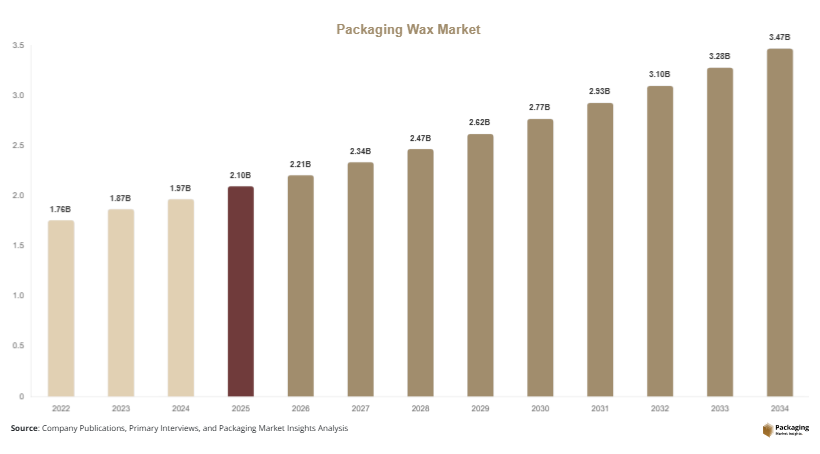
The global packaging wax market is estimated at USD 2.10 billion in 2025 and is projected to reach USD 2.21 billion in 2026. By 2034, the market is expected to attain a value of USD 3.45 billion, expanding at a CAGR of 5.8% during 2025–2034. The packaging wax market is witnessing steady expansion as industries increasingly adopt moisture-resistant, protective, and visually enhanced packaging materials across food, pharmaceuticals, cosmetics, and industrial goods.
Growth in the market is primarily driven by the rising demand for sustainable barrier coatings, increasing e-commerce packaging requirements, and expansion of temperature-sensitive supply chains. Additionally, advancements in bio-based wax formulations and increasing restrictions on plastic-based coatings are accelerating market adoption.
Key Highlights
- Europe dominated the market with a 36.8% share in 2025.
- Asia Pacific is projected to grow at the fastest CAGR of 8.6% (2025–2034).
- Food packaging accounted for 48.3% share in 2025.
- PLA-based films led the material segment with 42.1% share in 2025.
- Agricultural mulch films held 39.5% share in 2025.
- The US market reached USD 1.35 billion in 2025 and USD 1.46 billion in 2026.
Explore more data points, trends and opportunities Download Free Sample Report
Market Trends
Shift toward Bio-based and Sustainable Wax Solutions
The packaging wax market is undergoing a structural transformation due to increasing environmental regulations and consumer demand for sustainable packaging materials. Bio-based waxes derived from natural sources such as soy, palm, and beeswax are replacing conventional paraffin-based waxes in multiple applications. Manufacturers are focusing on reducing carbon emissions and improving recyclability in packaging systems. This trend is especially strong in Europe and North America, where regulatory frameworks such as plastic reduction mandates are accelerating adoption. Additionally, food-grade packaging applications are increasingly requiring non-toxic and biodegradable wax coatings, further strengthening this transition toward sustainable alternatives.
Expansion of High-Barrier Functional Packaging Applications
Another significant trend is the rising use of packaging wax in high-barrier applications where moisture, oxygen, and grease resistance are critical. This includes frozen food packaging, bakery items, pharmaceuticals, and industrial chemicals. Wax coatings are increasingly being integrated into multi-layer packaging systems to improve durability and shelf life. Technological advancements in coating techniques, such as spray and extrusion-based wax application, are enhancing efficiency and performance. Additionally, manufacturers are developing hybrid wax formulations combining synthetic and natural components to achieve better thermal stability and mechanical strength.
Market Drivers
Growth of E-commerce and Food Delivery Sector
The rapid expansion of global e-commerce platforms and online food delivery services is a major driver of the packaging wax market. These sectors require packaging materials that can withstand long-distance transportation, temperature variations, and moisture exposure. Wax-coated corrugated boxes and flexible packaging formats are widely used to protect perishable goods such as dairy, seafood, and frozen foods. Increasing consumer expectations for safe and intact product delivery are pushing manufacturers to adopt advanced wax-based protective coatings. The growth of quick-commerce and same-day delivery models is further strengthening demand for high-performance packaging solutions.
Rising Demand from Pharmaceutical and Healthcare Industry
The pharmaceutical sector is another strong growth driver for the packaging wax market. Wax coatings are widely used to ensure contamination-free packaging, extended shelf life, and resistance to environmental degradation. With increasing production of vaccines, biologics, and temperature-sensitive drugs, demand for moisture-resistant packaging is rising significantly. Additionally, stringent regulatory requirements regarding drug safety and packaging integrity are pushing pharmaceutical companies to adopt high-quality wax-coated packaging solutions. The expansion of global healthcare infrastructure and increasing pharmaceutical exports are further supporting market growth.
Market Restraint
Volatility in Raw Material Prices
One of the key restraints in the packaging wax market is the fluctuation in raw material prices, particularly petroleum-based paraffin wax and natural wax feedstocks. Since many wax products are derived from crude oil or agricultural sources, their pricing is highly sensitive to global supply chain disruptions and commodity price volatility. This creates cost uncertainty for manufacturers and reduces profit margins, especially for small and medium-sized packaging converters. Additionally, the transition toward bio-based waxes introduces supply limitations due to seasonal agricultural dependency. These factors collectively restrict stable pricing structures and long-term contracts in the market.
Market Opportunities
Development of Advanced Bio-composite Wax Materials
The increasing focus on sustainable packaging is creating opportunities for innovation in bio-composite wax materials. Manufacturers are investing in hybrid formulations that combine natural waxes with biodegradable polymers to improve strength, flexibility, and barrier properties. These advanced materials are expected to replace traditional petroleum-based coatings in high-performance packaging applications. Growing consumer awareness regarding environmental sustainability is also encouraging brands to adopt eco-friendly packaging solutions, creating strong demand for next-generation wax technologies.
Expansion in Emerging Economies
Emerging economies in Asia Pacific, Latin America, and the Middle East present significant growth opportunities for the packaging wax market. Rapid urbanization, rising disposable income, and increasing consumption of packaged food products are driving demand for cost-effective and durable packaging materials. Additionally, the expansion of cold chain logistics infrastructure in countries like India, Brazil, and Indonesia is creating new application areas for wax-coated packaging. Local manufacturing growth and foreign investments in packaging industries are further accelerating market penetration in these regions.
Report Scope
| Report Metric | Details |
|---|---|
| Market Size in 2025 | USD 2.10 Billion |
| Market Size in 2026 | USD 2.21 Billion |
| Market Size in 2034 | USD 3.45 Billion |
| CAGR | 5.8% (2026-2034) |
| Base Year for Estimation | 2025 |
| Historical Data | 2022-2024 |
| Forecast Period | 2026-2034 |
| Report Coverage | Revenue Forecast, Competitive Landscape, Supply Chain Disruption, Growth Factors, Environment & Regulatory Landscape and Trends |
| Geographies Covered | North America, Europe, APAC, Middle East and Africa, LATAM |
| Countries Covered | U.S., Canada, U.K., Germany, France, Spain, Italy, Russia, Nordic, Benelux, Rest of Europe, China, South Korea, Japan, India, Australia, Singapore, Taiwan, South East Asia, Rest of Asia-Pacific, UAE, Turky, Saudi Arabia, South Africa, Egypt, Nigeria, Rest of MEA, Brazil, Mexico, Argentina, Chile, Colombia, Rest of LATAM |
Explore more data points, trends and opportunities Download Free Sample Report
Segmental Analysis
By Product Type
The product type segment is led by paraffin wax, which accounted for approximately 52.8% market share in 2024. Paraffin wax remains widely used due to its cost-effectiveness, strong moisture barrier properties, and easy availability. It is extensively used in corrugated packaging, food wrapping, and industrial protective coatings. Its ability to enhance durability and prevent water penetration makes it a preferred material in bulk packaging applications. Despite environmental concerns, its widespread industrial usage continues to support strong market dominance.
The fastest-growing subsegment is bio-based wax, projected to expand at a CAGR of 7.1% during 2025–2034. Growth is driven by increasing environmental regulations, rising consumer awareness regarding sustainability, and corporate commitments to reduce carbon footprints. Bio-based waxes such as soy wax, beeswax, and palm wax are gaining traction in food and pharmaceutical packaging due to their biodegradable nature and non-toxic composition. Technological improvements in bio-refining processes are further enhancing performance and accelerating adoption across premium packaging applications.
By Application
The food packaging segment dominates the market, accounting for approximately 58.3% share in 2024. Packaging wax is widely used in food products such as bakery items, dairy products, frozen foods, and confectionery due to its excellent moisture resistance and grease barrier properties. The increasing global demand for packaged and ready-to-eat food is further strengthening this segment. Wax coatings help extend shelf life and maintain product freshness during transportation and storage.
The fastest-growing application segment is pharmaceutical packaging, expected to grow at a CAGR of 6.8% during 2025–2034. Growth is driven by rising demand for secure drug packaging, vaccine distribution, and temperature-sensitive biologics. Wax coatings provide contamination protection, moisture resistance, and improved stability, making them essential in healthcare packaging. Increasing regulatory compliance requirements and expansion of global pharmaceutical supply chains are further accelerating adoption.
By End-Use Industry
The food & beverage industry is the dominant end-use segment, accounting for approximately 61.5% market share in 2024. This dominance is attributed to the large-scale use of wax-coated packaging in processed food, dairy products, and frozen goods. The expansion of supermarkets, quick-service restaurants, and online grocery platforms is further increasing demand for protective packaging solutions. Wax materials play a critical role in maintaining product integrity across supply chains.
The fastest-growing end-use segment is healthcare & pharmaceuticals, projected to grow at a CAGR of 6.9% during 2025–2034. The rise in global healthcare demand, increasing vaccine production, and expansion of cold chain logistics are major growth drivers. Wax-based packaging ensures product safety, stability, and compliance with stringent regulatory standards. Increasing pharmaceutical exports from emerging economies is further boosting demand for high-performance packaging solutions.
Packaging Wax Market Segmentations
By Product Type
- Paraffin Wax
- Microcrystalline Wax
- Synthetic Wax
- Bio-based Wax
By Application
- Food Packaging
- Pharmaceutical Packaging
- Industrial Packaging
- Cosmetic Packaging
By End-Use Industry
- Food & Beverage
- Healthcare & Pharmaceuticals
- Cosmetics & Personal Care
- Industrial Goods
Regional Analysis
North America
North America accounted for approximately 23.4% of the global packaging wax market in 2025, supported by strong demand from food packaging, pharmaceutical packaging, and industrial applications. The region is expected to expand at a CAGR of 5.2% during 2025–2034, driven by rising adoption of sustainable and high-barrier packaging materials. Increasing consumer preference for packaged and convenience foods, along with stringent regulatory standards regarding food safety and packaging recyclability, continues to strengthen market growth. The presence of advanced packaging infrastructure and high penetration of e-commerce further supports regional expansion.
The United States dominates the North American market due to its well-established food processing industry and large-scale pharmaceutical production ecosystem. A key growth factor in the U.S. is the rapid expansion of cold chain logistics and frozen food distribution networks, which require moisture-resistant and temperature-stable packaging solutions. Additionally, increasing investments in sustainable packaging innovation and corporate sustainability initiatives are accelerating the shift toward bio-based wax materials across the country.
Europe
Europe held around 21.7% market share in 2025, with a projected CAGR of 5.6% through 2034. The region is heavily influenced by strict environmental regulations such as the EU Packaging Waste Directive, which is driving demand for biodegradable and recyclable packaging materials. Packaging wax is increasingly used as a sustainable coating alternative to plastic-based barriers in food and industrial packaging applications. Rising consumer awareness regarding eco-friendly packaging is further accelerating market penetration across European countries.
Germany leads the European market due to its strong chemical manufacturing base and advanced packaging technology ecosystem. A major growth driver in Germany is the increasing adoption of bio-based wax formulations in premium food packaging and pharmaceutical applications. Additionally, innovation in industrial coatings and the presence of major wax producers contribute to continuous product development and export-oriented growth across the region.
Asia Pacific
Asia Pacific dominated the global packaging wax market with a 38.9% share in 2025, making it the largest regional market. The region is projected to grow at the fastest CAGR of 6.4% during 2025–2034, driven by rapid industrialization, population growth, and expansion of food processing industries. Increasing consumption of packaged food, rising urbanization, and growing penetration of e-commerce logistics networks are major factors fueling demand for wax-based packaging materials.
China remains the dominant country in the region due to its massive manufacturing base and export-oriented packaging industry. A key growth factor in China is the expansion of cold chain logistics infrastructure, particularly for frozen food and pharmaceutical distribution. Additionally, strong government support for industrial modernization and sustainability initiatives is encouraging the adoption of advanced bio-based wax materials in packaging applications.
Middle East & Africa
The Middle East & Africa region accounted for approximately 8.6% market share in 2025, with a projected CAGR of 5.1% during 2025–2034. Growth in this region is supported by increasing food imports, expanding retail sectors, and rising investments in logistics and cold storage infrastructure. Packaging wax is widely used in food preservation applications, especially in hot climatic conditions where moisture and heat resistance are critical.
Saudi Arabia leads the regional market due to strong investments in food security programs and supply chain modernization. A key growth factor is the development of large-scale cold chain infrastructure to reduce food wastage and improve shelf-life of imported goods. Additionally, the expansion of retail supermarkets and processed food industries is increasing demand for protective packaging materials across the country.
Latin America
Latin America held approximately 7.4% market share in 2025, growing at a CAGR of 5.3% through 2034. The region’s growth is driven by increasing consumption of packaged food products, expansion of agricultural exports, and rising demand for cost-effective packaging solutions. Wax-coated packaging is widely used in food preservation, especially in tropical regions where humidity control is important.
Brazil dominates the Latin American market due to its strong agricultural production base and expanding food processing industry. A major growth factor is the increasing export of fresh fruits, meat, and processed food products, which require durable and moisture-resistant packaging materials. Additionally, growing investments in packaging manufacturing facilities are strengthening regional supply capabilities.
Competitive Landscape
The packaging wax market is moderately consolidated with key players focusing on product innovation, sustainability, and capacity expansion. Major companies include BASF SE, Sasol Limited, ExxonMobil Corporation, Honeywell International Inc., and Nippon Seiro Co., Ltd.
BASF SE is considered a leading player due to its strong portfolio of specialty waxes and continuous investment in bio-based packaging solutions. Recently, the company expanded its sustainable wax production capacity to meet growing demand from European packaging manufacturers, strengthening its market position.
Key Players List
- BASF SE
- ExxonMobil Corporation
- Sasol Limited
- Dow Inc.
- Honeywell International Inc.
- Nippon Seiro Co., Ltd.
- Evonik Industries AG
- China Petrochemical Corporation
- CNPC
- Royal Dutch Shell
- Mitsui Chemicals Inc.
- The International Group Inc.
- BP plc
- HF Sinclair Corporation
- Baker Hughes Company