Unidirectional Tapes Market Size
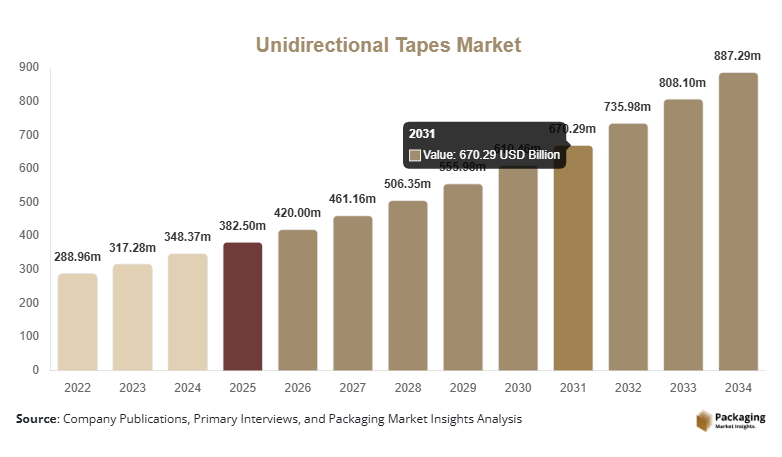
Unidirectional Tapes market size is projected at USD 420 million in 2026 and is expected to hit USD 890 million by 2034 with a CAGR of 9.8%.”The report provides comprehensive analysis of Unidirectional Tapes Market covering market segmentation, production capacity, technology adoption, competitive landscape, and regional performance. The study evaluates demand patterns, investment opportunities, and strategic developments across major industries using historical data from 2022–2024 and forecast analysis from 2026–2034.
Unidirectional Tapes are advanced composite materials consisting of continuous fibers aligned in a single direction and embedded within polymer matrices to deliver high strength-to-weight ratios, stiffness, and durability. The global production capacity of unidirectional tapes exceeded 95 thousand metric tons in 2025, supported by increasing demand from aerospace, automotive, wind energy, and sporting goods industries. Carbon fiber-based tapes accounted for nearly 48% of total consumption, while glass fiber variants contributed around 37% due to cost advantages. Adoption penetration increased by approximately 12% between 2022 and 2025 as manufacturers shifted toward lightweight composite solutions. Rising applications in electric vehicles, aircraft structures, and renewable energy components continue to strengthen the Unidirectional Tapes Market.
Explore more data points, trends and opportunities Download Free Sample Report
Unidirectional Tapes Market Trends
Increasing Adoption of Lightweight Composite Materials
The Unidirectional Tapes Market is experiencing strong growth due to increasing utilization of lightweight composite materials across transportation and industrial sectors. Global production of advanced composite tapes reached approximately 95,000 tons in 2025, with automotive applications accounting for nearly 28% of total demand. More than 35% of new electric vehicle platforms are integrating composite reinforcement solutions to improve weight reduction and battery efficiency. Automated fiber placement technologies have improved manufacturing efficiency by 20–30%, enabling wider adoption of unidirectional tapes in structural applications.
Growth of Thermoplastic Composite Technologies
Thermoplastic-based unidirectional tapes are gaining traction due to faster processing cycles, recyclability, and improved impact resistance. Thermoplastic tapes represented around 32% of market consumption in 2025 and are expected to expand rapidly through 2034. Aerospace manufacturers have increased thermoplastic composite adoption by nearly 18% annually, while sports equipment production using these materials increased by more than 10 million units globally. Continuous innovation in carbon fiber reinforcement and automated manufacturing is expected to influence Unidirectional Tapes Market Trends.
Unidirectional Tapes Market Drivers
Growing Demand for Lightweight Transportation Solutions Driving Market Expansion
The increasing requirement for fuel-efficient and lightweight vehicles is a major driver for the Unidirectional Tapes Market. Automotive manufacturers use composite tapes to reduce vehicle weight by 20–40% while maintaining structural performance. Electric vehicle production surpassed 17 million units globally in 2025, creating additional demand for lightweight reinforcement materials. Carbon fiber unidirectional tapes captured nearly 48% share in automotive applications, while composite integration rates increased by approximately 15% during 2022–2025.
Unidirectional Tapes Market Restraints
High Production Costs and Complex Manufacturing Processes Limiting Adoption
High raw material costs and complex processing requirements remain significant restraints for the Unidirectional Tapes Market. Carbon fiber-based tapes can cost 3–5 times higher than conventional reinforcement materials, limiting adoption among cost-sensitive industries. Manufacturing defects, resin compatibility issues, and specialized equipment requirements increase production expenses by approximately 20%. Small and medium manufacturers account for nearly 35% of potential users but face investment barriers due to high technology costs.
Unidirectional Tapes Market Opportunities
Expansion of Electric Vehicles and Renewable Energy Applications Creating Growth Opportunities
The growing electric vehicle and renewable energy sectors provide significant opportunities for Unidirectional Tapes Market expansion. Global wind turbine installations exceeded 110 GW annually, increasing demand for lightweight composite structures. Battery electric vehicles are expected to represent more than 40% of new vehicle sales by 2034, supporting composite material demand. Manufacturers investing in recyclable thermoplastic tapes and automated production systems could capture emerging opportunities across multiple industries.
Challenges in Unidirectional Tapes Market
Supply Chain Volatility and Limited Recycling Infrastructure Creating Industry Challenges
The Unidirectional Tapes Market faces challenges related to raw material availability, recycling limitations, and supply chain fluctuations. Carbon fiber production capacity remains concentrated among limited suppliers, creating dependency risks. Recycling rates for composite materials remain below 20% globally due to complex material separation processes. Additionally, fluctuations of 10–15% in resin and fiber prices impact overall manufacturing costs and restrict rapid market penetration.
Report Scope
| Report Metric | Details |
|---|---|
| Market Size in 2025 | USD 382.5 million |
| Market Size in 2026 | USD 420 million |
| Market Size in 2034 | USD 890 million |
| CAGR | 9.8% (2026-2034) |
| Base Year for Estimation | 2025 |
| Historical Data | 2022-2024 |
| Forecast Period | 2026-2034 |
| Report Coverage | Revenue Forecast, Competitive Landscape, Supply Chain Disruption, Growth Factors, Environment & Regulatory Landscape and Trends |
| Geographies Covered | North America, Europe, APAC, Middle East and Africa, LATAM |
| Countries Covered | U.S., Canada, U.K., Germany, France, Spain, Italy, Russia, Nordic, Benelux, Rest of Europe, China, South Korea, Japan, India, Australia, Singapore, Taiwan, South East Asia, Rest of Asia-Pacific, UAE, Turky, Saudi Arabia, South Africa, Egypt, Nigeria, Rest of MEA, Brazil, Mexico, Argentina, Chile, Colombia, Rest of LATAM |
Explore more data points, trends and opportunities Download Free Sample Report
Unidirectional Tapes Market Segmentation
The Unidirectional Tapes Market is segmented based on fiber type, resin type, and application. Carbon fiber dominated the market with approximately 48% share in 2025 due to superior strength and lightweight characteristics. Epoxy resin accounted for nearly 55% consumption share, while aerospace and automotive applications collectively represented more than 60% of total demand.
By Type
Carbon Fiber
Carbon fiber unidirectional tapes held around 48% market share in 2025 and represented more than 45 thousand tons of annual production. These tapes provide tensile strength exceeding 3,500 MPa and are widely used in aerospace structures, premium automotive components, and sporting equipment. Demand increased by nearly 14% between 2022 and 2025 due to lightweight design requirements.
Glass Fiber
Glass fiber unidirectional tapes accounted for approximately 37% share, supported by cost efficiency and high durability. Annual production exceeded 35 thousand tons globally, with applications in automotive parts, construction reinforcement, and industrial equipment. Glass fiber tapes offer tensile strength between 1,500–2,500 MPa and maintain strong demand in price-sensitive industries.
Aramid Fiber
Aramid fiber tapes contributed nearly 15% market share in 2025, with production volumes exceeding 14 thousand tons. These materials provide high impact resistance and thermal stability, making them suitable for defense, aerospace, and protective equipment applications.
By Application
Automotive
Automotive applications represented nearly 28% of Unidirectional Tapes Market demand in 2025. More than 17 million electric vehicles produced globally supported composite material adoption. Manufacturers use unidirectional tapes for chassis reinforcement, battery structures, and lightweight body components, improving weight efficiency by 15–30%.
Aerospace
Aerospace accounted for approximately 32% market share due to high-performance requirements. Aircraft manufacturers increased composite usage by more than 20% during 2022–2025, with unidirectional tapes used in wings, fuselage components, and structural reinforcements. Advanced aerospace programs require materials with strength-to-weight ratios exceeding traditional metals.
Sports Equipment
Sports equipment applications contributed nearly 18% share, supported by demand for high-performance bicycles, tennis rackets, and protective gear. More than 50 million sporting products annually incorporate composite materials, with penetration increasing by approximately 8% per year.
Unidirectional Tapes Market Segmentations
Fiber Type
- Carbon Fiber
- Glass Fiber
- Aramid Fiber
Resin Type
- Epoxy Resin
- Thermoplastic Resin
- Polyurethane Resin
Application
- Aerospace
- Automotive
- Sports Equipment
- Wind Energy
- Industrial Applications
Unidirectional Tapes Market Regional Outlook
North America
North America accounted for approximately 34% of global Unidirectional Tapes Market share in 2025, supported by aerospace and automotive industries. The United States contributed nearly 80% of regional demand, with aerospace applications representing over 40% of consumption. Production capacity exceeded 35 thousand tons annually due to investments in composite manufacturing facilities.
Europe
Europe captured around 29% market share, driven by Germany, France, and the United Kingdom. Automotive manufacturers contributed nearly 45% of regional consumption, while aerospace applications accounted for 30%. Sustainability regulations increased composite adoption by approximately 12% during 2022–2025.
Asia-Pacific
Asia-Pacific represented nearly 30% share and recorded the fastest growth rate. China, Japan, and South Korea contributed more than 75% of regional demand. Electric vehicle manufacturing exceeding 10 million units annually supported increasing consumption of lightweight composite tapes.
Rest of World
Latin America and Middle East & Africa collectively accounted for approximately 7% market share. Renewable energy projects and industrial applications are expected to increase regional demand by more than 8% annually through 2034.
Top players in Unidirectional Tapes Market
- Toray Industries Inc.
- SGL Carbon SE
- Hexcel Corporation
- Solvay SA
- Teijin Limited
- Mitsubishi Chemical Group
- Owens Corning
- Celanese Corporation
- Victrex plc
- Evonik Industries AG
Toray Industries Inc.
-
Holds a significant position with approximately 20% share in advanced carbon fiber composite materials.
-
Maintains strong global positioning through aerospace-grade unidirectional tape production.
-
Operates extensive manufacturing facilities across Asia, North America, and Europe.
-
Invests heavily in carbon fiber technology development, with R&D spending exceeding USD 500 million annually.
-
Supplies composite materials for aircraft, automotive, and industrial applications.
Hexcel Corporation
-
Accounts for nearly 12–15% share in aerospace composite solutions.
-
Focuses on high-performance carbon fiber reinforcement materials.
-
Supplies unidirectional tapes for commercial aircraft and defense applications.
-
Operates advanced composite manufacturing facilities with global production capacity exceeding thousands of tons annually.
-
Strengthens market positioning through innovation in lightweight aerospace materials.