Abrasive Grains Market Size
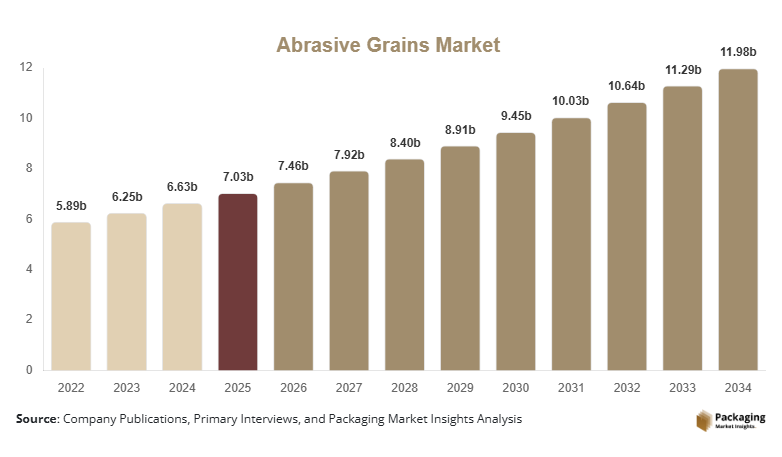
Abrasive Grains market size is projected at USD 7.46 billion in 2026 and is expected to hit USD 11.98 billion by 2034 with a CAGR of 6.10%. The report provides detailed analysis of historical performance from 2022–2024 with 2025 as the base year, evaluating production capacity, pricing trends, competitive landscape, value chain, and regional demand. The study includes quantitative forecasts, segmentation analysis, and competitive benchmarking to support strategic decision-making across the abrasive materials industry.
Abrasive grains are synthetic or natural hard mineral particles used in grinding, polishing, cutting, finishing, and surface preparation applications. Global production exceeded 6.4 million metric tons during 2025, while metal fabrication accounted for approximately 46% of total demand. Automotive applications contributed nearly 27%, electronics manufacturing represented 15%, and manufacturing capacity utilization remained around 86%, strengthening the Abrasive Grains market.
Explore more data points, trends and opportunities Download Free Sample Report
Abrasive Grains Trends
Growing adoption of precision abrasive technologies
Manufacturers are increasingly adopting precision-engineered abrasive grains to improve machining efficiency and component quality. Global production surpassed 6.7 million metric tons during 2025, while demand for precision grinding materials increased by approximately 9.4%. Automated abrasive manufacturing lines improved productivity by nearly 14%, and over 62% of industrial grinding applications now utilize engineered abrasive grains, supporting the Abrasive Grains market.
Rising demand from electronics and advanced manufacturing
Miniaturization in semiconductor and electronics manufacturing is accelerating demand for high-purity abrasive materials. Electronics-grade abrasive grain production exceeded 920,000 metric tons during 2025, while adoption increased by approximately 17% across precision polishing applications. Nearly 55% of semiconductor wafer finishing processes utilize premium abrasive grains, reinforcing the Abrasive Grains market.
Abrasive Grains Drivers
Expanding industrial manufacturing and metal fabrication
Rapid industrialization, infrastructure development, and automotive production continue driving demand for grinding and finishing materials. Global industrial manufacturing output increased by approximately 6.8% during 2025, while abrasive consumption in fabrication industries rose by 8.2%. More than 71% of fabricated metal components undergo abrasive finishing, supporting Abrasive Grains market growth.
Abrasive Grains Restraints
Volatility in raw material and energy costs
Rising electricity prices and fluctuations in alumina and silicon carbide feedstock costs continue affecting manufacturing margins. Raw material prices increased by nearly 13% during 2025, while energy expenses accounted for approximately 29% of production costs. These factors continue influencing profitability across the Abrasive Grains market.
Abrasive Grains Opportunities
Increasing adoption in electric vehicle manufacturing
Electric vehicle production requires precision machining for battery housings, motors, gears, and lightweight alloys, creating new opportunities. Global EV production exceeded 20 million units during 2025, while demand for advanced abrasive materials increased by approximately 18%. Nearly 52% of EV component manufacturers expanded the use of ceramic abrasive grains, creating opportunities across the Abrasive Grains market.
Challenges in Abrasive Grains
Maintaining consistent grain quality
Manufacturers continue facing challenges in achieving uniform grain size distribution and product consistency for high-precision applications. Quality rejection rates remain between 3% and 5%, while production process optimization investments increased by approximately 12% during 2025. Continuous innovation remains essential for the Abrasive Grains market.
Report Scope
| Report Metric | Details |
|---|---|
| Market Size in 2025 | USD 7.03 billion |
| Market Size in 2026 | USD 7.46 billion |
| Market Size in 2034 | USD 11.98 billion |
| CAGR | 6.10% (2026-2034) |
| Base Year for Estimation | 2025 |
| Historical Data | 2022-2024 |
| Forecast Period | 2026-2034 |
| Report Coverage | Revenue Forecast, Competitive Landscape, Supply Chain Disruption, Growth Factors, Environment & Regulatory Landscape and Trends |
| Geographies Covered | North America, Europe, APAC, Middle East and Africa, LATAM |
| Countries Covered | U.S., Canada, U.K., Germany, France, Spain, Italy, Russia, Nordic, Benelux, Rest of Europe, China, South Korea, Japan, India, Australia, Singapore, Taiwan, South East Asia, Rest of Asia-Pacific, UAE, Turky, Saudi Arabia, South Africa, Egypt, Nigeria, Rest of MEA, Brazil, Mexico, Argentina, Chile, Colombia, Rest of LATAM |
Explore more data points, trends and opportunities Download Free Sample Report
Abrasive Grains Market Segmentation
Aluminum Oxide accounts for approximately 49% of global production owing to its versatility and durability, while Metal Fabrication contributes nearly 46% of total demand. Automotive applications represent around 27%, supported by expanding vehicle manufacturing and precision engineering requirements.
By Type
Aluminum Oxide
Aluminum Oxide represents nearly 49% of market demand with annual production exceeding 3.1 million metric tons. Grain sizes typically range between 12 and 220 grit, providing excellent toughness, wear resistance, and grinding performance across industrial applications.
Silicon Carbide
Silicon Carbide accounts for approximately 31% of global production, exceeding 2.0 million metric tons annually. The material offers superior hardness, thermal conductivity, and sharp cutting characteristics for precision grinding and electronics manufacturing.
Ceramic Abrasive Grains
Ceramic Abrasive Grains contribute around 20% of market demand with production exceeding 1.3 million metric tons annually. These products deliver higher durability, faster cutting rates, and extended service life for demanding industrial machining operations.
By Application
Metal Fabrication
Metal Fabrication dominates the market with approximately 46% share and annual consumption exceeding 2.9 million metric tons. Grinding, deburring, weld finishing, and precision machining account for the majority of applications, while adoption exceeds 70% among industrial manufacturers.
Automotive
Automotive accounts for nearly 27% of market demand, consuming more than 1.7 million metric tons annually. Abrasive grains are extensively used in engine components, transmission systems, brake parts, and lightweight alloy finishing.
Electronics Manufacturing
Electronics Manufacturing represents approximately 15% of global demand with annual consumption exceeding 960,000 metric tons. Precision polishing, semiconductor wafer processing, and electronic component finishing continue driving sustained market expansion.
Abrasive Grains Market Segmentations
By Type
- Aluminum Oxide
- Silicon Carbide
- Ceramic Abrasive Grains
By Application
- Metal Fabrication
- Automotive
- Electronics Manufacturing
Abrasive Grains Regional Outlook
Asia-Pacific
Asia-Pacific accounts for approximately 51% of global demand and produces more than 3.3 million metric tons annually. China, Japan, India, and South Korea dominate regional production due to strong manufacturing, automotive, and electronics industries.
North America
North America represents nearly 21% of the market. The United States contributes approximately 82% of regional demand, supported by aerospace, automotive, industrial manufacturing, and precision engineering activities.
Europe
Europe accounts for approximately 20% of global consumption. Germany, Italy, France, and the United Kingdom remain leading manufacturing hubs with increasing demand for advanced abrasive technologies.
Latin America
Latin America contributes nearly 5% of global demand. Brazil and Mexico account for over 72% of regional consumption, supported by automotive production and industrial manufacturing expansion.
Middle East & Africa
The Middle East & Africa represent approximately 3% of the global market. Industrial diversification, mining activities, and infrastructure investments continue supporting gradual market expansion.
Top players in Abrasive Grains
- Saint-Gobain Abrasives
- 3M Company
- Tyrolit Group
- Fujimi Incorporated
- Carborundum Universal Limited
- Washington Mills
- Imerys S.A.
- Henan Huanghe Whirlwind Co., Ltd.
- Sak Abrasives Limited
- Asahi Diamond Industrial Co., Ltd.
- Shinhan Diamond Industrial Co., Ltd.
- Bosai Minerals Group Co., Ltd.
Saint-Gobain Abrasives
-
Estimated global market share: 15–17%
-
Leading global manufacturer of abrasive grains and industrial finishing solutions serving automotive, aerospace, electronics, and metal fabrication industries.
-
Offers aluminum oxide, silicon carbide, and ceramic abrasive products through an extensive manufacturing and distribution network.
-
Invests in advanced abrasive engineering, automation, and sustainable manufacturing technologies while expanding production capacity across North America, Europe, and Asia-Pacific to strengthen its competitive position.
3M Company
-
Estimated global market share: 11–13%
-
Recognized supplier of precision abrasive materials and engineered grinding solutions for industrial manufacturing.
-
Focuses on innovative ceramic abrasive technologies, high-performance coated abrasives, and precision finishing systems.
-
Expands manufacturing capabilities through automation, product innovation, and strategic partnerships while serving customers across automotive, aerospace, electronics, and heavy industrial sectors.