Fabric Cutting Machines Market Size
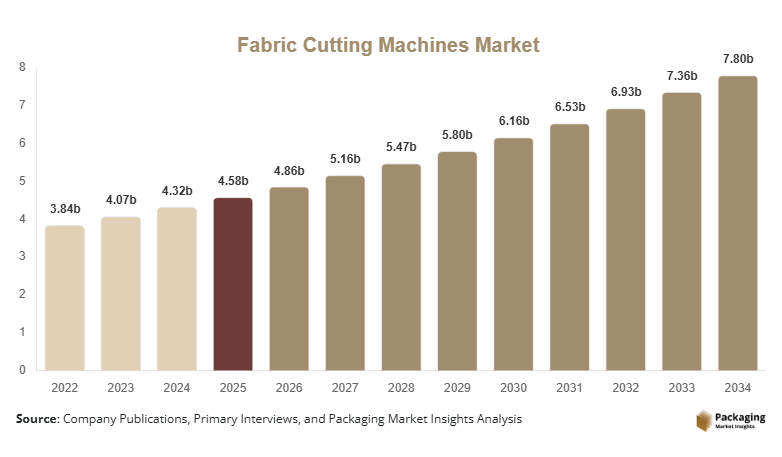
Fabric Cutting Machines market size is projected at USD 4.86 billion in 2026 and is expected to hit USD 7.82 billion by 2034 with a CAGR of 6.1%. The market is witnessing steady expansion due to increasing automation in textile manufacturing, higher production efficiency requirements, and growing investments in precision cutting technologies. Detailed segmentation analysis and competitive benchmarking enable manufacturers and investors to identify emerging opportunities across industrial applications.
The Fabric Cutting Machines Market comprises equipment designed to cut woven, non-woven, knitted, composite, and technical fabrics with high precision for industrial manufacturing. Global production surpassed 2.74 million machines in 2025, while automated systems accounted for nearly 61% of total installations. Apparel manufacturing represented approximately 58% of total equipment demand, followed by automotive textiles at 23% and home furnishing at 19%. Smart digital cutting technologies have achieved adoption rates exceeding 46%, reinforcing the Fabric Cutting Machines Market.
Explore more data points, trends and opportunities Download Free Sample Report
Fabric Cutting Machines Market Trends
Increasing Adoption of Automated and CNC Cutting Technologies
Manufacturers are replacing conventional cutting systems with CNC-controlled and AI-enabled machines capable of reducing material waste by 18% while increasing productivity by 27%. More than 1.36 million automated cutting machines were operational globally in 2025, and nearly 54% of large textile manufacturers have integrated digital nesting software to optimize fabric utilization, strengthening the Fabric Cutting Machines Market Trend.
The integration of IoT monitoring, laser guidance, and predictive maintenance technologies continues to improve operational efficiency. Annual production of CNC fabric cutting machines exceeded 690,000 units in 2025, while adoption within technical textile manufacturing increased by 22%. Demand from industrial garment factories and automotive interior manufacturers continues to accelerate modernization across the Fabric Cutting Machines Market.
Fabric Cutting Machines Market Drivers
Growing Automation Across Textile Manufacturing
Increasing labor costs and the need for precision production are accelerating automation investments. Global textile manufacturing exceeded USD 1.1 trillion in output during 2025, while automated cutting systems improved production efficiency by nearly 32%. More than 71% of large apparel manufacturers now utilize automatic cutting machines, significantly reducing fabric waste and production time, driving Fabric Cutting Machines Market Growth.
Fabric Cutting Machines Market Restraints
High Initial Investment and Maintenance Costs
Advanced CNC and automated cutting machines require significant capital investment, limiting adoption among small and medium textile manufacturers. Automated systems can cost 40–65% more than conventional machines, while annual maintenance expenses account for approximately 6–9% of equipment value. Skilled operator shortages further restrain widespread deployment across developing economies, limiting the Fabric Cutting Machines Market.
Fabric Cutting Machines Market Opportunities
Expansion of Technical and Smart Textile Production
Demand for technical textiles in healthcare, automotive, aerospace, and defense applications continues to expand rapidly. Global technical textile production exceeded 39 million metric tons in 2025, while investments in smart manufacturing increased by 19%. Growing adoption of precision cutting technologies for composite fabrics creates substantial opportunities throughout the Fabric Cutting Machines Market.
Challenges in Fabric Cutting Machines Market
Integration with Digital Manufacturing Systems
Manufacturers face challenges integrating cutting machines with ERP, CAD, and Industry 4.0 production platforms. Nearly 43% of textile facilities continue operating mixed production environments, increasing software compatibility costs by 15% and extending implementation timelines by approximately 20%. These operational complexities remain key challenges across the Fabric Cutting Machines Market.
Report Scope
| Report Metric | Details |
|---|---|
| Market Size in 2025 | USD 4.58 billion |
| Market Size in 2026 | USD 4.86 billion |
| Market Size in 2034 | USD 7.82 billion |
| CAGR | 6.1% (2026-2034) |
| Base Year for Estimation | 2025 |
| Historical Data | 2022-2024 |
| Forecast Period | 2026-2034 |
| Report Coverage | Revenue Forecast, Competitive Landscape, Supply Chain Disruption, Growth Factors, Environment & Regulatory Landscape and Trends |
| Geographies Covered | North America, Europe, APAC, Middle East and Africa, LATAM |
| Countries Covered | U.S., Canada, U.K., Germany, France, Spain, Italy, Russia, Nordic, Benelux, Rest of Europe, China, South Korea, Japan, India, Australia, Singapore, Taiwan, South East Asia, Rest of Asia-Pacific, UAE, Turky, Saudi Arabia, South Africa, Egypt, Nigeria, Rest of MEA, Brazil, Mexico, Argentina, Chile, Colombia, Rest of LATAM |
Explore more data points, trends and opportunities Download Free Sample Report
Fabric Cutting Machines Market Segmentation
The market is segmented by type and application to meet varying production capacities and precision requirements across textile industries. Automatic cutting machines account for approximately 47% of revenue, while apparel manufacturing contributes nearly 58% of total demand due to large-scale garment production.
By Type
Manual Fabric Cutting Machines
Manual fabric cutting machines account for approximately 24% of market demand. Annual production exceeded 650,000 units in 2025 and remains concentrated among small-scale apparel manufacturers, tailoring workshops, and low-volume production facilities requiring flexible operations.
Automatic Fabric Cutting Machines
Automatic fabric cutting machines hold nearly 47% of total market share. Production exceeded 1.28 million units during 2025, offering cutting speeds above 120 meters per minute, automated material handling, and optimized nesting software that reduces fabric waste by up to 20%.
CNC Fabric Cutting Machines
CNC fabric cutting machines represent approximately 29% of market demand. Global production surpassed 810,000 units in 2025. These systems deliver cutting precision within ±0.1 mm, making them suitable for technical textiles, automotive interiors, aerospace fabrics, and high-volume industrial manufacturing.
By Application
Apparel Manufacturing
Apparel manufacturing dominates the market with approximately 58% share. More than 1.58 million cutting machines were utilized across garment factories during 2025. Automation adoption exceeds 63%, enabling higher production efficiency, improved consistency, and lower material waste.
Automotive Textiles
Automotive textiles account for nearly 23% of market demand. Production facilities consumed approximately 630,000 machines supporting seat covers, airbags, insulation materials, and interior trim manufacturing. Precision cutting has improved component quality while reducing scrap rates by 16%.
Home Furnishing
Home furnishing represents around 19% of global demand. Nearly 520,000 cutting machines supported the production of upholstery, curtains, carpets, bedding, and decorative textiles. Automated cutting systems have increased productivity by 21% across large furniture manufacturing facilities.
Fabric Cutting Machines Market Segmentations
Type
- Manual Fabric Cutting Machines
- Automatic Fabric Cutting Machines
- CNC Fabric Cutting Machines
Application
- Apparel Manufacturing
- Automotive Textiles
- Home Furnishing
Fabric Cutting Machines Regional Outlook
North America
North America accounts for approximately 27% of global market revenue. The United States contributes nearly 79% of regional demand, supported by advanced technical textile manufacturing and automated apparel production. Annual machine production exceeded 420,000 units during 2025.
Europe
Europe represents approximately 29% of the market. Germany, Italy, France, and the United Kingdom collectively account for over 74% of regional installations. Technical textiles and automotive manufacturing continue driving investments in CNC fabric cutting technologies, with annual production exceeding 510,000 units.
Asia-Pacific
Asia-Pacific dominates the global market with approximately 37% share. China, India, Bangladesh, Vietnam, Japan, and South Korea collectively manufactured more than 1.12 million machines during 2025. Apparel exports and expanding industrial textile production remain the primary growth contributors.
Middle East & Africa
The Middle East & Africa account for nearly 7% of global demand. Textile manufacturing expansion across Turkey, the UAE, Egypt, and South Africa supported annual production exceeding 190,000 machines, while industrial automation investments continue strengthening regional competitiveness.
Top players in Fabric Cutting Machines Market
- Gerber Technology
- Lectra
- Eastman Machine Company
- Bullmer GmbH
- FKgroup S.p.A.
- Morgan Tecnica S.p.A.
- Hashima Co., Ltd.
- Kuris Spezialmaschinen GmbH
- IECHO
- Pathfinder Cutting Technology
Gerber Technology
-
Estimated market share: 14–16%
-
Global leader in automated cutting solutions for apparel, industrial textiles, and composite materials.
-
Extensive portfolio of CAD/CAM-integrated cutting systems with strong presence across North America, Europe, and Asia-Pacific.
-
Focuses on AI-driven production optimization, cloud-connected manufacturing platforms, and high-speed automated cutting systems that improve productivity, reduce waste, and enhance precision for large-scale textile manufacturers.
Lectra
-
Estimated market share: 12–14%
-
Strong global position in digital textile manufacturing and Industry 4.0 solutions.
-
Offers advanced CNC cutting equipment integrated with design software, production analytics, and automated workflow management.
-
The company continues expanding investments in smart factory technologies, predictive maintenance solutions, and digital manufacturing platforms to improve operational efficiency for apparel, automotive, furniture, and technical textile industries.