Packaging Primer Market Size and Growth
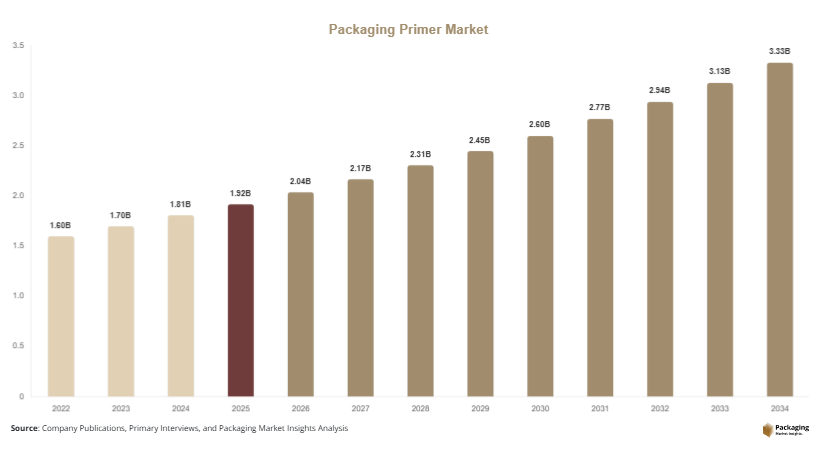
The global packaging primer market is projected to grow from USD 1.92 billion in 2025 to USD 3.34 billion by 2034, registering a CAGR of 6.3% during 2025–2034. In 2026, the market size is estimated at USD 2.04 billion, supported by rising demand from flexible packaging, increasing adoption of sustainable coating technologies, and expansion of global retail and e-commerce packaging applications.
Several growth factors are shaping market expansion. First, increasing demand for high-performance flexible packaging is driving the need for advanced primer solutions that improve adhesion and durability. Second, regulatory pressure on low-VOC and environmentally friendly coatings is accelerating the adoption of water-based and UV-curable primers. Third, rising investments in packaging aesthetics and brand differentiation are encouraging manufacturers to adopt high-quality surface treatment solutions.
Key Highlights
- Asia Pacific dominated the market with a 37.4% share in 2025.
- Latin America is projected to grow at the fastest CAGR of 6.2%.
- Water-based primers led the type segment with a 41.8% share.
- Flexible packaging dominated with a 53.2% share.
- Food & beverage applications led with 46.3% share.
- The US remained the dominant country with a market size of USD 0.62 billion in 2025 and USD 0.66 billion in 2026.
Explore more data points, trends and opportunities Download Free Sample Report
Market Trends
Shift Toward Water-Based and Low-VOC Primer Technologies
A major trend in the packaging primer market is the transition from solvent-based formulations to water-based and low-VOC primers. This shift is primarily driven by environmental regulations and corporate sustainability commitments. Water-based primers reduce harmful emissions while maintaining strong adhesion performance across paper and plastic substrates. For example, food packaging manufacturers in Europe are increasingly adopting water-based primers to comply with EU environmental directives. Similarly, beverage companies are using eco-friendly primers to enhance recyclability of packaging materials. This trend is expected to accelerate as global packaging regulations become stricter and sustainability becomes a core purchasing criterion for brands.
Integration of Digital Printing Compatibility in Primers
Another key trend is the development of primers compatible with digital and high-speed printing technologies. As packaging design becomes more customized and short-run production increases, primers must support fast-drying inks and high-resolution printing. For instance, e-commerce brands use digitally printed flexible packaging with primers that ensure sharp graphics and smudge resistance. Pharmaceutical packaging is also adopting primers optimized for serialization and QR-code printing. In the future, smart primers capable of interacting with digital inks and embedded tracking systems are expected to redefine packaging performance standards.
Market Drivers
Growth in Flexible Packaging Demand
The rising demand for flexible packaging is a key driver of the packaging primer market. Flexible packaging is widely used in food, beverages, pharmaceuticals, and personal care products due to its lightweight, cost efficiency, and extended shelf life benefits. However, flexible substrates often have low surface energy, requiring primers to ensure proper ink adhesion. For example, snack packaging companies use primers on polyethylene films to maintain branding quality during transportation. As flexible packaging continues to replace rigid formats, demand for high-performance primers is expected to rise steadily.
Expansion of E-Commerce Packaging Requirements
The rapid growth of e-commerce is another major driver. Online retail requires packaging that maintains visual appeal and structural integrity throughout shipping cycles. Packaging primers help ensure that printed branding does not fade or peel during handling and transportation. For instance, electronics and cosmetics brands use primer-coated packaging to ensure product presentation quality upon delivery. With global e-commerce volumes increasing, demand for durable and visually consistent packaging solutions is expanding significantly.
Market Restraint
A key restraint in the packaging primer market is the fluctuating cost of raw materials used in primer formulations, including resins, solvents, and specialty additives. These price variations directly impact production costs and profit margins for manufacturers.
Additionally, regulatory compliance challenges related to chemical safety and VOC emissions limit the use of certain high-performance solvent-based primers. Smaller manufacturers often face difficulties adapting to new environmental standards due to high transition costs and technical constraints.
Market Opportunities
Expansion of Sustainable Packaging Solutions
The increasing shift toward sustainable packaging presents a major opportunity for the market. Manufacturers are developing biodegradable and recyclable primer formulations compatible with eco-friendly substrates. For example, paper-based food packaging is increasingly using water-based primers to enhance printability without compromising recyclability. This trend is expected to expand as global brands commit to reducing carbon footprints.
Growth in Pharmaceutical and Specialty Packaging
Pharmaceutical packaging offers strong growth opportunities due to strict labeling and traceability requirements. Packaging primers are essential for ensuring clarity, durability, and resistance to sterilization processes. For instance, blister packs and medical labels require primers that withstand chemical exposure and temperature variations. With rising healthcare demand globally, this segment is expected to drive sustained market growth.
Report Scope
| Report Metric | Details |
|---|---|
| Market Size in 2025 | USD 1.92 Billion |
| Market Size in 2026 | USD 2.04 Billion |
| Market Size in 2034 | USD 3.34 Billion |
| CAGR | 6.3% (2026-2034) |
| Base Year for Estimation | 2025 |
| Historical Data | 2022-2024 |
| Forecast Period | 2026-2034 |
| Report Coverage | Revenue Forecast, Competitive Landscape, Supply Chain Disruption, Growth Factors, Environment & Regulatory Landscape and Trends |
| Geographies Covered | North America, Europe, APAC, Middle East and Africa, LATAM |
| Countries Covered | U.S., Canada, U.K., Germany, France, Spain, Italy, Russia, Nordic, Benelux, Rest of Europe, China, South Korea, Japan, India, Australia, Singapore, Taiwan, South East Asia, Rest of Asia-Pacific, UAE, Turky, Saudi Arabia, South Africa, Egypt, Nigeria, Rest of MEA, Brazil, Mexico, Argentina, Chile, Colombia, Rest of LATAM |
Explore more data points, trends and opportunities Download Free Sample Report
Segmental Analysis
Type Segment
The water-based primers segment dominated with a 2024 market share of 41.8%, driven by environmental regulations and increasing adoption of sustainable packaging solutions. These primers are widely used in food and beverage packaging due to their low toxicity and compatibility with recyclable substrates. For example, paperboard packaging for cereals and frozen foods frequently uses water-based primers to enhance ink adhesion.
Solvent-based primers still maintain presence in industrial applications requiring high durability.
The fastest-growing segment is UV-curable primers, with a CAGR of 7.1%, driven by demand for faster production cycles and high-performance packaging. These primers are widely used in premium packaging and digital printing applications. Future growth is expected as packaging lines adopt high-speed UV curing systems.
Material Segment
Flexible packaging substrates dominated with a 2024 share of 53.2%, due to widespread use in food, beverages, and pharmaceuticals. These materials require primers to improve surface compatibility and print durability.
Rigid packaging materials also use primers but at lower intensity.
The fastest-growing segment is paper-based sustainable substrates, with a CAGR of 6.8%, driven by eco-friendly packaging initiatives and regulatory pressure.
End-Use Segment
Food & beverage applications dominated with a 2024 share of 46.3%, driven by high consumption of packaged food and beverages. Packaging primers ensure durability and print quality in refrigerated and frozen environments.
Pharmaceutical packaging is the fastest-growing segment, with a CAGR of 7.2%, driven by regulatory requirements and serialization needs. Future demand will rise with increased healthcare consumption globally.
Packaging Primer Market Segmentations
By Type
- Water-Based Primers
- Solvent-Based Primers
- UV-Curable Primers
By Material
- Flexible Packaging
- Rigid Packaging
- Paper-Based Substrates
By End-User
- Food & Beverage
- Pharmaceuticals
- Personal Care & Cosmetics
- Industrial Packaging
- E-commerce Packaging
Regional Analysis
North America
North America accounted for approximately 28.1% share of the packaging primer market in 2025, with a projected CAGR of 6.1% through 2034. The region benefits from advanced packaging technologies, strong pharmaceutical manufacturing, and high demand for branded consumer goods. The United States and Canada are major contributors due to their established food processing and healthcare industries.
A key growth factor is the increasing adoption of high-performance flexible packaging in food and beverage sectors. For example, U.S. snack manufacturers are using primer-coated films to improve print durability and shelf appeal. Additionally, strict environmental regulations are pushing companies toward low-VOC and water-based primer solutions.
The United States dominates the region due to its large-scale packaging industry. A unique driver is the rapid expansion of digital printing technologies in packaging, where primers are essential for achieving high-resolution graphics in short-run production cycles.
Europe
Europe held around 25.6% market share in 2025, growing at a CAGR of 6.4%. The region is strongly influenced by sustainability regulations, advanced packaging design standards, and high adoption of recyclable materials. Countries such as Germany, France, Italy, and the UK lead demand.
A key growth factor is strict EU regulations promoting low-emission and recyclable packaging materials. For example, food packaging companies in Germany are adopting water-based primers to ensure compliance with environmental policies.
Germany dominates the region due to its strong industrial packaging base. A unique driver is the integration of premium packaging aesthetics in luxury goods and cosmetics, where primers are used to enhance print quality and durability.
Asia Pacific
Asia Pacific dominated with a 37.4% share in 2025, and is expected to grow at a CAGR of 7.0%. The region benefits from rapid industrialization, expanding food processing industries, and strong growth in e-commerce packaging across China, India, and Japan.
A key growth factor is the expansion of flexible packaging production for consumer goods. For example, Indian food manufacturers increasingly use primer-coated packaging for ready-to-eat meals and snacks.
China dominates the region due to its massive manufacturing ecosystem. A unique driver is the expansion of export-oriented packaging production requiring high-quality print durability and adhesion performance.
Middle East & Africa
Middle East & Africa accounted for 6.4% share in 2025, with a CAGR of 5.9%. Growth is driven by rising packaged food consumption and expanding pharmaceutical imports. A key growth factor is increasing demand for high-quality packaged consumer goods in urban areas. For example, Gulf countries are investing in modern food packaging facilities.
The UAE dominates the region due to strong logistics infrastructure. A unique driver is growing demand for premium packaging in imported luxury goods and cosmetics.
Latin America
Latin America held around 2.9% share in 2025, with a CAGR of 6.2%. Brazil and Mexico are major contributors due to expanding retail and food processing industries.
A key growth factor is increasing packaged food consumption driven by urbanization. For example, Brazil’s snack and beverage industries are adopting improved packaging materials for branding. Brazil dominates the region due to strong food manufacturing. A unique driver is expansion of export packaging standards requiring improved print durability and adhesion performance.
Competitive Landscape
The packaging primer market is moderately fragmented with key players focusing on innovation in sustainable formulations and high-performance coatings. Major companies include Henkel AG & Co. KGaA, PPG Industries, BASF SE, Dow Inc., and AkzoNobel N.V. Among these, Henkel leads due to its strong portfolio of adhesive and coating solutions for flexible packaging applications.
Companies are investing in water-based technologies, UV-curable systems, and digital printing-compatible primers. Strategic partnerships with packaging converters and FMCG brands are increasing.
Key Players List
- Henkel AG & Co. KGaA
- PPG Industries Inc.
- BASF SE
- Dow Inc.
- AkzoNobel N.V.
- Sun Chemical
- Flint Group
- Toyo Ink SC Holdings
- Siegwerk Druckfarben AG
- DIC Corporation
- ALTANA AG
- Evonik Industries
- Lubrizol Corporation
- Arkema Group
- Covestro AG