Straw Papers Market Size
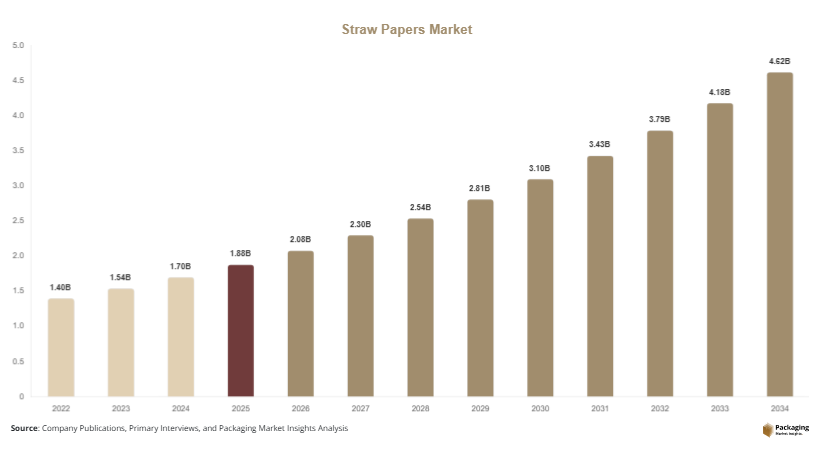
Straw paper's market size is projected at USD 2.08 billion in 2026 and is expected to hit USD 4.63 billion by 2034 with a CAGR of 10.5%. The market continues to expand due to increasing demand for sustainable food-contact packaging products across commercial and retail sectors. Comprehensive market assessment includes production analysis, segmentation by type and application, regional evaluation, and competitive landscape to provide strategic business intelligence for stakeholders.
The Straw Papers Market comprises paper materials specifically manufactured for producing disposable drinking straws used in foodservice, hospitality, retail, and household applications. Global production exceeded 910 billion paper straw units in 2026, supported by more than 4.8 million metric tons of specialty paper consumption. Foodservice applications accounted for approximately 52% of total consumption, while beverage manufacturers represented nearly 31%. Adoption of paper alternatives has crossed 68% among organized restaurant chains in several developed economies, reinforcing long-term expansion of the straw papers market.
Explore more data points, trends and opportunities Download Free Sample Report
Straw Papers Market Trends
Rising Adoption of Sustainable Fiber-Based Materials
Manufacturers are increasingly investing in high-strength virgin pulp and recycled fiber technologies to improve durability while maintaining compostability. Global production of straw papers surpassed 4.8 million metric tons, with recycled content exceeding 42% across new product launches. More than 61% of manufacturers have introduced water-resistant paper formulations, while automated converting lines improved production efficiency by 18%. These developments continue strengthening the straw papers market.
Technological Advancements in Barrier Coatings
Advanced water-based coatings and biodegradable barrier technologies are replacing conventional plastic laminates. Nearly 56% of newly commissioned production lines now utilize solvent-free coating systems, reducing emissions by over 35%. Beverage outlets contributed over 410 billion straw units annually, while premium cafés recorded paper straw penetration exceeding 78%. Continuous innovation supports sustainable manufacturing and reinforces the Straw Papers Market.
Straw Papers Market Drivers
Growing Restrictions on Single-Use Plastics
Government regulations restricting conventional plastic straws continue accelerating paper straw adoption. More than 80 countries have introduced partial or complete bans on selected plastic products, increasing paper straw consumption by over 14% annually. Foodservice chains representing nearly 65% of organized outlets have shifted toward fiber-based alternatives, while production investments exceeded USD 480 million globally. Regulatory momentum continues supporting the Straw Papers market.
Straw Papers Market Restraints
Higher Manufacturing Costs Compared with Plastic Alternatives
Paper straw production requires premium virgin pulp, specialty adhesives, and barrier coatings, increasing manufacturing expenses by approximately 22–35% over conventional plastic straws. Energy costs contribute nearly 18% of production expenditure, while raw material prices fluctuate by 10–15% annually. Smaller manufacturers face lower operating margins despite increasing demand, limiting expansion within the straw papers market.
Straw Papers Market Opportunities
Expansion of Eco-Friendly Foodservice Infrastructure
Growth in sustainable restaurants, cafés, hotels, and quick-service chains presents substantial opportunities. More than 74% of newly established beverage outlets now prioritize biodegradable consumables, while institutional procurement programs increased paper straw purchasing by 19%. Production capacity additions exceeding 650,000 metric tons are planned across multiple regions, creating long-term opportunities for the Straw Papers Market.
Challenges in Straw Papers Market
Performance Requirements under Extended Beverage Exposure
Maintaining structural integrity during prolonged liquid exposure remains a significant technical challenge. Nearly 28% of consumers report durability concerns, while manufacturers allocate over 7% of annual revenue toward research and product development. Performance testing now exceeds 2,000 quality cycles per production batch, reflecting ongoing innovation efforts supporting the Straw Papers Market.
Report Scope
| Report Metric | Details |
|---|---|
| Market Size in 2025 | USD 1.88 Billion |
| Market Size in 2026 | USD 2.08 Billion |
| Market Size in 2034 | USD 4.63 Billion |
| CAGR | 10.5% (2026-2034) |
| Base Year for Estimation | 2025 |
| Historical Data | 2022-2024 |
| Forecast Period | 2026-2034 |
| Report Coverage | Revenue Forecast, Competitive Landscape, Supply Chain Disruption, Growth Factors, Environment & Regulatory Landscape and Trends |
| Geographies Covered | North America, Europe, APAC, Middle East and Africa, LATAM |
| Countries Covered | U.S., Canada, U.K., Germany, France, Spain, Italy, Russia, Nordic, Benelux, Rest of Europe, China, South Korea, Japan, India, Australia, Singapore, Taiwan, South East Asia, Rest of Asia-Pacific, UAE, Turky, Saudi Arabia, South Africa, Egypt, Nigeria, Rest of MEA, Brazil, Mexico, Argentina, Chile, Colombia, Rest of LATAM |
Explore more data points, trends and opportunities Download Free Sample Report
Straw Papers Market Segmentation
The market is segmented by type and application to evaluate production capabilities and end-user demand. Virgin paper products account for approximately 47% of overall volume, while foodservice applications contribute nearly 52% of market consumption. Production exceeds 910 billion units annually across all product categories.
By Type
Virgin paper straws represent the largest product category with nearly 47% market share. Annual production exceeds 425 billion units, utilizing food-grade pulp with grammage ranging between 120–180 GSM. These products offer improved strength, uniform quality, and premium appearance for restaurants and cafés.
Recycled paper straws contribute approximately 34% of industry volume and exceed 300 billion units annually. Recycled fiber utilization reaches 80% in several manufacturing facilities while maintaining food-contact compliance. Growing environmental awareness continues supporting adoption.
Coated paper straws account for roughly 19% of production and demonstrate enhanced liquid resistance through biodegradable barrier coatings. Annual production surpasses 185 billion units, while advanced coating technologies improve usability by nearly 30% compared with conventional paper designs.
By Application
Foodservice dominates with approximately 52% market share. More than 470 billion units are consumed annually across restaurants, cafés, hotels, and institutional catering. Paper straw penetration exceeds 72% among premium restaurant chains due to sustainability commitments.
The beverage industry contributes around 35% of demand with annual utilization exceeding 315 billion units. Soft drink producers, juice manufacturers, and ready-to-drink beverage brands increasingly integrate paper straws into sustainable packaging initiatives. Automated packaging compatibility exceeds 90% across modern production facilities.
Household applications represent nearly 13% of total demand and continue expanding through retail distribution. Annual consumption exceeds 120 billion units, supported by growing awareness of biodegradable alternatives and rising adoption of eco-friendly disposable products.
Straw Papers Market Segmentations
Type
- Virgin Paper Straw
- Recycled Paper Straw
- Coated Paper Straw
Application
- Food Service
- Beverage Industry
- Household
Straw Papers Market Regional Outlook
North America
North America accounts for approximately 31% of global consumption, supported by production exceeding 1.4 million metric tons. The United States contributes nearly 82% of regional demand, while Canada continues expanding sustainable foodservice adoption. Beverage applications represent over 48% of regional consumption.
Europe
Europe holds around 29% of market share due to stringent environmental regulations. Germany, France, Italy, and the United Kingdom collectively contribute more than 71% of regional production. Annual paper straw manufacturing exceeds 260 billion units, supported by widespread plastic reduction initiatives.
Asia-Pacific
Asia-Pacific represents approximately 30% of global demand and records the fastest manufacturing expansion. China, Japan, India, and South Korea account for nearly 76% of regional production. Manufacturing capacity exceeds 2 million metric tons, driven by rapid growth in foodservice and beverage sectors.
Latin America
Latin America contributes nearly 6% of worldwide demand. Brazil and Mexico represent more than 63% of regional production, while hospitality investments and sustainable packaging initiatives continue increasing consumption.
Middle East & Africa
The Middle East & Africa account for approximately 4% of global consumption. GCC countries and South Africa lead regional demand with increasing adoption among hotels, airlines, and quick-service restaurants. Production capacity continues expanding alongside tourism and foodservice investments.
Top players in the straw papers market
- Hoffmaster Group Inc.
- Huhtamaki Oyj
- Aardvark Straws
- Tetra Pak
- Transcend Packaging
- Hoffmaster Paper Straws
- Vegware Ltd.
- BioPak Pty Ltd.
- Hello, Straw
- PT Strawland
- Footprint LLC
- The Paper Straw Co.
- TIPI Straws
- Canada Brown Eco Products
- OkStraw
Hoffmaster Group Inc.
- Estimated market presence: 9–11%
- Strong manufacturing footprint across North America.
- Broad portfolio serving foodservice distributors and hospitality customers.
- Significant investments in automated paper converting technologies and sustainable product innovation.
- Focus on premium-quality paper straw solutions with large-scale production capacity exceeding several billion units annually. The company continues expanding strategic partnerships with restaurant chains while improving manufacturing efficiency through advanced coating technologies and recyclable raw materials.
Huhtamaki Oyj
- Estimated market presence: 8–10%
- Global leader in sustainable food packaging solutions.
- Extensive manufacturing network across Europe, Asia-Pacific, and North America.
- Continuous investment in fiber-based packaging innovation.
- Strong customer relationships with multinational foodservice brands and beverage companies. The company emphasizes circular economy initiatives, high-performance paper products, and environmentally responsible manufacturing processes while strengthening global distribution capabilities and production scalability.