Deinkable Inks Market Size
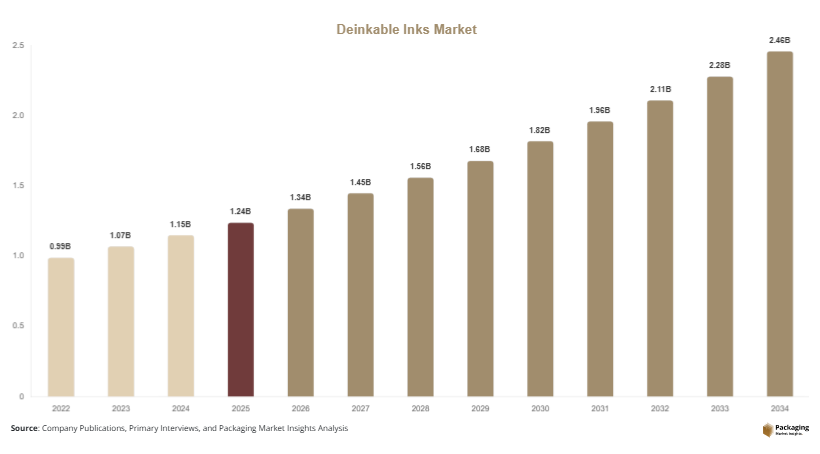
The deinkable inks market size is projected at USD 1.34 billion in 2026 and is expected to hit USD 2.46 billion by 2034 with a CAGR of 7.9%. The report provides comprehensive analysis of production volumes, recycling technology advancements, raw material trends, pricing structures, and competitive positioning across global markets. It also evaluates market segmentation, regional manufacturing capabilities, sustainability initiatives, and strategic developments shaping the competitive landscape.
Deinkable inks are specially formulated printing inks designed to separate efficiently from paper fibers during the recycling process, improving recovered fiber quality and supporting circular economy objectives. Global production exceeded 395 thousand metric tons in 2025, while industrial manufacturing utilization averaged 81%. Paper and paperboard packaging accounted for approximately 54% of total consumption, labels and tags represented 27%, and commercial printing contributed nearly 19%. Rising sustainability regulations and paper recycling initiatives continue accelerating the deinkable inks market.
Explore more data points, trends and opportunities Download Free Sample Report
Deinkable Inks Market Trends
Growing Adoption of Sustainable Printing Technologies
Packaging manufacturers and commercial printers are increasingly adopting deinkable inks to improve recyclability and comply with environmental regulations. More than 64% of newly introduced paper packaging products now utilize recyclable printing technologies, while annual deinkable ink production surpassed 412 thousand metric tons globally. Water-based ink adoption increased by 31% between 2023 and 2025, reinforcing sustainability initiatives throughout the Deinkable Inks market.
Advancements in pigment dispersion, bio-based binders, low-VOC formulations, and digital printing compatibility continue improving ink performance. Approximately 46% of recycled paper mills now process packaging printed with certified deinkable inks, increasing fiber recovery efficiency by nearly 17%. Continuous investments in environmentally responsible printing technologies continue strengthening the deinkable inks market.
Deinkable Inks Market Drivers
Increasing Global Paper Recycling Activities
Growing paper recycling rates and sustainability regulations continue driving demand for deinkable printing inks worldwide. Global recovered paper production exceeded 255 million metric tons during 2025, while recycled fiber utilization increased by approximately 14%. More than 72% of paper packaging manufacturers have adopted recyclable printing technologies to improve circular economy performance, supporting expansion of the deinkable inks market.
Deinkable Inks Market Restraints
Higher Formulation and Certification Costs
Developing certified deinkable formulations requires advanced raw materials, laboratory testing, and compliance with recycling standards. Specialty resin and pigment costs account for approximately 59% of manufacturing expenses, while certification and product validation increase development costs by nearly 13%. Smaller printing companies continue facing financial challenges when transitioning to sustainable ink technologies.
Deinkable Inks Market Opportunities
Expansion of Sustainable Paper Packaging
Increasing replacement of plastic packaging with recyclable paper solutions creates significant opportunities for deinkable ink manufacturers. Global paper packaging production exceeded 285 million metric tons, while recyclable packaging adoption increased by 18% during 2025. Investments in fiber-based packaging and eco-friendly printing systems continue generating long-term opportunities across food, retail, and e-commerce industries.
Challenges in Deinkable Inks Market
Balancing Print Performance with Recyclability
Maintaining excellent print quality while ensuring efficient ink removal during recycling remains a major technical challenge. Nearly 28% of new product formulations require multiple optimization cycles before commercial approval, while recycled fiber quality targets continue becoming more stringent. Manufacturers continue investing in advanced polymers, pigment chemistry, and binder technologies to improve overall recycling performance.
Report Scope
| Report Metric | Details |
|---|---|
| Market Size in 2025 | USD 1.24 Billion |
| Market Size in 2026 | USD 1.34 Billion |
| Market Size in 2034 | USD 2.46 Billion |
| CAGR | 7.9% (2026-2034) |
| Base Year for Estimation | 2025 |
| Historical Data | 2022-2024 |
| Forecast Period | 2026-2034 |
| Report Coverage | Revenue Forecast, Competitive Landscape, Supply Chain Disruption, Growth Factors, Environment & Regulatory Landscape and Trends |
| Geographies Covered | North America, Europe, APAC, Middle East and Africa, LATAM |
| Countries Covered | U.S., Canada, U.K., Germany, France, Spain, Italy, Russia, Nordic, Benelux, Rest of Europe, China, South Korea, Japan, India, Australia, Singapore, Taiwan, South East Asia, Rest of Asia-Pacific, UAE, Turky, Saudi Arabia, South Africa, Egypt, Nigeria, Rest of MEA, Brazil, Mexico, Argentina, Chile, Colombia, Rest of LATAM |
Explore more data points, trends and opportunities Download Free Sample Report
Deinkable Inks Market Segmentation
The market is segmented by type and application. Water-based deinkable inks account for approximately 49% of global consumption, while paper and paperboard packaging contributes nearly 54% of total demand owing to increasing sustainable packaging production and recycling initiatives.
By Type
Water-based formulations account for approximately 49% of global demand, with annual production exceeding 194 thousand metric tons. Low VOC emissions, excellent fiber separation, food-contact compatibility, and strong recycling performance support widespread adoption across paper packaging and label printing applications.
UV deinkable inks represent nearly 30% of market demand, with production exceeding 119 thousand metric tons annually. Rapid curing, high abrasion resistance, improved print durability, and compatibility with premium packaging make them suitable for advanced commercial printing applications.
Solvent-based products contribute approximately 21% of market demand, with annual production exceeding 82 thousand metric tons. Superior adhesion, fast drying, enhanced color density, and broad substrate compatibility continue supporting specialized industrial printing applications.
By Application
Paper and paperboard packaging account for approximately 54% of total demand, consuming more than 213 thousand metric tons annually. Corrugated boxes, folding cartons, paper bags, and food packaging increasingly utilize deinkable inks to improve fiber recovery and recyclability.
Labels and tags contribute nearly 27% of global consumption. Annual production exceeded 107 thousand metric tons, while sustainable label adoption surpassed 43% among retail, logistics, and consumer goods manufacturers seeking recyclable packaging solutions.
Commercial printing represents approximately 19% of market demand with annual consumption exceeding 75 thousand metric tons. Books, catalogs, magazines, promotional materials, and office printing continue transitioning toward environmentally responsible ink technologies with recycling-compatible formulations.
Deinkable Inks Market Segmentations
Type
- Water-based Deinkable Inks
- UV Deinkable Inks
- Solvent-based Deinkable Inks
Application
- Paper & Paperboard Packaging
- Labels & Tags
- Commercial Printing
Deinkable Inks Market Regional Outlook
North America
North America accounts for approximately 29% of global revenue, supported by advanced recycling infrastructure and sustainable packaging regulations. The United States contributes nearly 84% of regional demand, while annual deinkable ink consumption exceeds 114 thousand metric tons across paper packaging and commercial printing applications.
Europe
Europe represents approximately 32% of the global market, led by Germany, France, Italy, and the United Kingdom. Regional production exceeded 126 thousand metric tons, while certified recyclable printing technologies account for more than 61% of newly introduced paper packaging products.
Asia-Pacific
Asia-Pacific holds approximately 33% of global demand and remains the fastest-growing regional market. China, Japan, India, and South Korea contribute more than 80% of regional production. Annual manufacturing exceeded 131 thousand metric tons, supported by rapid growth in the paper packaging, publishing, and recycling industries.
Latin America
Latin America contributes approximately 4% of global revenue, with Brazil and Mexico serving as key paper packaging manufacturing centers. Regional consumption surpassed 16 thousand metric tons, supported by expanding recycled paper production.
Middle East & Africa
The Middle East & Africa account for nearly 2% of the market. Growing investments in sustainable packaging, recycling infrastructure, and commercial printing supported annual consumption exceeding 8 thousand metric tons during 2025.
Top Players In Deinkable Inks Market
- Siegwerk Druckfarben AG & Co. KGaA
- Flint Group
- Sun Chemical Corporation
- Toyo Ink SC Holdings Co., Ltd.
- Huber Group
- Sakata INX Corporation
- ALTANA AG (ACTEGA)
- Wikoff Color Corporation
- Fujifilm Holdings Corporation
- Encres DUBUIT
- Zeller+Gmelin GmbH & Co. KG
- Epple Druckfarben AG,
- Royal Dutch Printing Ink Factories Van Son
- Color Resolutions International
- Nazdar Company
Siegwerk Druckfarben AG & Co. KGaA's estimated global market share exceeds 16%, supported by an extensive portfolio of sustainable packaging inks and recycling-compatible printing technologies. Siegwerk focuses on environmentally friendly ink formulations, low-migration technologies, recyclable packaging solutions, and advanced research into circular economy innovations. Strong investments in bio-based raw materials, regulatory compliance, and global manufacturing capabilities enable the company to strengthen its leadership position across paper packaging, labels, and commercial printing industries while supporting sustainable printing practices. Flint Group holds an estimated 14% global market share with strong expertise in packaging and publication printing inks. The company continues expanding its deinkable ink portfolio through investments in water-based formulations, UV-curable technologies, recyclable packaging innovations, and advanced pigment chemistry. Comprehensive technical support, extensive manufacturing operations, and continuous product development enable Flint Group to maintain a competitive position while meeting increasing global demand for environmentally responsible printing solutions.