Bagasse Tableware Products Market Size
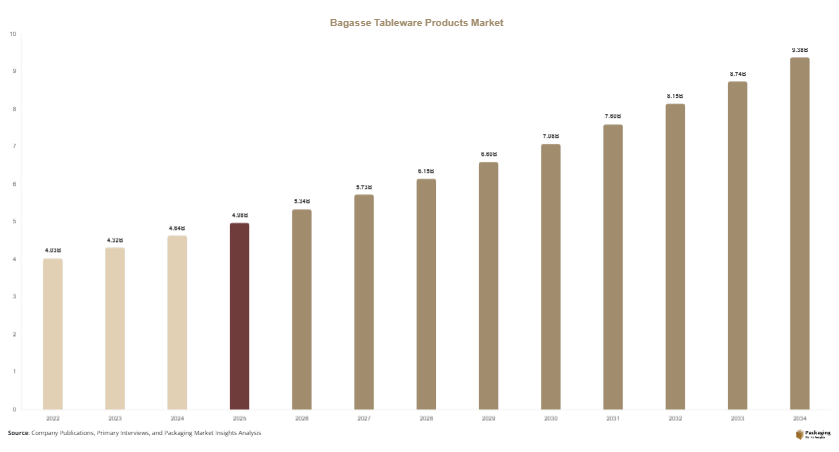
Bagasse Tableware The products' market size is projected at USD 5.34 billion in 2026 and is expected to hit USD 9.42 billion by 2034 with a CAGR of 7.3%. Rising restrictions on single-use plastics, increasing consumer preference for biodegradable food packaging, and expanding food delivery services continue to accelerate market expansion. The report provides detailed market segmentation, production analysis, competitive benchmarking, regional assessment, and supply chain evaluation across major economies.
Bagasse tableware products are biodegradable disposable foodservice products manufactured from sugarcane bagasse, an agricultural by-product remaining after juice extraction. Global production exceeded 62 billion units in 2025, with foodservice applications accounting for nearly 56% of total consumption. Plates represented approximately 41% of total production, while biodegradable packaging adoption surpassed 39% across quick-service restaurants and catering businesses. Growing environmental awareness continues strengthening the bagasse tableware products market.
Explore more data points, trends and opportunities Download Free Sample Report
Bagasse Tableware Products Market Trends
Rising Adoption of Compostable Foodservice Packaging
Foodservice operators are rapidly replacing plastic tableware with compostable bagasse alternatives to comply with sustainability regulations. Global production is projected to exceed 102 billion units by 2034, while compostable packaging adoption has surpassed 44% among organized foodservice chains. Investments exceeding USD 2.7 billion in molded fiber manufacturing technologies continue supporting the bagasse tableware products market.
Advanced thermoforming and molded fiber production technologies have improved product strength by approximately 20%, while manufacturing efficiency has increased by nearly 17%. Demand from restaurants, catering services, food delivery platforms, and institutional cafeterias continues expanding, with annual consumption increasing by over 8%, reinforcing the bagasse tableware products market.
Bagasse Tableware Products Market Drivers
Increasing Regulations Against Single-Use Plastic Products
Government restrictions on plastic foodservice products and rising sustainability commitments are major growth drivers. More than 70 countries have implemented partial or complete restrictions on selected plastic products, while biodegradable tableware adoption has increased by approximately 31% over the past five years. Annual production exceeded 62 billion units, contributing significantly to Bagasse Tableware Products' market growth.
Bagasse Tableware Products Market Restraints
Higher Production Costs Compared with Conventional Plastic
Bagasse tableware manufacturing requires specialized molding equipment and consistent agricultural fiber supply. Production costs remain approximately 18%–28% higher than traditional plastic products, while seasonal availability of raw materials can influence supply stability by nearly 12%. These factors continue limiting broader market penetration.
Bagasse Tableware Products Market Opportunities
Expansion of Sustainable Food Delivery Packaging
The rapid growth of food delivery platforms and environmentally responsible packaging presents significant opportunities. Online food delivery volumes have increased by more than 26% during the last five years, while sustainable packaging investments exceeded USD 3.1 billion globally. Increasing adoption among restaurants and catering providers creates long-term expansion opportunities.
Challenges in Bagasse Tableware Products Market
Maintaining Product Strength Under High Moisture Conditions
Manufacturers must improve water and grease resistance without compromising compostability. Moisture exposure may reduce structural strength by approximately 15%, while high-temperature food applications require enhanced coating technologies. Continuous innovation in biodegradable barrier coatings remains essential for long-term commercialization.
Report Scope
| Report Metric | Details |
|---|---|
| Market Size in 2025 | USD 4.98 Billion |
| Market Size in 2026 | USD 5.34 Billion |
| Market Size in 2034 | USD 9.42 Billion |
| CAGR | 7.3% (2026-2034) |
| Base Year for Estimation | 2025 |
| Historical Data | 2022-2024 |
| Forecast Period | 2026-2034 |
| Report Coverage | Revenue Forecast, Competitive Landscape, Supply Chain Disruption, Growth Factors, Environment & Regulatory Landscape and Trends |
| Geographies Covered | North America, Europe, APAC, Middle East and Africa, LATAM |
| Countries Covered | U.S., Canada, U.K., Germany, France, Spain, Italy, Russia, Nordic, Benelux, Rest of Europe, China, South Korea, Japan, India, Australia, Singapore, Taiwan, South East Asia, Rest of Asia-Pacific, UAE, Turkey, Saudi Arabia, South Africa, Egypt, Nigeria, Rest of MEA, Brazil, Mexico, Argentina, Chile, Colombia, Rest of LATAM |
Explore more data points, trends and opportunities Download Free Sample Report
Bagasse Tableware Products Market Segmentation
Product-based offerings account for nearly 63% of total industry revenue, while foodservice establishments contribute approximately 56% of global consumption. Growing demand for biodegradable disposable tableware continues encouraging product innovation and production expansion.
By Product Type
Plates dominate with approximately 41% of global production, exceeding 25 billion units annually. Molded fiber plates provide high rigidity, heat resistance above 120°C, and compostability, making them widely used in restaurants, catering services, and takeaway operations.
Bowls account for nearly 33% of total production, exceeding 20 billion units annually. Leak-resistant molded structures, lightweight construction, and compatibility with hot and cold foods support widespread adoption across foodservice applications.
Cups contribute approximately 26% of market demand, with annual production exceeding 16 billion units. Enhanced structural stability, beverage insulation, and biodegradable composition make bagasse cups suitable for institutional and commercial beverage services.
By End User
Foodservice represents approximately 56% of global demand, consuming more than 35 billion units annually. Restaurants, cafés, quick-service chains, and catering providers increasingly adopt compostable tableware to meet sustainability goals and regulatory requirements.
Household applications account for nearly 24% of market consumption, exceeding 15 billion units annually. Consumers increasingly prefer biodegradable disposable tableware for family gatherings, celebrations, and outdoor events.
Institutional users contribute approximately 20% of total demand, consuming over 12 billion units annually. Educational institutions, hospitals, corporate cafeterias, and public facilities continue expanding the use of sustainable disposable foodservice products.
Bagasse Tableware Products Market Segmentations
Product Type
- Plates
- Bowls
- Cups
End User
- Foodservice
- Household
- Institutional
Bagasse Tableware Products Market Regional Outlook
North America
North America accounts for approximately 29% of global revenue, producing more than 18 billion units annually. The United States contributes nearly 80% of regional demand, supported by strict sustainability initiatives and expanding food delivery services.
Europe
Europe represents approximately 27% of the global market, with production exceeding 17 billion units annually. Germany, France, Italy, and the United Kingdom collectively contribute more than 72% of regional consumption owing to stringent regulations on single-use plastics.
Asia-Pacific
The Asia-Pacific leads the market with approximately a 36% share and annual production exceeding 22 billion units. China and India together contribute nearly 61% of regional output due to abundant sugarcane production, growing foodservice industries, and expanding biodegradable packaging manufacturing.
Latin America
Latin America contributes nearly 5% of global demand, producing more than 3 billion units annually. Brazil and Mexico account for over 69% of regional consumption supported by strong sugarcane processing industries.
Middle East & Africa
The Middle East & Africa represents approximately 3% of the global market, producing more than 2 billion units annually. Saudi Arabia, the UAE, and South Africa continue investing in sustainable food packaging and hospitality infrastructure.
Top players in the Bagasse Tableware Products Market
- Dart Container Corporation
- Eco-Products, Inc. Pactiv Evergreen Inc.
- Genpak LLC
- Vegware Ltd.
- Huhtamaki Oyj
- BIOPAC UK Ltd.
- Duni AB
- Natural Tableware
- GreenGood USA
- World Centric
- Biotrem Sp. z o.o.
Dart Container Corporation holds an estimated 13% share of the global market. Maintains a strong presence in disposable foodservice packaging with continuous investments in sustainable molded fiber product development. Expands manufacturing capacity, product innovation, and distribution networks while offering biodegradable tableware solutions for commercial foodservice, hospitality, and institutional customers across North America and international markets. Huhtamaki Oyj accounts for approximately 10% of global market participation. Specializes in sustainable fiber-based food packaging and compostable molded fiber products serving restaurants, retail foodservice, and beverage companies. Continues investing in renewable materials, advanced molded fiber technologies, and circular economy initiatives while expanding manufacturing operations across Europe, Asia-Pacific, and North America.