Sustainable Secondary Packaging Market Size and Growth
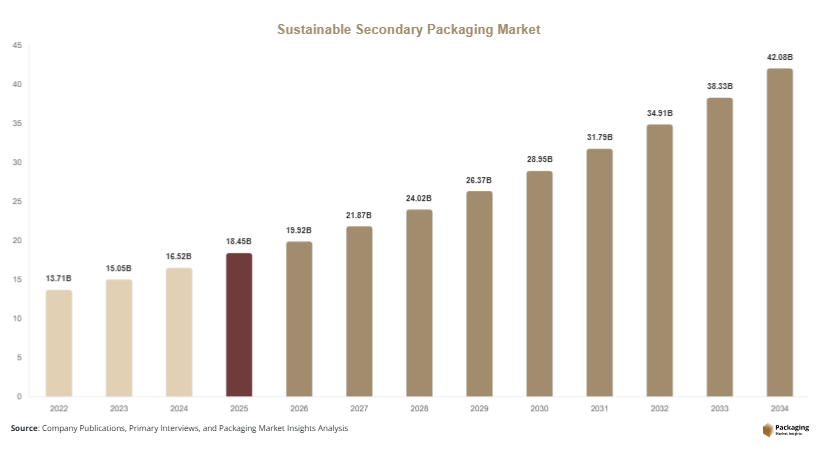
The global sustainable secondary packaging market size is estimated at approximately USD 18.45 billion in 2025, while in 2026 it is projected to reach around USD 19.92 billion, supported by rising demand from food & beverage, e-commerce, pharmaceutical, and consumer goods sectors. By 2034, the market is expected to reach nearly USD 41.68 billion, expanding at a CAGR of 9.8% (2025–2034).The sustainable secondary packaging market is gaining strong momentum as global industries transition toward eco-friendly and resource-efficient packaging systems. Secondary packaging plays a crucial role in product protection, transportation efficiency, and branding, and sustainability pressures are reshaping material choices and design structures.
The growth of the sustainable secondary packaging market is driven by three major factors. First, increasing environmental regulations across North America and Europe are pushing companies to reduce plastic waste and adopt recyclable packaging materials. Second, the rapid expansion of e-commerce and retail logistics is creating strong demand for lightweight, durable, and sustainable corrugated and fiber-based packaging solutions. Third, rising corporate sustainability commitments and ESG goals are encouraging brands to shift toward circular packaging systems.
Key Highlights:
- North America dominated the market with a 34.1% share in 2025.
- Europe accounted for a 29.5% share in 2025.
- Asia Pacific is projected to grow at the fastest CAGR of 10.5%.
- Recycled corrugated board led the material segment with a 46.8% share in 2024.
- Food & beverage dominated the application segment with a 51.2% share in 2024.
- Retail & FMCG led the end-use segment with a 44.9% share in 2024.
- The US remained the dominant country with a market size of USD 6.12 billion in 2025 and USD 6.71 billion in 2026.
Explore more data points, trends and opportunities Download Free Sample Report
Market Trends
Shift Toward Fiber-Based Secondary Packaging
The sustainable secondary packaging market is witnessing a strong shift toward fiber-based materials such as recycled corrugated boards, molded pulp, and paper-based protective packaging. Companies are replacing plastic-based secondary packaging with renewable and recyclable alternatives to meet sustainability regulations and consumer expectations. This trend is particularly strong in Europe and North America, where regulatory frameworks such as plastic tax policies and extended producer responsibility (EPR) are driving material substitution. Retailers and FMCG companies are adopting fiber-based trays, cartons, and wrap-around packaging to reduce environmental impact while maintaining product safety during transportation. Advances in material engineering are improving moisture resistance and structural durability of fiber-based packaging.
Integration of Smart and Minimalist Packaging Design
Another key trend in the sustainable secondary packaging market is the adoption of minimalist packaging designs combined with smart tracking technologies. Companies are reducing excess material usage while integrating QR codes, RFID tags, and digital tracking features into secondary packaging. This enables better supply chain visibility and reduces packaging waste. The trend is particularly prominent in e-commerce and pharmaceutical logistics, where efficiency and traceability are critical. Sustainable secondary packaging is increasingly being designed for easy recyclability, with single-material structures replacing complex multilayer systems.
Market Drivers
Expansion of E-Commerce and Logistics Sector
The rapid growth of e-commerce platforms and global logistics networks is a major driver of the sustainable secondary packaging market. Online retail requires strong, lightweight, and cost-efficient packaging solutions that can protect products during long-distance transportation. Sustainable corrugated boxes, paper-based wraps, and recyclable protective packaging are widely adopted to reduce environmental impact while ensuring durability. Increasing parcel volumes, cross-border trade, and last-mile delivery services are further accelerating demand for secondary packaging solutions that combine sustainability with performance efficiency.
Rising Regulatory Pressure on Plastic Usage
Government regulations aimed at reducing plastic waste are significantly driving market growth. Policies such as bans on single-use plastics, extended producer responsibility frameworks, and recycling mandates are encouraging industries to adopt sustainable secondary packaging solutions. Companies in food, beverage, and consumer goods sectors are increasingly switching to recyclable and biodegradable materials to comply with environmental standards. This regulatory pressure is particularly strong in Europe and parts of North America, where sustainability compliance is directly linked to market access.
Market Restraint
High Cost of Sustainable Packaging Materials and Infrastructure Limitations
A key restraint in the sustainable secondary packaging market is the relatively high cost of sustainable packaging materials compared to conventional plastic-based alternatives. Fiber-based materials, biodegradable coatings, and advanced recyclable structures often require higher production costs and specialized manufacturing processes. Small and medium-sized enterprises may find it difficult to adopt sustainable packaging due to budget constraints.
Additionally, limited recycling infrastructure in developing regions restricts efficient collection and processing of sustainable packaging waste. In many countries, the absence of standardized recycling systems reduces the effectiveness of circular packaging initiatives. This creates challenges for companies aiming to implement fully sustainable supply chain solutions. The cost-performance gap between traditional and sustainable materials continues to slow down adoption in price-sensitive markets.
Market Opportunities
Growth in Circular Packaging Systems
The increasing focus on circular economy models presents a significant opportunity for the sustainable secondary packaging market. Companies are investing in reusable, recyclable, and returnable packaging systems that minimize waste generation. Secondary packaging solutions designed for multiple lifecycle use are gaining traction, especially in retail and logistics sectors. Innovations in reusable crates, collapsible boxes, and refillable transport packaging systems are expected to open new growth avenues for manufacturers.
Expansion in Emerging Markets
Emerging economies in Asia Pacific, Latin America, and Africa present strong growth opportunities due to rapid industrialization and rising retail consumption. Increasing awareness about environmental sustainability is encouraging governments and businesses to adopt eco-friendly packaging solutions. Expansion of e-commerce platforms and FMCG industries in these regions is further driving demand for sustainable secondary packaging. Companies investing in low-cost, scalable sustainable packaging solutions are likely to benefit from strong market penetration.
Report Scope
| Report Metric | Details |
|---|---|
| Market Size in 2025 | USD 18.45 Billion |
| Market Size in 2026 | USD 19.92 Billion |
| Market Size in 2034 | USD 41.68 Billion |
| CAGR | 9.8% (2026-2034) |
| Base Year for Estimation | 2025 |
| Historical Data | 2022-2024 |
| Forecast Period | 2026-2034 |
| Report Coverage | Revenue Forecast, Competitive Landscape, Supply Chain Disruption, Growth Factors, Environment & Regulatory Landscape and Trends |
| Geographies Covered | North America, Europe, APAC, Middle East and Africa, LATAM |
| Countries Covered | U.S., Canada, U.K., Germany, France, Spain, Italy, Russia, Nordic, Benelux, Rest of Europe, China, South Korea, Japan, India, Australia, Singapore, Taiwan, South East Asia, Rest of Asia-Pacific, UAE, Turky, Saudi Arabia, South Africa, Egypt, Nigeria, Rest of MEA, Brazil, Mexico, Argentina, Chile, Colombia, Rest of LATAM |
Explore more data points, trends and opportunities Download Free Sample Report
Segmental Analysis
By Material Type
The material type segment of the sustainable secondary packaging market is dominated by recycled corrugated board, accounting for approximately 46.8% share in 2024. Recycled corrugated materials are widely used due to their strength, lightweight nature, cost efficiency, and high recyclability. They are extensively adopted across food & beverage, e-commerce, and consumer goods industries for secondary packaging applications such as shipping boxes, cartons, and protective packaging layers. Their ability to provide structural integrity while minimizing environmental impact makes them the most preferred sustainable packaging material globally.
The fastest-growing subsegment is molded fiber packaging, projected to grow at a CAGR of 10.7% through 2034, driven by increasing demand for fully biodegradable and compostable packaging solutions. Molded fiber is gaining popularity in premium packaging applications due to its cushioning properties and environmental benefits. Industries such as electronics, cosmetics, and food delivery are increasingly adopting molded fiber trays and inserts. Technological advancements in fiber molding processes are improving durability, moisture resistance, and cost efficiency, further accelerating adoption.
By Application
The application segment is led by food & beverage packaging, accounting for approximately 51.2% share in 2024. Sustainable secondary packaging plays a critical role in protecting food products during transportation and storage while maintaining freshness and hygiene standards. Recyclable cartons, paper-based wraps, and corrugated boxes are widely used in this sector. The growth of packaged food consumption, organized retail, and global food supply chains is significantly contributing to demand in this segment.
The fastest-growing subsegment is e-commerce packaging, projected to grow at a CAGR of 10.6% through 2034, driven by rapid expansion of online retail platforms. Increasing parcel volumes, cross-border shipping, and demand for lightweight yet durable packaging solutions are fueling adoption. Sustainable secondary packaging helps reduce shipping costs, improve logistics efficiency, and meet environmental compliance requirements. Major e-commerce players are increasingly integrating recyclable packaging materials into their supply chains to reduce environmental impact.
By End Use
The end-use segment is dominated by retail & FMCG, accounting for approximately 44.9% share in 2024. This dominance is driven by high consumption of packaged goods, fast-moving consumer products, and retail distribution networks. Secondary packaging is essential for product protection, branding, and logistics efficiency in this sector. Sustainable packaging solutions are increasingly being adopted by FMCG companies to meet corporate sustainability targets and consumer expectations.
The fastest-growing subsegment is pharmaceutical logistics, projected to grow at a CAGR of 10.2% through 2034, driven by rising demand for safe, traceable, and compliant packaging solutions. Sustainable secondary packaging is increasingly used for transporting medicines, vaccines, and medical devices. Regulatory requirements for eco-friendly packaging and increasing global healthcare distribution are further supporting growth in this segment. The shift toward green healthcare logistics is expected to strengthen adoption significantly over the forecast period.
Sustainable Secondary Packaging Market Segmentations
By Material Type
- Recycled Corrugated Board
- Molded Fiber
- Paper-Based Packaging
- Biodegradable Materials
By Application
- Food & Beverage
- E-Commerce
- Pharmaceuticals
- Consumer Goods
By End Use
- Retail & FMCG
- Logistics & Transportation
- Industrial Packaging
- Healthcare
Regional Analysis
North America
North America dominates the sustainable secondary packaging market, accounting for approximately 34.1% share in 2025, and is projected to grow at a CAGR of 9.6% during 2025–2034. The region’s strong position is driven by advanced packaging infrastructure, high environmental awareness, and strict regulatory frameworks focused on reducing packaging waste. The United States leads the regional market due to its large-scale retail sector, developed e-commerce ecosystem, and strong FMCG consumption base. Canada also contributes steadily, supported by sustainability-focused packaging policies and increasing adoption of recyclable materials in logistics operations.
A key growth factor in North America is the rapid shift toward circular economy-based packaging systems. Companies are increasingly replacing single-use plastic secondary packaging with recyclable corrugated boxes, molded fiber trays, and reusable transport packaging solutions. Large retailers and logistics companies are also adopting sustainable packaging standards across supply chains to reduce carbon emissions and meet ESG targets. Additionally, rising e-commerce shipments are increasing demand for durable yet eco-friendly secondary packaging that ensures product protection during long-distance transportation.
Europe
Europe holds approximately 29.5% share in 2025, with a projected CAGR of 9.9% through 2034 in the sustainable secondary packaging market. The region is highly regulated in terms of environmental protection, which strongly influences packaging material selection. Germany leads the European market due to its advanced packaging manufacturing sector and strong recycling infrastructure. Other major contributors include France, the United Kingdom, Italy, and Spain, where sustainability regulations are increasingly shaping industrial packaging practices.
A major growth factor in Europe is the implementation of strict circular economy policies and extended producer responsibility (EPR) regulations. These policies require manufacturers to reduce packaging waste and ensure recyclability of packaging materials. As a result, companies are shifting toward fiber-based and compostable secondary packaging solutions. Additionally, rising demand for premium and organic food products is driving adoption of eco-friendly packaging formats. The pharmaceutical sector is also contributing significantly due to strict compliance requirements for sustainable and traceable packaging systems.
Asia Pacific
Asia Pacific accounts for approximately 27.3% share in 2025, and is expected to grow at the fastest CAGR of 10.5% through 2034 in the sustainable secondary packaging market. The region’s rapid industrialization, expanding manufacturing base, and increasing consumer demand for packaged goods are key growth drivers. China dominates the market due to its massive FMCG production and strong export-oriented manufacturing ecosystem. India is emerging as a high-growth market due to rapid urbanization, rising disposable income, and expansion of retail and e-commerce sectors. Japan and South Korea also contribute due to advanced packaging technologies and strong environmental policies.
A key growth driver in Asia Pacific is the rapid expansion of e-commerce and logistics infrastructure. Increasing online shopping activity and cross-border trade are creating strong demand for durable and cost-efficient sustainable secondary packaging solutions. Governments in the region are also introducing policies to reduce plastic waste, encouraging adoption of recyclable and biodegradable packaging materials. Additionally, foreign direct investment in manufacturing and packaging industries is accelerating technological advancement and large-scale adoption of sustainable packaging systems.
Middle East & Africa
The Middle East & Africa (MEA) region holds approximately 4.6% share in 2025, with a projected CAGR of 8.7% through 2034 in the sustainable secondary packaging market. Growth in this region is supported by expanding retail infrastructure, increasing food imports, and rising investments in logistics and supply chain modernization. The United Arab Emirates, Saudi Arabia, South Africa, and Egypt are the key contributors to regional demand. The UAE leads the market due to its strong logistics hubs and growing e-commerce sector.
A key growth factor in MEA is the increasing dependency on imported packaged goods, which requires durable and protective secondary packaging solutions. Governments in the region are also focusing on economic diversification and industrial development, which is boosting demand for modern packaging systems. However, limited recycling infrastructure and high dependency on imported packaging materials still pose challenges. Despite this, rising awareness of sustainability and gradual regulatory improvements are expected to support steady market growth.
Latin America
Latin America accounts for approximately 4.5% share in 2025, and is projected to grow at a CAGR of 8.9% through 2034 in the sustainable secondary packaging market. The region is experiencing gradual expansion driven by growth in FMCG, retail, and food processing industries. Brazil is the largest market due to its strong consumer goods sector, followed by Mexico, Argentina, and Chile. These countries are witnessing increased adoption of sustainable packaging solutions in response to changing consumer preferences and global sustainability trends.
A major growth factor in Latin America is the expansion of organized retail and increasing penetration of e-commerce platforms. Rising urbanization and shifting consumer lifestyles are boosting demand for packaged and processed food products, which in turn increases demand for secondary packaging. Additionally, governments are beginning to implement sustainability-focused policies that encourage recyclable packaging usage. Investments in modern manufacturing facilities and packaging automation are also contributing to market development across the region.
Competitive Landscape
The sustainable secondary packaging market is moderately fragmented with strong competition among global packaging manufacturers. Key players include Amcor plc, Smurfit Kappa Group, International Paper Company, DS Smith Plc, and WestRock Company. These companies are focusing on recyclable fiber-based packaging, lightweight materials, and circular economy solutions.
Smurfit Kappa Group is a leading player due to its strong presence in corrugated packaging and sustainability-driven innovation. Recently, the company expanded its recycled paper production capacity to support growing demand for eco-friendly secondary packaging solutions.
Key Players List
- Amcor plc
- Smurfit Kappa Group
- International Paper Company
- DS Smith Plc
- WestRock Company
- Mondi Group
- Stora Enso
- Packaging Corporation of America
- Huhtamaki Oyj
- Sonoco Products Company
- Berry Global Inc.
- Coveris Holdings
- Pratt Industries
- UFP Industries
- Mayr-Melnhof Karton AG