Rice Paper Packaging Market Size and Growth
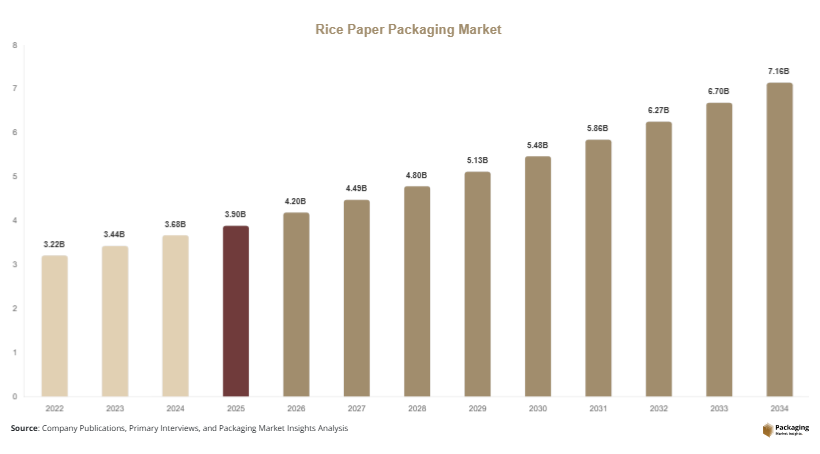
The global rice paper packaging market size was valued at USD 3.9 billion in 2025 and is projected to reach USD 4.2 billion in 2026. Over the forecast period from 2025 to 2034, the market is expected to expand at a CAGR of 6.9%, reaching approximately USD 7.6 billion by 2034. This growth reflects the increasing demand for eco-friendly packaging solutions across food, retail, and specialty product sectors. The rice paper packaging market is gaining traction as industries shift toward sustainable and biodegradable packaging alternatives.
One of the key growth factors driving the rice paper packaging market is the rising consumer awareness regarding environmental sustainability. As concerns over plastic waste increase, businesses are adopting biodegradable materials such as rice paper to reduce environmental impact. Another major factor is the growth of the food and beverage industry, particularly in segments that emphasize natural and organic products. Rice paper packaging is widely used for wrapping food items, especially in Asian cuisines, and is increasingly being adopted for modern retail packaging applications. Additionally, regulatory policies promoting the reduction of single-use plastics are encouraging manufacturers to explore alternative packaging solutions, further boosting market demand.
Key Highlights
- Asia Pacific dominated the market with a 42.1% share in 2025, while Latin America is projected to grow at the fastest CAGR of 7.4%.
- Edible rice paper led the type segment with a 33.5% share, while coated rice paper is expected to grow at a CAGR of 7.2%.
- Paper-based biodegradable packaging dominated with a 100% share, while enhanced composite rice paper is forecasted to grow at a CAGR of 6.8%.
- Food & beverage applications led the segment with 48.6% share, while personal care packaging is expected to grow at a CAGR of 6.5%.
- Vietnam remained the dominant country with a market size of USD 0.9 billion in 2025 and USD 1.0 billion in 2026.
Explore more data points, trends and opportunities Download Free Sample Report
Market Trends
Increasing focus on biodegradable and compostable packaging materials
The rice paper packaging market is being shaped by the growing emphasis on biodegradable and compostable materials. Consumers and businesses are actively seeking packaging options that reduce environmental impact, and rice paper offers a natural alternative to conventional plastics. Manufacturers are developing innovative rice paper solutions with improved strength and resistance while maintaining their eco-friendly characteristics. This trend is also supported by regulatory frameworks that encourage sustainable packaging practices. As environmental concerns continue to influence purchasing decisions, the demand for rice paper packaging is expected to rise steadily across multiple industries.
Rising demand for premium and aesthetic packaging solutions
The demand for premium and visually appealing packaging is increasing, particularly in the food, cosmetics, and gift packaging sectors. Rice paper packaging is valued for its natural texture and unique appearance, which enhances product presentation. Brands are using rice paper to create distinctive packaging designs that align with consumer preferences for authenticity and sustainability. Additionally, advancements in printing and coating technologies are enabling better customization and durability. This trend is encouraging manufacturers to invest in high-quality rice paper packaging solutions that cater to premium market segments.
Market Drivers
Growth of sustainable packaging initiatives across industries
The increasing adoption of sustainable packaging initiatives is a major factor driving the rice paper packaging market. Companies across various industries are committing to reducing their environmental footprint, which is leading to the adoption of biodegradable materials. Rice paper packaging aligns with these goals, as it is derived from natural sources and decomposes easily. Governments and regulatory bodies are also promoting sustainable practices through policies and incentives, encouraging businesses to transition away from plastic packaging. This shift is creating significant demand for rice paper packaging solutions in both developed and emerging markets.
Expansion of the food and beverage sector with natural packaging demand
The rapid growth of the food and beverage industry is contributing to the demand for rice paper packaging. Consumers are increasingly preferring natural and organic food products, which often require packaging that reflects these values. Rice paper is widely used for wrapping and packaging food items due to its safety and biodegradability. The rise of ready-to-eat meals and takeaway services is also driving the need for convenient and eco-friendly packaging solutions. As the food industry continues to expand, the demand for rice paper packaging is expected to increase significantly.
Market Restraint
Limited durability and moisture resistance compared to conventional materials
One of the key challenges in the rice paper packaging market is the limited durability and moisture resistance of rice paper compared to traditional packaging materials such as plastic and laminated films. While rice paper offers environmental benefits, it may not provide the same level of protection for certain products, particularly those requiring long shelf life or exposure to varying environmental conditions. This limitation can restrict its application in some industries, such as heavy-duty packaging or products requiring high barrier properties. For example, food items with high moisture content may require additional coatings or protective layers, increasing production costs. These challenges can slow market adoption and require continuous innovation to improve material performance.
Market Opportunities
Development of advanced coated and reinforced rice paper materials
Advancements in material technology are creating opportunities for the development of coated and reinforced rice paper packaging. Manufacturers are exploring ways to enhance the strength, durability, and moisture resistance of rice paper while maintaining its biodegradable properties. These innovations are expanding the range of applications for rice paper packaging, making it suitable for more demanding uses. As research and development efforts continue, improved rice paper materials are expected to drive market growth and increase adoption across various industries.
Growing demand for eco-friendly packaging in e-commerce and retail sectors
The expansion of e-commerce and retail sectors is creating new opportunities for rice paper packaging. Online shopping requires packaging solutions that are both protective and sustainable. Consumers are increasingly expecting environmentally responsible packaging from brands, which is driving the adoption of rice paper solutions. Retailers are also using eco-friendly packaging as a branding tool to attract environmentally conscious customers. This trend is expected to support the growth of the rice paper packaging market as businesses seek to align with consumer preferences and sustainability goals.
Report Scope
| Report Metric | Details |
|---|---|
| Market Size in 2025 | USD 3.9 Billion |
| Market Size in 2026 | USD 4.2 Billion |
| Market Size in 2034 | USD 7.6 Billion |
| CAGR | 6.9% (2026-2034) |
| Base Year for Estimation | 2025 |
| Historical Data | 2022-2024 |
| Forecast Period | 2026-2034 |
| Report Coverage | Revenue Forecast, Competitive Landscape, Supply Chain Disruption, Growth Factors, Environment & Regulatory Landscape and Trends |
| Geographies Covered | North America, Europe, APAC, Middle East and Africa, LATAM |
| Countries Covered | U.S., Canada, U.K., Germany, France, Spain, Italy, Russia, Nordic, Benelux, Rest of Europe, China, South Korea, Japan, India, Australia, Singapore, Taiwan, South East Asia, Rest of Asia-Pacific, UAE, Turky, Saudi Arabia, South Africa, Egypt, Nigeria, Rest of MEA, Brazil, Mexico, Argentina, Chile, Colombia, Rest of LATAM |
Explore more data points, trends and opportunities Download Free Sample Report
Segmental Analysis
By Type
Edible rice paper dominated the market in 2024, accounting for approximately 33.5% of the total share. This segment is widely used in food packaging applications due to its natural composition and biodegradability. Edible rice paper is particularly popular in Asian cuisines and is increasingly being adopted in global markets. The growing demand for natural and organic food products is supporting the growth of this segment.
Coated rice paper is expected to grow at the fastest CAGR of 7.2% during the forecast period. This growth is driven by the need for improved durability and moisture resistance. Coated rice paper offers enhanced performance while maintaining its eco-friendly characteristics. This is encouraging its adoption in a wider range of applications.
By Material
Biodegradable rice paper packaging accounted for the largest share of 100% in 2024, as it is inherently eco-friendly. The demand for sustainable packaging solutions is driving the growth of this segment. Manufacturers are focusing on improving the performance of biodegradable materials to meet industry requirements.
Composite rice paper is expected to grow at a CAGR of 6.8% during the forecast period. This segment includes rice paper combined with other materials to enhance its properties. The growing demand for durable and versatile packaging solutions is supporting the growth of this segment.
By Application
Food & beverage applications held the largest share of 48.6% in 2024, driven by the widespread use of rice paper in food packaging. The demand for natural and biodegradable packaging solutions is supporting the growth of this segment. The expansion of the food industry is also contributing to increased demand.
Personal care packaging is expected to grow at the fastest CAGR of 6.5% during the forecast period. This growth is driven by the increasing demand for eco-friendly packaging in the cosmetics industry. Brands are adopting rice paper packaging to align with sustainability goals.
Rice Paper Packaging Market Segmentations
By Product Type
- Edible Rice Paper
- Coated Rice Paper
- Decorative Rice Paper
- Industrial Rice Paper
By Material
- Biodegradable Rice Paper
- Composite Rice Paper
By Application
- Food & Beverage Packaging
- Personal Care Packaging
- Retail Packaging
Regional Analysis
North America
North America accounted for 21.4% of the rice paper packaging market share in 2025 and is projected to grow at a CAGR of 6.3% during the forecast period. The region is witnessing increasing adoption of sustainable packaging solutions, driven by consumer awareness and regulatory initiatives. The presence of established food and retail industries is supporting demand for innovative packaging materials. Companies are investing in research and development to improve the functionality of rice paper packaging.
The United States is the dominant country in North America, supported by strong demand for eco-friendly packaging. A key growth factor is the increasing adoption of sustainable packaging in the food service and retail sectors. Consumers are prioritizing environmentally responsible products, encouraging businesses to adopt rice paper packaging solutions.
Europe
Europe held a market share of 19.8% in 2025 and is expected to grow at a CAGR of 6.1% through 2034. The region is characterized by strict environmental regulations and a strong focus on sustainability. Packaging manufacturers are adopting biodegradable materials to comply with regulatory standards. The demand for eco-friendly packaging is also supported by consumer awareness.
Germany leads the European market due to its advanced manufacturing capabilities. A unique growth factor is the increasing adoption of circular economy practices, which emphasize recycling and sustainability. This trend is driving the demand for rice paper packaging solutions.
Asia Pacific
Asia Pacific dominated the rice paper packaging market with a 42.1% share in 2025 and is projected to grow at a CAGR of 7.0%. The region benefits from a strong cultural association with rice paper, particularly in food applications. Rapid urbanization and increasing disposable incomes are driving demand for packaged food products.
Vietnam is the leading country in the region, supported by its strong production capabilities. A key growth factor is the increasing export of rice paper products, which is driving demand for packaging solutions. This trend is supporting market growth in the region.
Middle East & Africa
The Middle East & Africa accounted for 7.2% of the market share in 2025 and is expected to grow at a CAGR of 6.5%. The region is gradually adopting sustainable packaging solutions, supported by increasing awareness and regulatory initiatives. The growth of the food and beverage sector is also driving demand for packaging materials.
The United Arab Emirates is a key market in the region, driven by its focus on innovation and sustainability. A unique growth factor is the increasing demand for eco-friendly packaging in the retail sector, which is supporting market growth.
Latin America
Latin America held a market share of 9.5% in 2025 and is projected to grow at the fastest CAGR of 7.4%. The region is experiencing growth in the food and retail sectors, which is driving demand for packaging solutions. Increasing awareness of environmental issues is also supporting market growth.
Brazil is the dominant country in Latin America, supported by its large consumer base. A key growth factor is the increasing demand for sustainable packaging solutions in the food industry, which is driving the adoption of rice paper packaging.
Competitive Landscape
The rice paper packaging market is characterized by the presence of both regional and global players focusing on sustainable packaging solutions. Companies are investing in research and development to improve the performance and versatility of rice paper materials. Vietnam Packaging Company is considered a leading player due to its strong production capabilities and focus on innovation. The company has recently introduced reinforced rice paper packaging solutions to enhance durability.
Other players are focusing on expanding their product portfolios and entering new markets. Strategic partnerships and collaborations are common, as companies aim to strengthen their market position. The competitive landscape is expected to remain dynamic, with sustainability driving innovation.
Key Players List
- Vietnam Packaging Company
- Asia Rice Paper Co. Ltd.
- Green Pack Solutions
- EcoWrap Packaging Ltd.
- BioPack Industries
- NatureFlex Packaging
- Sustainable Wrap Co.
- Bamboo Packaging Group
- Organic Pack Solutions
- FreshWrap Industries
- EcoLeaf Packaging
- PurePack Solutions
- GreenLayer Packaging
- NaturalWrap Co.
- BioEco Packaging