Molded Pulp Packaging (MPP) Market Size and Growth
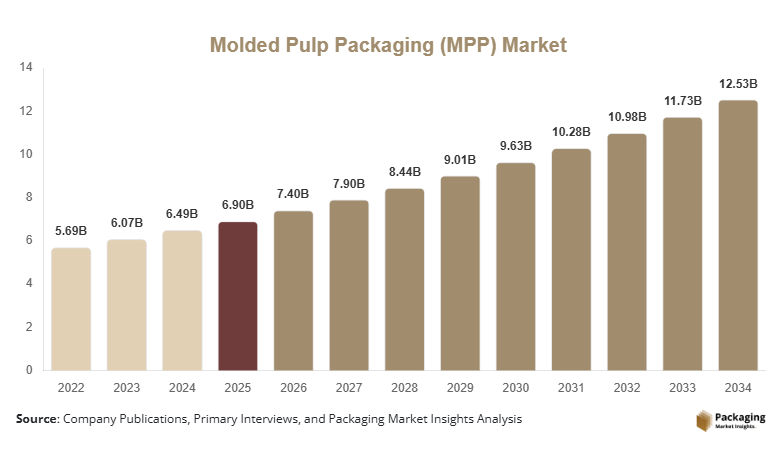
The global market size was valued at approximately USD 6.9 billion in 2025 and is expected to reach USD 7.4 billion in 2026. By 2034, the market is projected to attain USD 13.8 billion, registering a CAGR of 6.8% during 2025–2034. The growing transition away from single-use plastics and increasing environmental regulations are major factors supporting market growth worldwide. The molded pulp packaging (MPP) market is experiencing notable expansion due to rising demand for sustainable and biodegradable packaging solutions across multiple industries.
Molded pulp packaging products are manufactured using recycled paper, cardboard, and natural fibers, making them environmentally compatible alternatives to plastic-based packaging. Industries including food service, electronics, healthcare, and consumer goods are increasingly adopting molded pulp packaging because of its lightweight structure, cushioning properties, and recyclability. The food and beverage sector remains a primary consumer due to rising use of sustainable egg cartons, trays, takeaway containers, and drink carriers.
Key Highlights
- Asia Pacific dominated the market with a 39.1% share in 2025.
- Latin America is projected to grow at the fastest CAGR of 7.2%.
- Transfer molded products led the type segment with a 42.6% share.
- Recycled paper material dominated with a 57.3% share.
- Food packaging applications led the market with a 46.4% share.
- China remained the dominant country with a market size of USD 1.8 billion in 2025 and USD 1.9 billion in 2026.
Explore more data points, trends and opportunities Download Free Sample Report
Market Trends
Increasing Adoption of Thermoformed Fiber Packaging
Thermoformed fiber packaging is emerging as a significant trend in the molded pulp packaging (MPP) market due to its improved appearance, strength, and versatility compared to traditional molded pulp products. Manufacturers are increasingly using thermoformed fiber technology to produce premium-quality trays, clamshells, and food containers with smooth surfaces and enhanced structural integrity. This packaging type is gaining popularity in electronics and consumer goods industries where product presentation and protection are essential. Additionally, thermoformed fiber products are compatible with automated manufacturing systems, improving operational efficiency for large-scale production. The growing demand for high-performance sustainable packaging is expected to accelerate investment in advanced fiber molding technologies.
Expansion of Sustainable Food Service Packaging
The rapid growth of sustainable food service packaging is reshaping the market landscape. Restaurants, cafés, and food delivery companies are increasingly replacing plastic takeaway containers with molded pulp alternatives due to rising environmental concerns and government restrictions on plastic waste. Molded pulp packaging offers compostability, insulation properties, and leak resistance, making it suitable for hot and cold food applications. Global quick-service restaurant chains are also incorporating biodegradable packaging into their sustainability strategies. The rising popularity of online food delivery platforms has further increased demand for disposable eco-friendly containers. This trend is encouraging manufacturers to develop customized molded pulp solutions with improved moisture resistance and durability.
Market Drivers
Government Regulations Against Plastic Packaging
Government regulations limiting single-use plastic usage are significantly driving the molded pulp packaging (MPP) market. Many countries are implementing bans, taxes, and waste reduction policies to encourage adoption of biodegradable packaging alternatives. These regulations are compelling manufacturers and retailers to transition toward recyclable fiber-based packaging materials. Molded pulp products offer an environmentally compliant solution because they are biodegradable, recyclable, and manufactured using recycled fibers. Industries such as food service and retail are rapidly adopting molded pulp packaging to align with sustainability standards and regulatory requirements. The continued expansion of environmental policies globally is expected to strengthen long-term market demand.
Growth of E-commerce and Consumer Electronics Industries
The expansion of e-commerce and consumer electronics sectors is another major driver supporting market growth. Molded pulp packaging provides protective cushioning for fragile products during transportation while reducing environmental impact compared to plastic foam packaging. Electronics manufacturers are increasingly using molded pulp trays and inserts for smartphones, laptops, and household appliances. Additionally, rising online shopping activity has increased the need for secure and lightweight packaging materials that can withstand shipping conditions. Molded pulp packaging is gaining preference because it combines shock absorption with sustainability advantages. This trend is expected to continue as online retail activity expands globally.
Market Restraint
Limited Moisture Resistance and Structural Constraints
One of the key restraints affecting the molded pulp packaging (MPP) market is the limited moisture resistance and structural performance of traditional molded pulp materials compared to plastic-based packaging. Molded pulp products can lose strength when exposed to excessive humidity or liquids, restricting their application in certain industries that require long-term moisture protection. Although manufacturers are developing coatings and additives to improve water resistance, these modifications may increase production costs and affect recyclability. Industries handling liquid-based products often remain dependent on plastic packaging due to durability concerns. For example, some frozen food manufacturers still prefer plastic containers because they provide stronger moisture barriers during cold storage and transportation. Additionally, molded pulp packaging has limitations in achieving highly complex shapes and thin-wall structures, which can affect product customization for premium consumer goods. These performance constraints may slow adoption rates in specialized applications where packaging durability and barrier protection remain critical priorities.
Market Opportunities
Rising Demand for Agricultural Waste Fiber Packaging
The increasing utilization of agricultural waste fibers presents a strong growth opportunity for the market. Manufacturers are exploring alternative raw materials such as sugarcane bagasse, wheat straw, bamboo fiber, and rice husk to produce molded pulp packaging products. These materials reduce dependence on conventional recycled paper while supporting sustainable waste management practices. Agricultural fiber packaging also offers improved texture and strength for certain applications. Governments and environmental organizations are encouraging the use of renewable agricultural waste to minimize landfill generation and improve circular economy initiatives. This opportunity is expected to support product innovation and create new supply chain advantages for manufacturers.
Expansion in Healthcare and Pharmaceutical Packaging
Healthcare and pharmaceutical industries are creating new opportunities for molded pulp packaging manufacturers. Hospitals and pharmaceutical companies are seeking sustainable packaging solutions for medical devices, disposable trays, and protective inserts. Molded pulp packaging offers lightweight cushioning and recyclability, making it suitable for transporting delicate medical equipment. Increasing healthcare investments in emerging economies are contributing to higher demand for protective packaging materials. Additionally, pharmaceutical companies are adopting sustainable packaging practices to meet environmental goals and improve corporate responsibility initiatives. This trend is expected to increase adoption of customized molded pulp packaging solutions in the healthcare sector.
Report Scope
| Report Metric | Details |
|---|---|
| Market Size in 2025 | USD 6.9 Billion |
| Market Size in 2026 | USD 7.4 Billion |
| Market Size in 2034 | USD 13.8 Billion |
| CAGR | 6.8% (2026-2034) |
| Base Year for Estimation | 2025 |
| Historical Data | 2022-2024 |
| Forecast Period | 2026-2034 |
| Report Coverage | Revenue Forecast, Competitive Landscape, Supply Chain Disruption, Growth Factors, Environment & Regulatory Landscape and Trends |
| Geographies Covered | North America, Europe, APAC, Middle East and Africa, LATAM |
| Countries Covered | U.S., Canada, U.K., Germany, France, Spain, Italy, Russia, Nordic, Benelux, Rest of Europe, China, South Korea, Japan, India, Australia, Singapore, Taiwan, South East Asia, Rest of Asia-Pacific, UAE, Turky, Saudi Arabia, South Africa, Egypt, Nigeria, Rest of MEA, Brazil, Mexico, Argentina, Chile, Colombia, Rest of LATAM |
Explore more data points, trends and opportunities Download Free Sample Report
Segmental Analysis
By Type
Transfer molded products dominated the molded pulp packaging (MPP) market in 2024 and accounted for approximately 42.6% of the global market share. These products are widely used because they provide effective cushioning and cost-efficient manufacturing for applications such as egg trays, fruit trays, and industrial packaging inserts. Transfer molded packaging is produced using recycled paper pulp and offers adequate structural strength for mass-market packaging applications. The segment continues to benefit from rising demand in food packaging and protective industrial packaging. Manufacturers prefer transfer molded products due to their low production costs, scalability, and compatibility with automated production systems across large manufacturing facilities.
Thermoformed fiber products are projected to be the fastest-growing subsegment, registering a CAGR of 7.5% during the forecast period. These products offer smoother surfaces, enhanced aesthetics, and greater precision compared to conventional molded pulp packaging. Thermoformed fiber solutions are increasingly adopted in premium electronics packaging, food service containers, and cosmetic packaging applications. Rising consumer preference for visually appealing sustainable packaging is supporting segment growth. Additionally, manufacturers are investing in advanced molding technologies to improve moisture resistance and product durability. The growing shift toward premium biodegradable packaging solutions across retail and consumer goods industries is expected to accelerate adoption of thermoformed fiber packaging products globally.
By Material
Recycled paper material dominated the market in 2024 with a share of approximately 57.3%. Recycled paper remains the primary raw material for molded pulp packaging because of its wide availability, cost efficiency, and environmental advantages. Manufacturers extensively utilize recycled newspaper, cardboard, and office paper waste to produce trays, clamshells, and protective packaging inserts. The segment benefits from established recycling infrastructure in developed economies and increasing emphasis on circular economy practices. Additionally, recycled paper packaging aligns with sustainability objectives across food service, retail, and industrial packaging industries. Its biodegradable nature and compatibility with large-scale production systems continue to support strong market adoption globally.
Bagasse fiber materials are anticipated to witness the fastest growth, expanding at a CAGR of 7.1% during the forecast period. Bagasse, a byproduct of sugarcane processing, is increasingly used as a renewable raw material for sustainable packaging applications. Manufacturers are adopting bagasse because it provides improved rigidity and natural compostability compared to some conventional paper-based materials. The food service sector is particularly driving demand for bagasse-based plates, bowls, and takeaway containers. Growing agricultural waste utilization initiatives and rising availability of sugarcane residues in developing economies are supporting segment expansion. This trend is expected to encourage further innovation in renewable fiber-based molded pulp packaging solutions.
By Application
Food packaging represented the dominant application segment in 2024 and captured approximately 46.4% of the total market share. Molded pulp packaging is extensively used for egg cartons, beverage carriers, fruit trays, and takeaway containers because of its biodegradability and cushioning performance. The increasing adoption of eco-friendly packaging by restaurants, supermarkets, and food delivery companies continues to support segment growth. Rising government restrictions on plastic food containers are also encouraging businesses to transition toward molded pulp alternatives. Furthermore, growing consumer preference for sustainable food packaging is influencing manufacturers to expand production capacities for compostable packaging products across developed and emerging markets.
Electronics packaging is expected to grow at the fastest CAGR of 7.0% during the forecast period. Consumer electronics manufacturers are increasingly replacing plastic foam inserts with molded pulp trays and protective components to reduce environmental impact. Molded pulp packaging offers effective shock absorption while supporting sustainability goals within electronics supply chains. Rising shipments of smartphones, laptops, household appliances, and wearable devices are creating significant demand for protective fiber-based packaging. Additionally, major electronics brands are adopting recyclable packaging strategies to improve environmental performance and comply with sustainability commitments. This transition is expected to create substantial growth opportunities for molded pulp packaging manufacturers globally.
Molded Pulp Packaging (MPP) Market Segmentations
By Type
- Transfer Molded
- Thermoformed Fiber
- Thick Wall
- Processed Pulp
By Material
- Recycled Paper
- Bagasse Fiber
- Bamboo Fiber
- Wood Pulp
By Application
- Food Packaging
- Electronics Packaging
- Healthcare Packaging
- Consumer Goods Packaging
- Industrial Packaging
Regional Analysis
North America
North America accounted for approximately 27.6% of the global molded pulp packaging (MPP) market share in 2025 and is projected to expand at a CAGR of 6.1% during the forecast period. The region benefits from increasing environmental regulations and widespread adoption of sustainable packaging across retail and food service industries. Companies in the United States and Canada are actively replacing plastic trays and containers with biodegradable molded pulp alternatives. Growing investments in recycling infrastructure and sustainable manufacturing technologies are also contributing to market expansion.
The United States dominates the North American market due to its advanced packaging industry and strong e-commerce ecosystem. One unique growth factor is the rising demand for eco-friendly electronics packaging solutions among consumer electronics manufacturers. Major technology companies are increasingly incorporating molded pulp inserts and trays into product packaging to reduce plastic waste and support sustainability commitments. This transition is expected to strengthen long-term market growth in the country.
Europe
Europe held around 24.9% of the market share in 2025 and is anticipated to grow at a CAGR of 5.9% during the forecast period. Strict environmental regulations introduced by the European Union are encouraging industries to adopt recyclable and compostable packaging materials. Food service companies, supermarkets, and retailers are increasingly shifting toward fiber-based packaging solutions. Consumer awareness regarding environmental sustainability also remains high across the region, supporting consistent market demand.
Germany is the dominant country within Europe because of its advanced recycling infrastructure and strong industrial manufacturing base. A unique growth factor in Germany is the increasing use of molded pulp packaging in automotive component transportation. Automotive manufacturers are adopting fiber-based protective packaging to reduce packaging waste and improve supply chain sustainability. This application is creating additional growth opportunities beyond traditional food packaging sectors.
Asia Pacific
Asia Pacific dominated the global market with a 39.1% share in 2025 and is expected to register a CAGR of 7.4% during the forecast period. Rapid industrialization, urbanization, and rising consumer awareness regarding sustainable products are major growth contributors in the region. Expanding food delivery services and increasing exports of consumer electronics are further driving demand for molded pulp packaging products. Government initiatives supporting plastic reduction policies are also encouraging adoption across various industries.
China leads the Asia Pacific market due to its large manufacturing sector and extensive packaging production capabilities. One unique growth factor is the country’s rapid expansion of sustainable food delivery packaging. Online food delivery platforms are increasingly using molded pulp takeaway containers and drink carriers to comply with environmental regulations. This trend is generating significant demand for large-scale molded pulp production facilities across the country.
Middle East & Africa
The Middle East & Africa region accounted for approximately 4.7% of the global market share in 2025 and is projected to grow at a CAGR of 6.0% during the forecast period. The market is gradually expanding due to increasing awareness regarding sustainable packaging and rising investments in food processing industries. Governments across the region are promoting environmentally friendly alternatives to reduce plastic waste generation. Additionally, growth in retail and hospitality sectors is creating new demand for disposable biodegradable packaging products.
The United Arab Emirates dominates the regional market because of its growing hospitality and tourism industries. A unique growth factor is the increasing adoption of sustainable takeaway packaging among restaurants and hotels. Businesses are introducing molded pulp food containers and trays to align with environmental goals and improve brand image among environmentally conscious consumers. This trend is supporting gradual market development across the country.
Latin America
Latin America represented approximately 3.7% of the market share in 2025 and is forecast to grow at the fastest CAGR of 7.2% during the projection period. Rising environmental awareness and government efforts to reduce plastic pollution are encouraging businesses to adopt biodegradable packaging alternatives. Expanding agricultural exports and food processing industries are also supporting market growth. Additionally, international packaging manufacturers are increasing investments in regional production facilities to strengthen supply chains and improve market accessibility.
Brazil remains the leading country in the Latin American market due to its large food and beverage sector and abundant agricultural resources. One unique growth factor is the growing availability of sugarcane bagasse as a raw material for molded pulp production. Local manufacturers are increasingly utilizing agricultural waste fibers to produce sustainable packaging products, reducing raw material costs while supporting environmental sustainability initiatives.
Competitive Landscape
The molded pulp packaging (MPP) market is moderately fragmented, with several regional and international players competing through product innovation, sustainability initiatives, and production expansion strategies. Companies are increasingly investing in advanced thermoforming technologies and agricultural fiber processing capabilities to improve product quality and operational efficiency. Strategic partnerships with food service companies and electronics manufacturers are also shaping the competitive environment.
Huhtamaki Oyj remains one of the leading companies in the market due to its broad sustainable packaging portfolio and strong global distribution network. In 2024, the company expanded its molded fiber production capacity in Asia to address growing demand from food packaging customers. Other notable participants include UFP Technologies, Brodrene Hartmann A/S, EnviroPAK Corporation, and Henry Molded Products. These companies are focusing on recyclable material innovation, lightweight packaging designs, and customized industrial packaging solutions. Market participants are also pursuing mergers and acquisitions to strengthen regional market presence and enhance raw material sourcing capabilities.
Key Players List
- Huhtamaki Oyj
- Brodrene Hartmann A/S
- UFP Technologies
- EnviroPAK Corporation
- Henry Molded Products Inc.
- Pactiv Evergreen Inc.
- FiberCel Packaging LLC
- Sabert Corporation
- Keiding Inc.
- Genpak LLC
- CDL Omni-Pac
- Eco-Products Inc.
- PrimeWare by PrimeLink Solutions
- Protopak Engineering Corporation
- Brødrene Hartmann Group
- Cellulose de la Loire
- Pacific Pulp Molding LLC