Sterile Barrier Packaging Market Size
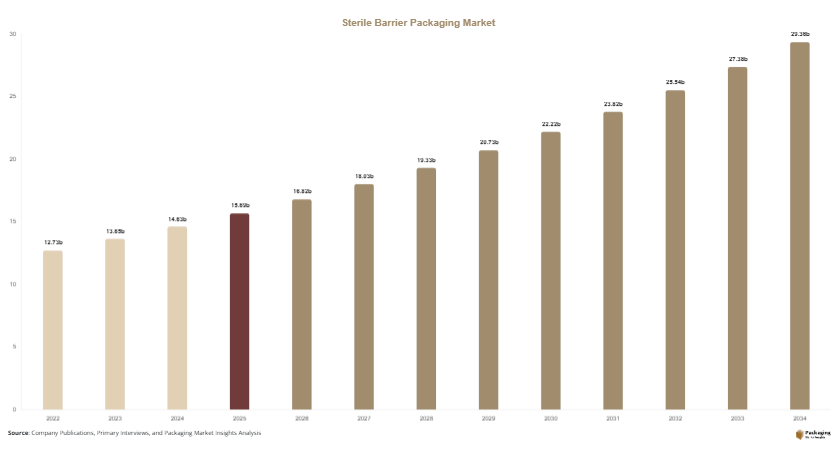
Sterile Barrier Packaging market size is projected at USD 16.82 billion in 2026 and is expected to hit USD 29.34 billion by 2034 with a CAGR of 7.21%. The report provides an in-depth assessment of production capacity, raw material trends, regulatory standards, competitive benchmarking, pricing analysis, and end-user demand. It further evaluates regional opportunities, technological innovations, and company strategies to provide a comprehensive overview of the competitive landscape.
The Sterile Barrier Packaging Market comprises specialized packaging systems designed to maintain sterility for medical devices, pharmaceutical products, surgical instruments, and diagnostic equipment until the point of use. Global production exceeded 58 billion sterile packaging units in 2025, with medical devices accounting for nearly 52% of total demand, pharmaceuticals contributing 31%, and healthcare facilities representing approximately 17%. Pouches & bags held around 47% of production, followed by wraps at 34% and trays at 19%. Increasing infection prevention requirements continue strengthening the Sterile Barrier Packaging Market.
Explore more data points, trends and opportunities Download Free Sample Report
Sterile Barrier Packaging Market Trends
Rising Adoption of High-Performance Sterile Packaging Solutions
Healthcare providers and medical device manufacturers are increasingly adopting advanced sterile barrier systems to improve patient safety and regulatory compliance. Global production exceeded 60 billion sterile packaging units annually, while adoption of validated sterile packaging systems surpassed 76% among regulated medical manufacturers. Advanced multilayer materials have improved microbial barrier performance by nearly 24% while reducing packaging weight by approximately 12%, reinforcing the Sterile Barrier Packaging Market.
Growing demand for single-use medical devices and minimally invasive surgical procedures continues accelerating packaging innovation. More than 71% of medical device manufacturers utilize high-barrier pouches and trays, while automation adoption in sterile packaging production has increased by nearly 22%. Investments exceeding USD 1.3 billion in healthcare packaging technologies continue supporting expansion across the Sterile Barrier Packaging Market.
Sterile Barrier Packaging Market Drivers
Increasing Demand for Sterile Medical Packaging
The expansion of healthcare infrastructure and rising medical device production are significantly driving market expansion. Global medical device packaging demand increased by 8.8% during 2025, while sterile surgical procedure volumes expanded by approximately 9.4%. More than 78% of healthcare facilities rely on validated sterile barrier systems to maintain infection control, supporting continuous investment across the Sterile Barrier Packaging Market.
Sterile Barrier Packaging Market Restraints
High Manufacturing and Regulatory Compliance Costs
Strict validation requirements and quality assurance standards increase production costs for manufacturers. Compliance and sterilization validation expenses account for nearly 18% of total manufacturing costs, while high-performance medical-grade materials experienced price increases of approximately 11%. Certification timelines extending beyond 12 months may delay commercialization, limiting expansion within the Sterile Barrier Packaging Market.
Sterile Barrier Packaging Market Opportunities
Expansion of Healthcare Infrastructure in Emerging Economies
Growing investments in hospitals, diagnostic laboratories, and pharmaceutical manufacturing continue creating new market opportunities. Healthcare infrastructure investments increased by more than 14% across emerging economies, while demand for sterile disposable products rose by approximately 10% annually. Production of sterile packaging units is projected to exceed 75 billion units before 2030, creating substantial opportunities for the Sterile Barrier Packaging Market.
Challenges in Sterile Barrier Packaging Market
Maintaining Sterility Throughout the Supply Chain
Manufacturers must ensure packaging integrity throughout transportation, storage, and clinical use. More than 63% of manufacturers continue investing in advanced seal integrity testing, while maintaining microbial barrier performance beyond 5 years requires stringent validation. Compliance with ISO and healthcare regulations remains a significant operational challenge for the Sterile Barrier Packaging Market.
Report Scope
| Report Metric | Details |
|---|---|
| Market Size in 2025 | USD 15.69 billion |
| Market Size in 2026 | USD 16.82 billion |
| Market Size in 2034 | USD 29.34 billion |
| CAGR | 7.21% (2026-2034) |
| Base Year for Estimation | 2025 |
| Historical Data | 2022-2024 |
| Forecast Period | 2026-2034 |
| Report Coverage | Revenue Forecast, Competitive Landscape, Supply Chain Disruption, Growth Factors, Environment & Regulatory Landscape and Trends |
| Geographies Covered | North America, Europe, APAC, Middle East and Africa, LATAM |
| Countries Covered | U.S., Canada, U.K., Germany, France, Spain, Italy, Russia, Nordic, Benelux, Rest of Europe, China, South Korea, Japan, India, Australia, Singapore, Taiwan, South East Asia, Rest of Asia-Pacific, UAE, Turky, Saudi Arabia, South Africa, Egypt, Nigeria, Rest of MEA, Brazil, Mexico, Argentina, Chile, Colombia, Rest of LATAM |
Explore more data points, trends and opportunities Download Free Sample Report
Sterile Barrier Packaging Market Segmentation
The market is segmented by type and application, with medical devices accounting for approximately 52% of total revenue and pouches & bags representing nearly 47% of worldwide production. Continuous improvements in sterilization compatibility and packaging validation continue expanding market adoption.
By Type
Pouches & Bags
Pouches & bags account for approximately 47% of total demand and annual production exceeding 27 billion units. These products provide superior microbial barrier protection, peelability, sterilization compatibility, and cost-effective packaging for disposable medical devices.
Wraps
Wraps represent nearly 34% of the global market with production exceeding 20 billion units annually. They are widely utilized for surgical instrument sterilization due to excellent breathability, tear resistance, and compatibility with steam and ethylene oxide sterilization.
Trays
Trays contribute approximately 19% of global demand. Annual production exceeds 11 billion units, providing rigid protection, product stability, and sterile presentation for surgical kits, implants, and high-value medical devices.
By Application
Medical Devices
Medical devices account for approximately 52% of market demand. More than 30 billion sterile packaging units are utilized annually for surgical instruments, catheters, implants, diagnostic equipment, and disposable medical products. Strict regulatory compliance continues driving adoption.
Pharmaceuticals
Pharmaceutical applications represent nearly 31% of global consumption. Annual demand exceeds 18 billion units for injectable drugs, sterile medicines, biologics, and combination products requiring contamination-free packaging.
Healthcare Facilities
Healthcare facilities contribute approximately 17% of total demand. More than 10 billion units are consumed annually for hospital sterilization centers, surgical departments, and clinical laboratories requiring sterile packaging systems.
Sterile Barrier Packaging Market Segmentations
Type
- Pouches & Bags
- Wraps
- Trays
Application
- Medical Devices
- Pharmaceuticals
- Healthcare Facilities
Sterile Barrier Packaging Regional Outlook
North America
North America accounts for approximately 39% of global demand. The United States contributes nearly 84% of regional consumption, supported by advanced medical device manufacturing and healthcare infrastructure. Annual production exceeds 22 billion sterile packaging units.
Europe
Europe represents approximately 29% of the global market. Germany, France, the United Kingdom, and Italy contribute over 74% of regional production. Medical device packaging accounts for nearly 54% of regional demand due to stringent healthcare regulations.
Asia-Pacific
Asia-Pacific holds approximately 25% of worldwide demand and remains the fastest-growing manufacturing region. China contributes nearly 43% of regional production, followed by Japan at 19%, India at 17%, and South Korea at 8%. Annual production exceeds 15 billion sterile packaging units.
Latin America
Latin America contributes approximately 4% of global demand. Brazil represents nearly 45% of regional consumption, while Mexico contributes approximately 28%, supported by expanding healthcare infrastructure and pharmaceutical manufacturing.
Middle East & Africa
The Middle East & Africa account for approximately 3% of worldwide demand. Growing investments in hospitals, healthcare modernization, and medical device imports continue supporting market expansion.
Top players in Sterile Barrier Packaging Market
- Amcor plc
- Berry Global Inc.
- DuPont de Nemours, Inc.
- Sonoco Products Company
- Oliver Healthcare Packaging
- Wipak Group
- Mondi plc
- ProAmpac LLC
- Placon Corporation
- Nelipak Healthcare Packaging
- Coveris Holdings S.A.
- 3M Company
Amcor plc
-
Holds an estimated 15–17% global market share.
-
Maintains a leading position in sterile medical packaging solutions.
-
Operates advanced manufacturing facilities across North America, Europe, and Asia.
-
The company focuses on high-barrier flexible packaging, recyclable healthcare materials, and advanced sterilization-compatible structures. Continuous investments in innovation, regulatory compliance, and sustainable medical packaging strengthen its competitive position across pharmaceutical and medical device applications.
DuPont de Nemours, Inc.
-
Accounts for approximately 11–13% global market share.
-
Recognized for high-performance sterile barrier materials including medical-grade packaging technologies.
-
Maintains a strong global manufacturing and distribution network.
-
The company continues investing in breathable sterile barrier materials, microbial protection technologies, and advanced healthcare packaging innovations to support the growing demand for safe, validated, and sustainable sterile packaging solutions worldwide.