Medical Tray Sealers Market Size
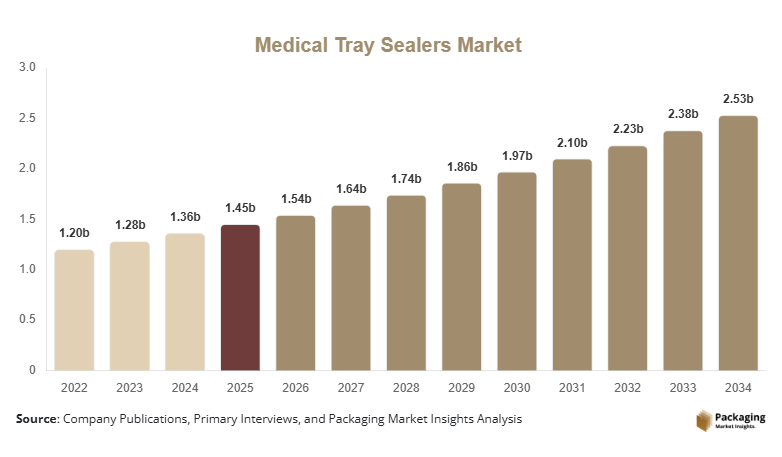
Medical Tray Sealers market size is projected at USD 1.54 billion in 2026 and is expected to hit USD 2.53 billion by 2034 with a CAGR of 6.40%. Rising production of sterile medical devices, increasing regulatory requirements for packaging integrity, and the expansion of healthcare manufacturing facilities are accelerating market development. The report delivers detailed market sizing, segmentation, production analysis, technological assessment, and competitive landscape evaluation.
Medical tray sealers are specialized packaging systems used to create sterile barrier packaging for medical devices, surgical instruments, implants, and diagnostic products. Global production exceeded 205,000 tray sealing systems in 2025, while sterile medical packaging utilization surpassed 18.4 billion trays annually. Automatic sealing equipment accounted for approximately 61% of new installations, reinforcing the medical tray sealers market.
Explore more data points, trends and opportunities Download Free Sample Report
Medical Tray Sealers Trends
Growing Adoption of Automated Sterile Packaging Systems
Healthcare manufacturers continue investing in automated tray sealing technologies to improve packaging consistency and regulatory compliance. More than 118,000 automated tray sealers were operational globally in 2025, while automation adoption increased by 16% compared with the previous year. High-speed sealers capable of processing over 30 trays per minute are becoming increasingly common, supporting the medical tray sealers market.
The integration of Industry 4.0 technologies, digital validation systems, and real-time seal quality monitoring is transforming production facilities. Approximately 58% of newly installed machines feature touchscreen controls, barcode traceability, and electronic process validation. Demand from orthopedic, cardiovascular, and diagnostic device manufacturers continues to expand, strengthening the medical tray sealers market.
Medical Tray Sealers Drivers
Increasing Production of Sterile Medical Devices
Growing demand for sterile surgical instruments, implants, catheters, and disposable medical products continues driving investments in tray sealing equipment. Medical device production increased by nearly 8%, while sterile packaging demand exceeded 18 billion units annually. More than 72% of Class II and Class III medical devices utilize sealed rigid trays, supporting medical tray sealers market growth.
Medical Tray Sealers Restraints
High Equipment Investment and Validation Costs
Advanced automated tray sealing systems require significant capital investment and extensive validation before deployment. Equipment prices range from USD 60,000 to USD 450,000, while validation expenses can account for 8–12% of total project costs. These financial barriers continue limiting the medical tray sealers market.
Medical Tray Sealers Opportunities
Expansion of Contract Medical Packaging Services
The increasing outsourcing of sterile packaging operations is creating significant growth opportunities. Contract packaging organizations recorded approximately 14% annual expansion, while investments in sterile packaging facilities exceeded USD 1.6 billion globally during 2025. Expansion of pharmaceutical combination products further supports the medical tray sealers market.
Challenges in Medical Tray Sealers
Maintaining Seal Integrity Across Diverse Packaging Materials
Manufacturers must ensure consistent sealing performance across PETG, HDPE, Tyvek®, and multilayer barrier materials while complying with ISO 11607 standards. Material compatibility testing has increased by 19%, while quality assurance costs rose by approximately 11%. These technical requirements remain significant challenges for the medical tray sealers market.
Report Scope
| Report Metric | Details |
|---|---|
| Market Size in 2025 | USD 1.45 billion |
| Market Size in 2026 | USD 1.54 billion |
| Market Size in 2034 | USD 2.53 billion |
| CAGR | 6.40% (2026-2034) |
| Base Year for Estimation | 2025 |
| Historical Data | 2022-2024 |
| Forecast Period | 2026-2034 |
| Report Coverage | Revenue Forecast, Competitive Landscape, Supply Chain Disruption, Growth Factors, Environment & Regulatory Landscape and Trends |
| Geographies Covered | North America, Europe, APAC, Middle East and Africa, LATAM |
| Countries Covered | U.S., Canada, U.K., Germany, France, Spain, Italy, Russia, Nordic, Benelux, Rest of Europe, China, South Korea, Japan, India, Australia, Singapore, Taiwan, South East Asia, Rest of Asia-Pacific, UAE, Turky, Saudi Arabia, South Africa, Egypt, Nigeria, Rest of MEA, Brazil, Mexico, Argentina, Chile, Colombia, Rest of LATAM |
Explore more data points, trends and opportunities Download Free Sample Report
Medical Tray Sealers Market Segmentation
Automatic tray sealers account for approximately 48% of market revenue due to higher productivity and process consistency. Medical device manufacturers represent nearly 55% of total equipment demand because of increasing sterile packaging requirements.
By Product Type
Manual systems account for approximately 23% of market demand. They are primarily used in laboratories, hospitals, and low-volume production environments, processing up to 6 trays per minute.
Semi-automatic equipment represents nearly 29% of global revenue. These systems process 10–18 trays per minute while offering improved sealing consistency and lower operating costs.
Automatic tray sealers dominate with approximately 48% market share. Advanced systems exceed 30 trays per minute, feature PLC controls, automated validation, and integrated inspection systems for high-volume manufacturing.
By Application
Hospitals contribute approximately 22% of market demand through in-house sterile processing departments and specialized medical packaging operations.
Medical device manufacturers account for nearly 55% of total demand. Production facilities package billions of sterile devices annually while requiring validated sealing systems for regulatory compliance.
Contract packaging organizations represent approximately 23% of the market. Rising outsourcing trends and increasing demand for sterile packaging services continue supporting equipment installations.
Medical Tray Sealers Market Segmentations
Product Type
- Manual Tray Sealers
- Semi-Automatic Tray Sealers
- Automatic Tray Sealers
Application
- Hospitals
- Medical Device Manufacturers
- Contract Packaging Organizations
Distribution Channel
- Direct Sales
- Industrial Distributors
- Online Sales
- OEM Partnerships
Medical Tray Sealers Regional Outlook
North America
North America holds approximately 37% of global revenue. The United States leads regional demand with more than 65,000 installed tray sealing systems serving medical device manufacturing facilities.
Europe
Europe accounts for nearly 30% of the market. Germany, Switzerland, Ireland, France, and Italy continue expanding medical technology manufacturing while increasing investments in automated sterile packaging.
Asia-Pacific
Asia-Pacific represents approximately 27% of global demand and remains the fastest-growing region. China, Japan, India, South Korea, and Singapore continue expanding medical device production capacity and healthcare manufacturing investments.
Latin America
Latin America contributes approximately 4% of global demand, led by Brazil and Mexico through increasing healthcare infrastructure and regional medical device manufacturing.
Middle East & Africa
The Middle East & Africa account for around 2% of the market. Growth is supported by healthcare modernization, medical imports, and increasing investment in sterile medical packaging.
Top players in Medical Tray Sealers Market
- Multivac Group
- Nelipak Healthcare Packaging
- Paxxus Inc.
- Placon Corporation
- SencorpWhite
- Atlas Vac Machine LLC
- Belco Packaging Systems, Inc.
- ULMA Packaging
- ProMach Inc.
- Accu-Seal Corporation
- Audion Packaging Machines
- Veripack S.r.l.
- Starview Packaging Machinery, Inc.
- Medical Packaging Inc., LLC
- Amcor plc
Multivac Group
-
Holds an estimated 13–15% share of the global market.
-
Operates one of the industry's broadest portfolios of medical tray sealing technologies.
-
Focuses on automated packaging lines, intelligent sealing validation, Industry 4.0 integration, and high-speed production systems while serving medical device manufacturers across North America, Europe, and Asia with comprehensive sterile packaging solutions.
ULMA Packaging
-
Commands approximately 9–11% market share globally.
-
Provides automated tray sealing equipment for sterile medical packaging and healthcare applications.
-
Invests extensively in digital process control, energy-efficient sealing technologies, and sustainable packaging innovations while expanding manufacturing capacity and global service capabilities for regulated medical industries.