Absorbent Cover Market Size
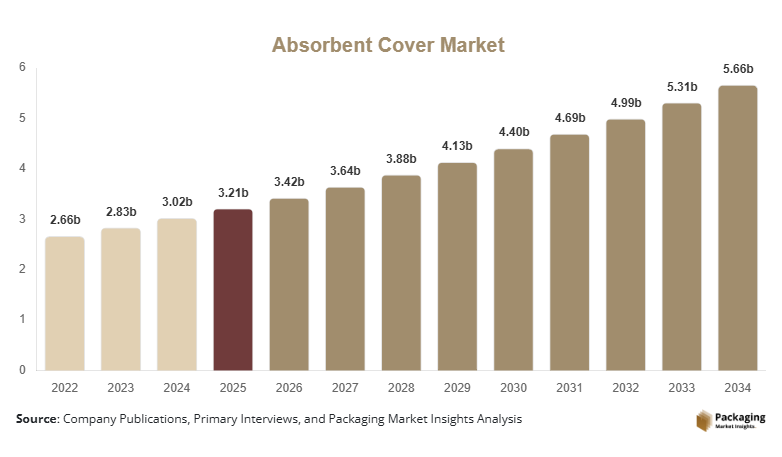
Absorbent Cover market size is projected at USD 3.42 billion in 2026 and is expected to hit USD 5.66 billion by 2034 with a CAGR of 6.50%. Increasing demand for hygienic packaging, food safety compliance, and healthcare disposables is supporting market expansion. The report provides detailed market data, segmentation analysis, production trends, technological developments, and competitive landscape across major regions.
Absorbent covers are specialized packaging and protective materials designed to absorb excess liquids, prevent leakage, and maintain product integrity in food, medical, and industrial applications. Global production exceeded 13.8 billion units in 2025, with polypropylene-based absorbent covers accounting for approximately 49% of total production. Food packaging represented nearly 46% of market consumption, while healthcare applications contributed around 34%. Automated manufacturing adoption exceeded 62% among leading producers, strengthening the absorbent cover market.
Explore more data points, trends and opportunities Download Free Sample Report
Absorbent Cover Trends
Rising Adoption of Sustainable and High-Performance Absorbent Materials
Manufacturers are increasingly utilizing recyclable fibers, bio-based materials, and multilayer absorbent structures to improve sustainability while maintaining liquid retention performance. More than 3.6 billion eco-friendly absorbent covers were manufactured in 2025, while sustainable product adoption increased by over 24%. Advanced multilayer designs improve absorption capacity by nearly 35%, reinforcing the absorbent cover market.
Automation, precision lamination, and antimicrobial coating technologies are transforming production efficiency. Nearly 59% of production facilities have integrated automated converting lines capable of producing over 240 units per minute. Demand from fresh meat, poultry, seafood, and healthcare sectors continues supporting the absorbent cover market.
Absorbent Cover Drivers
Growing Demand for Hygienic Food and Medical Packaging
Increasing consumer awareness regarding food safety and infection prevention is driving demand for absorbent covers. Global packaged fresh food consumption exceeds 620 million tons annually, while medical disposable usage continues to increase by over 8% each year. More than 72% of premium fresh meat packaging incorporates absorbent pads, supporting absorbent cover market growth.
Absorbent Cover Restraints
Volatility in Raw Material Prices
Price fluctuations for polypropylene resins, cellulose pulp, and specialty absorbent polymers continue affecting manufacturing costs. Raw material prices have varied by 10–22% annually, while logistics expenses increased by approximately 11%. These cost pressures continue impacting profitability across the absorbent cover market.
Absorbent Cover Opportunities
Expansion of Sustainable Packaging Solutions
Growing demand for biodegradable absorbent materials and recyclable food packaging creates substantial opportunities. Bio-based absorbent cover production increased by nearly 21%, while investments in sustainable packaging exceeded USD 1.5 billion globally. Rising regulatory support further expands opportunities within the absorbent cover market.
Challenges in Absorbent Cover
Balancing Absorption Performance with Environmental Compliance
Developing environmentally friendly absorbent covers while maintaining liquid retention, durability, and food safety compliance remains challenging. Sustainable products account for approximately 18% of market production, while eco-friendly materials may increase manufacturing costs by 15–28%. Maintaining high-performance standards continues challenging the absorbent cover market.
Report Scope
| Report Metric | Details |
|---|---|
| Market Size in 2025 | USD 3.21 billion |
| Market Size in 2026 | USD 3.42 billion |
| Market Size in 2034 | USD 5.66 billion |
| CAGR | 6.50% (2026-2034) |
| Base Year for Estimation | 2025 |
| Historical Data | 2022-2024 |
| Forecast Period | 2026-2034 |
| Report Coverage | Revenue Forecast, Competitive Landscape, Supply Chain Disruption, Growth Factors, Environment & Regulatory Landscape and Trends |
| Geographies Covered | North America, Europe, APAC, Middle East and Africa, LATAM |
| Countries Covered | U.S., Canada, U.K., Germany, France, Spain, Italy, Russia, Nordic, Benelux, Rest of Europe, China, South Korea, Japan, India, Australia, Singapore, Taiwan, South East Asia, Rest of Asia-Pacific, UAE, Turky, Saudi Arabia, South Africa, Egypt, Nigeria, Rest of MEA, Brazil, Mexico, Argentina, Chile, Colombia, Rest of LATAM |
Explore more data points, trends and opportunities Download Free Sample Report
Absorbent Cover Market Segmentation
Polypropylene dominates with approximately 49% market share due to excellent moisture resistance, durability, and processing efficiency. Food packaging remains the largest application segment, accounting for nearly 46% of total demand.
By Material
Polypropylene accounts for approximately 49% of market revenue with annual production exceeding 6.7 billion units. The material provides excellent liquid management, tear resistance, and compatibility with automated packaging equipment.
Polyethylene represents nearly 28% market share. Annual production exceeds 3.8 billion units, offering flexibility, moisture barrier performance, and cost-effective manufacturing for disposable absorbent covers.
Cellulose fiber contributes approximately 23% of demand. Natural fiber absorbent covers provide enhanced sustainability, biodegradability, and high liquid absorption suitable for food and healthcare applications.
By Application
Medical and healthcare account for approximately 34% of the market. Production exceeds 4.6 billion units annually for surgical trays, diagnostic kits, wound care products, and sterile packaging applications.
Food packaging dominates with nearly 46% market share. More than 6.3 billion units are used annually in fresh meat, poultry, seafood, and fresh produce packaging to improve hygiene and extend shelf life.
Industrial packaging represents approximately 20% of total demand. Absorbent covers protect industrial products against moisture, chemical leakage, and transportation-related contamination.
Absorbent Cover Market Segmentations
Material
- Polypropylene
- Polyethylene
- Cellulose Fiber
Application
- Medical & Healthcare
- Food Packaging
- Industrial Packaging
End User
- Food Processing Industry
- Healthcare Facilities
- Industrial Manufacturers
- Retail Packaging Companies
Absorbent Cover Regional Outlook
North America
North America accounts for approximately 35% of global revenue. The United States dominates regional demand through advanced food processing, healthcare packaging, and strict food safety regulations. Production exceeds 4.5 billion units annually.
Europe
Europe represents nearly 28% of the market. Germany, France, Italy, and the United Kingdom lead production with increasing adoption of sustainable packaging materials and stringent environmental regulations.
Asia-Pacific
Asia-Pacific holds approximately 30% market share and records the fastest growth. China, Japan, India, South Korea, and Australia continue expanding food processing and healthcare manufacturing, producing more than 4.1 billion absorbent covers annually.
Latin America
Latin America contributes approximately 4% of global demand. Brazil and Mexico lead regional consumption through expanding meat processing and packaged food industries.
Middle East & Africa
The Middle East & Africa account for around 3% of the market. Growth is supported by increasing food imports, healthcare investments, and modern retail expansion.
Top players in Absorbent Cover
- Novipax LLC
- Sirane Group Ltd.
- McAirlaid's Vliesstoffe GmbH
- Cellcomb AB
- Sealed Air Corporation
- Amcor plc
- ProAmpac LLC
- Coveris Holdings S.A.
- Mondi plc
- APTAR Group, Inc.
- UFP Technologies, Inc.
- TekniPlex Healthcare
- Berry Global Inc.
- Winpak Ltd.
- Smurfit WestRock
Novipax LLC
-
Holds an estimated 10–12% share of the global market.
-
Specializes in absorbent pads and moisture management solutions for fresh food packaging.
-
Maintains extensive manufacturing capabilities with advanced absorbent technologies serving meat, poultry, seafood, and produce packaging while focusing on product safety, sustainability, and high-volume production.
Sirane Group Ltd.
-
Commands approximately 8–10% market share.
-
Recognized for innovative absorbent packaging and antimicrobial packaging technologies.
-
Focuses on sustainable absorbent materials, recyclable packaging solutions, and customized products for healthcare and food packaging industries while expanding global manufacturing capabilities.