Medical Device Trays Market Size
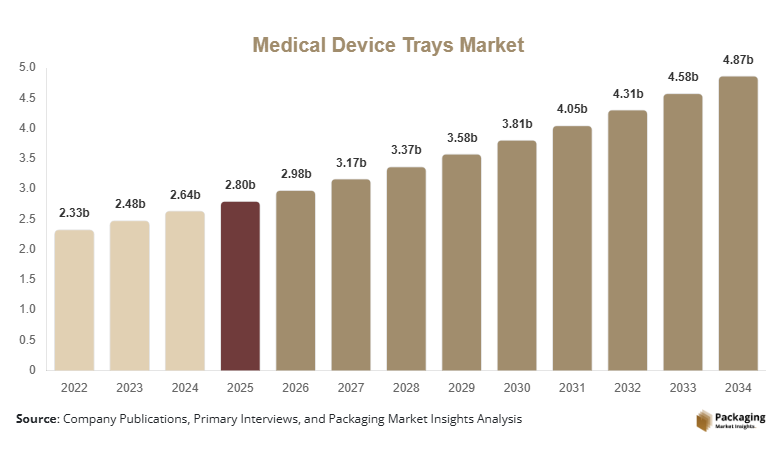
Medical Device Trays market size is projected at USD 2.98 billion in 2026 and is expected to hit USD 4.87 billion by 2034 with a CAGR of 6.33%. Rising demand for sterile medical packaging, increasing surgical procedures, and stringent healthcare regulations are driving market expansion. The report provides comprehensive data on market segmentation, production volumes, technology developments, and the competitive landscape across key regions.
Medical device trays are specialized packaging solutions designed to protect, organize, and maintain the sterility of medical instruments and devices during transportation and storage. Global production exceeded 5.8 billion trays in 2025, with plastic trays accounting for nearly 76% of total production. Sterile tray systems represent approximately 61% of total market demand, while hospitals account for over 58% of overall consumption. Increasing medical device manufacturing and healthcare investments continue to strengthen the medical device trays market.
Explore more data points, trends and opportunities Download Free Sample Report
Medical Device Trays Trends
Growing Adoption of Sustainable Sterile Packaging
Healthcare manufacturers are increasingly adopting recyclable PET, RPET, and mono-material thermoformed trays to reduce environmental impact. More than 1.9 billion recyclable medical trays were manufactured globally in 2025, while sustainable packaging adoption increased by over 23% year-over-year. High-barrier sterile packaging continues to improve product protection, reinforcing the medical device trays market.
Automation and smart manufacturing technologies are transforming tray production through precision thermoforming, robotic inspection, and digital quality control systems. Nearly 57% of leading manufacturers have implemented automated production lines capable of producing over 180 trays per minute. Demand from minimally invasive surgical devices and diagnostic equipment continues supporting the medical device trays market.
Medical Device Trays Drivers
Increasing Demand for Sterile Medical Packaging
Growing healthcare expenditure, rising surgical procedures, and expanding medical device manufacturing are driving demand. More than 330 million major surgeries are performed globally each year, while sterile packaging utilization exceeds 90% across regulated healthcare markets. Demand for customized thermoformed trays has increased by over 18%, supporting medical device trays market growth.
Medical Device Trays Restraints
High Production and Regulatory Compliance Costs
Manufacturers face increasing costs associated with medical-grade polymers, validation testing, and regulatory certifications. Medical-grade resin prices have fluctuated by 12–20%, while compliance costs have increased by approximately 15% across major markets. These factors create pricing pressure within the medical device trays market.
Medical Device Trays Opportunities
Expansion of Advanced Medical Devices and Personalized Healthcare
Increasing production of implantable devices, diagnostic kits, and customized surgical instruments creates strong opportunities. Personalized medical devices have recorded annual growth exceeding 11%, while demand for custom thermoformed trays has increased by 16%. Growing investments in healthcare infrastructure continue creating opportunities for the medical device trays market.
Challenges in Medical Device Trays
Balancing Sustainability with Sterility Requirements
Developing recyclable packaging materials while maintaining sterility, mechanical strength, and regulatory compliance remains challenging. Sustainable materials account for approximately 19% of production, while conversion to eco-friendly materials may increase manufacturing costs by 10–25%. Maintaining high barrier performance continues to challenge the medical device trays market.
Report Scope
| Report Metric | Details |
|---|---|
| Market Size in 2025 | USD 2.80 billion |
| Market Size in 2026 | USD 2.98 billion |
| Market Size in 2034 | USD 4.87 billion |
| CAGR | 6.33% (2026-2034) |
| Base Year for Estimation | 2025 |
| Historical Data | 2022-2024 |
| Forecast Period | 2026-2034 |
| Report Coverage | Revenue Forecast, Competitive Landscape, Supply Chain Disruption, Growth Factors, Environment & Regulatory Landscape and Trends |
| Geographies Covered | North America, Europe, APAC, Middle East and Africa, LATAM |
| Countries Covered | U.S., Canada, U.K., Germany, France, Spain, Italy, Russia, Nordic, Benelux, Rest of Europe, China, South Korea, Japan, India, Australia, Singapore, Taiwan, South East Asia, Rest of Asia-Pacific, UAE, Turky, Saudi Arabia, South Africa, Egypt, Nigeria, Rest of MEA, Brazil, Mexico, Argentina, Chile, Colombia, Rest of LATAM |
Explore more data points, trends and opportunities Download Free Sample Report
Medical Device Trays Market Segmentation
Plastic materials dominate with nearly 76% market share due to excellent thermoforming capability, durability, and sterilization compatibility. Sterile trays contribute approximately 61% of total demand owing to increasing surgical and diagnostic procedures worldwide.
By Material
Plastic accounts for approximately 76% of market revenue with annual production exceeding 4.4 billion trays. PET, HDPE, PP, and HIPS materials offer high impact resistance, dimensional stability, and compatibility with EtO and gamma sterilization.
Paperboard represents nearly 15% of the market. Production exceeds 850 million trays annually, primarily serving secondary packaging applications with recyclable and lightweight characteristics.
Metal trays contribute approximately 9% market share and are widely used for reusable surgical instrument trays. Stainless steel trays provide long service life exceeding 10 years and superior corrosion resistance.
By Product Type
Sterile trays hold around 61% of the market with production exceeding 3.5 billion units annually. These trays ensure contamination protection and compatibility with multiple sterilization methods.
Procedure trays account for nearly 24% market share and simplify surgical workflows by organizing multiple instruments into ready-to-use kits, improving hospital efficiency by nearly 20%.
Custom trays represent approximately 15% of demand. These trays are designed for specialized medical devices and implants, offering improved product fit, shock protection, and transportation safety.
Medical Device Trays Market Segmentations
Material
- Plastic
- Paperboard
- Metal
Product Type
- Sterile Trays
- Procedure Trays
- Custom Trays
End User
- Hospitals
- Medical Device Manufacturers
- Diagnostic Centers
- Ambulatory Surgical Centers (ASCs)
Medical Device Trays Regional Outlook
North America
North America accounts for approximately 39% of global revenue. The United States dominates regional demand with advanced medical device manufacturing and healthcare expenditure exceeding USD 4 trillion annually. Canada supports growth through expanding medical technology production.
Europe
Europe represents nearly 29% of the market. Germany, France, the United Kingdom, and Italy lead production through established medical device manufacturing industries and stringent MDR regulations. Sustainable packaging adoption exceeds 28% across the region.
Asia-Pacific
Asia-Pacific holds approximately 25% market share and records the fastest growth. China, Japan, India, South Korea, and Singapore continue expanding medical device manufacturing capacity with production exceeding 1.6 billion trays annually.
Latin America
Latin America contributes approximately 4% of global demand. Brazil and Mexico lead regional growth through increasing healthcare investments and expanding domestic medical device production.
Middle East & Africa
The Middle East & Africa account for around 3% of the market. Growth is supported by healthcare infrastructure modernization, increasing hospital construction, and higher medical equipment imports.
Top players in Medical Device Trays
- Sonoco Products Company
- Nelipak Corporation
- Placon Corporation
- TekniPlex Healthcare
- Oliver Healthcare Packaging
- DuPont de Nemours, Inc.
- Thermoformed Engineered Quality LLC (TEQ)
- Prent Corporation
- Nelson Labs Packaging
- UFP Technologies, Inc.
- Amcor plc
- WestRock Company
- PAXXUS, Inc.
- Rohrer Corporation
- Display Pack, Inc.
Sonoco Products Company
-
Holds an estimated 9–11% share of the global market.
-
Operates advanced thermoforming and healthcare packaging facilities across North America and Europe.
-
Focuses on sterile packaging innovations, recyclable medical trays, and customized healthcare solutions for medical device manufacturers while maintaining strong relationships with global healthcare OEMs.
Nelipak Corporation
-
Commands approximately 8–10% global market share.
-
Recognized as a leading supplier of rigid sterile barrier packaging and thermoformed trays.
-
Maintains extensive manufacturing capabilities across Europe, North America, and Asia while investing in cleanroom production, medical-grade materials, and sustainable tray technologies for high-value medical devices.