Steel Containers Market Size
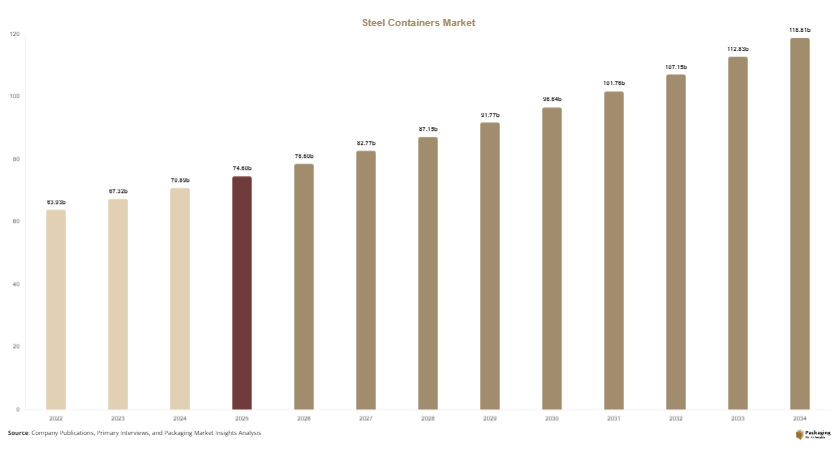
Steel Containers market size is projected at USD 78.6 billion in 2026 and is expected to hit USD 118.5 billion by 2034 with a CAGR of 5.3%. Increasing demand for durable industrial packaging, expanding food preservation requirements, and growing chemical transportation are supporting market expansion. The report provides detailed segmentation, production capacity analysis, competitive benchmarking, and regional performance assessment to support strategic decision-making across the Steel Containers market.
Steel containers are rigid packaging products manufactured from carbon steel or stainless steel for storing and transporting chemicals, petroleum products, food, beverages, pharmaceuticals, paints, and industrial materials. Global production exceeded 1.62 billion units in 2025, with food and beverage applications contributing approximately 38% of total consumption, chemicals accounting for 29%, and industrial applications representing 21%. More than 72% of hazardous liquid transportation utilizes certified steel containers, reinforcing the Steel Containers market.
Explore more data points, trends and opportunities Download Free Sample Report
Steel Containers Market Trends
Growing Adoption of Sustainable and Recyclable Steel Packaging
Global recycling initiatives continue accelerating demand for reusable steel packaging. More than 82% of industrial steel containers are recovered for recycling, while recycled steel utilization increased by 19% over the past five years. Annual production surpassed 1.68 billion units, supported by rising demand from chemical processing, lubricant manufacturing, and food preservation industries. Sustainability initiatives continue strengthening the Steel Containers market.
Automation and digital manufacturing technologies are transforming production efficiency. Over 48% of manufacturers have integrated robotic welding and automated inspection systems, improving production efficiency by nearly 17% while reducing defects below 2%. Smart coatings, corrosion-resistant alloys, and lightweight steel grades continue expanding industrial applications across global supply chains, supporting the Steel Containers market.
Steel Containers Market Drivers
Increasing Demand for Safe Industrial and Chemical Packaging
The expansion of chemical manufacturing and hazardous material transportation significantly increases steel container consumption. Global chemical production exceeded 4.5 billion metric tons, while nearly 64% of industrial liquid chemicals are transported using steel drums and bulk containers. Industrial packaging investments surpassed USD 18 billion, with demand increasing by approximately 6% annually. These developments continue driving Steel Containers market growth.
Steel Containers Market Restraints
Volatility in Steel Raw Material Prices
Fluctuating steel prices remain a major concern for manufacturers. Raw material costs increased between 12% and 18% during recent procurement cycles, while energy expenses account for nearly 21% of production costs. Price volatility directly impacts profit margins, particularly for small and medium manufacturers producing over 120 million units annually, restraining Steel Containers market growth.
Steel Containers Market Opportunities
Expansion of Food Processing and Pharmaceutical Packaging
Growing packaged food production and pharmaceutical manufacturing present significant opportunities. Global processed food output exceeded 1.1 billion metric tons, while pharmaceutical packaging demand increased by over 8% annually. More than 35% of new industrial packaging investments are directed toward corrosion-resistant steel containers with enhanced protective coatings, creating opportunities across the Steel Containers market.
Challenges in Steel Containers Market
Balancing Weight Reduction with Structural Strength
Manufacturers face challenges in reducing container weight while maintaining durability and regulatory compliance. Approximately 31% of research programs focus on lightweight steel alloys capable of maintaining load capacities above 250 liters and compressive strength exceeding 450 MPa. Achieving optimal corrosion resistance and transportation efficiency remains a significant technical challenge for the Steel Containers market.
Report Scope
| Report Metric | Details |
|---|---|
| Market Size in 2025 | USD 74.6 billion |
| Market Size in 2026 | USD 78.6 billion |
| Market Size in 2034 | USD 118.5 billion |
| CAGR | 5.3% (2026-2034) |
| Base Year for Estimation | 2025 |
| Historical Data | 2022-2024 |
| Forecast Period | 2026-2034 |
| Report Coverage | Revenue Forecast, Competitive Landscape, Supply Chain Disruption, Growth Factors, Environment & Regulatory Landscape and Trends |
| Geographies Covered | North America, Europe, APAC, Middle East and Africa, LATAM |
| Countries Covered | U.S., Canada, U.K., Germany, France, Spain, Italy, Russia, Nordic, Benelux, Rest of Europe, China, South Korea, Japan, India, Australia, Singapore, Taiwan, South East Asia, Rest of Asia-Pacific, UAE, Turky, Saudi Arabia, South Africa, Egypt, Nigeria, Rest of MEA, Brazil, Mexico, Argentina, Chile, Colombia, Rest of LATAM |
Explore more data points, trends and opportunities Download Free Sample Report
Steel Containers Market Segmentation
The market is segmented by type and application to evaluate demand across end-use industries. Steel cans account for nearly 44% of total consumption, while chemicals remain the largest application segment with approximately 39% market contribution due to high-volume industrial transportation requirements.
By Type
Drums
Steel drums contribute approximately 34% of global demand, with annual production exceeding 540 million units. Available in 30-liter, 55-gallon, and customized capacities, they provide high impact resistance and leak-proof performance for transporting chemicals, oils, and hazardous materials.
Intermediate Bulk Containers
Intermediate Bulk Containers account for nearly 22% of production, exceeding 180 million units annually. These containers offer capacities ranging from 500 liters to 1,500 liters, high stacking strength, and improved logistics efficiency for bulk liquid transportation.
Steel Cans
Steel cans dominate with approximately 44% market share and annual production exceeding 900 million units. They provide excellent oxygen and moisture barriers, extended shelf life, and corrosion-resistant coatings for food, beverage, aerosol, and paint packaging.
By Application
Chemicals
Chemicals represent approximately 39% of total demand, supported by production exceeding 630 million steel containers annually. High-pressure resistance, UN certification, and chemical compatibility make steel containers essential for industrial transportation and storage.
Food & Beverage
Food and beverage applications contribute nearly 38% of market consumption. More than 610 million steel containers are produced annually for edible oils, canned foods, beverages, and dairy products, with adoption exceeding 68% among long-shelf-life packaging formats.
Industrial
Industrial applications account for approximately 23% of global demand. Steel containers are widely utilized for lubricants, paints, coatings, adhesives, and petroleum products, offering high mechanical strength, durability, and reusability across manufacturing industries.
Steel Containers Market Segmentations
Type
- Drums
- Intermediate Bulk Containers
- Steel Cans
Application
- Chemicals
- Food & Beverage
- Industrial
Capacity
- Up to 50 Liters
- 51–250 Liters
- 251–500 Liters
- Above 500 Liters
Steel Containers Regional Outlook
North America
North America accounts for approximately 31% of global revenue, producing more than 500 million units annually. The United States contributes nearly 84% of regional production, driven by strong chemical manufacturing, food processing, and petroleum industries.
Europe
Europe represents approximately 29% of global demand. Germany, France, Italy, and the United Kingdom collectively contribute over 72% of regional production, exceeding 470 million units annually. Strict recycling regulations continue encouraging reusable steel packaging.
Asia-Pacific
Asia-Pacific holds nearly 33% of global consumption and records the fastest expansion. China contributes approximately 49% of regional production, followed by India, Japan, and South Korea. Regional output exceeds 560 million units, supported by rapid industrialization and export-oriented manufacturing.
Middle East & Africa and South America
These regions collectively contribute around 7% of global demand. Brazil leads South America, while Saudi Arabia, the UAE, and South Africa continue expanding industrial packaging production. Combined output exceeds 110 million units, supported by petrochemical and food industries.
Top players in Steel Containers Market
- Greif Inc.
- Mauser Packaging Solutions
- Schütz GmbH & Co. KGaA
- Time Technoplast Ltd.
- Balmer Lawrie & Co. Ltd.
- BWAY Corporation
- Industrial Container Services, LLC
- Thielmann AG
- Hoover Ferguson Group
- Müller Group
- CL Smith Company
- Sicagen India Limited
Greif Inc.
-
Holds an estimated 11–13% global market share in industrial steel packaging.
-
Operates manufacturing facilities across more than 35 countries with an extensive portfolio of steel drums, intermediate bulk containers, and specialty packaging. The company emphasizes sustainable manufacturing through recycled steel utilization, advanced coating technologies, and circular packaging programs. Strong customer relationships across chemical, lubricant, food, and pharmaceutical industries support its leading position in the Steel Containers market.
Mauser Packaging Solutions
-
Accounts for approximately 9–11% of the global market.
-
Maintains a diversified product portfolio covering steel drums, intermediate bulk containers, plastic packaging, and reconditioning services. The company continues expanding recycling operations and smart industrial packaging solutions while strengthening its global manufacturing footprint. Its integrated packaging lifecycle services and strong presence across industrial and chemical sectors reinforce its competitive position within the Steel Containers market.