Market Overview
The 2 Piece Packaging Cans Market size was valued at USD 38.62 billion in 2025 and is estimated to reach USD 40.71 billion in 2026, expanding further to touch USD 62.48 billion by 2034, registering a compound annual growth rate (CAGR) of 5.48% during the forecast period of 2025 to 2034. The 2 piece packaging cans market has established itself as a preferred packaging format across beverage, food, and personal care industries owing to its lightweight construction, superior sealing performance, and cost-efficient manufacturing process compared with traditional 3 piece cans. Market growth is closely tied to rising consumption of carbonated soft drinks, beer, energy drinks, and ready-to-drink beverages worldwide, alongside a steady shift toward sustainable, recyclable metal packaging solutions.
One of the primary growth factors supporting this market is the increasing consumer preference for aluminum-based packaging due to its high recyclability rate and lower carbon footprint relative to plastic and glass alternatives. Beverage brands are actively replacing PET bottles with 2 piece aluminum cans to align with corporate sustainability commitments and evolving regulatory frameworks around single-use plastics. A second growth factor is the technological advancement in can-forming processes, including drawing and wall ironing (DWI) technology, which allows manufacturers to produce thinner, lighter cans without compromising structural integrity, thereby reducing material costs and transportation expenses. A third growth factor is the expanding food and beverage retail sector in emerging economies, where rising disposable incomes and urbanization are fueling demand for packaged and convenience products, directly benefiting can manufacturers.
Key Highlights:
- North America dominated the 2 piece packaging cans market with the largest share of 34.82% in 2025.
- Asia Pacific is expected to be the fastest-growing region in the 2 piece packaging cans market during the forecast period at a CAGR of 6.94%.
- Based on material type, the aluminum segment dominated the 2 piece packaging cans market with a share of 71.26% in 2025.
- Based on can size, the 330–500 ml segment dominated the market with a share of 44.18% in 2025.
- Based on application, the beverage cans segment dominated the market with a share of 68.53% in 2025.
- Based on end-use industry, the alcoholic beverages segment dominated the market with 39.61% in 2025.
- The US 2 piece packaging cans market size was valued at USD 11.47 billion in 2025 and is projected to reach USD 12.05 billion in 2026.
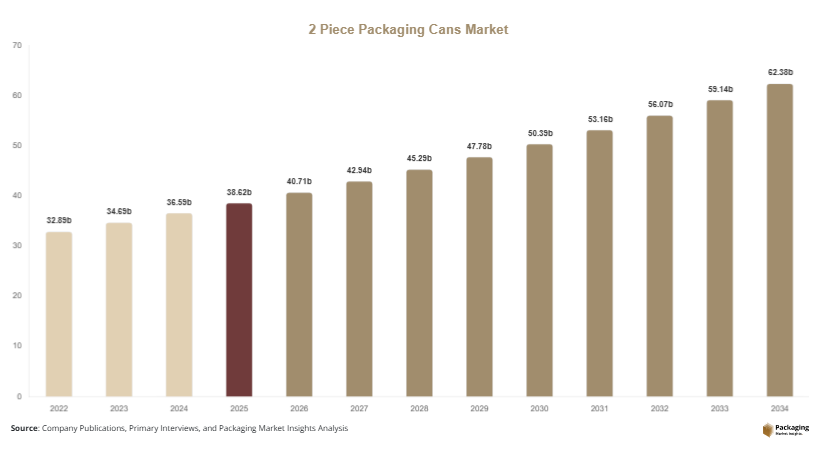
Explore more data points, trends and opportunities Download Free Sample Report
Market Trends
Rising Adoption of Slim and Sleek Can Formats
Beverage manufacturers are increasingly transitioning toward slim and sleek can formats to differentiate their products on crowded retail shelves and appeal to health-conscious consumers seeking portion-controlled packaging. These formats are widely used for energy drinks, sparkling water, and premium alcoholic beverages, where visual differentiation strongly influences purchase decisions. Can producers are investing in specialized tooling to manufacture varied diameters and heights without significantly increasing production costs. This trend is also supported by retailers who favor slim cans for efficient shelf space utilization, further reinforcing their popularity among brand owners across developed and emerging markets alike.
Growing Integration of Digital and Enhanced Printing Technologies
Can manufacturers are adopting high-definition digital printing and enhanced decoration technologies to support shorter production runs, seasonal packaging designs, and personalized branding campaigns. This shift allows beverage companies to launch limited-edition designs and region-specific labeling without incurring the high costs traditionally associated with offset printing changeovers. Digital printing also reduces setup times and material waste, making it attractive for smaller craft beverage producers entering the canned beverage segment. As competition intensifies within the beverage industry, this trend is expected to remain a defining feature of the 2 piece packaging cans market throughout the forecast period.
Market Drivers
Increasing Consumer Shift Toward Sustainable and Recyclable Packaging
Environmental awareness among consumers and stringent government regulations on plastic waste are driving a pronounced shift toward aluminum 2 piece cans, which offer high recyclability rates exceeding those of most plastic packaging formats. Many national governments have introduced extended producer responsibility programs and deposit return schemes that financially incentivize the use of recyclable metal packaging. Beverage companies are responding by reformulating their packaging portfolios to include a greater proportion of canned products, particularly in regions with established aluminum recycling infrastructure such as North America and Europe, thereby directly boosting demand for 2 piece packaging cans.
Expansion of the Global Beverage Industry and Ready-to-Drink Segment
The consistent growth of the global beverage industry, particularly carbonated soft drinks, energy drinks, hard seltzers, and ready-to-drink alcoholic beverages, continues to serve as a fundamental driver for the 2 piece packaging cans market. Changing consumer lifestyles, increasing on-the-go consumption patterns, and rising disposable incomes in developing economies are collectively expanding the addressable market for canned beverages. Beverage manufacturers favor 2 piece cans for their durability during transportation, extended shelf life, and superior barrier protection against light and oxygen, which helps preserve product freshness and flavor integrity across long supply chains.
Market Restraint
Volatility in raw material prices, particularly aluminum and tinplate steel, represents a significant restraint for the 2 piece packaging cans market. Aluminum prices are influenced by global supply chain disruptions, energy costs associated with smelting operations, and geopolitical tensions affecting bauxite mining and export activities. When raw material costs rise sharply, can manufacturers face compressed profit margins, as long-term supply contracts with beverage brands often limit their ability to pass on increased costs immediately. This pricing volatility can also discourage smaller regional can producers from expanding production capacity, since uncertain input costs complicate long-term investment planning and return-on-investment calculations. For example, aluminum price fluctuations during periods of global trade disruption have historically forced several packaging companies to renegotiate supply agreements or absorb temporary margin losses, directly impacting profitability across the value chain. Additionally, energy-intensive can manufacturing processes make producers vulnerable to rising electricity and natural gas prices, further compounding cost pressures. This restraint is particularly pronounced for manufacturers operating in regions with limited domestic aluminum production, as they must rely on imports subject to currency fluctuations and tariff structures, adding another layer of financial unpredictability to an already capital-intensive industry.
Market Opportunities
Untapped Growth Potential in Emerging Beverage Markets
Rapid urbanization, expanding modern retail infrastructure, and growing middle-class populations across Southeast Asia, Africa, and Latin America present substantial opportunities for 2 piece packaging cans manufacturers to establish new production facilities and distribution partnerships. As local beverage brands increasingly transition from glass bottles and pouches to canned formats, international packaging companies have opportunities to form joint ventures with regional bottlers and beverage producers. This localized manufacturing approach reduces logistics costs and import duties while allowing companies to tailor can sizes and designs to region-specific consumer preferences and price sensitivities.
Expansion into Non-Beverage Applications Including Food and Personal Care
While beverage applications currently dominate the market, growing opportunities exist in adapting 2 piece can technology for food products such as soups, pet food, and ready meals, as well as personal care items like aerosols and cosmetic packaging. Manufacturers investing in specialized coating technologies that prevent product interaction with metal surfaces can unlock new revenue streams beyond traditional beverage applications. This diversification strategy reduces dependency on beverage industry cyclicality and positions companies to capture demand from food and personal care brands seeking sustainable packaging alternatives to plastic containers.
Report Scope
| Report Metric | Details |
|---|---|
| Market Size in 2025 | USD 38.62 billion |
| Market Size in 2026 | USD 40.71 billion |
| Market Size in 2034 | USD 62.48 billion |
| CAGR | 5.48% (2026-2034) |
| Base Year for Estimation | 2025 |
| Historical Data | 2022-2024 |
| Forecast Period | 2026-2034 |
| Report Coverage | Revenue Forecast, Competitive Landscape, Supply Chain Disruption, Growth Factors, Environment & Regulatory Landscape and Trends |
| Geographies Covered | North America, Europe, APAC, Middle East and Africa, LATAM |
| Countries Covered | U.S., Canada, U.K., Germany, France, Spain, Italy, Russia, Nordic, Benelux, Rest of Europe, China, South Korea, Japan, India, Australia, Singapore, Taiwan, South East Asia, Rest of Asia-Pacific, UAE, Turky, Saudi Arabia, South Africa, Egypt, Nigeria, Rest of MEA, Brazil, Mexico, Argentina, Chile, Colombia, Rest of LATAM |
Explore more data points, trends and opportunities Download Free Sample Report
Segmental Analysis
By Material Type
The aluminum segment dominated the 2 piece packaging cans market, accounting for a share of approximately 71.26% in 2025. Aluminum cans are favored across the beverage industry due to their lightweight nature, superior recyclability, and ability to maintain product carbonation and freshness over extended periods. Beverage manufacturers particularly value aluminum's compatibility with high-speed filling lines and its capacity to be formed into varied shapes and sizes without compromising structural strength. The segment's dominance is further reinforced by widespread recycling infrastructure across developed markets, which allows manufacturers to incorporate recycled aluminum content into new can production, reducing both environmental impact and raw material costs simultaneously.
The tinplate steel segment is projected to be the fastest-growing material type, registering a CAGR of 5.87% through 2034. This growth is primarily attributed to increasing adoption of steel cans within the food packaging segment, where their higher rigidity and resistance to denting make them suitable for products requiring robust protection during transportation and storage. Growing demand for canned food products in emerging economies, combined with steel's cost advantages over aluminum in certain regional markets, is expected to support accelerated growth for this segment throughout the forecast period.
By Can Size
The 330–500 ml segment dominated the 2 piece packaging cans market with a share of approximately 44.18% in 2025. This size range represents the standard format widely adopted across carbonated soft drinks, beer, and energy drink categories globally, making it the preferred choice for both established beverage brands and new market entrants. The popularity of this segment stems from its balance between portion size and cost-effectiveness, appealing to consumers seeking convenient single-serving packaging while allowing manufacturers to optimize production efficiency through standardized can-forming equipment across multiple beverage categories and regional markets.
The below-250 ml segment is anticipated to record the fastest growth rate, with a projected CAGR of 6.42% during the forecast period. This accelerated growth is driven by rising consumer interest in portion-controlled and premium beverage offerings, particularly within the energy drink and functional beverage categories, where smaller can sizes are associated with concentrated formulations and premium positioning. Additionally, growing health consciousness among consumers has encouraged beverage brands to introduce smaller serving sizes that help manage sugar and calorie intake, further supporting demand growth within this segment across multiple regional markets.
By Application
The beverage cans segment dominated the 2 piece packaging cans market, capturing a share of approximately 68.53% in 2025. This segment's leading position is attributed to the extensive and diversified use of 2 piece cans across carbonated soft drinks, beer, energy drinks, and ready-to-drink beverages, all of which continue to experience consistent global demand growth. Beverage manufacturers value 2 piece can construction for its seamless body design, which eliminates side seams and reduces the risk of leakage, while also providing an ideal surface for high-quality graphic printing that supports brand differentiation and consumer engagement at the point of sale.
The food cans segment is projected to witness the fastest growth, expanding at a CAGR of 6.18% through 2034. This growth is fueled by increasing consumer demand for convenient, shelf-stable food products such as soups, vegetables, and pet food, particularly in urban households with time-constrained lifestyles. Manufacturers are increasingly adapting 2 piece can technology, traditionally associated with beverages, for food applications by incorporating specialized internal coatings that prevent chemical interaction between food contents and metal surfaces, thereby expanding the addressable market for this packaging format beyond its conventional beverage stronghold.
2 Piece Packaging Cans Market Segmentations
Material Type
- Aluminum
- Tinplate Steel
Can Size
- Below 250 ml
- 250–330 ml
- 330–500 ml
- Above 500 ml
Application
- Beverage Cans
- Food Cans
- Personal Care and Aerosol Cans
End-Use Industry
- Alcoholic Beverages
- Non-Alcoholic Beverages
- Food Products
- Household and Personal Care
Regional Analysis
North America
North America held a dominant share of approximately 34.82% of the 2 piece packaging cans market in 2025 and is projected to expand at a steady CAGR of 4.91% through 2034. The region benefits from a mature beverage industry, well-established aluminum recycling infrastructure, and strong consumer preference for canned beverages across carbonated soft drinks, beer, and hard seltzer categories. Regulatory support for recyclable packaging further reinforces the region's leading position in the global market landscape.
The United States remains the dominant country within North America, driven by the widespread presence of major beverage manufacturers and craft brewery expansion across the country. A unique growth factor supporting the US market is the rapid proliferation of canned cocktails and ready-to-drink alcoholic beverages, which has encouraged both established and emerging beverage brands to increase their reliance on 2 piece can packaging formats for new product launches.
Europe
Europe accounted for a substantial market share of around 26.14% in 2025 and is anticipated to grow at a CAGR of 4.67% during the forecast period. Stringent European Union regulations promoting circular economy principles and extended producer responsibility schemes continue to encourage beverage companies across the region to adopt aluminum cans over plastic packaging, supporting consistent regional demand growth.
Germany leads the European market, supported by its well-developed deposit return system and high aluminum recycling rates exceeding regional averages. A unique growth factor for Germany is the strong domestic beer industry, where breweries are increasingly canning premium and craft beer variants to expand export capabilities and appeal to environmentally conscious consumers across neighboring European markets.
Asia Pacific
Asia Pacific represented a market share of nearly 24.37% in 2025 and is projected to be the fastest-growing region globally, expanding at a CAGR of 6.94% through 2034. Rapid urbanization, rising disposable incomes, and expanding modern retail channels across China, India, and Southeast Asian nations are driving increased consumption of packaged beverages, directly benefiting regional can manufacturers.
China dominates the Asia Pacific market, supported by its massive beverage manufacturing base and growing export activities for canned beverage products. A unique growth factor for China is substantial government investment in domestic aluminum production capacity, which reduces reliance on imported raw materials and provides local can manufacturers with more stable and cost-competitive input supplies.
Middle East & Africa
The Middle East and Africa region held a comparatively smaller market share of approximately 8.29% in 2025, with projected growth at a CAGR of 5.12% during the forecast period. Expanding beverage consumption in urban centers, along with growing foreign direct investment in regional bottling and packaging facilities, is gradually strengthening the market position of 2 piece cans across the region.
Saudi Arabia leads the regional market, supported by government-led economic diversification initiatives that have attracted international beverage and packaging companies to establish local manufacturing operations. A unique growth factor for Saudi Arabia is the rising popularity of energy drinks and flavored carbonated beverages among the country's youthful population, which has significantly increased canned beverage consumption in recent years.
Latin America
Latin America accounted for around 6.38% of the global market share in 2025 and is expected to grow at a CAGR of 5.34% through 2034. Rising beer consumption, expanding soft drink markets, and increasing investments by multinational beverage companies in regional bottling infrastructure are collectively supporting steady market expansion across the region.
Brazil dominates the Latin American market, owing to its position as one of the largest beer-producing and consuming nations globally. A unique growth factor for Brazil is the strong cultural preference for canned beer among younger consumers, coupled with growing investments in domestic aluminum can manufacturing facilities aimed at reducing dependency on imported packaging materials.
Competitive Landscape
The 2 piece packaging cans market features a moderately consolidated competitive landscape, with several established packaging companies holding significant regional and global manufacturing footprints. Market participants are focusing on capacity expansion, strategic partnerships with beverage brands, and investments in sustainable aluminum sourcing to strengthen their competitive positioning. Ball Corporation maintains a leading position within the global market, supported by its extensive manufacturing network spanning North America, Europe, and Asia Pacific, along with continued investment in low-carbon aluminum production initiatives. The company recently announced the expansion of its beverage can manufacturing facility in Southeast Asia to meet rising regional demand from beverage bottlers. Other prominent companies are similarly pursuing capacity additions, recycling partnerships, and lightweighting innovations to maintain competitive advantages within this dynamic and increasingly sustainability-focused market environment.
Key Players List
- Ball Corporation
- Crown Holdings, Inc.
- Ardagh Group S.A.
- CANPACK Group
- Toyo Seikan Group Holdings, Ltd.
- Silgan Holdings Inc.
- Envases Universales Group
- CPMC Holdings Limited
- Kian Joo Can Factory Berhad
- Trivium Packaging
- Nampak Ltd.
- Universal Can Corporation
- Showa Denko Packaging Co., Ltd.
- HUBER Packaging Group GmbH
- Massilly Group
- COFRESCO Frischhalteprodukte GmbH & Co. KG
- Independent Can Company