Market Overview
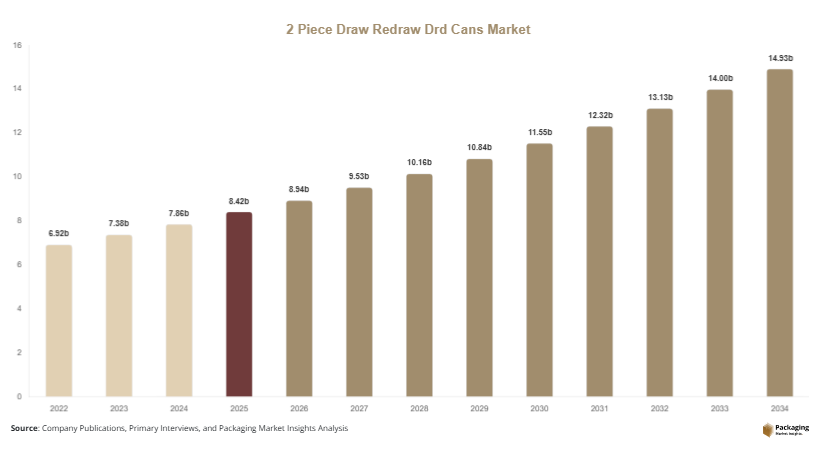
The global 2 Piece Draw Redraw Drd Cans Market size was valued at USD 8.42 billion in 2025 and is estimated to reach USD 8.94 billion in 2026. The market is projected to grow to USD 15.87 billion by 2034, at a compound annual growth rate (CAGR) of 6.62% during 2025 to 2034. This growth is supported by rising consumption of packaged beverages, expanding demand for recyclable metal packaging, and continuous innovation in can-forming technologies.
Draw and redraw (DRD) technology allows manufacturers to produce two-piece cans with a deeper body profile than draw and wall-iron methods, making it suitable for food cans, aerosol cans, and smaller-diameter beverage cans. Growing preference for sustainable, infinitely recyclable aluminum and steel packaging over plastic and glass alternatives is a central force propelling market expansion, alongside a broader shift toward premium and craft beverage packaging.
Three primary growth factors shape this industry outlook. First, environmental regulations promoting recyclable packaging over single-use plastics are driving metal can adoption. Second, advancements in high-speed press lines are lowering production costs. Third, expanding food and beverage manufacturing capacity across emerging economies is generating upstream demand for DRD can supply chains.
Key Highlights:
- North America dominated the 2 Piece Draw Redraw Drd Cans Market with the largest share of 34.18% in 2025.
- Asia Pacific is expected to be the fastest-growing region during the forecast period, expanding at a CAGR of 8.46%.
- Based on material type, the aluminum segment dominated the market with a share of 58.62% in 2025.
- Based on can size, the standard 330ml–500ml segment dominated the market with a share of 41.27% in 2025.
- Based on end use, the beverage cans segment dominated the market with a share of 62.35% in 2025.
- Based on distribution channel, direct sales to beverage manufacturers dominated with 55.18% in 2025.
- The US 2 Piece Draw Redraw Drd Cans Market size was valued at USD 2.61 billion in 2025 and is projected to reach USD 2.79 billion in 2026.
Explore more data points, trends and opportunities Download Free Sample Report
Market Trends
The 2 Piece Draw Redraw Drd Cans Market is currently shaped by two dominant trends that reflect shifting consumer preferences and manufacturing priorities.
Rising Adoption of Slim and Sleek Can Formats: Beverage brands increasingly favor slim and sleek can silhouettes to differentiate products on retail shelves and appeal to premium consumer segments. DRD forming technology suits these narrower diameters because it allows deeper draws without excessive metal thinning. This trend is especially visible in energy drinks, ready-to-drink cocktails, and specialty coffee categories, where packaging aesthetics directly influence purchase decisions. As brand owners compete for shelf visibility, converters are investing in tooling upgrades that support diverse can geometries, reinforcing DRD technology's relevance within modern beverage packaging strategy.
Integration of Digital Printing and Smart Packaging Features: Can manufacturers are integrating digital printing capabilities and smart packaging elements such as QR codes, temperature indicators, and augmented reality triggers directly onto two-piece DRD can surfaces. This trend supports shorter production runs, personalized branding campaigns, and enhanced consumer engagement without compromising can structural integrity. Digital printing also reduces changeover time between product variants, allowing beverage companies to launch limited-edition packaging more efficiently, meeting rising expectations among premium and mid-tier beverage brands.
Market Drivers
Two principal drivers are propelling sustained expansion of the 2 Piece Draw Redraw Drd Cans Market through the forecast period.
Growing Preference for Recyclable and Sustainable Packaging: Consumers and regulatory bodies alike are placing greater emphasis on circular packaging solutions, and aluminum and steel cans consistently rank among the most recycled packaging materials worldwide. Two-piece DRD cans offer high recyclability rates without loss of material quality, making them attractive to brand owners pursuing sustainability commitments. Government initiatives promoting extended producer responsibility and deposit return schemes further incentivize beverage companies to transition from plastic bottles toward metal can formats, sustaining steady order volumes for producers across developed and emerging markets.
Expansion of the Global Ready-to-Drink and Craft Beverage Sector: The ready-to-drink beverage category, including hard seltzers, canned cocktails, functional beverages, and craft beer, has expanded rapidly across North America, Europe, and parts of Asia Pacific. These categories often require smaller-volume, uniquely shaped cans that align well with DRD manufacturing capabilities. As craft and independent producers scale production, demand for flexible can-forming solutions that support shorter runs and varied heights continues to rise, providing a durable demand base beyond traditional carbonated soft drink applications.
Market Restraints
Despite favorable growth conditions, the market faces a notable restraint related to high capital investment and operational complexity associated with DRD tooling and press-line equipment. Establishing a DRD production facility requires substantial upfront expenditure on precision presses, multi-stage tooling, and quality control systems capable of maintaining consistent wall thickness across deep-drawn can bodies. Unlike simpler forming processes, DRD technology demands specialized engineering expertise and frequent tooling maintenance, which can elevate production costs for small and mid-sized converters.
This financial and technical barrier disproportionately affects manufacturers in developing regions where access to advanced machinery and skilled technical labor remains limited. A mid-sized canning operation entering the DRD segment may face multi-year payback periods before achieving profitable scale, discouraging new entrants and concentrating market share among established, well-capitalized players. Fluctuating aluminum and tinplate steel prices further compound cost pressures for converters operating on thinner margins.
The cumulative effect of these constraints is a market structure where consolidation among larger manufacturers persists, potentially limiting supply chain flexibility for smaller beverage brands seeking customized can formats. Addressing this restraint will likely require continued innovation in modular, lower-cost tooling systems and expanded equipment financing options to broaden participation, particularly in price-sensitive emerging markets.
Market Opportunities
The market presents two significant opportunities capable of unlocking incremental value for stakeholders across the DRD can value chain.
Expansion into Personal Care and Aerosol Packaging Applications: Beyond beverages, two-piece DRD cans are gaining traction in personal care, household aerosol, and specialty food packaging segments where deep-drawn profiles and precise dimensional control are advantageous. Manufacturers that diversify their product portfolios to serve cosmetics, deodorant, and food can applications can reduce dependency on beverage industry cyclicality while accessing new revenue streams. This cross-industry diversification allows converters to leverage existing DRD tooling investments more efficiently, spreading fixed costs across multiple end-use categories and strengthening overall business resilience.
Growth Potential in Emerging Economies with Rising Packaged Beverage Consumption: Countries across Southeast Asia, Latin America, and parts of Africa are experiencing rapid growth in packaged beverage consumption driven by urbanization, rising disposable incomes, and expanding modern retail infrastructure. These regions currently show lower per-capita metal can penetration compared to mature markets, indicating substantial headroom for future adoption. Manufacturers that establish early production capacity or strategic partnerships in these emerging markets stand to capture disproportionate long-term growth as beverage companies increasingly favor recyclable packaging formats over imported plastic alternatives.
Report Scope
| Report Metric | Details |
|---|---|
| Market Size in 2025 | USD 8.42 billion |
| Market Size in 2026 | USD 8.94 billion |
| Market Size in 2034 | USD 15.87 billion |
| CAGR | 6.62% (2026-2034) |
| Base Year for Estimation | 2025 |
| Historical Data | 2022-2024 |
| Forecast Period | 2026-2034 |
| Report Coverage | Revenue Forecast, Competitive Landscape, Supply Chain Disruption, Growth Factors, Environment & Regulatory Landscape and Trends |
| Geographies Covered | North America, Europe, APAC, Middle East and Africa, LATAM |
| Countries Covered | U.S., Canada, U.K., Germany, France, Spain, Italy, Russia, Nordic, Benelux, Rest of Europe, China, South Korea, Japan, India, Australia, Singapore, Taiwan, South East Asia, Rest of Asia-Pacific, UAE, Turky, Saudi Arabia, South Africa, Egypt, Nigeria, Rest of MEA, Brazil, Mexico, Argentina, Chile, Colombia, Rest of LATAM |
Explore more data points, trends and opportunities Download Free Sample Report
Segmental Analysis
By Material Type
The aluminum segment dominated the 2 Piece Draw Redraw Drd Cans Market with a share of 58.62% in 2025, primarily due to its lightweight properties, superior recyclability, and widespread acceptance across beverage packaging applications. Aluminum cans offer faster chilling properties and improved barrier protection compared to alternative materials, making them the preferred choice among carbonated soft drink, beer, and energy drink manufacturers. The material's high scrap value also supports efficient closed-loop recycling systems, reducing raw material costs for converters over time. Established supply chains for aluminum coil and sheet further reinforce this segment's continued dominance, as beverage brands prioritize consistent material availability and predictable production quality across large-scale manufacturing operations worldwide.
The steel segment is projected to register the fastest growth within the material type category, expanding at a CAGR of 7.12% through 2034. This growth is driven by increasing use of tinplate steel in food can and aerosol applications where structural rigidity and puncture resistance are particularly important. Steel's cost stability relative to aluminum during periods of raw material price volatility is encouraging select converters to diversify their material sourcing strategies. Additionally, ongoing advancements in thin-gauge steel production are narrowing the weight gap with aluminum, making steel an increasingly viable option for manufacturers seeking to balance cost efficiency with packaging performance requirements across diverse regional supply chains and evolving customer specifications.
By Can Size
The standard 330ml–500ml segment dominated the market with a share of 41.27% in 2025, reflecting its widespread use across mainstream carbonated soft drinks, beer, and general beverage categories globally. This size range represents the most commercially established format across retail and food service distribution channels, benefiting from decades of standardized production tooling and consumer familiarity. Beverage manufacturers favor this segment due to its balance between production efficiency and consumer serving preferences, allowing converters to maintain high-volume production runs with minimal changeover requirements. The segment's established position within existing filling line infrastructure further reinforces its continued market leadership across both developed and developing beverage packaging markets worldwide, spanning multiple retail formats and diverse consumer purchasing occasions.
The compact below-250ml segment is expected to be the fastest-growing can size category, registering a CAGR of 7.85% during the forecast period. This growth is attributed to rising demand for single-serve energy drinks, functional shots, and premium specialty beverages that target portion-controlled consumption occasions. Smaller can formats align well with DRD forming capabilities, which accommodate deeper draw ratios needed for compact, narrow-diameter designs. Growing consumer interest in convenient, on-the-go beverage formats, particularly among younger demographics, is expected to sustain strong demand growth for this segment throughout the forecast period across multiple regional markets.
By End Use
The beverage cans segment dominated the 2 Piece Draw Redraw Drd Cans Market with a share of 62.35% in 2025, driven by sustained global consumption of carbonated soft drinks, beer, and increasingly popular ready-to-drink alcoholic and non-alcoholic beverages. This segment benefits from extensive filling infrastructure already established across major beverage producers, along with strong brand preference for metal packaging due to its recyclability credentials and superior product protection properties. Continued new product launches within the functional beverage and hard seltzer categories are further reinforcing beverage cans as the primary application driving overall market volume, supporting stable long-term demand across both established and emerging beverage manufacturing regions, while also encouraging converters to expand dedicated production lines to meet rising order volumes.
The food cans and aerosol packaging segment is projected to expand at the fastest CAGR of 7.34% during the forecast period, supported by rising demand for shelf-stable packaged food products and household aerosol items such as personal care sprays and cleaning products. Growing urban populations with limited storage space are increasingly favoring compact, shelf-stable packaged food formats, driving incremental demand for DRD-formed food cans. Additionally, expanding personal care product portfolios among global consumer goods companies are creating new opportunities for aerosol can applications, positioning this segment for above-average growth relative to the broader end-use category landscape as manufacturers continue investing in dedicated tooling for these specialized packaging formats.
2 Piece Draw Redraw Drd Cans Market Segmentations
Material Type
- Aluminum
- Steel
Can Size
- Below 250ml
- 250ml–330ml
- 330ml–500ml
- Above 500ml
End Use
- Beverage Cans
- Food Cans
- Aerosol and Personal Care Cans
Distribution Channel
- Direct Sales
- Distributors
Regional Analysis
North America
North America accounted for a market share of 34.18% in 2025 and is projected to expand at a CAGR of 5.94% through 2034, supported by mature beverage packaging infrastructure and consistent recycling program participation. The region benefits from established relationships between can manufacturers and major beverage producers, along with continued investment in production efficiency upgrades. Stable regulatory support for metal packaging recyclability further reinforces steady regional demand across both carbonated and non-carbonated beverage categories throughout the forecast period.
The United States dominates the North American market, driven by the rapid expansion of the hard seltzer, canned cocktail, and functional beverage segments that rely heavily on slim DRD can formats. Strong retail distribution networks and consumer familiarity with canned beverage formats provide a unique growth advantage, allowing US-based converters to scale production efficiently while meeting evolving brand packaging specifications across diverse beverage categories.
Europe
Europe held a market share of 24.65% in 2025 and is expected to grow at a CAGR of 5.71% during the forecast period, underpinned by stringent packaging waste regulations and strong consumer recycling participation rates. The region's well-developed circular economy framework encourages beverage brands to prioritize metal packaging over plastic alternatives, sustaining consistent demand for two-piece DRD cans across both established and emerging beverage categories throughout the coming years.
Germany leads the European market, supported by its advanced deposit return system and extensive craft beer and non-alcoholic beverage manufacturing base. This unique regulatory environment, which mandates high collection rates for beverage containers, creates strong incentives for domestic producers to adopt fully recyclable can formats, positioning Germany as a central hub for DRD can innovation and production within the broader European packaging landscape.
Asia Pacific
Asia Pacific is projected to be the fastest-growing region during the forecast period, expanding at a CAGR of 8.46% from a 2025 market share of 22.74%. Rapid urbanization, expanding modern retail formats, and rising disposable incomes across the region are driving increased consumption of packaged beverages, creating substantial upstream demand for two-piece DRD can production capacity across both domestic and export-oriented manufacturing operations.
China dominates the Asia Pacific market, supported by its extensive beverage manufacturing base and continuous investment in domestic can production infrastructure. A unique growth factor for China is the government's active promotion of recyclable packaging materials as part of broader environmental policy initiatives, which is accelerating the transition of regional beverage producers away from plastic packaging toward aluminum and steel can formats at an accelerated pace.
Middle East & Africa
The Middle East & Africa region accounted for a market share of 9.87% in 2025 and is anticipated to grow at a CAGR of 6.38% through 2034, supported by expanding beverage manufacturing investment and gradually improving packaging infrastructure. Rising tourism activity and hospitality sector growth across key markets are contributing to increased demand for packaged beverages, providing incremental support for regional can production and distribution networks.
Saudi Arabia leads the regional market, driven by significant government-backed investment in domestic manufacturing diversification under national economic transformation programs. This unique growth factor has encouraged the establishment of new beverage and packaging production facilities within the country, reducing reliance on imported cans and positioning Saudi Arabia as an emerging regional hub for two-piece DRD can manufacturing capacity across the wider Gulf region.
Latin America
Latin America held a market share of 8.56% in 2025 and is projected to expand at a CAGR of 6.05% during the forecast period, supported by growing packaged beverage consumption and increasing modernization of regional retail and distribution channels. Rising awareness of packaging sustainability among regional beverage brands is gradually shifting preference toward recyclable metal can formats, supporting long-term regional market development and encouraging continued investment across the broader Latin American packaging value chain.
Brazil dominates the Latin American market, benefiting from its large domestic beverage manufacturing industry and well-established aluminum recycling ecosystem. A unique growth factor for Brazil is its high existing aluminum can recycling rate, which lowers input material costs for domestic converters and strengthens the overall economic case for continued DRD can production expansion across the country's beverage packaging sector and neighboring export markets.
Competitive Landscape
The 2 Piece Draw Redraw Drd Cans Market features a moderately consolidated competitive landscape, with established global packaging manufacturers holding substantial production capacity alongside a growing number of regional converters. Leading companies are focusing on capacity expansion, sustainability-linked product innovation, and strategic partnerships with beverage producers to strengthen long-term supply agreements. Crown Holdings maintains a leading position within the market, supported by its extensive global manufacturing footprint and continued investment in lightweight can technology. The company recently announced capacity expansion at select facilities aimed at supporting growing demand for slim and sleek can formats among ready-to-drink beverage brands. Competitive strategies across the industry increasingly emphasize recycled content integration, digital printing capability, and regional manufacturing proximity to end-use beverage and food producers, reflecting broader industry priorities around sustainability, customization, and long-term supply chain resilience across both mature and emerging packaging markets globally.
Key Players
- Crown Holdings, Inc.
- Ball Corporation
- Ardagh Group
- CANPACK Group
- Toyo Seikan Group Holdings
- Silgan Holdings Inc.
- Envases Universales de Mexico
- Trivium Packaging
- Nampak Ltd.
- CPMC Holdings Limited
- Kian Joo Can Factory Berhad
- Universal Can Corporation
- HUBER Packaging Group
- Massilly Group
- Daiwa Can Company